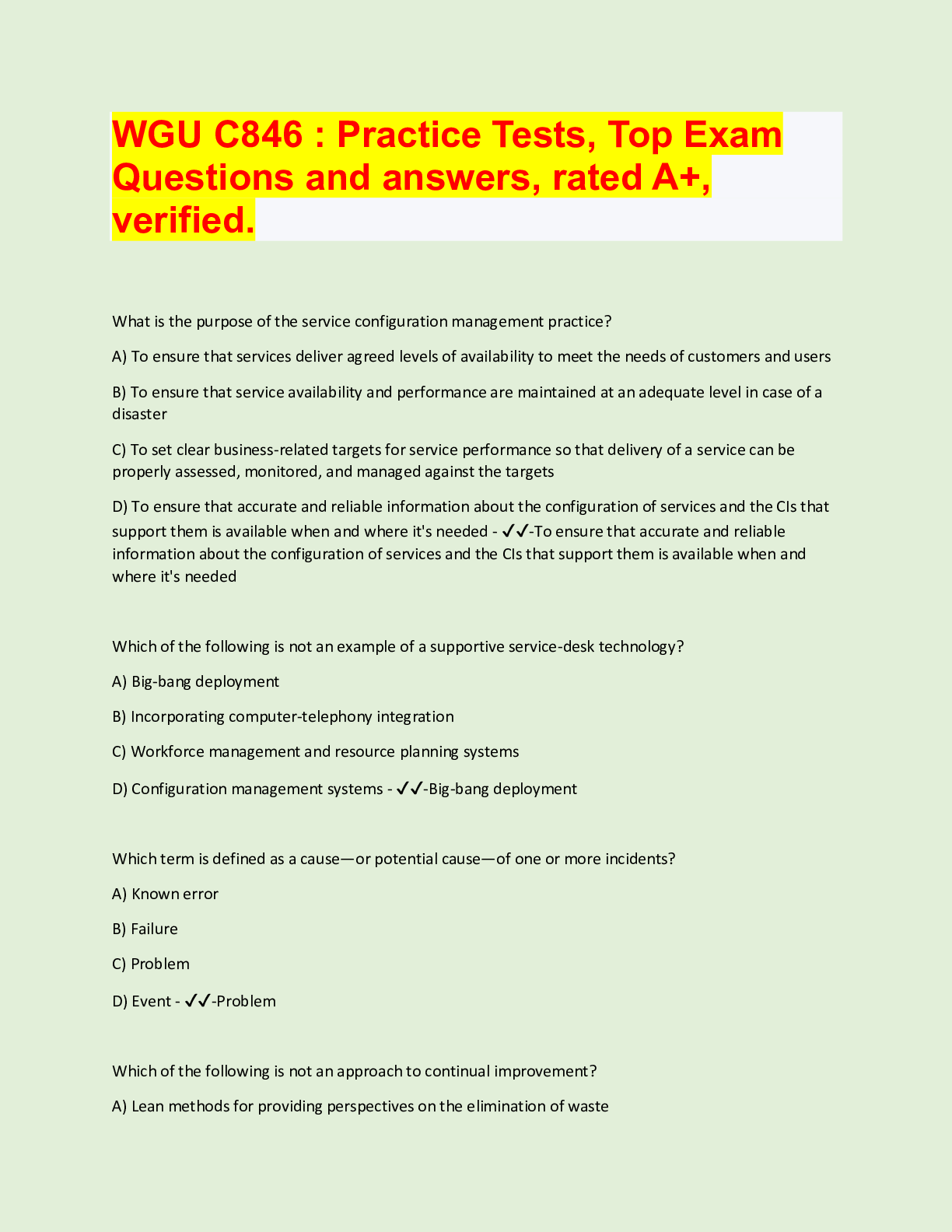
C846 WGU, Top Exam Questions and
answers, graded A+. Verified.
Service
Enabling value co-creation by facilitating outcomes that customers want to achieve without the
customer having to manage specific costs and ris
...
C846 WGU, Top Exam Questions and
answers, graded A+. Verified.
Service
Enabling value co-creation by facilitating outcomes that customers want to achieve without the
customer having to manage specific costs and risks.
Utility
Fit for Purpose. Service does what it is meant to do.
Warranty
Fit for use. Assurance that a product or service will meet agreed requirements.
Customer
Defines requirements for service.
User
A person who uses services.
Service Management
A set of specialized capabilities for enabling value for customers in the form of services.
Sponsor
Authorizes budgets for services
Cost
The amount of money spent on a specific activity or resource.
Value
The perceived benefits, usefulness and importance of something.
Organization
A group of people that has its own functions with responsibilities and authorities to achieve specific
objectives.
Outcome
A result for a stakeholder enabled by one or more outputs.
Output
A tangible or intangible deliverable of an activity.
Risk
Uncertainty of outcome. Can be good (opportunity) or bad (hazard)
Utility
A service must either support the performance of the consumer or remove constraints from the
consumer.
Warranty
1. Often relates to service levels aligned with the needs of service consumers.
2. Addresses such areas as the availability of the service, its capacity, levels of security and continuity.
What are the 4 key concepts of service relationships?
1. Service Offering
2. Service Relationship Management
3. Service Provision
4. Service Consumption
Service Offering
A specific mix of services and products sold to a specific customer.
Service Relationship Management
Establishes and nurtures links between organizations and stakeholders at strategic and tactical levels.
Service Provision
Activities performed by an organization to provide services.
Service Consumption
Activities performed by an organization to consume services.
Focus on Value
Everything you do must be somehow (directly or indirectly) valuable to your stakeholders. Best be
served by understanding the cost and financial consequences that a service consumer might face when
choosing to use a service.
Start Where You Are
Reuse existing resources whenever possible instead of reinventing the wheel over and over again
Progress Iteratively With Feedback
Don't do everything at once. Take baby-steps instead. Learning by doing with lots of feedback
Collaborate and Promote Visibility
Involve the right people at the right time and gather factual data to make the right decisions. Recognizes
the complexity of a system and seeks to understand the relationships between the various components
that make up a service
Think and Work Holistically
Nothing is ever alone Think about the effect of your initiative or work on other components. Work on
the system not just it's parts.
Keep it Simple and Practical
Don't overcomplicate work. Use the least possible steps. Outcome based thinking helps.
Optimize & Automate
Maximize the value of human work. Automate only after optimization. Apply DevOps. The use of
technology with limited or no human intervention.
What are the 4 dimensions of service management?
1. Organizations and People
2. Information and Technology
3. Partners and Suppliers
4. Value Streams and Processes
Organizations and People
Ensures that the way an organization is structured and managed, as well as its roles, responsibilities, and
systems of authority and communication.
Information & Technology
Includes the information and knowledge necessary for the management of services, as well as the
technologies required. Also incorporates the relationships between different component, such as the
inputs and outputs of activities and practices.
Partners & Suppliers
1. Encompasses an organization's relationships with other organizations that are involved in the design,
development, deployment, delivery, support, and/or continual improvement of services.
2. It also incorporates contracts.
Value Streams and Processes
1. Applicable to both the SVS in general, and to specific products and services.
2. It defines the activities, workflows, controls, and procedures needed to achieve agreed objectives.
3. Concerned with how the various parts of the organization work to enable value creation through
products and services.
Value Stream
A series of steps an organization undertakes to create and deliver products and services to consumers.
Service Value System
Describes how all the components and activities of the organization work together as a system to enable
value creation.
Service Value Chain
An operating model for service providers that covers all the key activities required to effectively manage
products and services.
How does the service value chain support value streams?
The ITIL service value chain includes six value chain activities which lead to the creation of products and
services and, in turn, value.
Value streams combine practices and value chain activities in various ways to improve products and
services and increase potential value for the consumers and the organization.
What are the 6 Value Chain Activities?
1. Plan
2. Improve
3. Engage
4. Design & Transition
5. Obtain/Build
6. Deliver & Support
Plan
Ensures a shared understanding of the vision, current status, and improvement direction for all four
dimensions and all products and services across the organization. Includes portfolio decisions for Design
and Transition.
Improve
Ensures continual improvement of products, services, and practices across all value chain activities and
the four dimensions of service management.
Engage
Provides a good understanding of stakeholder needs, transparency, and continual engagements and
good relationships with all stakeholders.
Transition
Ensures products and services continually meet stakeholder expectations for quality, costs, and time to
market.
Obtain/Build
Ensures service components are available when and where they are needed and meet agreed
specifications.
Deliver & Support
Ensures services are delivered and supported according to agreed specifications and stakeholders'
expectations. Best used to categorize the actions of the service desk when they are responding to a
consumer's request for assistance.
Information Security Management
Protects information needed by organizations to conduct business
1. Confidentiality
2. Integrity
3. availability
4. Authentication
5. Non-Repudiation
Relationship Management
Establishes and nurtures the links between the organization and its stakeholders at strategic and tactical
levels. It includes the identification, analysis, monitoring, and continual improvement of relationships
with and between stakeholders.
Supplier Management
Ensures that suppliers of the organization and their performances are managed to support seamless
service provision to customers.
IT Asset Management
Plans and manages the full lifecycle of IT assets to maximize their value, control their costs, and support
decisions about reusing or purchasing new assets.
Monitoring and Event Management
Systematically observes services and service components and records and reports selected changes of
state identified as events.
Release Management
Makes new and changed services and features available for use.
Service Configuration Management
Ensures accurate and reliable information about the configuration of services and the configuration
items that support them is available when and where needed
Deployment Management
Moves new or changed hardware, software, documentation, or any other service component to live
environments.
Continual Improvement
Aligns an organization's practices and services with changing business needs through ongoing
identification and improvement of all elements of effective management of products and services.
Change Enablement
Maximizes the number of successful changes through proper risk assessment and minimizes the
negative impact of failed changes.
Ensures risks are properly assessed, authorizing changes to proceed, and managing a change schedule to
minimize the number of successful IT changes
Incident Management
Minimizes negative impact of incidents by restoring normal operations as soon as possible.
Problem Management
Reduces the likelihood of recurring incidents by identifying root causes. Manages work arounds and
known errors.
Service Request Management
Supports the agreed quality of services by handling all predefined, user-initiated service requests in an
effective and user-friendly way.
Service Desk
Captures demand for incidents and service requests. Single point contact between service provider and
users.
Service Level Management
Sets clear business-based targets for service performance, so that the delivery of a service can be
measured properly.
IT Asset
Any financially valuable component that can contribute to the delivery of an IT products or service
Event
Any change of state that has a significance for the management of a configuration item or service.
CI (Configuration Item)
Any component that needs to be managed to deliver an IT service
Change
When something becomes different ove
[Show More]





.png)
.png)
.png)
.png)
.png)
.png)
.png)
.png)
.png)