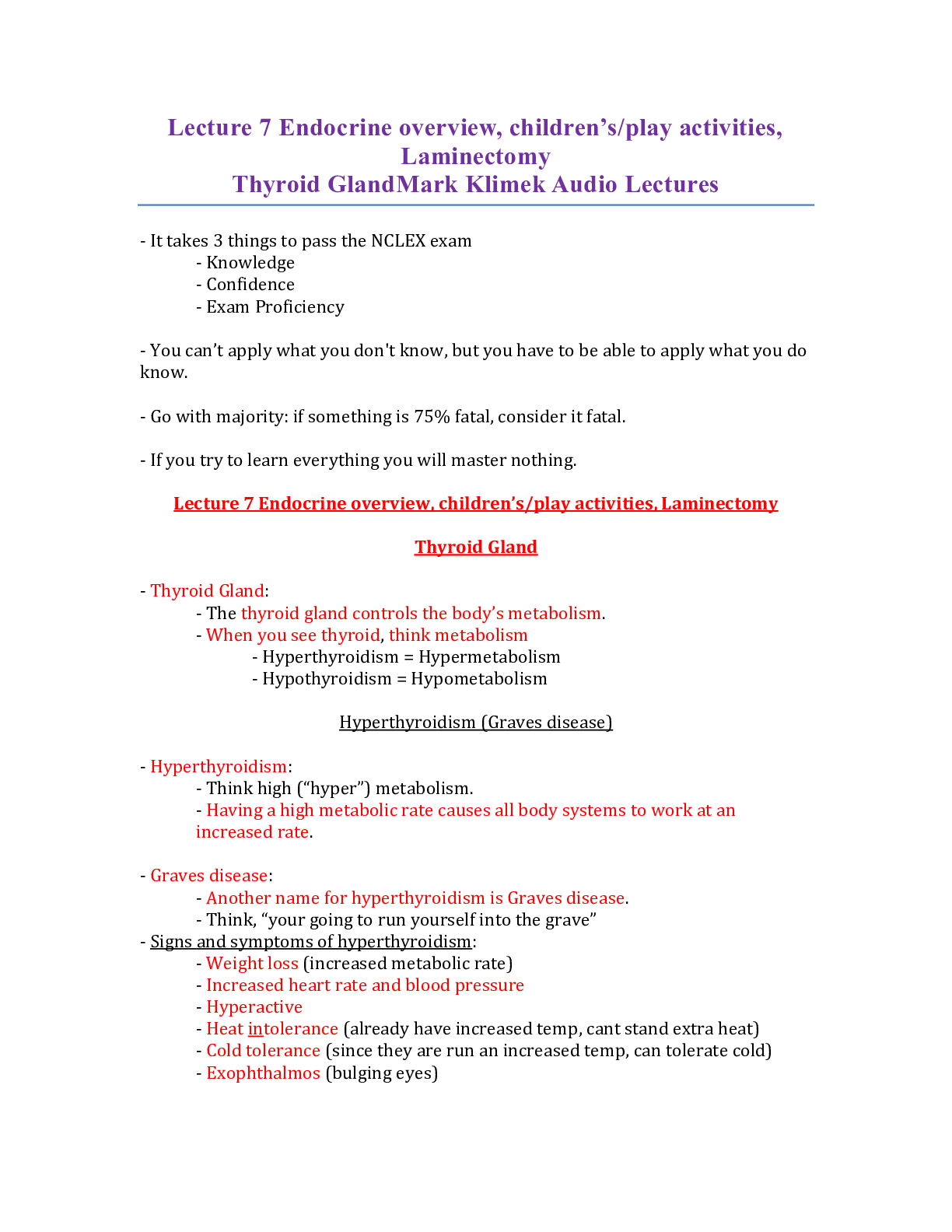
Lecture 7 Endocrine overview, children’s/play activities, Laminectomy
Thyroid GlandMark Klimek Audio Lectures
Lecture 7 Endocrine overview, children’s/play activities, Laminectomy
Thyroid Gland
- Thyroid Glan
...
Lecture 7 Endocrine overview, children’s/play activities, Laminectomy
Thyroid GlandMark Klimek Audio Lectures
Lecture 7 Endocrine overview, children’s/play activities, Laminectomy
Thyroid Gland
- Thyroid Gland:
- The thyroid gland controls the body’s metabolism.
- When you see thyroid, think metabolism
- Hyperthyroidism = Hypermetabolism
- Hypothyroidism = Hypometabolism
Hyperthyroidism (Graves disease)
- Hyperthyroidism:
- Think high (“hyper”) metabolism.
- Having a high metabolic rate causes all body systems to work at an increased rate.
- Graves disease:
- Another name for hyperthyroidism is Graves disease.
- Think, “your going to run yourself into the grave”
- Signs and symptoms of hyperthyroidism:
- Weight loss (increased metabolic rate)
- Increased heart rate and blood pressure
- Hyperactive
- Heat intolerance (already have increased temp, cant stand extra heat)
- Cold tolerance (since they are run an increased temp, can tolerate cold)
- Exophthalmos (bulging eyes)
- Treatment of hyperthyroidism:
- Radioactive Iodine treatment:
- For the next 24 hours after Radioactive Iodine treatment the patient needs to be in a private room, by themselves. No visitation
- After the 24-hour mark the patient’s urine is still radioactive. They should flush three times after urination. If their urine is spilled the HAZMAT team need clean the entire room.
- PTU (Propylthiuracil)
- PTU, think “Puts Thyroid Under”
- Primarily used in cancer. All cancer drugs are immunosuppressant’s.
- Thyroidectomy is the most common treatment of hyperthyroidism:
- Removing part of the thyroid, called Partial/subtotal Thyroidectomy
- Subtotal thyroidectomy patients may be on thyroid hormone replacement for a little while until the remaining thyroid resumes normal function.
- Parathyroids are left in tact so there is no risk of calcium imbalances.
- Risk for thyroid storm.
- Priorities after subtotal thyroidectomy:
- First 12 hours first priority is the patient’s airway and hemorrhaging
- 12-48 hours after the second biggest risk is thyroid storm
- 48 hours after they are at risk of infection. (first, after 72 hr)
- Removing the complete thyroid, called Complete/total Thyroidectomy
- Total thyroidectomy’s need life long hormone replacement therapy (thyroxin, synthroid)
- Because the total thyroid is removed the parathyroids are also removed and the patient is at risk of calcium imbalances (lecture 6).
- No risk of thyroid storm.
- Priorities after total thyroidectomy:
- Within 12 hours first priority is the patient’s airway and hemorrhaging
- 12-48 hours after the second biggest risk is tetany from low calcium levels
- 48 hours after they are at risk of infection (first, after 72 hr)
- Thyroid storm: A life-threatening condition that is caused by a hyper-release of thyroid hormones, which causes 4 serious complications:
- Extremely high temperatures: 40oC and above
- Extremely high blood pressure: 210/180 (ballpark)
- Extreme tachycardia: 180 (ballpark)
- Psychotic delirium
- This is a medical emergency. Patients are at risk of brain damage and death from frying their brain due to increased temp, and brain hypoxia.
- Treatment of Thyroid storm:
- Treatment of thyroid storm is aimed at getting the temperature down and getting the oxygen levels up.
- Surround them with ice (second)
- Getting them under a cooling blanket (third, and best)
- Give oxygen by mask at 10 liters (first)
- Two nurses monitoring patient continuously
- This is a self-limiting condition. No medications are given. The goal of the treatment is to spare the patients brain until the thyroid hormones are out of the patients system.
Hypothyroidism (Myxedema)
- Hypothyroidism:
- Think high (“hypo”) metabolism.
- Having a low metabolic rate causes all body systems to work at an decreased rate.
- Myxedema:
- Another name for severe hypothyroidism is myxedema
- Signs and symptoms of hypothyroidism:
- Weight gain (Metabolize at a slower rate)
- Hypoactive
- Flat affect
- Heat tolerance (Usually run cold so heat is tolerated well)
- Cold intolerance (Usually run cold so can tolerate addition coldness)
- Low heart rate and blood pressure
- Treatment of myxedema:
- Thyroid hormone replacement therapy (thyroxin, synthroid)
- Do not sedate these patients. They already have low metabolism and bodily functioning. Sedating them may cause them to enter a coma, called a myxedemic coma.
- Patients with myxedema need to have their thyroid hormone replacement medication before any surgery, regardless of NPO orders.
The Adrenal Cortex
- Adrenal Cortex:
- Disorders of the adrenal cortex begin with either the letter “A” or “C”.
- Addison’s disease
- Cushing’s disease
- Conn’s disease
- Cortical insufficiency
- Adrenal insufficiency
::::::::::::::::::::::::::::::::::::::::CONTENT CONTINUED IN THE ATTACHMENT:::::::::::::::::::::::::::::::::::::::::::::::::::
[Show More]