LEIK FNP Practice Questions &
Answers. Exam predictor questions,
Graded A
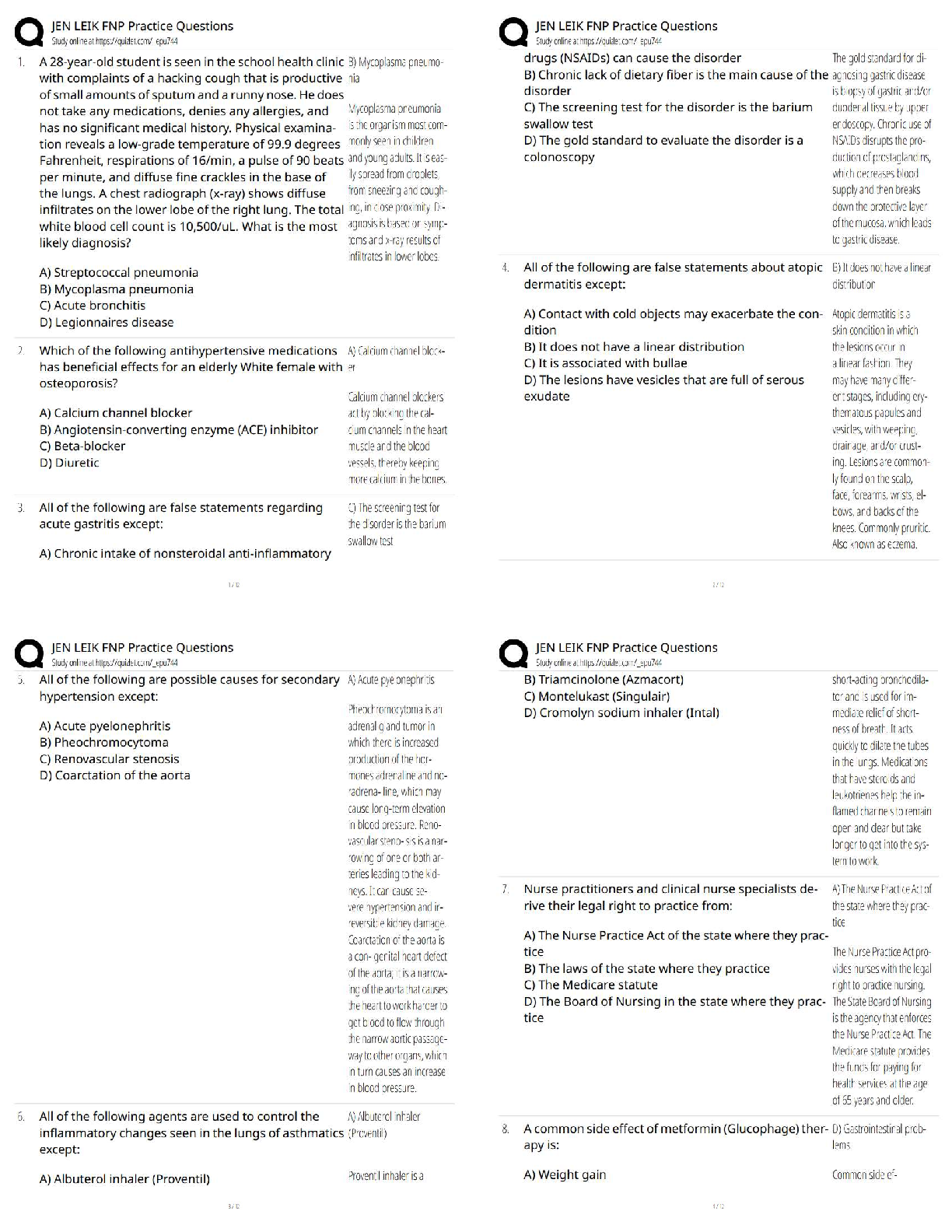
2. All of the following are infections that affect mostly the labia and vagina except:
A) Bacterialvaginosis
B) Candidiasis
C) Trichomonia
...
LEIK FNP Practice Questions &
Answers. Exam predictor questions,
Graded A
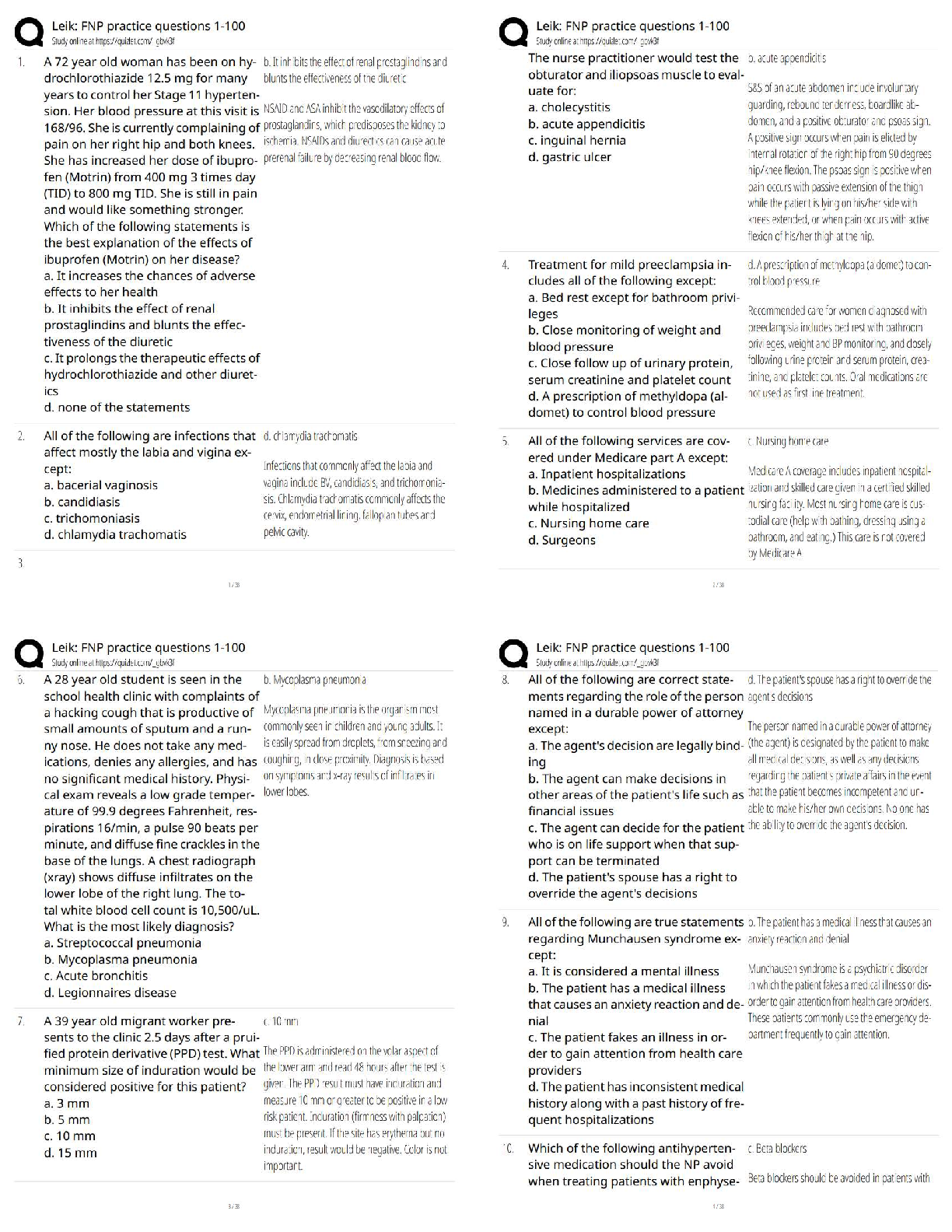
2. All of the following are infections that affect mostly the labia and vagina except:
A) Bacterialvaginosis
B) Candidiasis
C) Trichomoniasis
D) Chlamydia trachomatis - ✔✔D) Chlamydia trachomatis
Infections that commonly affect the labia and vagina include bacterial vaginosis, candidiasis, and
trichomoniasis. Chlamydia trachomatis commonly affects the cervix, endometrial lining , fallopian tubes,
and pelvic cavity.
124. Which of the following viral infections is associated with occasional abnormal forms of lymphocytes
during an acute infection?
A) Cytomegalovirus (CMV)
B) Epstein-Barr virus (EBV)
C) Human papilloma virus (HPV)
D) Coxsackie virus - ✔✔B) Epstein-Barr virus (EBV)
A test for an acute infection of the Epstein-Barr virus will show abnormal forms of lymphocytes.
411. Which of the following is the most common cause of nongonococcal urethritis?
A) Escherichia coli
B) Chlamydia trachomatis
C) Neisseria gonorrhoeae
D) Mycoplasma - ✔✔B) Chlamydia trachomatis
The most common cause of nongonococcal urethritis is Chlamydia trachomatis.
A 4-year-old boy is brought in by his mother for a wellness visit. His mother tells the family nurse
practitioner that he had a bad case of chickenpox 1 year ago. Which of the following immunizations are
indicated?
A) IPV, Hib (hemophilus influenzae type B), hepatitis B
B) IPV, Hib, MMR
C) DTaP, IPV, MMR, hepatitis B
D) DTaP, IPV - ✔✔D) DTaP, IPV
DTap and IPV would be due for this 4-year-old child.
A 10-year-old boy complains of a sudden onset of scrotal pain when he woke up that morning. He is also
complaining of severe nausea and vomiting. During the physical examination, the nurse practitioner
finds a tender, warm, and swollen left scrotum. The cremasteric reflex is negative and the urine dipstick
is negative for leukocytes, nitrites, and blood. The most likely diagnosis is:
A) Acute epididymitis
B) A severe salmonella infection
C) Testicular torsion
D) Acute orchitis - ✔✔C) Testicular torsion
Testicular torsion signs and symptoms include sudden onset of unilateral scrotal pain, nausea, vomiting,
and abdominal pain. Acute epididymitis causes fever, chills, nausea, and unilateral pain and is most com-
monly seen in sexually active men. Unilateral scrotal pain does not occur with Salmonella infection.
Acute orchitis is often based on having a recent mumps infec- tion or parotitis with testicular edema.
A 10-year-old male who was recently accepted into his school's soccer team has a history of exercise�induced asthma. The child wants to know when he should take his albuterol inhaler. The nurse
practitioner would advise the patient:
A) Premedicate himself 20 minutes prior to starting exercise
B) Wait until he starts to exercise before using the inhaler
C) Premedicate 60 minutes before starting exercise
D) Wait until he finishes his exercise before using his inhaler - ✔✔A) Premedicate himself 20 minutes
prior to starting exercise
Exercise-induced asthma is best controlled by using the Proventil inhaler (bronchodilator) approximately
20 minutes prior to exercise, to prevent vasospasm of the bronchioles and shortness of breath with
exercise. These bronchodilators usually last approximately 4 hours. They also work quickly to open up
the bronchioles if an acute attack/shortness of breath occurs
A 12-year-old girl is complaining of a 2-week history of facial pressure that worsens when she bends
over. She complains of tooth pain in her upper molars on the right side of her face. On physical exam,
her lung and heart sounds are normal. Which of the following is the most likely diagnosis?
A) An acute dental abscess
B) Chronic sinusitis
C) Acute sinusitis
D) Severe allergic rhinitis - ✔✔C) Acute sinusitis
Signs/symptoms of acute sinusitis includes headache, facial pain that worsens with bending over,
eye/ear pressure and pain, aching in upper jaw/teeth, reduced smell and taste, cough (especially at
night due to the nasal drainage), sore throat, bad breath, and fatigue.
A 12-year-old male's peak expiratory flow results indicate 60 to 80% of the predicted range. How would
you classify his asthma?
A) Mild intermittent asthma
B) Mild persistent asthma
C) Moderate persistent asthma
D) Severe asthma - ✔✔C) Moderate persistent asthma
Asthma classifications: Intermittent: normal FEV between exacerbations, FEV > 80%; mild persistent,
FEV > 80%; moderate persistent, FEV 60-80%; severe persistent, FEV < 60%.
A 13-year-old adolescent female is brought in by her mother for a sports physical. The mother reports
that the teen's last vaccines were given at the age of 6 years. Which of the following vaccines is
recommended by the CDC for this patient?
A) Td and HPV vaccines
B) Tdap, MCV4, and the HPV vaccines
C) DTap and the flu vaccine
D) DT and MCV4 vaccines - ✔✔B) Tdap, MCV4, and the HPV vaccines
Vaccine questions usually are not this complicated, but there are several lessons that can be learned
with this question. The 2012 CDC recommendations for the ages 13 to 18 years are the Tdap catch-up (if
did not receive at age 11-12 years), HPV or Gardasil catch-up (if did not receive at age 11-12 years), and
the MCV4 or meningococcal conjugate vaccine (Menactra). Only one dose of Tdap is recommended
(lifetime). Thereafter, the Td form of the vaccine is indicated every 10 years.
A 13-year-old boy wants to be treated for his acne. He has a large number of closed and open
comedones on his face. The patient has been treating himself with OTC benzoyl peroxide and salicylic
acid topical products. Which of the following would be recommended next?
A) Retinoic acid (Accutane)
B) Tetracycline
C) Retin A 0.25% gel
D) Wash face carefully with medicated soap at bedtime - ✔✔C) Retin A 0.25% gel
Topical agents are the first-line treatment for acne vulgaris. Retin A 0.25% gel would be the next step.
Oral preparations would then be offered for the next step (tetracycline), and Accutane would be the
final step of therapy.
A 13-year-old male is brought in by his mother for a physical exam. During the genital exam, the nurse
practitioner notices that the patient is at Tanner Stage II. Which of the following is the best description
of this Tanner stage?
A) The penis is growing more in length than in width and the testicles become larger with darker scrotal
skin and the pubic hair is starting to curl
B) The penis is growing more in width than in length with darker scrotal skin and more numerous pubic
hairs that are darker, curly, and coarser
C) The testicles become larger and the skin of the scrotum starts to become darker with straight, fine,
countable hairs on the genitals and the axilla
D) The testicles, penile width and length are all developing quickly - ✔✔C) The testicles become larger
and the skin of the scrotum starts to become darker with straight, fine, countable hairs on the genitals
and the axilla
Tanner Stage II is when the testicles start to grow. The scrotal skin becomes thicker and starts to get
darker (hyperpigmentation). The pubic hair is of a fine texture and straight and there are few countable
hairs on the genitals and the axilla.
A 13-year-old patient has a throat culture that is positive for strep throat. She reports that her younger
brother was recently diagnosed with strep throat and treated. The patient has a severe allergy to
penicillin and reports that erythromycin makes her very nauseated. Which of the following antibiotics is
the best choice?
A) Azithromycin (Zithromax)
B) Cephalexin (Keflex)
C) Cefuroxime axetil (Ceftin)
D) Levofloxacin (Levaquin) - ✔✔A) Azithromycin (Zithromax)
If the patient has a severe penicillin allergy, there is a 10% chance of cross-reactivity to cephalosporins
(especially first generation). Because the patient is a child, the levofloxacin is contraindicated. Nausea is
a com- mon adverse reaction to erythromycin (it is not an allergic reaction). The best option is to use
azithromycin because of its minimal GI adverse effects. Azithromycin has fewer drug interactions
compared with other macrolides.
A 14-year-old female who is sexually active is brought in by her mother for an immunization update.
According to the mother, her daughter had 1 dose of hepatitis B vaccine. Which of the following
vaccines would you administer at this visit?
A) Td and hepatitis B
B) DTaP (diphtheria, tetanus, acellular pertussis) and hepatitis B
C) Hepatitis B only
D) MMR (measles, mumps, rubella) and Td - ✔✔A) Td and hepatitis B
The CDC recommends Td and hepatitis B for 14-year-old females. It is recommended for her to continue
the hepatitis series, which includes a total of 3 injections.
A 14-year-old female with amenorrhea is tested for pregnancy and has a positive result. The patient tells
the NP that she is seriously considering terminating the pregnancy. She tells the NP that she wants to be
referred to a Planned Parenthood clinic. The NP's personal beliefs and religious beliefs are pro-life.
Which of the fol- lowing is the best action for the NP?
A) The nurse practitioner should tell the patient about her personal beliefs and advise her against
getting an abortion
B) The NP advises the patient that an NP peer who is working with the NP can help answer her questions
more thoroughly
C) The NP should excuse herself from the case
D) The nurse practitioner should refer the patient to an obstetrician - ✔✔B) The NP advises the patient
that an NP peer who is working with the NP can help answer her questions more thoroughly
In general, discussing personal beliefs is considered unprofessional behavior. Respecting the patient's
right to choose is an example of supporting patient autonomy.
A 14-year-old is brought in by his mother who reports that her child has been complaining for several
months of recurrent bloating, stomach upset, and occasional loose stools. She reports that her son has
difficulty gaining weight and is short for his age. She has noticed that his symptoms are worse after
eating large amounts of crackers, cookies, and breads. She denies seeing blood in the child's stool.
Which of the following conditions is most likely?
A) Amebiasis
B) Malabsorption
C) Crohn's colitis
D) Celiac disease - ✔✔D) Celiac disease
Celiac disease is also known as celiac sprue. Patients should avoid foods containing gluten, which causes
malabsorption (diarrhea, gas, bloat- ing, abdominal pain, etc.). Foods to avoid are wheat, rye, and
barley. Oats do not damage the mucosa in celiac disease. Antigliadin IgA and IgG are elevated in almost
all patients (90%).
A 14-year-old teen is worried that she has not started to menstruate like most of her friends. During the
gynecological examination, the nurse practitioner tells the mother, who is in the room with the patient,
that her daughter is starting Tanner Stage II. What are the physical exam findings during this stage?
A) Breast buds and some straight pubic hair
B) Fully developed breasts and curly pubic hair
C) Breast tissue with the areola on a separate mound with curly pubic hair
D) No breast tissue and no pubic hair - ✔✔A) Breast buds and some straight pubic hair
Tanner Stage II in females includes breast buds and few straight, fine pubic hairs.
A 15-month-old child who is eating and behaving normally is found to have a high fever. After a few
days, the fever resolves and the infant breaks out in a maculopapular rash. This is a description of which
of the following conditions?
A) Erythema infectiosum
B) Roseola infantum
C) Fifth disease
D) Scarlet fever - ✔✔B) Roseola infantum
The signs/symptoms of roseola infantum include high fever for a few days with a maculopapular rash
occuring after the fever breaks. Fifth disease is a lacy-appearing rash that usually begins on the face and
moves to the extremities and trunk. It is known by the "slapped cheek " appearance at onset. Erythema
infectiosum is the same as Fifth disease. Scarlet fever is a red rash that feels like sandpaper that usually
begins on the neck and trunk and spreads to the extremities. Patients will have other symptoms such as
fever, sore throat, and beefy red tongue. This is caused by the Group A Streptococcus bacterium.
A 15-month-old infant is in your office for a well baby check. The mother denies history of chickenpox
infection. Which of the following immunizations is indicated at this visit?
A) DTaP, Hib, IPV, hepatitis B
B) DTaP, Hib, PCV, IPV, MMR
C) MMR, hepatitis B, varicella
D) DTaP, IPV, MMR, varicella - ✔✔D) DTap, IPV, MMR, varicella
Immunizations for a 15-month-old child include DTap, IPV, MMR, and varicella vaccine.
A 15-year-old basketball player who is 6 ft tall is seen for complaints of painful lumps on his knees. Upon
inspection, the nurse practitioner notes a bonelike growth on the upper tibia midline below the kneecap
on both knees. The patient has full range of motion with no joint tenderness, redness, or swelling.
Which of the following conditions is best described?
A) Osteosarcoma of the tibia
B) Juvenile rheumatoid arthritis
C) Osgood- Schlatter disease
D) Paget's disease of the bone - ✔✔C) Osgood-Schlatter disease
Osgood-Schlatter disease is characterized by having pain over the tibial tuberosity with palpation of a
bony mass over the anterior tubercle of one or both knees. Exercise worsens the pain
A 15-year-old female who attends a public school is referred to the nurse practitioner by one of her
teachers. The teen has been missing school and is falling behind in her schoolwork. After closing the
exam room door, the nurse practitioner starts to interview the teen, asking about her moods, her
appetite, her sleep, whether she any plan of hurting herself or others, and other questions. What is the
level of health prevention that the nurse practitioner is performing?
A) Primary prevention
B) Secondary prevention
C) Tertiary prevention
D) Dropout prevention program - ✔✔B) Secondary prevention
The nurse practitioner is evaluating the teenager for
major depression. Because the teenager already has the disease (depression), it is a screening "test." All
screening tests/labs (mammography, Pap smears, etc.) are
secondary prevention activities.
A 15-year-old White male is brought in by his father for a physical exam. He is concerned that his son is
"too short" for his age. The father reports that when he was the same age, he was much taller. His son
wants to try out for the football team, but the father is concerned because his son might be "too short"
to join. Which of the follow- ing physical exam findings is worrisome?
A) Small smooth testicles with no pubic or facial hair
B) Smooth testicles with rugated scrotum that is a darker color than his normal skin color
C) Smooth testicles with coarse and curly pubic hair
D) Straight pubic and axillary hair with a long thin penis - ✔✔A) Small smooth testicles with no pubic or
facial hair
Small, smooth testicles with no pubic or facial hair (Tanner Stage I) is a worrisome finding at the age of
14 years because it signifies that the boy is not in the pubertal stage yet. The average age of onset of
puberty among boys is 12 years (range 10 to 14 years). The maximum growth spurt in boys occurs about
2 years after the onset of puberty. Boys start about 1 year later than girls and continue
to grow until their early 20s (college).
A 16-year-old complains of a severe sore throat for 3 days along with a generalized rash and fever. The
skin has the texture of fine sandpaper. This best describes:
A) Kawasaki's disease
B) Scarlet fever
C) German measles
D) Rubeola - ✔✔B) Scarlet fever
Scarlet fever is a bacterial infection caused by the group A Streptococcus infection. The patient will
exhibit sore throat, high fever, and a fine sandpaper rash, which is characteristic of scarlet fever.
A 16-year-old male with a recent history of a cat bite is brought in by his father. The bite occurred about
2 hours before the visit. The nurse practitioner evaluates the wound and notes 2 small puncture
wounds. There is no redness or purulent discharge. The father reports that the teenager received a
tetanus booster when he was 12 years old. Which of the following is the correct action to take?
A) Clean the wound with soap and water and apply topical antibiotic and a bandage
B) Because the wound is clean and does not appear infected, there is no need for antibiotics
C) Give the patient a tetanus booster using the Tdap form of the vaccine
D) Clean the wound with soap and water and prescribe Augmentin 500mg PO BID x 10 days for the
patient - ✔✔D) Clean the wound with soap and water and prescribe Augmentin 500 mg PO BID x 10
days for the patient
Cat wounds are more likely to become infected compared with dog bites; in addition, this patient's bite
is located on an extremity. These facts justify the prescription of Augmentin 500 mg PO BID x 10
days for the patient.
A 17-year-old boy reports feeling something on his left scrotum. On palpation, soft and movable blood
vessels that feel like a "bag of worms" are noted underneath the scrotal skin. It is not swollen or
reddened. The most likely diagnosis is:
A) Chronic orchitis
B) Chronic epididymitis
C) Testicular torsion
D) Varicocele - ✔✔D) Varicocele
Palpation of varicose veins, known as "bag of worms" in the scrotum, is a classic symptom of a
varicocele. Chronic epididymitis and chronic orchi- tis are caused by a bacterial infection and commonly
have burning, frequency, and pain. Testicular torsion is an emergent condition in which the testicle
becomes twisted, interrupting the blood supply to the testis; to avoid damage, the condition must be
corrected within 6 hours.
A 17-year-old high school student is considering her birth control options. She wants to know more
about Seasonale. Which of the following statements is false?
A) Taking Seasonale results in only 4 periods per year
B) Her period will occur within the 7 days when she is on the inert pills
C) It is a progesterone-only method of birth control and does not contain estrogen
D) Take 1 tablet daily for 84 consecutive days followed by 7 days of inert pills - ✔✔C) It is a
progesterone-only method of birth control and does not contain estrogen
Seasonale is an extended-cycle form of birth control. It contains both levonorgestrel and ethinyl
estradiol. There are 84 pink tablets (active) and 7 white pills (inert). In general, more spotting
(breakthrough bleeding) is experienced
with extended-cycle pills during the first few months of use (compared with the monthly birth control
pills).
A 19-year-old female has recently been diagnosed with acute hepatitis B. She is sexually active and is
monogamous. She reports using condoms inconsistently. What would you recommend for her male
sexual partner who was also tested for hepatitis with the following results: HBsAg (−), anti-HBs (−), anti�HCV (−), anti-HAV (+)?
A) A hepatitis B vaccination
B) Hepatitis B immunoglobulin
C) Hepatitis B vaccination and hepatitis B immunoglobulin
D) No vaccination is needed at this time - ✔✔C) Hepatitis B vaccination and hepatitis B immunoglobulin
Hepatitis B vaccination is given for long-term prophylaxis treatment to prevent hepatitis B infection.
Hepatitis B immunoglobulin is given for prevention of hepatitis B infection when the person has been
directly exposed to the hepatitis B infection. The immnoglobulin is not a vaccine and does not protect
against long-term prophylaxis.
A 19-year-old male athlete complains of acute knee pain after a football game. The nurse practitioner
elicits McMurray's sign, which is positive on the patient's injured knee. This is a test for:
A) Meniscal injury
B) Inflammation of the knee joint
C) Osteophytes of the knee joint
D) Tenosynovitis - ✔✔A) Meniscal injury
With an acute knee injury, the knee should be assessed using McMurray's sign. A positive McMurray's
sign indicates a meniscal injury. Inflammation of the knee, osteophytes, and tenosynovitis would not
elicit a positive McMurray's sign.
A 19-year-old student who is on a prescription of Triphasil is being seen for an annual gynecologic exam
in the college health center. The nurse practitioner has obtained the Pap smear and is about to perform
the bimanual exam. She gently removes the plastic speculum from the vagina. While the NP is
performing the bimanual vaginal exam, the patient complains of slight discomfort during deep palpation
of the ovaries. Which of the following is a true statement?
A) The uterus and the ovaries are both very sensitive to any type of palpation
B) The fallopian tubes and ovaries are not sensitive to light or deep palpation
C) The ovaries are sensitive to deep palpation but they should not be painful
D) The uterus and the ovaries are not important organs of reproduction - ✔✔C) The ovaries are sensitive
to deep palpation but they should not be painful
The ovaries are usually slightly sensitive to deep palpation, but they should not be painful. Unilateral
adnexal pain accompanied by cervical motion tenderness and purulent endocervical discharge is
suggestive of PID.
A 21-year-old female who is complaining of random palpitations is diagnosed with mitral valve prolapse
(MVP). Her echocardiogram (EKG) reveals redundant and thickened leaflets. You note a Grade III/VI
systolic murmur with an ejection click during physical examination. You would recommend:
A) Endocarditis prophylaxis for most dental and urologic procedures
B) Endocarditis prophylaxis is not necessary
C) Lifetime anticoagulation therapy with warfarin sodium
D) Endocarditis prophylaxis for dental procedures only - ✔✔B) Endocarditis prophylaxis is not necessary
Prophylaxis treatment for endocarditis is no longer recommended for MVP.
A 21-year-old woman complains of left-sided pelvic pain accompanied by dyspareunia. During the
gynecological exam, the nurse practitioner notices green cervical discharge. The patient mentions a new
onset of a painful and swollen left knee and denies a history of trauma. This best describes:
A) Septic arthritis
B) Reiter's syndrome
C) Chondromalacia of the patella
D) Disseminated gonorrheal infection - ✔✔D) Disseminated gonorrheal infection
Symptoms of PID with painful, swollen joints of extremities indicate disseminated gonorrheal infection.
Untreated disseminated gonorrhea can lead to septic arthritis. Symptoms may be mild from slight joint
pain and no fever to severe joint pain with high fever. PID symptoms do not occur with septic arthritis,
Reiter's syndrome, or chondromalacia of the patella.
A 22-year old is going on a 5-day cruise for her honeymoon. She reports a history of severe motion
sickness. Which of the following medicines can be prescribed for motion sickness?
A) Dimenhydrinate (Dramamine)
B) Metochlopramide (Reglan)
C) Ondansetron (Zofran) _
D) Scopolamine patch (Transderm Scop) - ✔✔D) Scopolamine patch (Transderm Scop)
Scopolamine patch (Transderm Scop) is a prescription medicine that is used for motion/sea sickness. It is
a small, circular patch that is placed behind the ear and is effective for 3 days. Advise the patient to
apply it 4 hours before the trip to be effective. Because the question is asking about a "prescribed" med,
answers with OTCs such as Dramamine are incorrect. Zofran is indicated for cancer-related nausea and
vomiting (chemo, radiation, surgery).
A 22-year-old male is brought to an urgent care center by his anxious mother. She reports that her son
returned from a camping trip 2 days ago with a high fever and bad headache. Apparently, the patient
had complained to her of a painful and stiff neck along with nausea shortly after he arrived. According to
the mother, her son started breaking out in a rash the day before, some of which is turning a dark red to
purple color. During the physical exam, the nurse practitioner evaluates the patient for Kernig's sign,
which is positive. Which of the following conditions is most likely?
A) Stevens-Johnson syndrome
B) Meningococcemia
C) Rocky Mountain spotted fever
D) Erythema multiforme - ✔✔B) Meningococcemia
Kernig's maneuver is performed by flexing both hips and legs and having the patient straighten the legs
against resistance, testing for men- ingitis. A positive test indicates meningitis. Other characteristics of
meningitis include high fever, headache, stiff neck, and nausea/vomiting.
A 22-year-old male presents to the urgent care clinic with burns caused by a hot oil spill while frying
food. He denies facial involvement, dyspnea, or weakness. During the physical exam, the nurse
practitioner notices bright red skin with numerous bullae on the right arm and hand and bright red skin
on the right thigh and the right lower leg. On a pain scale of 1-10, he reports the pain as 8. Based on the
Rule of Nines, what is the TBSA of this patient's burns?
A) 36%
B) 27%
C) 18%
D) 9% - ✔✔B) 27%
This patient has a TBSA of 27% and should be referred to the emergency department as soon as
possible. Check the "ABCs" and monitor the patient for shock. Do not puncture bullae.
A 25-year-old female presents with an onset of severe right-sided pelvic pain for the past 48 hours. She
reports small amounts of vaginal bleeding. The pain is aggravated by jumping or any movement that jars
her pelvis. The best initial intervention is which of the following?
A) Follicle-stimulating hormone (FSH)
B) Serum quantitative pregnancy test
C) Pelvic ultrasound
D) CBC with white cell differentials - ✔✔B) Serum quantitative pregnancy test
Severe right-sided pain with vaginal bleeding in a 25-year-old patient requires an evaluation for
pregnancy, by performing a serum quantitative pregnancy test. Ectopic pregnancy and/or miscarriage
should be ruled out.
A 25-year-old male who was involved in a car accident is brought in to the local emergency department.
He reports wearing a seat belt and was the driver of the vehicle. The patient is complaining of pain on
his right leg. The skin is intact, but the right foot is abducted slightly. The right knee is tender and
swollen. Which of the following tests is/are the best choice for evaluating for possible fractures and joint
damage?
A) Plain radiographs of the right hip and knee
B) Ultrasound with a CT scan of the right leg
C) Plain radiograph of the right hip and leg with an MRI of the knee joint
D) Radiograph of the right hip and knee with special view of the hip - ✔✔C) Plain radiograph of the right
hip and leg with an MRI of the knee joint
The stem is asking for two things " . . . evaluating for possible fractures joint damage." Plain x-rays are
the first exam ordered for suspected or obvious bony fractures. An MRI scan is the best test for any type
of joint pathology (swollen right knee).
A 25-year-old male with schizophrenia comes in for a routine annual physical. He is a heavy smoker and
has a BMI of 28. The patient has been on olanzapine (Zyprexa) for 10 years. Regarding the patient's
prescription, which of the following laboratory tests is recommended for monitoring for adverse effects
of atypical antipsychotics?
A) Fasting blood glucose, fasting lipid profile, and weight
B) Urinalysis, serum creatinine, 24-hour urine for protein and creatinine
clearance
C) Liver function tests only
D) CBC with differential, liver function tests, weight - ✔✔A) Fasting blood glucose, fasting lipid profile,
and weight
Patients on atypical antipsychotics commonly gain weight and are at risk for obesity, hyperglycemia, and
type 2 diabetes. Zyprexa will increase lipids (cholesterol, LDL, and triglycerides). Atypical antipsychotics
also increase the risk of death among frail elders and older adults living in nursing homes
A 25-year-old woman complains of dysuria, severe vaginal pruritis, and a malodorous vaginal discharge.
Pelvic examination reveals a strawberry-colored cervix and frothy yellow discharge. Microscopic exam of
the discharge reveals mobile organisms that have flagella. The correct pharmacologic therapy for the
condition is:
A) Metronidazole (Flagyl)
B) Ceftriaxone sodium (Rocephin)
C) Doxycycline hyclate (Vibramycin)
D) Clotrimazole (Gyne-Lotrimin) - ✔✔A) Metronidazole (Flagyl)
Trichomoniasis symptoms include dysuria, severe vaginal pruritis, and malodorous vaginal discharge.
Wet prep will show trichomonads that are pear-shaped and have several flagella (whiplike tails) at one
end. CDC recommendation for treatment is metronidazole.
A 25-year-old woman's last menstrual period was 6 weeks ago. She is complaining of nausea with
vomiting in the morning and fatigue. Her breasts feel bloated. The nurse practitioner suspects that she is
pregnant. Her symptoms would be considered:
A) Positive signs of pregnancy
B) Probable signs of pregnancy
C) Presumptive signs of pregnancy
D) Possible signs of pregnancy - ✔✔C) Presumptive signs of pregnancy
Presumptive signs of pregnancy are symptoms experienced by the woman, such as amenorrhea, breast
tenderness, nausea/ vomiting, fatigue, and increased urinary frequency.
A 28-year-old male nurse of Hispanic descent reports a history of a cold that resolved 2 weeks ago
except for a dry cough and pain over his right cheek that worsens when he bends down. The patient
denies fever. He tells the employee health nurse practitioner that he is very allergic to both cephalexin
(Keflex) and erythromycin. The vital signs show that the patient's temperature is 99.2 degrees
Fahrenheit, a pulse of 72 beats per minute, and a respiratory rate of 12 breaths per minute. Which of
the following conditions is most likely?
A) Acute sinusitis
B) Acute bronchitis
C) Fever secondary to the previous viral URI (upper respiratory infection)
D) Munchausen's syndrome - ✔✔A) Acute sinusitis
Acute sinusitis symptoms include cough, facial pain, and low-grade fever.
A 28-year-old male nurse tells the employee health nurse practitioner that he was treated for a UTI
twice the previous year. The patient denies fever, flank pain, or urethral discharge during the visit.
Which of the following is the best follow-up for this patient?
A) Refer the patient to a urologist
B) Prescribe the patient ofloxacin (Floxin) for 2 weeks instead of 1 week
C) Advise the patient that he needs to void every 2 hours when awake
D) Refer the patient to the local ED, because he has a very high risk of sepsis - ✔✔A) Refer the patient to
a urologist
It is recommended that frequent UTIs in males be referred to a urologist for evaluation and treatment.
A 28-year-old multipara who is at 32 weeks of gestation presents to your office complaining of a sudden
onset of small amounts of bright red vaginal bleeding. She has had several episodes and appears
anxious. On exam, her uterus is soft to palpation. Which of the following is most likely?
A) Placenta abruptio
B) Placenta previa
C) Acute cervicitis
D) Molar pregnancy (hydatidiform mole) - ✔✔B) Placenta previa
Placenta previa occurs when abnormal implantation of the placenta occurs. A common symptom of
placenta previa is painless, bright red bleeding.
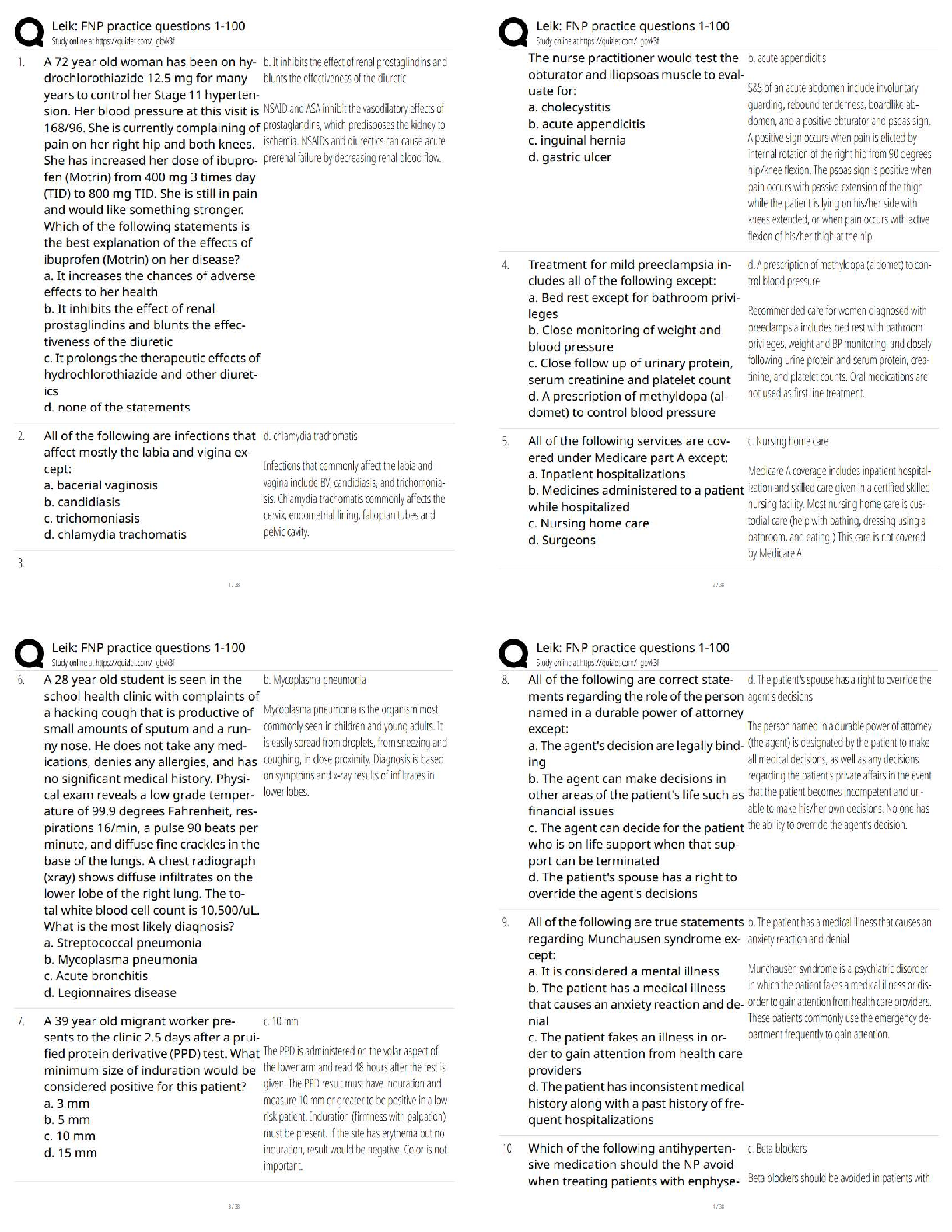
A 28-year-old student is seen in the school health clinic with complaints of a hacking cough that is
productive of small amounts of sputum and a runny nose. He does not take any medications, denies any
allergies, and has no significant medical history. Physical examination reveals a low-grade temperature
of 99.9 degrees Fahrenheit, respirations of 16/min, a pulse of 90 beats per minute, and diffuse fine
crackles in the base of the lungs. A chest radiograph (x-ray) shows diffuse infiltrates on the lower lobe of
the right lung. The total white blood cell count is 10,500/uL. What is the most likely diagnosis?
A) Streptococcal pneumonia
B) Mycoplasma pneumonia
C) Acute bronchitis
D) Legionnaires disease - ✔✔B) Mycoplasma pneumonia
Mycoplasma pneumonia is the organism most com- monly seen in children and young adults. It is easily
spread from droplets, from sneezing and coughing, in close proximity. Diagnosis is based on symptoms
and x-ray results of infiltrates in lower lobes.
A 30-year-old chef complains of pruritic hives over her chest and arms but denies difficulty swallowing
or breathing. She reports a family history of allergic rhinitis and asthma. Which of the following
interventions is most appropriate?
A) Perform a complete and thorough history
B) Prescribe an oral antihistamine such as diphenhydramine 25 mg PO QID
C) Give an injection of epinephrine 1:1000 intramuscularly stat
D) Call 911 - ✔✔A) Perform a complete and thorough history
Prior to prescribing medications, a complete and thorough history must be performed to determine
possible causes of hives. The patient denied difficulty with swallowing and breathing, so there was no
medical emergency to require calling 911.
A 30-year-old female complains of having no period for the last 12 weeks. She is sexually active and has
been using condoms inconsistently. The patient has a his- tory of irregular menstrual cycles and severe
dysmenorrhea. The urine pregnancy test result is positive.
Which of the following is a true statement regarding this pregnancy?
A) The fundus of the uterus should be at the level of the symphysis pubis
B) The cervix should be dilated about 0.5 in. at this time of gestation
C) "Quickening" starts during this period
D) Hegar's sign is present during this period of pregnancy - ✔✔A) The fundus of the uterus should be at
the level of the symphysis pubis
At 12 weeks gestation, the fundus of the uterus should be located approximately at the symphysis pubis.
A 30-year-old female who is sexually active complains of a large amount of milk- like vaginal discharge
for several weeks. A microscopy slide reveals a large amount of squamous epithelial cells that have
blurred margins. Very few white blood cells are seen. The vaginal pH is at 6.0. What is most likely?
A) Trichomonas infection
B) Bacterial vaginosis
C) Candidal infection
D) A normal finding - ✔✔B) Bacterial vaginosis
Bacterial vaginosis is a bacterial infection of the vagina. Signs and symptoms include copious off-white to
gray discharge with foul odor without vaginal erythema or irritation. Wet prep will show positive for clue
cells. When performing a wet prep, the "whiff test" will be positive for a strong "fishy" odor when
vaginal discharge is mixed with one drop of KOH.
A 30-year-old male patient refuses to take his afternoon dose of pills. The nurse tells him of the possible
consequences of his action, but the patient still refuses to cooperate. Which of the following is the best
course for the nurse to follow?
A) Document in the patient's record his behaviors and the action taken by the nurse
B) Reassure the patient that he will be fine after taking the medicine
C) Document only the patient behavior
D) Document only the nurse's action - ✔✔A) Document in the patient's record his behaviors and the
action taken by the nurse
If a patient is non-compliant, documentation of the patient behavior and the actions taken by the nurse
both must be documented.
A 30-year-old male with a history of gout is walking to the examination room and the nurse practitioner
notices that he is limping. When the patient sits down, the nurse practitioner notes that the
metatarsophalangeal joint of the great toe is very swollen and is bright red. The patient reports that he
was attending a party the night before and drank. The patient is requesting a prescription to treat his
painful toe. The nurse practitioner prescribes the patient indomethacin (Indocin) 50 mg TID PRN and
colchicine. Regarding colchicine, which of the following instructions is correct?
A) Take 1 pill every hour to every 2 hours until relief is obtained or adverse gastrointestinal effects
occur, such as abdominal pain, nausea, or diarrhea
B) Take 1 pill every hour until relief is obtained up to 24 hours
C) Take 1 pill every 4 to 6 hours until the pain is relieved
D) Take 2 to 3 pills QID until relief is obtained or adverse GI effects occur, such as abdominal pain,
nausea, or diarrhea - ✔✔A) Take 1 pill every hour to every 2 hours until relief is obtained or adverse
gastrointestinal effects occur, such as abdominal pain, nausea, or diarrhea
Colchicine acts as an anti-inflammatory and helps to suppress gouty attacks. It is usually taken as 1
tablet (0.6 mg) every 1 to 2 hours until relief is obtained (or adverse gastrointestinal effects occur, such
as abdominal pain, nausea, or diarrhea). Prescribe the patient only 10 tablets at a time (do not refill)
during a flare-up. The maximum dose is 6 mg/day. Many patients will develop GI adverse effects even
before the pain is relieved. Colchicine can also be taken daily in small amounts for prophylaxis.
A 30-year-old primigravida is diagnosed with a possible threatened abortion. The result of the urine
pregnancy test is positive. Which of the following statements is true regarding a threatened abortion?
A) Vaginal bleeding and cramping are present, but the cervix remains closed
B) Vaginal bleeding and cramping are present along with a dilated cervix
C) The fetus and placenta are all expelled
D) The products of conception and the placenta remain inside the uterus along
with a dilated cervix - ✔✔A) Vaginal bleeding and cramping are present, but the cervix remains closed
Threatened abortion is defined as vaginal bleeding and cramping with- out the presence of cervical
dilation.
A 35-year-old male has a history of an upper respiratory viral infection 4 weeks ago. He reports that he
started feeling short of breath and now complains of sharp pain in the middle of his chest that seems to
worsen when he lies down. The patient's physical exam is within normal limits with the exception of a
precordial rub on auscultation. The most likely diagnosis would be:
A) Pulmonary embolism
B) Dissecting aneurysm
C) Pericarditis
D) Esophageal reflux - ✔✔C) Pericarditis
Pericarditis is inflammation of the sac around the heart. Common signs/symptoms include chest pain
over the center/left side of the chest; shortness of breath, especially with lying down; low-grade fever;
weakness; fatigue; dry cough; and abdominal or leg swelling. Pericardial rub may be auscultated.
A 35-year-old male presents complaining of the acute onset of episodes of dizziness with nausea that
started a few days after he got over a cold. The patient describes it as the sensation of the room moving
or of the room spinning. It is worsened by sudden head movement. During the episodes, he gets very
nauseated. He also has tinnitus with hearing loss in his right ear. The patient is a type 2 diabetic and is
on a prescription of metformin 500 mg PO BID and an ACE inhibitor. The blood glucose during the visit is
80 mg/dL. Which of the following conditions is most likely?
A) Vasovagal presyncopal episode
B) Ménière's disease
C) Atypical migraine
D) Hypoglycemia - ✔✔B) Ménière's disease
The classic triad of symptoms of Ménière's disease are vertigo, tinnitus, and hearing loss. The condition
can resolve spontaneously or may be chronic. BPV has similar symptoms except that it does not cause
hearing loss. Vertigo is due to the dysfunction of the labyrinthine system. Differential diagnoses are
many (Ménière's, acute labyrinthitis, acoustic neuroma, etc.). Vasovagal syncope does not cause hearing
loss or tinnitus, nor is it episodic.
A 35-year-old primigravida who is at 28 weeks of gestation is expecting twins. What would you would
expect her alpha fetoprotein (AFP) values to be?
A) Normal
B) Higher than normal
C) Lower than normal
D) None of the above - ✔✔B) Higher than normal
Alpha fetoprotein is produced in the fetal and maternal liver. Higher levels of alpha fetoprotein are
commonly seen in multiple gestations due to the growing fetuses and enlargement of the livers.
A 35-year-old sexually active male presents with a 1-week history of fever and pain over the left
scrotum. It is accompanied by frequency and dysuria. The scrotum is edematous and tender to touch.
He denies flank pain, nausea, and vomiting. He reports that the pain is lessened when he uses scrotal
support briefs. His urinalysis shows 2+ blood and a large number of leukocytes. What is the most likely
diagnosis?
A) Acute urinary tract infection
B) Acute pyelonephritis
C) Acute orchitis
D) Acute epididymitis - ✔✔D) Acute epididymitis
Acute epididymitis is the infection presented here. Scrotal edema and pain with palpation do not occur
in UTI or pyelonephritis. Acute orchitis symptoms include testicular pain and edema, are usually
associated with the mumps, but do not have frequency and dysuria.
A 35-year-old smoker is being evaluated for birth control choices. The patient has a history of PID along
with an embolic episode after her last pregnancy. Which of the following methods of birth control would
you recommend?
A) Condoms and the vaginal sponge (Today Sponge)
B) Estrogen patches
C) Intrauterine device
D) Depo-Provera (depot medroxyprogesterone) - ✔✔A) Condoms and the vaginal sponge (Today
Sponge)
Contraindications for hormonal contraception include: Migraine headaches; cigarette smoking or
obesity in women older than 35 years; history of thromboembolic disease; hypertension or vascular
disease if over 35 years of age; systemic lupus erythematosus with vascular disease, nephritis, or
antiphospholipid antibodies; breastfeeding (may use progestin-only pills); hypertriglyceridemia; CAD;
CHF; and strokes.
A 35-year-old woman is complaining of gradual weight gain, lack of energy, and amenorrhea. The urine
pregnancy test is negative. The CBC shows a hemoglobin of 13.5 g and MCV 84. The nurse practitioner
suspects that the patient may have hypothyroidism. The TSH is 10 mU/L. Which of the following is the
next step in the evaluation?
A) Check the thyroid profile
B) Check the total T3 and T4 levels
C) Check for antithyroid peroxidase antibodies
D) Recheck the TSH in 4 to 6 months - ✔✔A) Check the thyroid profile
The upper limit of the serum TSH level is about
5.0 mU/L (range of 0.5 to 5.0). With an elevated TSH of 10, it is important to rule out hypothyroidism.
The next step in this patient's evaluation is to order a thyroid profile test. Serum assays measure bound
and unbound (free) forms of thyroxine (T4) and triiodothyronine (T3). Classic findings of hypothyroidism
are a low total T4, low T3-resin uptake (THBI), and low free T4 index.
A 38-year-old multigravida who is at 32 weeks of gestation calls the family nurse practitioner
complaining of bright red vaginal bleeding. There is no watery dis- charge. She complains that her uterus
feels hard and is very painful. Which of the following conditions is most likely?
A) Placenta previa
B) Placenta abruptio
C) A molar pregnancy
D) An ectopic pregnancy - ✔✔B) Placenta abruptio
Abruptio placenta symptoms are bright red vaginal bleeding, board-like uterus on palpation, and pain.
However, there can be concealed hemorrhage and the patient may not have vaginal bleeding. Placenta
previa is painless bleeding. Ectopic and molar pregnancy would not progress to 32 weeks gestation
A 39-year-old migrant worker presents to the clinic 2.5 days after a purified protein derivative (PPD)
test. What minimum size of induration would be considered posi- tive for this patient?
A) 3 mm B) 5 mm C) 10 mm D) 15 mm - ✔✔C) 10 mm
The PPD is administered on the volar aspect of the lower arm and read 48 hours after the test is given.
The PPD result must have induration and measure 10 mm or greater to be positive in a low-risk patient.
Induration (firmness with palpation) must be present. If the site has erythema but no induration, result
would be negative. Color is not important.
A 40-year-old cashier complains of periods of dizziness and palpitations that have a sudden onset. The
EKG shows P waves before each QRS complex and a heart rate of 170 beats/minute. A carotid massage
decreases the heart rate to 80 beats/min. These best describe:
A) Ventricular tachycardia
B) Paroxysmal atrial tachycardia
C) Atrial fibrillation
D) Ventricular fibrillation - ✔✔B) Paroxysmal atrial tachycardia
Signs/symptoms of paroxysmal atrial tachycardia include rapid, regular heart rate that begins and ends
very quickly. The atria are beating at a very fast rate, but it is not life-threatening. Ventricular
tachycardia is usually associated with heart disease, occurs when the ventricles are beating rapidly and
inefficiently, and can lead to death if not treated. Atrial fibrillation is an irregular heartbeat that can be
life threatening if not treated. Ventricular fibrillation occurs when the heartbeat is rapid and chaotic,
and death will occur if the condition is not treated.
A 40-year-old female is positive for anti-hepatitis C virus (HCV). Which test is appropriate for follow-up?
A) HCV RNA
B) HCV antibodies
C) HCV core antigen
D) Hepatitis C surface antigen - ✔✔A) HCV RNA
HCV RNA is performed following a positive anti-hepatitis C virus test.
A 40-year-old male complains to the nurse practitioner of severe stabbing pains behind his left eye for
the past 2 days. It is accompanied by some nasal congestion and rhinorrhea, which is clear in color. The
patient denies pharyngitis and fever. Which of the following conditions is most likely?
A) Migraine headache with aura
B) Cluster headache
C) Tic douloureux
D) Cranial neuralgia - ✔✔B) Cluster headache
Signs/symptoms of cluster headaches include severe stabbing pain behind the eyes, with nasal
congestion and rhinorrhea. Migraine head- aches with aura include visual changes, such as blind spots or
flashing lights that appear before the onset of the headache. Trigeminal neuralgia (tic douloureux) is a
unilateral headache from compression or inflammation of the trigeminal nerve (cranial nerve 5).
A 40-year-old nurse complains of a new onset of back pain secondary to her job on the medical-surgical
floor of a hospital. She reports lifting some obese patients while working the previous night shift. She
reports to the worker's compensation clinic where she was referred. She describes the pain as starting in
her right but- tocks area and radiating down the back of her thigh. It becomes worse when she sits down
for long periods. You would suspect:
A) Sciatica
B) Acute muscle spasm
C) Cauda equina syndrome
D) Acute muscle strain - ✔✔A) Sciatica
Sciatica is defined as pain that begins in the buttock area and radiates down one leg. Other symptoms
include weakness and tingling sensation. Acute muscle spasm and strain do not cause tingling down the
leg. Cauda equina syndrome is an emergent issue, in which there is neurological involvement and
patient complaints of weakness and loss of bladder and bowel control.
A 40-year-old White female with a BMI (body mass index) of 32 complains of col- icky pain in the right
upper quadrant of her abdomen that gets worse if she eats fried food. During the physical exam, the
nurse practitioner presses deeply on the left lower quadrant of the abdomen. After releasing her hand,
the patient complains of pain on the right side of the lower abdomen. What is the name of this finding?
A) Rebound tenderness
B) Rovsing's sign
C) Murphy's sign
D) Psoas test - ✔✔B) Rovsing's sign
Rovsing's sign is referred pain to the opposite side of the abdomen after release of palpation.
A 40-year-old woman is in the office complaining of palpitations and some light headedness for the past
6 months. These are random episodes. The nurse practitioner notices a mid-systolic click with a late
systolic murmur that is best heard in the apical area during auscultation of the chest. The NP would
suspect:
A) Atrial fibrillation
B) Sinus arrhythmia
C) Mitral stenosis
D) Mitral valve prolapse - ✔✔D) Mitral valve prolapse
Mitral valve prolapse occurs when the mitral valve does not close all the way, causing a late systolic
murmur heard best in the apical area during auscultation of the chest. Symptoms patients may
experience at times include palpitations and dizziness.
A 44-year-old female who is undergoing treatment for infertility complains of not having a menstrual
period for a few months. The night before, she started spotting and is now having cramp-type pains in
her pelvic area. Her blood pressure (BP) is 160/80, the pulse rate is 110, and she is afebrile. Her labs
reveal a mild anemia with mild leukocytosis. On pelvic exam, the uterine fundus is found above the
symphy- sis pubis. The cervical os is dilated at 3 cm. Which of the following is most likely?
A) Inevitable abortion
B) Threatened abortion
C) Incomplete abortion
D) Acute pelvic inflammatory disease - ✔✔A) Inevitable abortion
Inevitable abortion is defined as vaginal bleeding with pain and cervical dilation and/or effacement.
Threatened abortion is defined as vaginal bleeding with absent or minimal pain and a closed, long, and
thick cervix. Incomplete abortion is moderate to diffuse vaginal bleeding, with the passage of tissue and
painful uterine cramping or contractions. Acute pelvic inflammatory disease is a sudden onset of
inflammation and pain that affects the pelvic area, cervix, uterus, and ovaries, which is caused by
infection.
A 44-year-old patient with Down syndrome starts to develop impaired memory and difficulty with his
usual daily life routines. He is having problems functioning at the job that he has done for the past 10
years. The physical exam and routine labs are all negative. The vital signs are normal. His appetite is
normal. The most likely diagnosis is:
A) Tic douloureux
B) A stroke
C) Alzheimer's disease
D) Delirium - ✔✔C) Alzheimer's disease
Delirium is an acute decline in mental status and is temporary. Common causes are fever, shock, drugs,
alcohol, and dehydration. Alzheimer's disease is a permanent change to the brain that causes short-term
memory loss, agnosia, apraxia, and aphasia. In this case, the patient's physical exam is normal; however,
he is having memory loss and difficulty working and carrying out his normal tasks
A 45-year-old gardener is seen as a walk-in patient in a private clinic. He reports stepping on a nail that
morning. His last tetanus vaccine was 7 years ago. Which of the following vaccines is recommended?
A) DTaP
B) DT
C) Td
D) Tdap - ✔✔D) Tdap
The CDC recommends that 1 of the tetanus boosters be replaced with the Tdap (once in a lifetime).
Thereafter, the Td form of the vaccine is indicated every 10 years. The DTaP (diphtheria-tetanus�acellullar pertussis) and DT (diphtheria-tetanus) forms of the tetanus vaccine are not given after the age
of 7 years. Puncture wounds are at higher risk for tetanus because Clostridium tetani bacteria are
anaerobes (deep puncture wounds are not exposed to air compared with superficial wounds).
A 45-year-old man fell asleep while smoking in his bedroom and started a fire. According to the patient,
he refused to go to the emergency department because he had only minor burns. About 12 hours later,
he presents to a walk-in urgent care center complaining of a new cough that is productive of saliva with
clear mucus with small carbonaceous black particles. His brows appear singed. Which of the following is
the priority when evaluating this patient?
A) Perform a medical history, including prescription, OTC, and herbal medicines
B) Assess the patient for respiratory distress
C) Evaluate the patient for asthma and atopy
D) Use the Rule of Nines to evaluate the total body surface area (TBSA) - ✔✔B) Assess the patient for
respiratory distress
Assess the patient for respiratory distress ASAP. Follow the "ABCs" and assess the patient for any life�threatening symptoms. Smoke inhalation lung injury is the main cause of death in thermal burn victims.
A 48-year-old woman is told by a physician that she is starting menopause. All of the following are
possible findings except:
A) Hot flashes
B) Irregular menstrual periods
C) Severe vaginal atrophic changes
D) Cyclic mood swings - ✔✔C) Severe vaginal atrophic changes
As women reach menopause, changes that may occur include hot flashes, irregular menstrual periods,
and cyclic mood swings. Vaginal changes, such as dryness and thinning, may also begin to occur
A 50-year-old woman of Irish descent presents with history of lethargy, feeling weak, nausea, anorexia
with diarrhea and abdominal pain. The woman's skin appears tanned, but she denies prolonged sun
exposure. During physical exam, the skin appears tan with hyperpigmentation of the nipple area, the
gums, and the lips. The electrolyte panel reveals hyperkalemia and hyponatremia. She reports craving
salty foods. Which of the following is most likely?
A) Addison's disease
B) Cushing's disease
C) Metabolic syndrome
D) Cutaneous drug reaction - ✔✔A) Addison's disease
Addison's disease is also known as primary adrenal insufficiency. The most common cause of damage to
the adrenal cortex (the outer layer of the gland) is autoimmune destruction. The adrenal cortex
produces glucocorticoids (cortisol) and mineralocorticoids (aldosterone). Aldosterone regulates sodium
retention and potassium excretion through the kidneys (affects blood pressure). Electrolyte
abnormalities are high potassium and low sodium. In primary disease (Addison's), serum cortisol is low,
ACTH is high, and serum aldosterone is low. If the patient is not treated, severe stress (illness, accident)
may cause an adrenal crisis ("Addisonian" crisis), which can be fatal.
A 53-year-old crossing guard complains of twisting his right knee while working that morning. The knee
is swollen and tender to palpation. The nurse practitioner diagnoses a Grade II sprain. The initial
treatment plan includes which of the following?
A) Application of cold packs the first 24 hours followed by applications of low heat at bedtime
B) Elevation of the affected limb and intermittent applications of cold packs for the next 48 hours
C) Rechecking the knee in 24 hours and isometric exercises
D) The application of an Ace bandage to the affected kne - ✔✔B) Elevation of the affected limb and
intermittent applications of cold packs for the next 48 hours
Elevation of the injured knee above the heart will reduce the amout of swelling that can occur. Use of
ice packs immediately after the injury is most effective and will reduce swelling in the tissue. Ice the
affected area for 15 minutes at a time intermittently to prevent frostbite and further damage to tissue.
Allowing 30-45 minutes between icings of the limb is recommended.
A 55-year-old female with a history of migraine headaches has recently been diagnosed with Stage II
hypertension. Her EKG strips reveal second-degree heart block. The chest x-ray is normal. Which of the
following drugs should this patient avoid?
A) ACE inhibitors
B) Angiotensin receptor blockers
C) Diuretics
D) Calcium channel blockers - ✔✔D) Calcium channel blockers
Common side effects of calcium channel blockers include headaches, edema of the lower extremities,
and heart block or bradycardia. Contraindications for calcium channel blockers include second- or third�degree AV block, bradycardia, and congestive heart failure.
A 55-year-old male patient describes to you an episode of chest tightness in his substernal area that
radiated to his back while he was jogging. It was relieved immediately when he stopped. Which of the
following conditions does this best describe?
A) Angina pectoris
B) Acute myocardial infarction
C) Gastroesophageal reflux disease
D) Acute costochondritis - ✔✔A) Angina pectoris
Symptoms of angina pectoris include a pressing, squeezing, or crushing pain, usually in the chest or back,
arms, neck, or ear lobes. Weakness, fatigue, and shortness of breath and pain radiating in the arms,
shoulders, jaw, neck, and/or back may also occur. Angina pectoris is most commonly brought on by
physical exertion, but can also be triggered by stress and other stressors to the body.
A 55-year-old nurse brings her mother, who is 82 years of age, to the emergency department of a local
hospital. She reports she found her mother on the floor when she checked on her that morning. Her
mother was awake and oriented, but needed help getting up. Her mother states that she thinks she
passed out. She is being evaluated by a physician who orders an EKG and x-rays of both hips. Regarding
laboratory testing, which of the following is important to perform initially?
A) Urinalysis
B) Serum electrolytes
C) Blood glucose
D) Hemoglobin and hematocrit - ✔✔C) Blood glucose
Checking the blood glucose is indicated for patients with syncopal and near syncopal episodes. The NP
has performed a thorough history of the incident (diabetic, rapid onset or slow, position, provocation),
medical history, health history, and the medications.
A 55-year-old woman who has type 2 diabetes is concerned about her kidneys. She has a history of 3
urinary tract infections within the past 8 months. She denies dysuria and frequency at this visit. Which of
the following is the best initial course to follow?
A) Recheck the patient's urine and order a urine for culture and sensitivity
B) Order an IVP (intravenous pyelogram)
C) Advise the patient to follow up with a urologist
D) Evaluate the patient for a possible kidney infection - ✔✔A) Recheck the patient's urine and order a
urine for culture and sensitivity
A urinary tract infection is defined as the presence of 100,000 organisms per mL of urine in
asymptomatic patients or greater than 100 organisms per mL or urine with pyuria (more than 7
WBCs/mL) in a symptomatic patient
A 55-year-old woman who is on a prescription of clindamycin for a dental infection presents to the nurse
practitioner with complaints of watery diarrhea for the past 4 days. She complains of abdominal
cramping and bloating with diarrheal stools up to 10 times a day. She denies seeing blood or pus in her
stool. There is no history of recent travel. The patient has been taking over-the-counter medicine with
no relief. The nurse practitioner suspects that the patient has a mild case of Clostridium difficile colitis.
Which of the following antibiotics is indicated for this infection?
A) Ciprofloxacin (Cipro) 400 mg PO BID x 7 days
B) Metronidazole (Flagyl) 500 mg PO TID x 10 days
C) Levofloxacin (Levaquin) 750 mg PO daily x 7 days
D) Trimethoprim-sulfamethoxazole (Bactrim DS) 1 tablet PO BID x 10 days - ✔✔B) Metronidazole (Flagyl)
500 mg PO TID x 10 days
First-line treatment for a mild case of Clostridium difficile colitis is metronidazole (Flagyl) 500 mg PO TID
x 10 days. Discontinuation of the offending antibiotic (if possible) or switching to another antibiotic class
is recommended. The role of probiotic supplementation is controversial. Complications are
pseudomembranous colitis, toxic megacolon, and fulminant colitis.
A 56-year-old man complains of episodes of lancinating pain that shoots up to his right cheek when he
eats or drinks. He has stopped drinking cold drinks because of the pain. Which of the following is most
likely?
A) Trigeminal neuralgia
B) Cluster headache
C) Acute sinusitis
D) Sinus headache - ✔✔A) Trigeminal neuralgia
Pain shooting up the right cheek with food or drink is seen with trigeminal neuralgia.
A 56-year-old mechanic is brought to your office complaining of heavy pressure in the substernal area of
his chest that is radiating to his jaw. The pain began while he was lifting up a tire. He now appears pale
and is diaphoretic. His blood pressure is 100/60 mm Hg, and his pulse rate 50. What is the most
appropriate action?
A) Perform a 12-lead EKG
B) Dial 9-1-1
C) Administer a morphine injection for pain
D) Observe the patient in the office - ✔✔B) Dial 9-1-1
Heavy chest pressure in the substernal area, radiating to the jaw, diaphoresis, low BP, and bradycardia
are signs of cardiac distress and 9-1-1 should be called immediately for transfer to the emergency
department.
A 60-year-old female truck driver presents to the outpatient urgent care clinic of a hospital complaining
of the worsening of her low back pain the past few days. She describes the pain as "sharp and burning"
and points to the left buttock. She reports that the pain started on the mid-buttock of the left leg and
recently started to go down the lateral aspect of the leg toward the top of the foot. During the physical
exam, the ankle jerk and the knee jerk reflex is 1+ on the affected leg and 2+ on the other leg. The pedal,
posterior tibialis, and popliteal pulses are the same on both legs. Which of the following tests should the
nurse practitioner consider for this patient?
A) Order both a plain radiograph and computed tomography (CT) scan of the spine as soon as possible
B) Write a prescription for ibuprofen 800 mg PO QID with a muscle relaxant and advise the patient to
follow up with her primary care provider within 3 days
C) Refer the patient to an orthopedic surgeon
D) Ordering an imaging study of the spine is premature because the majority of low back pain cases
resolve within 10 to 12 weeks - ✔✔A) Order both a plain radiograph and computed tomography (CT)
scan of the spine as soon as possible
The patient has a severe case of sciatica that is worsening quickly (may progress to cauda equina). In
addition, older age and an abnormal neurologic exam are red flags for potentially serious underlying
pathology (osteoporosis fracture, cancer, infection, spondylolisthesis). Because the patient's symptoms
are worsening, a CT scan is the best choice. A plain radiograph can only detect bony pathology, but a CT
scan can detect nerve root compression, herniated disc, cancer, and spinal stenosis (narrowing of the
spinal canal). In addition, the patient needs to follow up with a neurologist as soon as possible.
A 62-year-old female complains of chronic severe low back pain. She also reports mild episodes of fecal
incontinence and numbness to her lower legs over the past week. You would suspect which of the
following?
A) Fracture of the lower spine
B) A herniated disc
C) Cauda equina syndrome
D) Ankylosing spondylitis - ✔✔C) Cauda equina syndrome
Cauda equina syndrome is a surgical emergency. Signs and symptoms include a change in bowel and
bladder control (incontinence). Acute pressure on the sacral nerve root causes inflammatory and
ischemic changes to the nerve and can lead to permanent nerve damage.
A 62-year-old male with chronic obstructive pulmonary disease (COPD) complains to the nurse
practitioner that his prescription of ipratropium bromide (Atrovent) is not working. He reports that he
still feels short of breath even after using it 4 times a day for 3 months. Which of the following actions is
the next step for the nurse practitioner?
A) Increase the patient's dose of ipratropium bromide (Atrovent) to 3 inhalations QID
B) Continue the ipratropium bromide and start the patient on oxygen by nasal cannula
C) Continue ipratropium bromide (Atrovent) and add albuterol (Ventolin) inhaler 2 inhalations QID
D) Start the patient on oxygen by nasal cannula at bedtime and PRN during the daytime - ✔✔C)
Continue ipratropium bromide (Atrovent) and add albuterol (Ventolin) inhaler 2 inhalations QID
Treatment of COPD starts with an anticholinergic (ipratropium bromide). The next step is to add a short�acting beta-2 agonist (albuterol)
A 63-year-old patient with a 10-year history of poorly controlled hypertension presents with a cluster of
physical exam findings. Which of the following indicate target organ damage commonly seen in
hypertensive patients?
A) Pedal edema, hepatomegaly, and enlarged kidneys
B) Hepatomegaly, AV nicking, bibasilar crackles
C) Renal infection, S3, neuromuscular abnormalities
D) Glaucoma, jugular vein atrophy, heart failure - ✔✔B) Hepatomegaly, AV nicking, bibasilar crackles
With long-term, uncontrolled hypertension, organ damage may occur. Organs commonly affected
include: brain (stroke), eyes (retinopathy, AV nicking, bleeding, blindness), heart (heart dis- ease, left
ventricular hypertrophy, MI, and/or CHF), and kidneys (renal failure, proteinuria).
A 65-year-old Hispanic woman has a history of type 2 diabetes. A routine urinalysis reveals a few
epithelial cells and is negative for leukocytes, nitrites, and protein. Which of the following would you
recommend next?
A) Order a urine for C&S
B) Order a 24-hour urine for microalbumin
C) Because it is negative, no further tests are necessary
D) Recommend a screening IVP (intravenous pyelogram) - ✔✔B) Order a 24-hour urine for microalbumin
Epithelial cells are cells that are present on the inside lining of the organs. Few epithelial cells can be
normal; however, with her history of type 2 diabetes, a 24-hour urine for microalbumin should be
ordered to assess kidney function.
A 65-year-old woman's bone density result shows severe demineralization of cortical bone. All of the
following pharmacologic agents are useful in treating this condition except:
A) Raloxifene (Evista)
B) Calcitonin (Miacalcin)
C) Medroxyprogesterone (Depo-Provera)
D) Calcium with Vitamin D - ✔✔C) Medroxyprogesterone (Depo-Provera)
Common treatments for osteoporosis include calcium and Vitamin D, Evista, Miacalcin, and
bisphosphonates. Depo- Provera is a type of contraception.
A 67-year-old female with a 50 pack/year history of smoking presents for a routine annual physical
examination. She complains of being easily short of breath and is frequently fatigued. Physical
examination reveals diminished breath sounds, hyperresonance, and hypertrophied respiratory
accessory muscles. Her CBC results reveal that her hematocrit level is slightly elevated. Her pulmonary
function test (PFT) results show increased total lung capacity. What is the most likely diagnosis for this
patient?
A) Bronchogenic carcinoma
B) COPD (chronic obstructive pulmonary disease)
C) Chronic bronchitis
D) Congestive heart failure - ✔✔B) COPD (chronic obstructive pulmonary disease)
Common complaints and signs/symptoms of COPD include shortness of breath, fatigue, chronic cough,
wheezing, difficulty performing tasks and speaking, pursed-lip breathing, digital clubbing, diminished
breath sounds, use of accessory muscles, and polycythemia due to chronic hypoxia. Pulmonary function
tests/ spirometry include forced expira- tory volume, forced vital capacity, and FEV1/FVC ratios.
A 67-year-old retired clerk presents with complaints of shortness of breath and weight gain over a 2-
week period. A nonproductive cough accompanies her symptoms. The lung exam is positive for fine
crackles in the lower lobes with no wheezing. The exam is positive for egophony. Which of the following
conditions is most likely?
A) Acute exacerbation of asthma
B) Left-heart failure
C) Right-heart failure
D) Chronic obstructive pulmonary disease - ✔✔B) Left-heart failure
Signs and symptoms of left-heart failure include tachypnea, labored breathing, and rales or crackles in
the lower bases of the lungs, which can develop into pulmonary edema.
A 68-year-old woman complains of leaking a small amount of urine whenever she sneezes, laughs,
and/or strains. The problem has been present for many months. The patient denies dysuria, frequency,
and nocturia. The urine dipstick test is neg- ative for white blood cells, red blood cells, ketones, and
urobilinogen. What is the name of this condition?
A) Urge incontinence
B) Overflow incontinence
C) Urinary incontinence
D) Stress incontinence - ✔✔D) Stress incontinence
[Show More]

.png)
.png)