Physics > Lab Report > PHY 2053L Physics 2 lab - Miami Dade College, Miami. Factors Affecting Electrical Resistance Experim (All)
PHY 2053L Physics 2 lab - Miami Dade College, Miami. Factors Affecting Electrical Resistance Experiment Research and Pleriminary Q&A
Document Content and Description Below
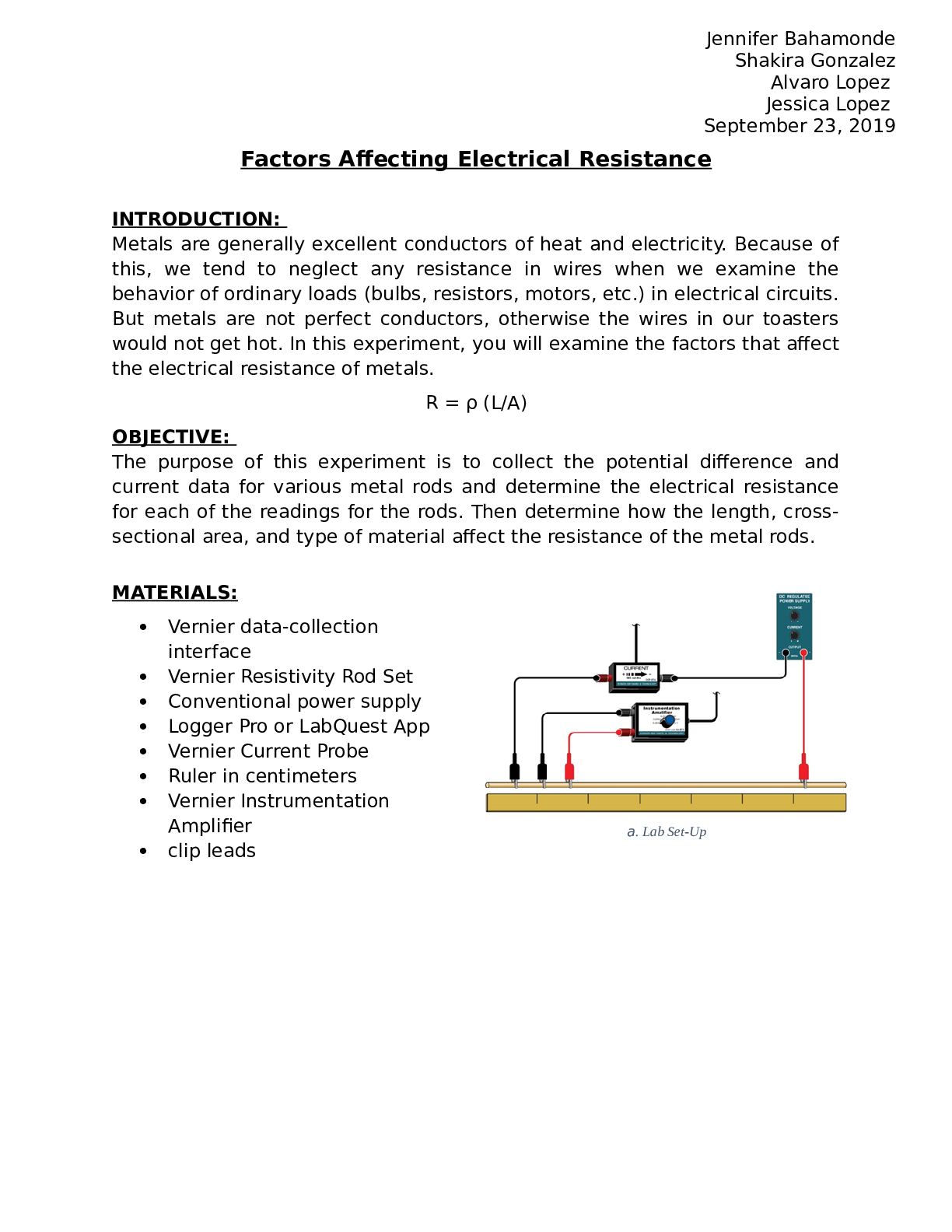
Factors Affecting Electrical Resistance INTRODUCTION: Metals are generally excellent conductors of heat and electricity. Because of this, we tend to neglect any resistance in wires when we examine ... the behavior of ordinary loads (bulbs, resistors, motors, etc.) in electrical circuits. But metals are not perfect conductors, otherwise the wires in our toasters would not get hot. In this experiment, you will examine the factors that affect the electrical resistance of metals. R = ρ (L/A) OBJECTIVE: The purpose of this experiment is to collect the potential difference and current data for various metal rods and determine the electrical resistance for each of the readings for the rods. Then determine how the length, crosssectional area, and type of material affect the resistance of the metal rods. MATERIALS: Vernier data-collection interface Vernier Resistivity Rod Set Conventional power supply Logger Pro or LabQuest App Vernier Current Probe Ruler in centimeters Vernier Instrumentation Amplifier clip leads a. Lab Set-UpPROCEDURE: Setup using conventional power supply and Lab-Pro 1. Connect a Vernier Current Probe to the interface. Connect the current probe in series to the negative terminal on the power supply and to one end of the brass rod (see Figure 3). 2. Connect an Instrumentation Amplifier to the interface. Set the range to 0–20 mV. Use a lead to connect the black post on the instrumentation amplifier to ground (usually the black terminal on the power supply). Start the data-collection program. 3. Connect clip leads to the red and black terminals of the instrumentation amplifier; these will act as the probe leads for your measurements of potential. Connect the black lead to a position just inside the lead carrying current to the rod. Note this as the zero position. Touch the other lead (hereafter referred to as the red lead) to the black lead on the rod and zero both sensors (see Figure 3). 4. Your instructor will provide specific instructions that will enable you to run a DC current of approximately 0.5 A through the rod. [Show More]
Last updated: 2 years ago
Preview 1 out of 11 pages
Buy this document to get the full access instantly
Instant Download Access after purchase
Buy NowInstant download
We Accept:

Reviews( 0 )
$10.50
Can't find what you want? Try our AI powered Search
Document information
Connected school, study & course
About the document
Uploaded On
Apr 17, 2023
Number of pages
11
Written in
All

Additional information
This document has been written for:
Uploaded
Apr 17, 2023
Downloads
0
Views
161







.png)



.png)