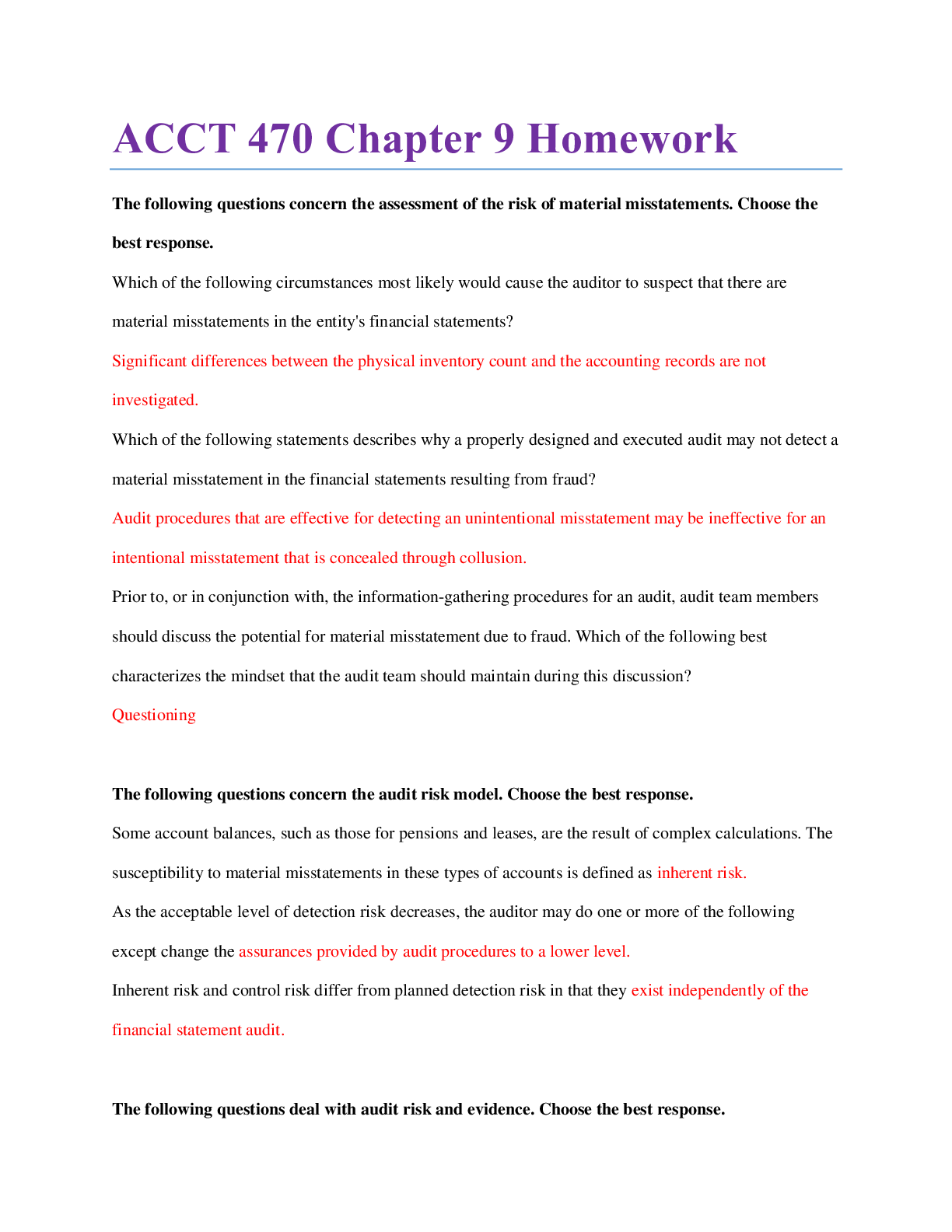
ACCT 470 Chapter 9 Homework
The following questions concern the assessment of the risk of material misstatements. Choose the best response.
Which of the following circumstances most likely would cause the auditor to s
...
ACCT 470 Chapter 9 Homework
The following questions concern the assessment of the risk of material misstatements. Choose the best response.
Which of the following circumstances most likely would cause the auditor to suspect that there are material misstatements in the entity's financial statements?
Which of the following statements describes why a properly designed and executed audit may not detect a material misstatement in the financial statements resulting from fraud?
Prior to, or in conjunction with, the information-gathering procedures for an audit, audit team members should discuss the potential for material misstatement due to fraud. Which of the following best characterizes the mindset that the audit team should maintain during this discussion?
The following questions concern the audit risk model. Choose the best response.
The following questions deal with audit risk and evidence. Choose the best response.
Which of the following does not increase the need for sufficient appropriate audit evidence?
As lower acceptable levels of both audit risk and materiality are established, the auditor should plan more work on individual accounts to
Based on evidence gathered and evaluated, an auditor decides to increase the assessed level of control risk from that originally planned. To achieve an overall audit risk level that is substantially the same as the planned audit risk level, the auditor could
The following questions concern auditor responsibilities related to the assessment of risks of material misstatement. Choose the best response.
Which of the following procedures would a CPA most likely perform during the planning stage of the audit?
Dan, CPA, has been engaged to audit Modern Home, a manufacturing company that specializes in furniture. Which of the following matters related to the year under audit would most likely result in an increase of inherent risk?
After making a preliminary assessment of the risk of material misstatement during planning and beginning to apply audit procedures, an auditor determines that this risk is actually higher than anticipated. Which would be the most likely effect of this finding on the auditor's desired level of detection risk and the overall level of audit risk, as compared to the levels originally planned?
Auditor's Desired Level of Detection Risk Overall Level of Audit Risk
There are eight parts of the planning phase of an audit. Which parts involve the evaluation of risk?
Why is it important for the auditor to consider the risk of material misstatement at the overall financial statement level?
Provide two examples of factors that might increase the risk of material misstatement at the overall financial statement level.
Assume that you are concerned that your client has recorded revenues that did not occur. What audit objective would you assess as having a high risk of materialmisstatement?
Describe the types of procedures auditors perform as part of their risk assessment procedures. (Select all that apply.)
In addition to inquiring of individuals among management who are involved in financial reporting positions, such as the CFO and controller, which additional individuals should you consider making inquiries of as part of your risk assessment procedures? Be sure to describe how those individuals might be helpful to you in assessing risks of material misstatement. (Select all that apply.)
Auditing standards require that the engagement team members engage in discussion about the risk of material misstatement. Describe the nature of this required discussion and who should be involved.
Auditing standards require that the engagement team members engage in discussion about the susceptibility of the financial statements to the risk of fraud. How does this discussion relate to the required discussion about the risk of material misstatement?
Why is it important to distinguish the auditor's assessment of the risk of material misstatement due to fraud from the assessment of the risk of material misstatement due to error?
How should the auditor consider risks related to revenue recognition when assessing the risk of material misstatement due to fraud?
What types of inquiries should the auditor make when considering the risk of material misstatement due to fraud?
What constitutes a significant risk?
Describe examples of characteristics of transactions and balances that might cause an auditor to determine that a risk of material misstatement is a significant risk.
Select the characteristics of transactions and balances that might cause an auditor to determine that a risk of material misstatement is a significant risk and then select each characteristic's matching description.
Characteristic Description
Describe which two factors of the audit risk model relate to the risk of material misstatement at the assertion level.
Factor Description
Explain the causes of an increased or decreased planned detection risk.
Begin by explaining the causes of an increased planned detection risk.
Next explain the causes of a decreased planned detection risk.
Define what is meant by inherent risk. Identify four factors that are associated with higher inherent risk in audits.
Define what is meant by inherent risk.
Identify four factors that are associated with higher inherent risk in audits. (Identify all four answers from the list below.)
Explain why inherent risk is set for audit objectives for segments (classes of transactions, balances, and presentation and disclosure) rather than for the overall audit. What is the effect on the amount of evidence the auditor must accumulate when inherent risk is increased from medium too high for an audit objective?
What is the effect on the amount of evidence the auditor must accumulate when inherent risk is increased from medium too high for a segment?
When inherent risk is increased from medium to high, the auditor should increase the audit evidence accumulated
Explain the effect of extensive misstatements found in the prior year's audit on inherent risk, planned detection risk, and planned audit evidence.
Explain what is meant by the term acceptable audit risk. What is its relevance to evidence accumulation?
What is its relevance to evidence accumulation?
Explain the relationship between acceptable audit risk and the legal liability of auditors.
Explain why there is an inverse relationship between planned detection risk and the amount of evidence an auditor collects for a specific audit objective.
Auditors have not been successful in measuring the components of the audit risk model. How is it possible to use the model in a meaningful way without a precise way of measuring the risk?
Explain the circumstances when the auditor should revise the components of the audit risk model and the effect of the revisions on planned detection risk and planned evidence.
Explain the effect of the revisions on planned detection risk and planned evidence.
Explain how audit risk and materiality are related and why they need to be considered together in planning an audit.
[Show More]




 1e Gail Fayerman.png)
.png)
![Preview of Advanced Accounting 5th Edition By Susan Hamlen - TEST BANK [All Chapters 1-16]](https://scholarfriends.com/storage/TB 5e Susan Hamlen_Updated.png)