Medical Management of Septic Shock
Identification and elimination of source of infection (goals are to id & tx within 3 hrs to increase pt outcome)
Pan culture/Labs/Lactic acid (greater than 2)/ABG
Remove infe
...
Medical Management of Septic Shock
Identification and elimination of source of infection (goals are to id & tx within 3 hrs to increase pt outcome)
Pan culture/Labs/Lactic acid (greater than 2)/ABG
Remove infected lines/catheters then replace
Fluid replacement through aggressive fluid resuscitation is key (monitor bp, CVP, fluid responsiveness w/ passive leg raise, u/o, serum lactate levels)
Vasopressors (norepinephrine 1st line or dopamine to achieve MAP of >65; inotropic; PRBC to support O2 delivery; neuromuscular agent & sedation may be required to reduce metabolic demands & provide comfort; DVT plus SCD prophylactic, antacid [PPI])
Broad spectrum antibiotics; Change to appropriate antibiotics when cultures returned (do blood & urine culture prior; can take 24-36 hrs depend on labs)
Nutritional Therapy (within 24-48 hrs in ICU to address hypermetabolic state; if not it will further impair pt’s resistance to infection enteral feeding if GI tract have good peristalsis)
Nursing Management of Septic Shock
Respiratory support
Transfuse when Hgb < 7 g/dL
Glucose control (< 180 mg/dL)
DVT prophylaxis
GI prophylaxis (antipeptic & protonic especially bc they on steroids)
IV hydrocortisone
Advanced planning
If pt is hyperthermia: give acetaminophen or apply hypothermia blanket (avoid shivering)
Patient & Family Support
Anxiety
Support of coping
Patient, family education
Communication
End-of-life issues
Grief processes
Neurogenic Shock
Pathophysiology
Vasodilatation occurs as a result of a loss of balance between parasympathetic and sympathetic stimulation
o Sympathetic stimulation: vascular smooth muscle constriction (in neurogenic state the SNS is not able to respond to body stressor)
o Parasympathetic stimulation: vascular smooth muscle relaxation
Parasympathetic stimulation is predominant
Relative hypovolemia with adequate volume status
Clinical Manifestations & Etiology (remember SNS is not able to function properly, so the s/s that will appear with neurogenic shock will be parasymptomatic signs)
Causes bradycardia (slow HR), hypotension (low BP) & blood pooling
Etiology
o Spinal cord injury
o Spinal anesthesia*
o Nervous system damage
o Depressant action of medications
o Hypoglycemia/ lack of glc (insulin reaction)
o Low bp, low HR, cyanosis, hypothermia, blank stare, Dry/warm skin
Medical Management
Restore sympathetic tone either by stabilization of a SCI or position pt properly
Proper positioning
Treat the cause! Pacemaker, atropine, vasopressor
Nursing Management
HOB up 30 degrees with epidural anesthesia
Assess for DVT increase pooling of blood from vascular dilation (not able to feel anything if they have SCI daily check for lower extremity pain, redness, tenderness & warmth passive ROM of the immobile extremities help promote circulation early prevention includes SCD’s & antithrombotic agents [Lovenox])
Asses for signs/symptoms internal bleeding that could lead to hypovolemic shock
Anaphylactic Shock
Anaphylaxis
Severe allergic reaction in patient who has already produced antibodies to an antigen
Systemic antigen-antibody reaction
o IgE mediated
The antigen-antibodies reaction provokes mast cells to release potent vasoactive substance as histamine, bradykinin, inflammatory cytokines released
o Widespread vasodilation and increased capillary permeability
Common triggers
o Food (peanuts)
o Medication (ARB, ACE-I, ASA, NSAIDS, antibiotics, beta-blockers)
o Insects (bee’s)
o IV dye, iodine
People who have been previous expose have worsened reaction to the 2 times, can occur in many year
Clinical Manifestations
1. Acute onset of symptoms
2. Presence of two or more symptoms (resp compromise, reduce BP, GI distress & skin or mucosal tissues irritation)
3. Cardiovascular compromise from min (2-30 min) to hrs after exposure to antigen
Headache, lightheaded
N/V, acute abdominal pain or discomfort
Pruritus, erythema, flushing & feeling of impending doom
Laryngeal edema, bronchospasm
Hypotension (due to trying to compensate)
Cardiac dysrhythmia/arrest
Characteristics of severe anaphylaxis usually include rapid onset of hypotension, neurologic compromise, resp distress & cardiac arrest
Medical Management
Remove the causative agent (such as d/c an antibiotic agent)
Administering medications that restore vascular tone
o IM Epinephrine (along with 50 mg IV of Benadryl to reverse histamine)
o Albuterol (Proventil) may be given to reverse histamine-induced bronchospasm
Emergency support
Fluid management is critical, as massive fluid shifts can occur within min due to increase vascular permeability
Medications (Reduce histamine)
o Nebulizer treatments
o Benadryl
o Steroids
Nursing Management
Assess all patients for allergies or previous reactions to antigens (meds, blood product, food, contrast agent, latex)
o Communicate existence of allergy to other team members (allergies to iodine or fish, previous contrast agent reaction)
Prevent further exposure (bracelet)
Observe for reactions while administering new medications (IV)
Assess for reactions
Be prepared for cardiac arrestperform CPR
Multiple Organ Dysfunction Syndrome
Altered organ function in acutely ill patients
Requires medical intervention to support continued organ function
Not always possible to predict
Associated mortality rate as high as 75%
***High level antibiotic can increase BUN & Cr in pt w/o adequate fluid balance (whatever system pt have effected, know what doctor is on the case)
Labs for liver issue: AST, ALT, albumin (s/s: jaundice, AMS, ascites)
***MODS mat be a complication of all form of shock but common in in pt w/ sepsis & result of inadequate tissues perfusion
***Organs failure usually begins in the lung & cardiovascular instability then liver, GI, renal, immunologic, & CNS follows
Clinical Manifestations
Hypotension
Respiratory compromise (ALI or ARDS) requiring intubation & mechanical vent
Hypermetabolic state
o Hyperglycemia
Lactic Acidosis
o Hyper-lactic acidemia (excess lactic acid in the blood)
Hepatic dysfunction elevated bilirubin & liver function test
Renal dysfunction elevated cr & anuria
Hematologic dysfunction: DIC, PT/INR, PTT
Immunocompromise worsens
Unstable cardiac system
Neurologic compromised (unresponsive/coma)
Systemic fulminant edema swelling everywhere
electrolyte imbalance: d/r
Medical & Nursing Management (Everything about MODS is about
preventing it)
Control the initiating event
Promote adequate organ perfusion
Provide nutritional support
Nursing: supportive caremay be supportive end of life care
Effective communication between nurse-patient and nurse-family
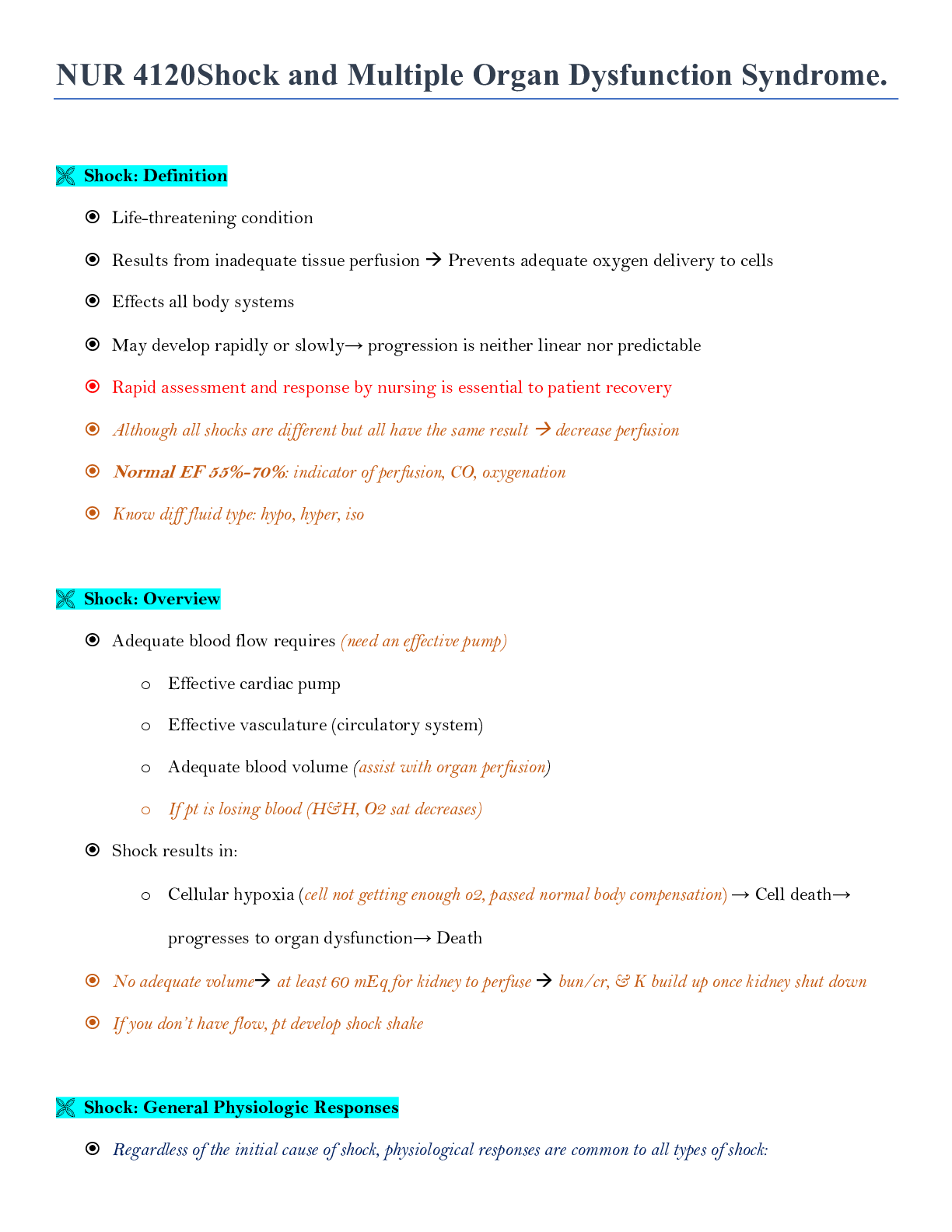
Shock: Definition
Life-threatening condition
Results from inadequate tissue perfusion Prevents adequate oxygen delivery to cells
Shock: Overview
Adequate blood flow requires (need an effective pump)
Shock: General Physiologic Responses
Regardless of the initial cause of shock, physiological responses are common to all types of shock:
Pathophysiology: Cellular Responses
Cellular swelling occurs
Pathophysiology: Cellular Responses
Cellular changes that occur with shock:
BP regulation requires adequate
Pathophysiology: Coagulopathic Responses
Pathophysiology: Inflammatory Responses
1. )
How is BP regulated? MAP= CO x PVR (peripheral vascular resistance)
Blood Pressure Regulation: pressure Receptors
Blood Pressure Regulation: RAA (kidney regulator, slowest system yet safest)
3 Stages of Shock
Compensatory Stage of Shock
SNS causes vasoconstriction, increased HR/increased heart contractility
Inadequate tissue perfusion
Progressive Stage of Shock
Mechanisms that regulate BP can no longer compensate
Progressive Stage of Shock
Irreversible Stage of Shock (Refractory)
At this point, organ damage so severe that patient does not respond to treatment, cannot survive (despite tx, BP remain low, resp system d/f prevent adequate oxygenation & ventilation despite mechanical vent support)
o End-organ perfusion is decreased significantly
o Organ damage is severe
o Progresses to multiple organ dysfunction syndrome (MODS)
Complete organ failure
o Judgment that shock
[Show More]

, All Correct, Download to Score A.png)
 Med Surg test Questions and Answers with Explanations, 100% Correct, Download to Score A.png)
 2021.png)


![Preview of eBook [PDF] Mosby's Textbook for Nursing Assistants 10th Edition By Sheila A. Sorrentino,](https://browseimages.nyc3.digitaloceanspaces.com/paper-images/2024/Sep/06/8JMuZ3LF2024-09-06-04-1066daff404b5f8.png)
 Correct Study Guide, Download to Score A.png)