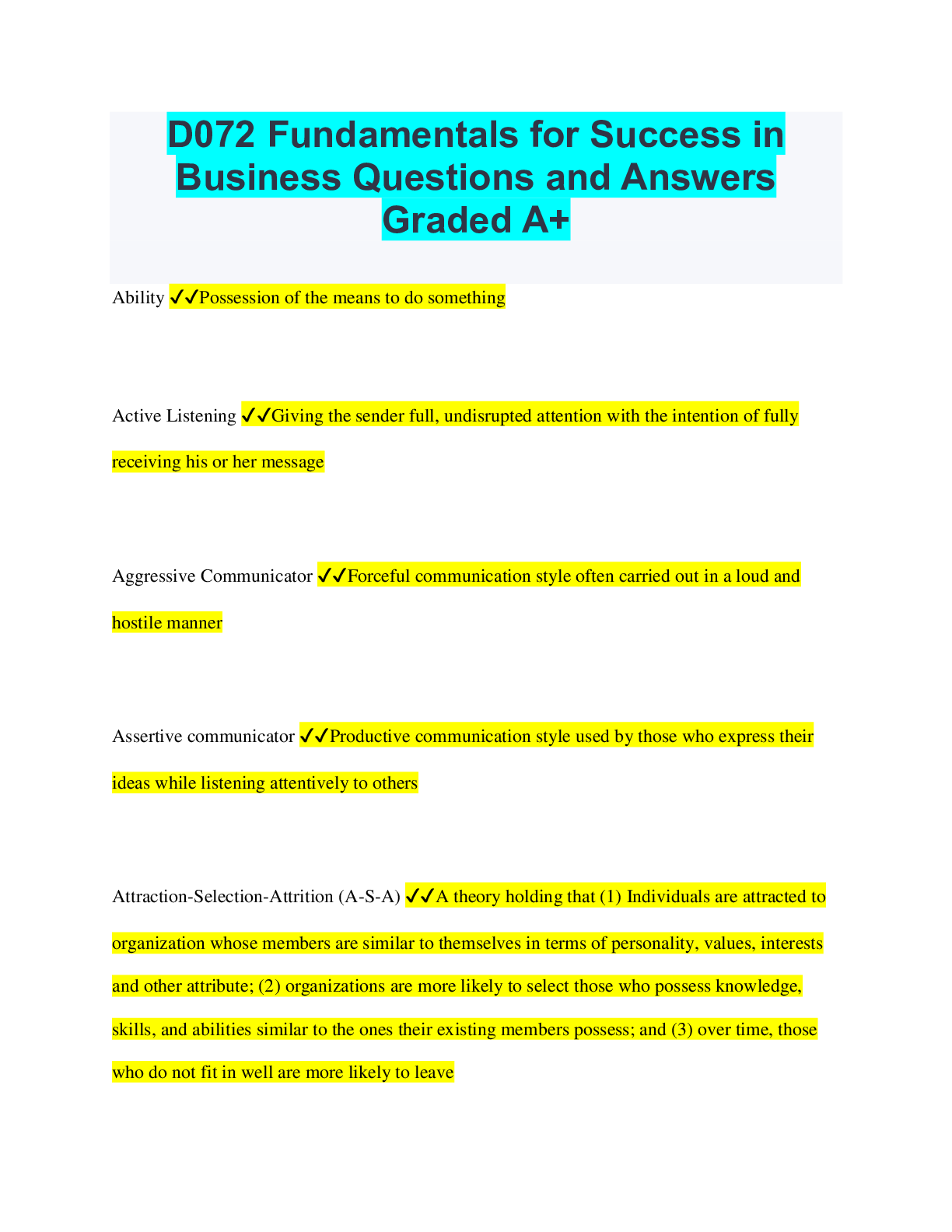
Ability ✔✔Possession of the means or skill to do something
Active listening ✔✔Giving the sender full, undisturbed attention with the intention of fully
receiving his or her message
Aggressive communicaton ✔✔Forceful c
...
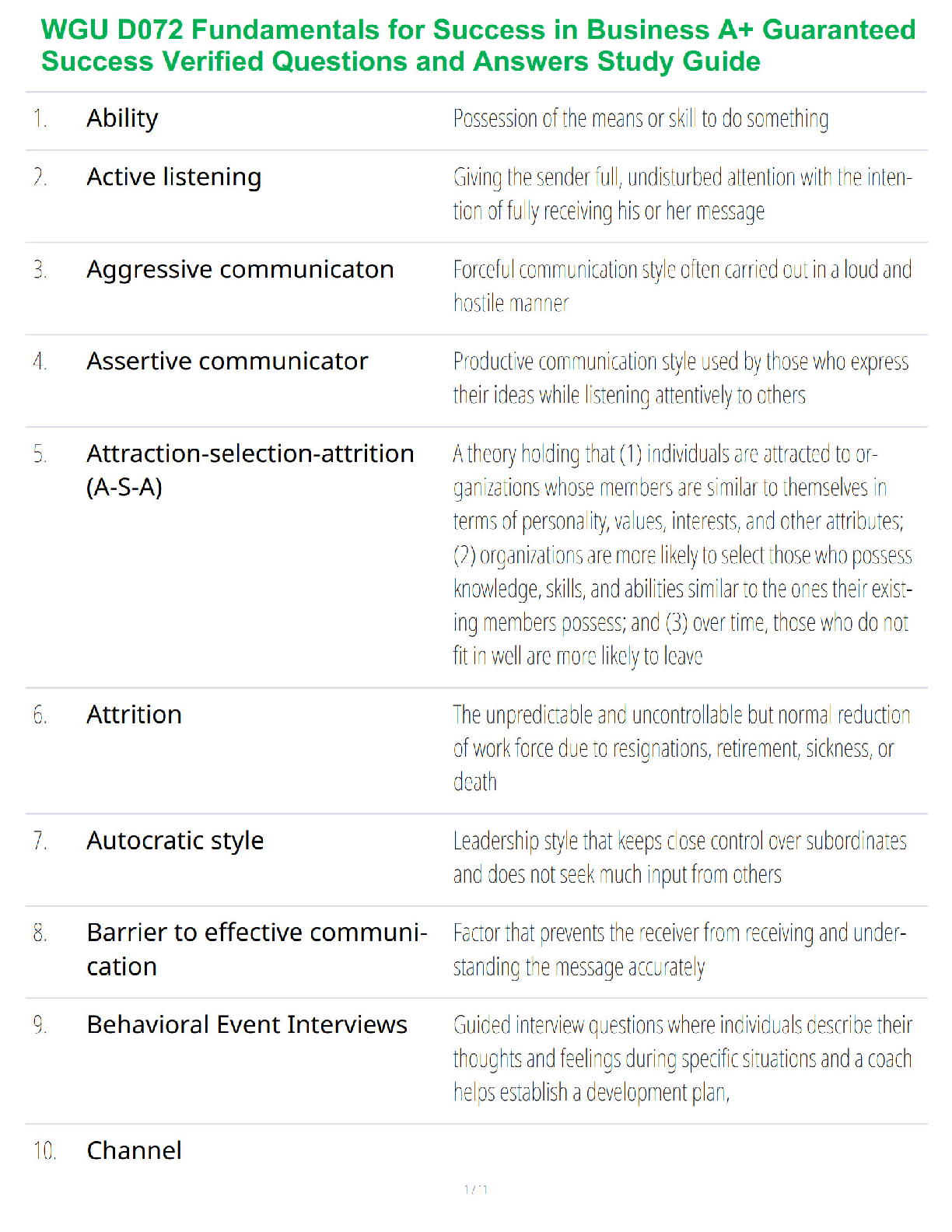
Ability ✔✔Possession of the means or skill to do something
Active listening ✔✔Giving the sender full, undisturbed attention with the intention of fully
receiving his or her message
Aggressive communicaton ✔✔Forceful communication style often carried out in a loud and
hostile manner
Assertive communicator ✔✔Productive communication style used by those who express their
ideas while listening attentively to others
Attraction-selection-attrition (A-S-A) ✔✔A theory holding that (1) individuals are attracted to
organizations whose members are similar to themselves in terms of personality, values, interests,
and other attributes; (2) organizations are more likely to select those who possess knowledge,
skills, and abilities similar to the ones their existing members possess; and (3) over time, those
who do not fit in well are more likely to leaveAttrition ✔✔The unpredictable and uncontrollable but normal reduction of work force due to
resignations, retirement, sickness, or death
Autocratic style ✔✔Leadership style that keeps close control over subordinates and does not
seek much input from others
Barrier to effective communication ✔✔Factor that prevents the receiver from receiving and
understanding the message accurately
Behavioral Event Interviews ✔✔Guided interview questions where individuals describe their
thoughts and feelings during specific situations and a coach helps establish a development plan,
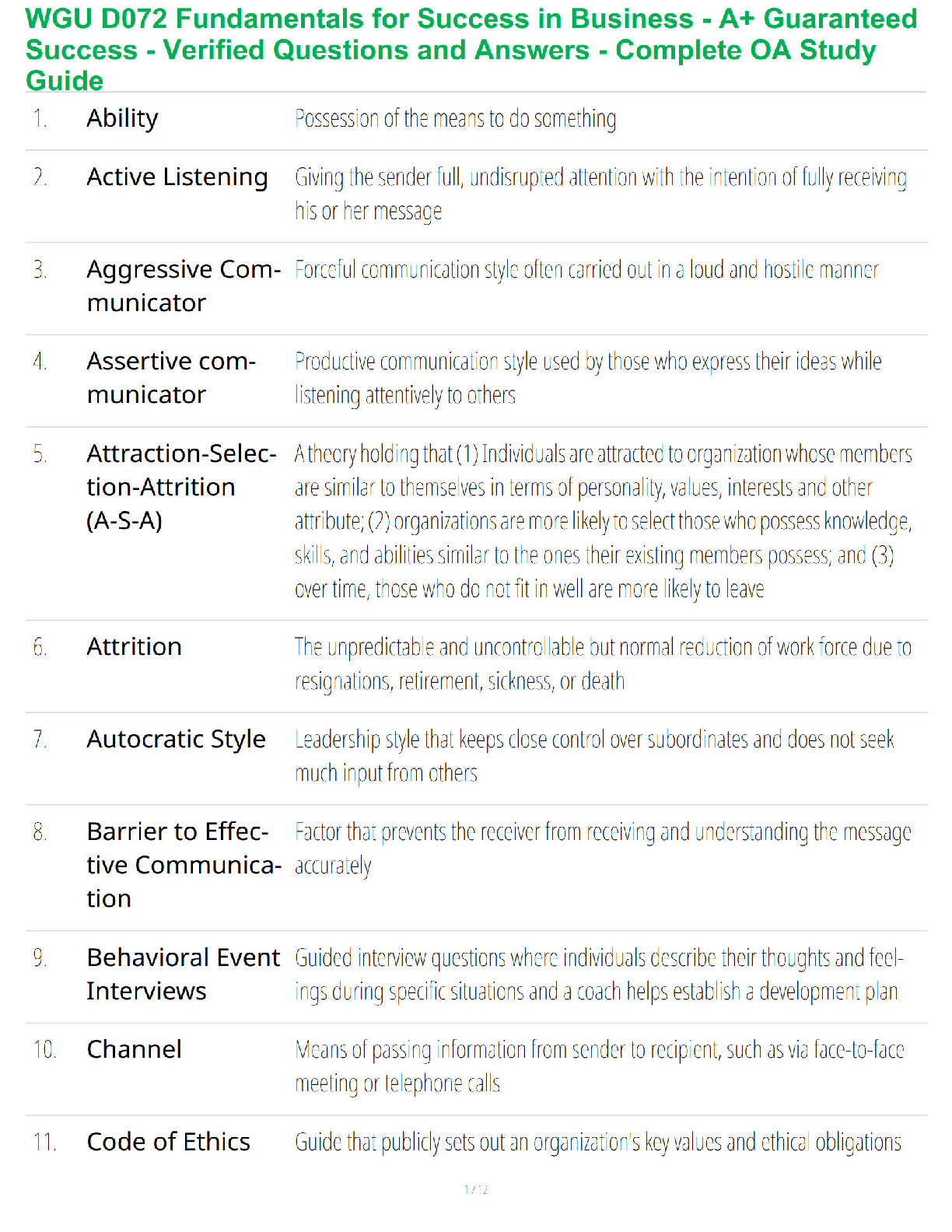
Channel ✔✔Means of passing information from sender to recipient, such as via face-to-face
meeting or telephone call
Code of ethics ✔✔Guide that publicly sets out an organization's key values and ethical
obligations
Coercive power ✔✔Ability to take something away or punish someone for noncomplianceCommunication ✔✔Sharing understanding and meaning via oral, nonverbal, and written forms
Communication style ✔✔Dominant way in which an individual interacts and exchanges
information with others
Consideration ✔✔The relationship-oriented behaviors of a leader
Corporate culture ✔✔The attitudes, values, and standards of behavior that distinguishes one
organization from another
Corporate social responsibility (CSR) ✔✔Philosophy in which a company voluntarily engages in
actions that benefit society, be it economically, socially, politically, or environmentally
Cultural alignment ✔✔Linking of organizational goals with the employees' personal goals
Cultural diversity ✔✔The existence of a variety of cultural or ethnic groups within a workplaceCVF model ✔✔Framework for assessing organizational culture and organizational dynamics
Design thinking ✔✔A method of problem-solving strategy wherein the data collected are
expressed visually in order to create new strategies, ways, and methods to solve problems, create
opportunities or strengthen weaknesses
Effective communication ✔✔When information transmitted is interpreted by the receiver in the
way it was intended by the sender
Emotional intelligence ✔✔The capacity to be aware of, control, and express one's emotions, and
to handle interpersonal relationships judiciously and empathetically
Emotional quotient ✔✔The level of a person's emotional intelligence, often as represented by a
score in a standardized test
Empathy ✔✔Being attuned and sensitive to the emotional states of others
Employee-member-centered behaviors ✔✔Behaviors that focus on supporting employeesEQ ✔✔The level of a person's emotional intelligence, often as represented by a score in a
standardized test
Ethics ✔✔Principles that serve as a guide about how to behave
Expert power ✔✔Power based on knowledge and special skill or experience
Formal leaders ✔✔A person who is officially designated as the leader of a group
Greenwashing ✔✔When organizations carry about CSR missions in an inauthentic way, using
them to increase publicity rather than to spur real change
Idealized influence ✔✔Form of transformational leadership in which a leader models behaviors
and attitude that subordinates choose to emulate
Illegal-ethical ✔✔Dilemma in which the ethical choice would be in violation of established lawsIndividual contributori ✔✔An individual contributor is someone uses their personal skills to
contributes to a team
Individualized consideration ✔✔Form of transformational leadership in which a leader takes the
time to learn about the talents of each individual and puts them to good use
Influence tactics ✔✔The way individuals attempt to influence one another in organizations
Informal leaders ✔✔A person who is not officially appointed as the head of a group
Information power ✔✔Power that stems from when a leader possesses knowledge that others
need or want
Initiating ✔✔The task-related behaviors of a leader
inspirational appeals ✔✔Engage values, emotions, and beliefs to gain support for course of
actionInspirational motivation ✔✔Form of transformational leadership in which a leader inspires a
passionate vision among subordinates or the organization itself
Intellectual stimulation ✔✔Form of transformational leadership in which a leader recognizes the
intellect of subordinates and empowers them to contribute towards the success or vision of the
organization
Intelligence ✔✔The ability to acquire and apply knowledge and skills
intelligence quotient ✔✔A number representing a person's reasoning ability as compared to the
statistical norm or average for their age
Internal transparency ✔✔Degree to which an organization operates with openness,
communication, and accountability
International business culture ✔✔Variations in attitudes, values, goals, and practices shared by
individuals, organizations, or societies based on geographyJob-centered behaviors ✔✔Refers to supervisory functions, such as planning, scheduling,
coordinating work activities, and providing resources
Journaling ✔✔Self-reflective process of recording thoughts and emotions from day to day, in
order to identify patterns
Knowledge ✔✔Facts, information, and skills acquired by a person through experience or
education
Laissez-faire style ✔✔A largely "hands-off" leadership style that provides considerable freedom
to subordinates
Leader ✔✔A person who holds a dominant position within a field and can exercise a high degree
of control or influence over others
Leadership ✔✔The activity of leading a group of people or an organization or the ability to do
thisLeadership style ✔✔Manner and approach of providing direction, implementing plans, and
motivating people
Legal ✔✔An act that is allowed or is in conformity with the law of the land
Legal-ethical ✔✔When the law and personal or organizational ethics are in accordance with each
other
Legal-unethical ✔✔Dilemma in which established laws are not in accordance or do not uphold
the ethical choice
Legitimate power ✔✔Power that comes from one's organizational role or position
Locus of control ✔✔Extent to which an entity believes the current and anticipated
circumstances, and its response to them are within its control
Machiavellian ✔✔Cunning, scheming, and unscrupulousManager ✔✔An individual who oversees a certain group of tasks, or a certain subset of a
company and often has a staff of people who report to them
McKinsey 7-S ✔✔An organizational model developed in the 1980s by Tom Peters and Robert
Waterman (the authors of In Search of Excellence) that analyzes seven key internal aspects of an
organization that need to be aligned if it is too achieve its objectives and improve performance
Mechanistic ✔✔Hierarchical, bureaucratic, organizational structure characterized by (1)
centralization of authority, (2) formalization of procedures and practices, and (3) specialization
of functions
Meditation ✔✔Focusing all of your energy and attention on one specific area of the present
moment
Mindfulness ✔✔Consciousness of the present moment
Morals ✔✔Rules people develop as a result of cultural norms and values and are, traditionally
passed down through generations and characterize a cultural grou
[Show More]