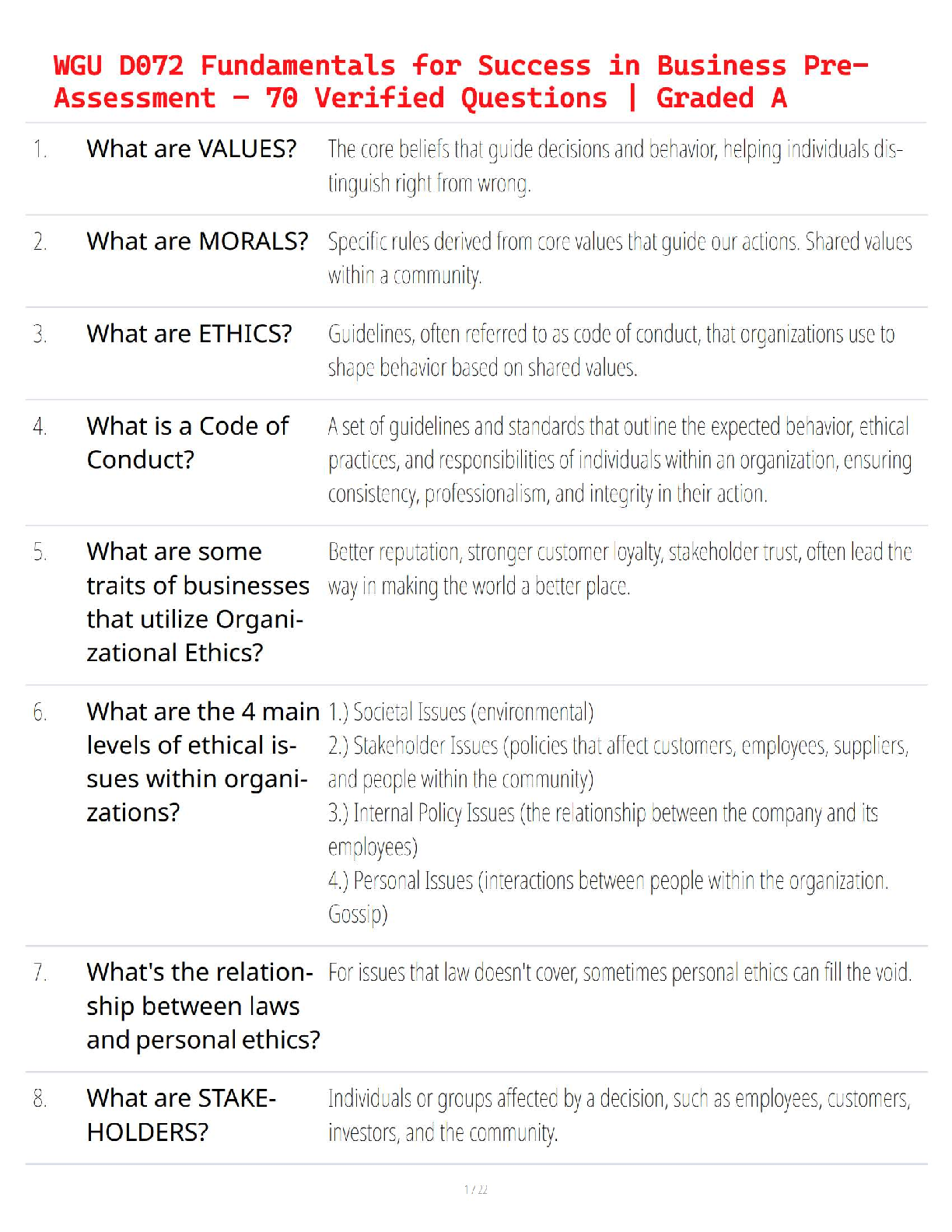
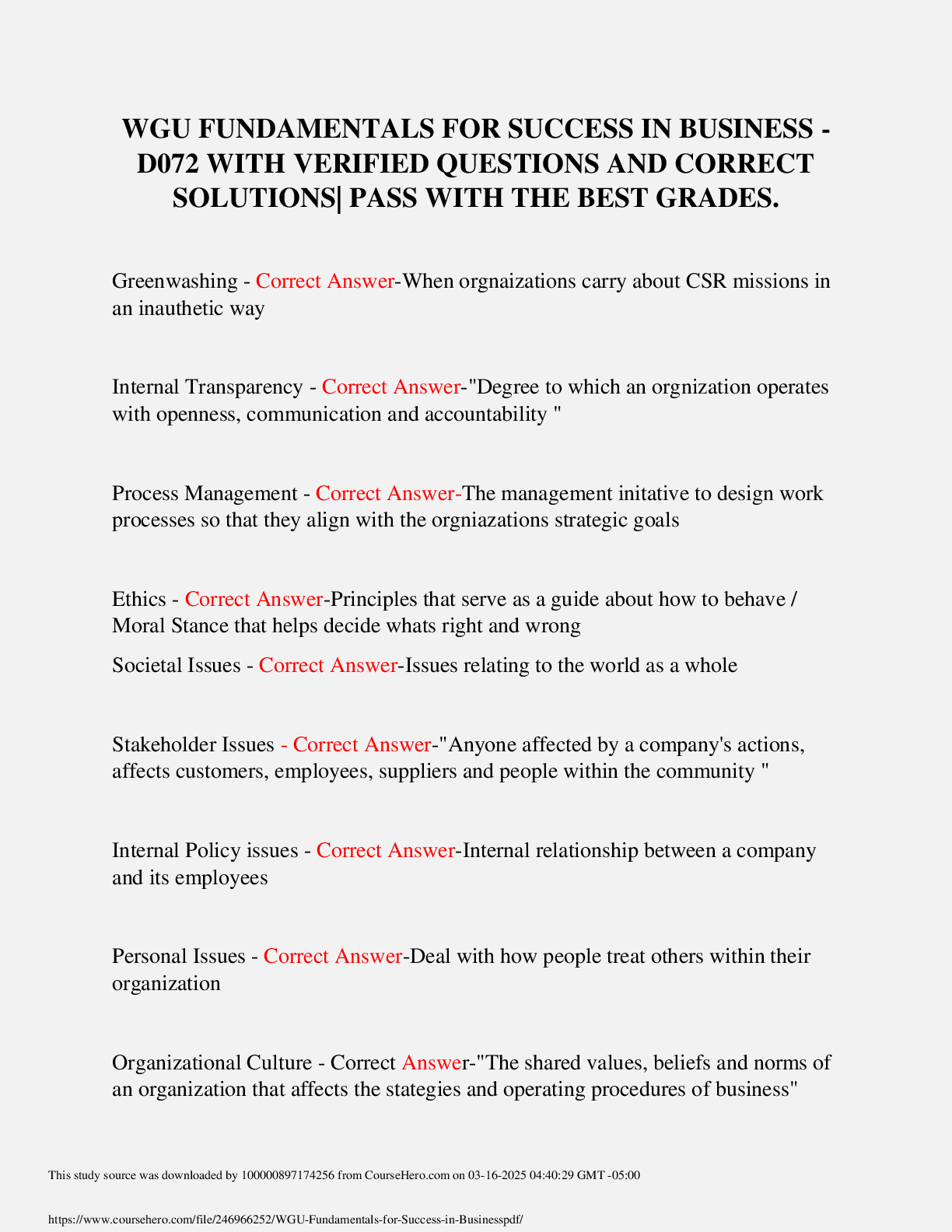
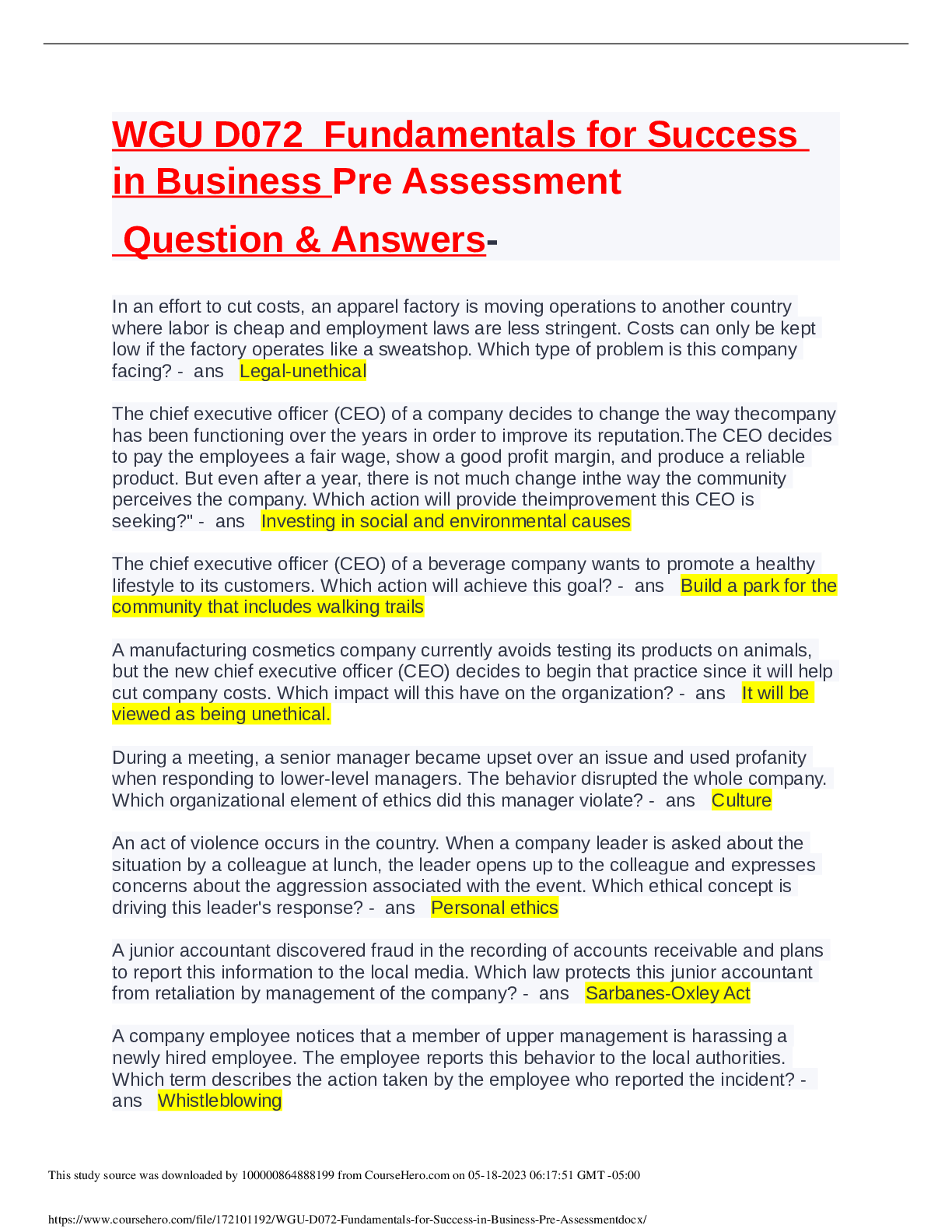
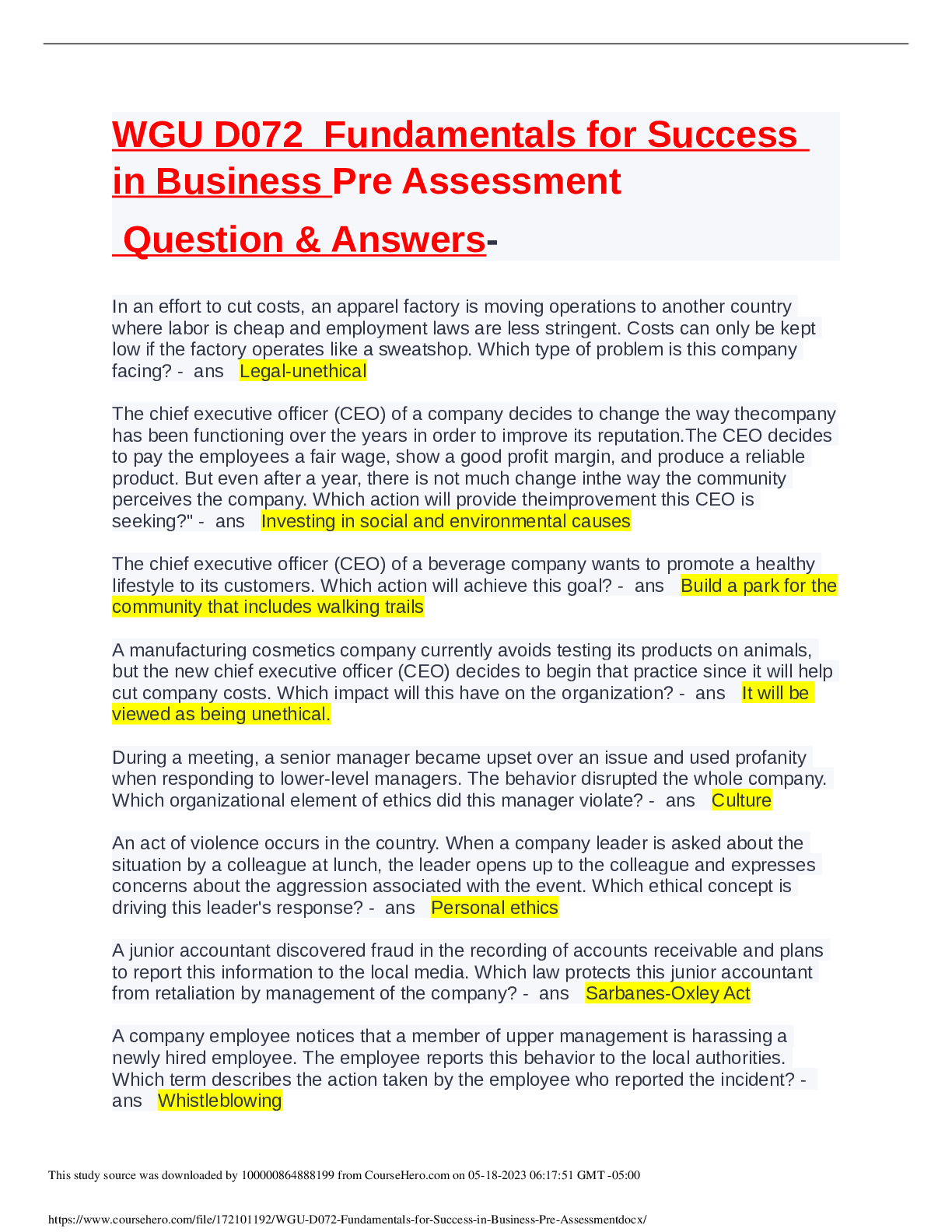
Ethics ✔✔A system of moral principles.
The principles of right and wrong that guide an individual in making decisions
Legal ✔✔Permitted by law.
An act that is permissible or in conformity with the law of the land
Leg
...
Ethics ✔✔A system of moral principles.
The principles of right and wrong that guide an individual in making decisions
Legal ✔✔Permitted by law.
An act that is permissible or in conformity with the law of the land
Legal and Ethical (legal-ethical) ✔✔When the law and personal or organization are in
concordance with each other
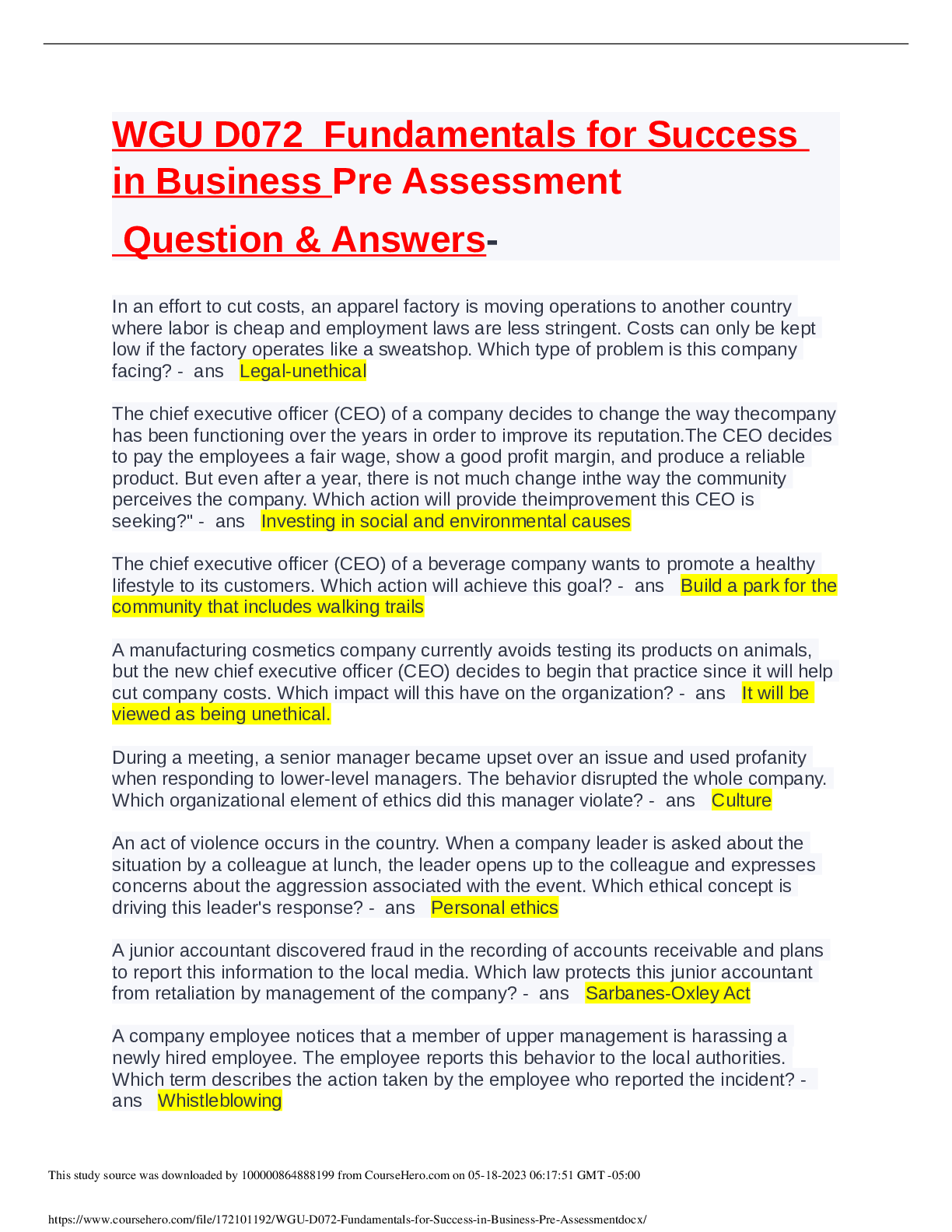
Legal and Unethical (legal-unethical) ✔✔Dilemma in which stablished laws are not in
accordance or do not uphold the ethical choice
Illegal and Ethical (illegal-ethical) ✔✔Dilemma in which ethical choice would be in violation of
stablished lawsScenarios: Legal and Unethical (legal-unethical) ✔✔I: As the outsourcing movement has grown,
so have accompanying reports of sweatshop abuses and health and safety issues. Ignoring
dangerous work conditions is unethical in any sense, regardless of where the workers are located.
II: A judge believes that the use of cannabis should never be allowed regardless of the situation
due to personal principles of what is right and wrong. A law was recently passed, however,
allowing individuals to use cannabis.
Scenarios: Legal and Ethical (legal-ethical) ✔✔An organization plans to close its local factory
and shift manufacturing operations overseas. This brings opposition from employees.
Scenarios: Illegal and Ethical (illegal-ethical) ✔✔Pentagon papers case: U.S government
officials leaked top secret papers to inform the public about government actions during the
Vietnam War.
Personal Ethics ✔✔Codes, principals, and values that shape people's interactions with others
Values ✔✔Stable life goals that people have that reflect what is most important to themMorals ✔✔are sets of rules that individuals develop based on cultural norms and beliefs
Scenarios: Values ✔✔A job candidate asks questions during an interview to determine whether
their personal life goals align with those of the organization.
Organizational ethics ✔✔Rules, principals, and standards for deciding what is morally right or
wrong when doing business
Scenarios: Organizational ethics ✔✔If an organization can create an ethically oriented culture, it
is more likely to hire people who behave the same.
4 main Ethical Issues ✔✔1. Societal issues
2. Stakeholder issues
3. Internal policy issues
4. Personal Issues
Ethical Issues: Societal issues ✔✔Concerns issues relating to the world as a wholeInvolvement happens because of the ethics the organization creates out of care and concern for
individuals.
Ethical Issues: Stakeholder issues ✔✔Concerns policies that affect its customers, employees,
suppliers, and people within the community
Ethical Issues: Internal policy issues ✔✔Concerns internal relationships between a company and
its employees
Examples include fairness in management, pay, and employee participation.
Ethical Issues: Personal issues ✔✔Concerns how people treat others in their organization
Examples include gossiping at work or taking credit for another's work.
Stakeholder issues ✔✔A company insists on treating suppliers with respect and refuses to push
them to the lowest pricing possible. Which level of organizational ethics is being used by this
companyInternal policy issues ✔✔A retail company frequently updates its principles, rules, and
guidelines to reflect input by employees.
Which level of organizational ethics is being illustrated by this company?
How Personal Ethics Affect Organizational Ethics ✔✔Ethics and integrity tend to start (or fail)
at the top and trickle down.
Who is responsible for setting the ethical tone of a corporation? ✔✔Managers
Integrity and ethics starts at the top with organizations' leadership and trickles down to everyone
else.
A company is working hard to establish objectives that promote ethics and standards.
What terms describe how these objectives are defined? ✔✔Specific and measurable
Specific outcomes define a desired outcome, and measurable outcomes define a method for
determining whether an objective has been met. Promoting ethics and standards requires
specifically defining which ethics and standards have been established and should be measurable
based on outcomes.Corporate Social Responsibility (CSR) ✔✔The notion in which a company voluntarily engages
in action that benefits society, be it economically, socially, politically, or environmentally.
Corporate Social Responsibility (CSR) Main Idea ✔✔Their aim is to more directly benefit from
corporate growth as well as surrounding entrepreneurial opportunities.
A company has embraced the philosophy of CSR.
Which practice reflects this commitment?
A) Ensuring that local, state, and federal taxes are paid on time
B) Abiding by state environmental laws
C) Holding a food drive to support local residents in need
D) Providing the workers with free coffee and tea during their shifts ✔✔Correct Answer:
C - CSR refers to voluntary actions taken by a company that benefits the community at large. A
food drive is both voluntary and works to benefit the local community.Steakholders ✔✔Those who have a stake in the performance and output of an organization, such
as employees, unions, investors, suppliers, consumers, local and national government, and
communities.
World Trade Organization (WTO) ✔✔a permanent global institution to promote international
trade and to settle international trade disputes
What is the strategic value of implementing CSR?
A) To maintain global operating guidelines such as those set by the WTO
B) To help recruit, train, and maintain groups of local employees
C) To generate a profit and meet the letter of the law in their business operations
D) To increase profits and trust in the long-term while promoting positive community relations
✔✔Correct Answer:D - CSR is designed to increase long-term profits and shareholder trust while promoting positive
community relations and maintaining high ethical standards.
A company develops a program to help guide employees in decision-making and defines
expectations for accepting gift from clients.
A) Whistleblower and protection
B) Social responsibility
C) Internal transparency
D) Compliance and ethics ✔✔Correct Answer:
D - Many organizations implement compliance and ethics programs to help guide decisionmaking and employee behavior.
CSR Key Concepts: ✔✔CSR refers to a philosophy in which a company voluntarily engages in
actions that benefit society economically, socially, politically, or environmentally.
Organizations are increasingly launching CSR initiatives in which companies do more than
produce a reliable product, charge a fair price with a fair profit margin, and pay a fair wage to
employees. These organizations also care for the environment and act on other social concerns.CSR initiatives are based on the underlying utilitarian notion of mutual benefit—the idea that an
organization should give back to the customers and communities in which it does business.
Today many U.S. citizens expect organizations to conduct themselves in an ethical and socially
responsible manner. However, CSR has many strategic benefits for the corporation as well and
can lead to an improved bottom line.
Institutions like the WTO function as international instruments to support ethical trade on a
global scale.
Code of Ethics ✔✔begins by establishing the organization's key values and describes the
company's obligation to its stakeholders
Greenwashing ✔✔When organizations carry about CSR missions in an inauthentic way, using
them to increase publicity rather than to spur real change.
Therefore, ethical commitments and statements run contrary to actual practices.Confined animal feeding operations CAFOs ✔✔CAFOs have been condemned by animal rights
activists as harmful to the well-being of the animals
Internal transparency ✔✔Degree in which an organization operates with openness,
communication, and accountability.
Sarbanes-Oxley Act (SOX) ✔✔Regulations passed by Congress to reduce unethical corporate
behavior.
whistleblowers ✔✔insiders who report illegal or unethical behavior
A large manufacturer of ice cream products has a core value of "making the world a better
place." However, it was discovered that the manufacturer sourced their main raw ingredient from
a company that used practices considered detrimental to the well-being of animals.
A) Whistleblowing
B) Greenwashing
C) Kickbacking
D) Publicizing ✔✔Correct Answer:B - Greenwashing is when a company's ethical commitments and statements run contrary to their
actual practices. Sourcing ingredients from suppliers who have practices detrimental to the wellbeing of animals is clearly contrary to the manufacturer's commitment to "making the world a
better place."
The top management of a publicly traded company has been cited for violation of the
transparency standards with respect to their financial and accounting reporting practices.
A)Generally Accepted Accounting Principles Act (GAAP)
B)Corporate Social Responsibility Act (CSR)
C)Sarbanes-Oxley Act (SOX)
D)Governmental Accounting Standards Act (GAS) ✔✔Correct Answer:
C - SOX mandates publicly traded companies to follow reporting transparency in financial and
accounting reporting. The law also makes the top management of the company personally
responsible for errors in financial reporting.
A group of employees discovered alleged misconduct by senior managers of their company and
leaked information about the situation to the press and general public.
A) Compliance boardB) Public auditors
C) Whistleblowers
D) Greenwashers ✔✔Correct Answer:
C - A whistleblower is someone like an employee or group of employees who informs the public
about alleged misconduct occurring in an organization.
The top management of a company implemented a policy in which all employees can attend the
board meetings so they can be present when important decisions are made.
A) Greenwashing
B) Social responsibility
C) Internal auditing
D) Internal transparency ✔✔Correct Answer:
D- Internal transparency is the ability of all individuals in an organization to operate in an
environment of openness, communication, and accountability.
During the workday, an employee's tasks include processing incoming payments, creating
invoices, and making timely payments. ✔✔Accounting and financeDuring the workday, an employee's tasks include recruiting, onboarding new employees, and
administering training and development. ✔✔HR
Which department in an organization is responsible for customer research, branding, and
advertising? ✔✔Marketing
Process Management ✔✔The management initiate to design work processes so that they align
with the organization's strategic goals
Relationship management ✔✔involves strategies that govern how an organization maintains
relationships with an audience.
A company is looking to optimize their procure-to-pay system by implementing robotics to
automate this match, which is currently handled manually.
Which type of management is this company pursuing?
A) Process
B) Investment
C) RelationshipD) Information ✔✔Correct Answer
A- Process
process management refers to an organization's desire to design processes that will optimize and
improve business performance. This task can be completed through automation and use of
technology such as robotics.
Leadership versus Management ✔✔Leader: Visionary, passionate, creative, inspiring,
innovative, imaginative, warm, acts like a coach/teacher, focuses on uplifting ideas. Does the
right things.
Manager: Rational, persistent, analytical, deliberative, authoritative, acts like a boss, focuses on
plumbing. Does things right.
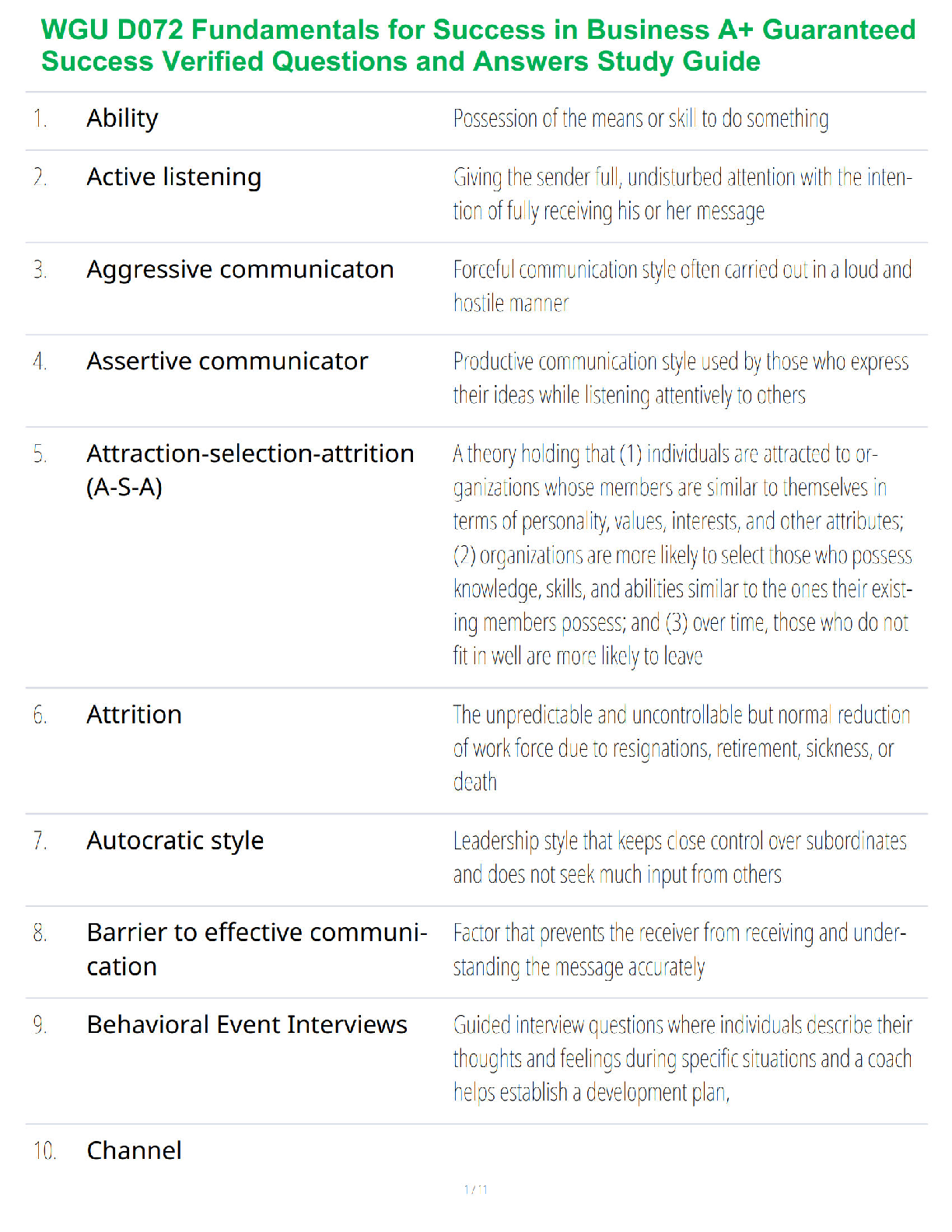
individual contributor ✔✔Someone who uses their personal skills to contribute to a team
Manager ✔✔An individual who oversees a certain group of tasks or a certain subset of a
company and often has a staff of people who report to themLevels of Management ✔✔top, middle, first line
Top Management ✔✔President, CEO, Executive Vice Presidents
Middle Management ✔✔Plant Managers, Division Managers, Department Managers
Frist-Line Management ✔✔Foreman, Supervisors, Office Managers
Non-managerial employees ✔✔people who work directly on a job or task and have no
responsibility for overseeing the work of others
Mintzberg(1990) Manager core roles: ✔✔interpersonal, informational, and decisional.
Interpersonal ✔✔Managers focused on relationship building - Internally and externally.
They act like role models and source of inspiration.
Evaluate performance, productivity, providing constructive feedback.A manager trains, mentor, and motivates employees to a higher level of productivity.
Informational ✔✔Managers spend much of their time gathering, analyzing, and disseminating
information to those both above and below them
Decisional ✔✔Managers are responsible for making decisions, allocating resources, and
negotiating.
Management Skills ✔✔Technical, Communication, Analysis
Which type of skill do managers exemplify when they have the ability to understand daily
problems, provide solutions, and understand the skills required for their department to operate?
A) Interpersonal
B) Communication
C) Analysis
D) Technical ✔✔Correct Answer:D- Technical skills refer to managers' ability to understand skills and processes that relate to their
department. With technical skills, they can identify when there are issues and are able to provide
solutions to problems.
Which core managerial role involves gathering and organizing data to distribute to various
people in the company?
A) Decisional
B) Interpersonal
C) Informational
D) Intrapersonal ✔✔Correct Answer:
C- Informational: A manager who has an informational role spends time collecting, gathering,
and analyzing data in order to disseminate the information across the organization. This manager
is responsible for gathering and organizing data to distribute to various people in the company.
Which type of skill includes a manager's ability to navigate conflict as it arises and understand
the motivation factors that the employees express?
A) Intrapersonal
B) Communication
C) AnalysisD) Technical ✔✔B- Communication skills are described as managers' ability to navigate conflict
as it arises, listen, and understand their employees. With communication skills, they are able to
help the team dynamic by identifying the motivation factors for the group.
Leadership ✔✔Refers to the act of influencing others to work toward a goal.
The ability to motivate individuals and groups to accomplish important goals
Managers vs. Leaders ✔✔Managers work to create circles of power
X
Leaders work to create circles of influence
Managers are not always good leaders
X
Good leaders are not necessarily in management
Formal leaders ✔✔come from a position of authority built into the organization's structureInformal leaders ✔✔They do not have a recognized position of authority, but influence people.
Leaders can influence others even if they do not have a formal role. ✔✔Leaders influence others
while trying to accomplish a goal. Leaders do not always have to be in a formal position of
power.
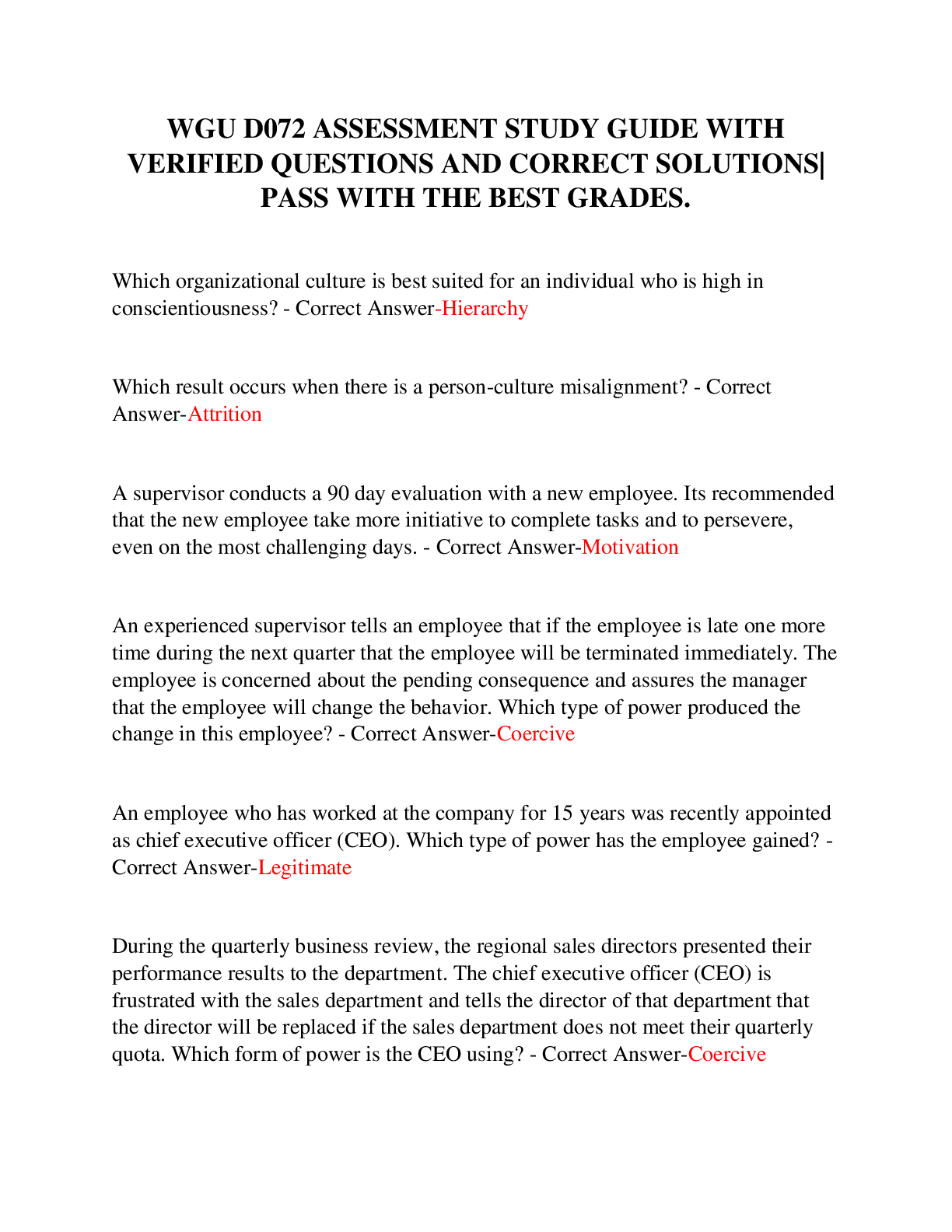
organizational culture ✔✔The sets of values beliefs, and norms of an organization that affects
the strategies and operating procedures of the business
It is considered one of the most important measures of the effectiveness of an organization
Competing Values Framework Model (CVF) ✔✔Framework for assessing organizational culture
and organizational dynamics
Competing Values Framework Model, the CVF is composed of four concepts ✔✔Clan,
Adhocracy, Hierarchy, and Market.
Cultural Diversity ✔✔the existence of a variety of cultural or ethnic groups within a workplace.Clan: ✔✔It tends to be more family oriented and flexible and less structured and has a more
extensive hierarchy (e.g., small start-up business).
Hierarchy: ✔✔It tends to be internally focused on internal processes and procedures and less
flexible (e.g., government agencies).
Market: ✔✔It tends to be externally focused on competition and profits and less flexible (e.g.,
security companies).
Adhocracy: ✔✔It tends to be more flexible and responsive to external forces and is characterized
as a dynamic, entrepreneurial, and creative workplace (e.g., technology businesses).
CVF - Internal focus ✔✔Clan and Hierarchy
CVF - External focus ✔✔Market and Adhocracy
CVF - Flexibility ✔✔Clan and Adhocracy
[Show More]