CE 335 Compression Members Notes
1 Introduction
The design of compression members is covered in Chapter E (Sections E1 to E3), Chapter C, and
Chapter B (Section B4) of the AISC Specifications and Commentary. Part 4 of
...
CE 335 Compression Members Notes
1 Introduction
The design of compression members is covered in Chapter E (Sections E1 to E3), Chapter C, and
Chapter B (Section B4) of the AISC Specifications and Commentary. Part 4 of the AISC Manual
provides column design aids.
Compression members, for the purposed of this class, are defined as structural elements that
are subjected only to axial compressive forces (except due to minor eccentricities in the load or
column imperfections). Compression members are often referred to as columns. Some examples of
compression members include: top chord of a truss, diagonal braces and columns in braced frames.
An example of a member that is in compression but would not be a \compression member" per our
definition is a column with an applied lateral load (e.g. a column loaded with gravity and wind). A
member subjected to compression and bending is referred to as a \beam-column." Beam-columns
are discussed in AISC Chapter H.
Design of compression members has similarities to tension member design. Particularly, designs
are based on average axial stresses assumed over the cross-section. Unlike tension members though,
compression members are subject to buckling (discussed in more detail in later sections), which
can lead to large out-of-plane deformations. If out-of-plane deformations become large, the load
is no longer truly axial as moments develop in the bending member. This phenomenon is often
referred to as a P-delta (P-δ) effect (‘P’ signifies compressive load, ‘δ’ signifies the out-of-plane
deformation). Also unlike tension member design, net section fracture is generally not considered
in compression member design as fracture is a product of large tensile loading.
Compression members can either buckle globally or locally. Global buckling, in which the
member bends (i.e. is subjected to flexure) due to the compressive loads, is often referred to
flexural, or Euler, buckling. For local buckling parts of the member buckle locally. Both of these
buckling limit states and associated design criteria will be discussed in the sections below.
2 Euler column buckling theory
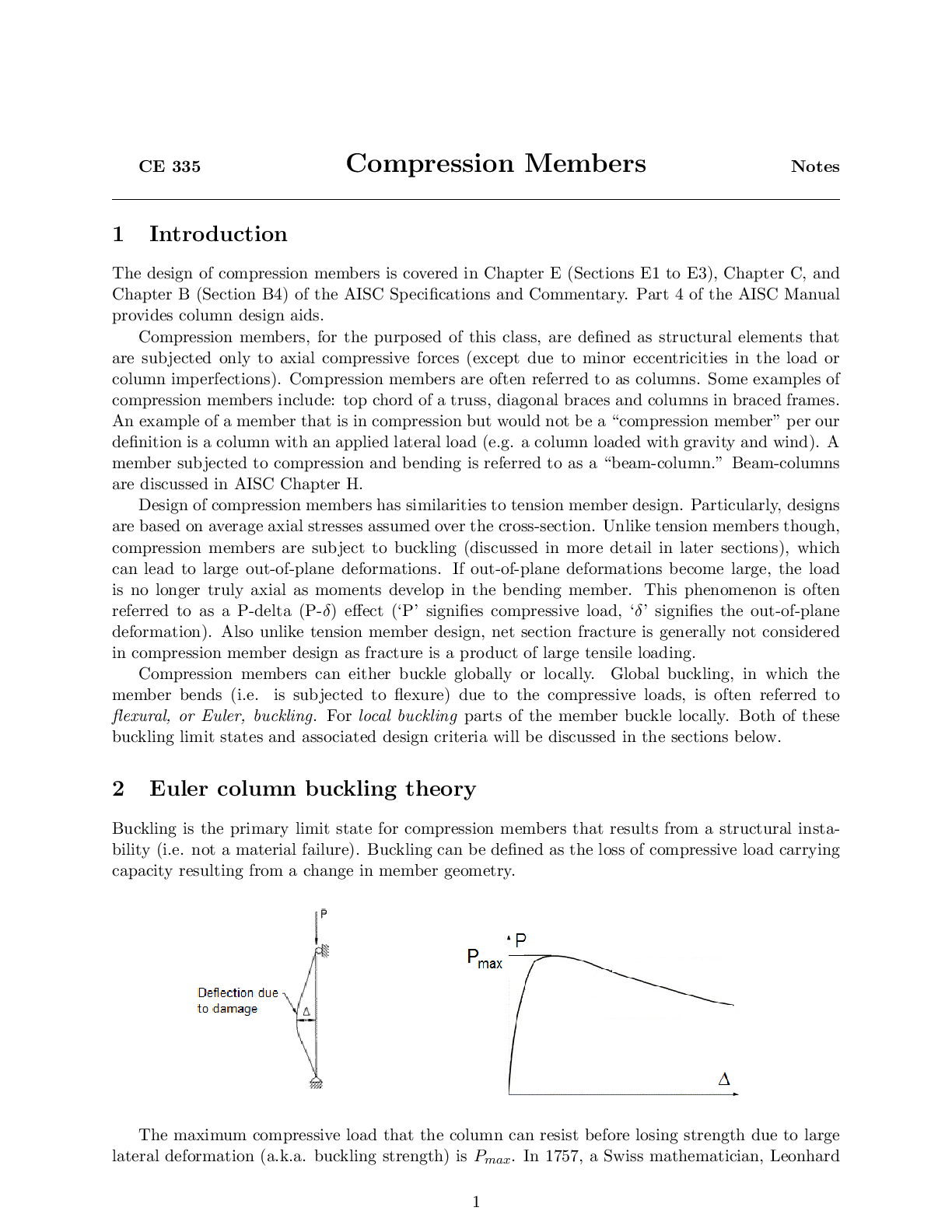
Buckling is the primary limit state for compression members that results from a structural instability (i.e. not a material failure). Buckling can be defined as the loss of compressive load carrying
capacity resulting from a change in member geometry.
The maximum compressive load that the column can resist before losing strength due to large
lateral deformation (a.k.a. buckling strength) is Pmax. In 1757, a Swiss mathematician, Leonhar
[Show More]









.png)





.png)
.png)
.png)

