This PDF contains a set of carefully selected practice questions for the
L4M3 exam. These questions are designed to reflect the structure,
difficulty, and topics covered in the actual exam, helping you reinforce
your
...
This PDF contains a set of carefully selected practice questions for the
L4M3 exam. These questions are designed to reflect the structure,
difficulty, and topics covered in the actual exam, helping you reinforce
your understanding and identify areas for improvement.
What's Inside:
1. Topic-focused questions based on the latest exam objectives
2. Accurate answer keys to support self-review
3. Designed to simulate the real test environment
4. Ideal for final review or daily practice
Important Note:
This material is for personal study purposes only. Please do not
redistribute or use for commercial purposes without permission.
For full access to the complete question bank and topic-wise explanations, visit:
CertQuestionsBank.com
Our YouTube: https://www.youtube.com/@CertQuestionsBank
FB page: https://www.facebook.com/certquestionsbank
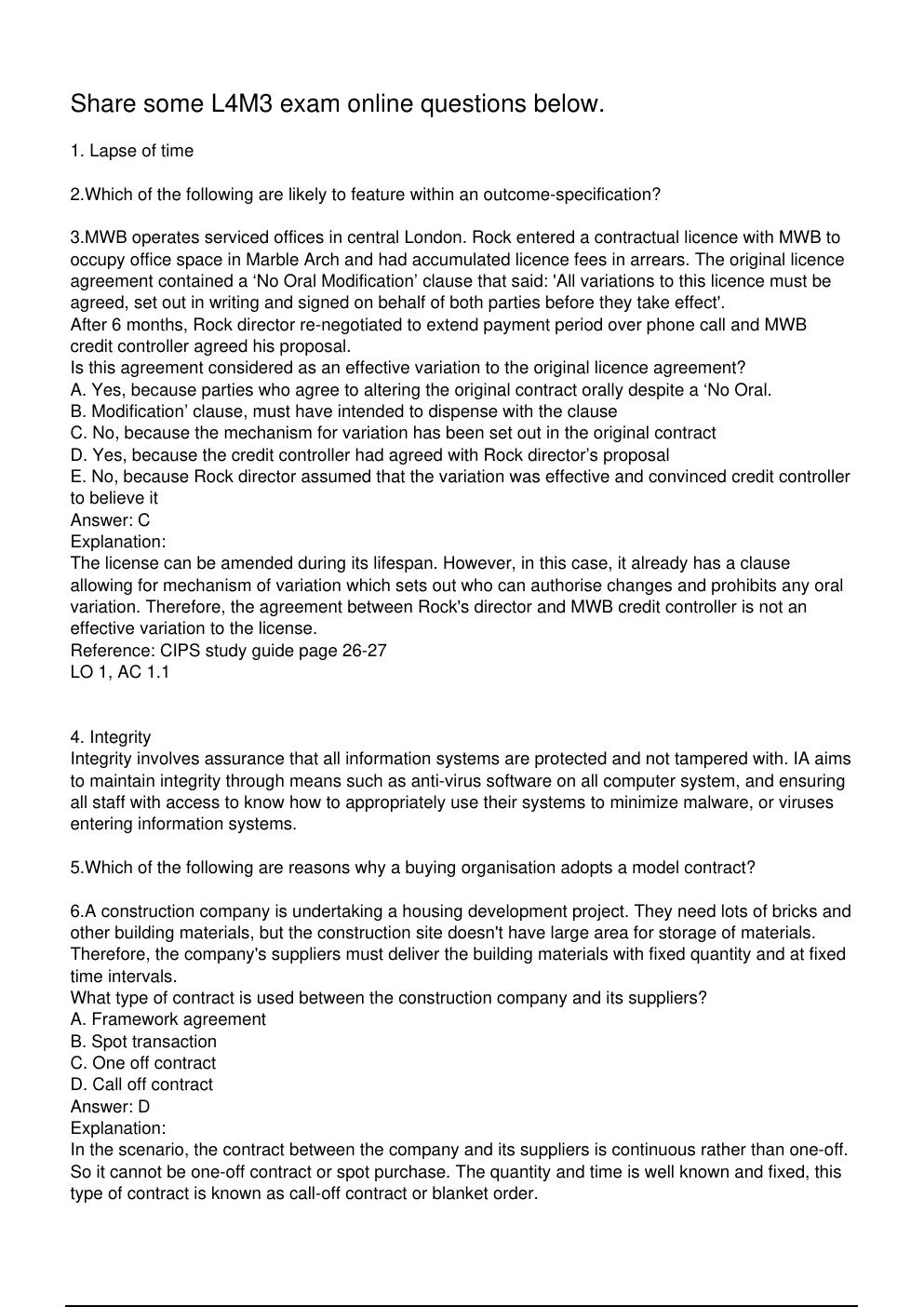
Share some L4M3 exam online questions below.
1. Lapse of time
2.Which of the following are likely to feature within an outcome-specification?
3.MWB operates serviced offices in central London. Rock entered a contractual licence with MWB to
occupy office space in Marble Arch and had accumulated licence fees in arrears. The original licence
agreement contained a ‘No Oral Modification’ clause that said: 'All variations to this licence must be
agreed, set out in writing and signed on behalf of both parties before they take effect'.
After 6 months, Rock director re-negotiated to extend payment period over phone call and MWB
credit controller agreed his proposal.
Is this agreement considered as an effective variation to the original licence agreement?
A. Yes, because parties who agree to altering the original contract orally despite a ‘No Oral.
B. Modification’ clause, must have intended to dispense with the clause
C. No, because the mechanism for variation has been set out in the original contract
D. Yes, because the credit controller had agreed with Rock director’s proposal
E. No, because Rock director assumed that the variation was effective and convinced credit controller
to believe it
Answer: C
Explanation:
The license can be amended during its lifespan. However, in this case, it already has a clause
allowing for mechanism of variation which sets out who can authorise changes and prohibits any oral
variation. Therefore, the agreement between Rock's director and MWB credit controller is not an
effective variation to the license.
Reference: CIPS study guide page 26-27
LO 1, AC 1.1
4. Integrity
Integrity involves assurance that all information systems are protected and not tampered with. IA aims
to maintain integrity through means such as anti-virus software on all computer system, and ensuring
all staff with access to know how to appropriately use their systems to minimize malware, or viruses
entering information systems.
5.Which of the following are reasons why a buying organisation adopts a model contract?
6.A construction company is undertaking a housing development project. They need lots of bricks and
other building materials, but the construction site doesn't have large area for storage of materials.
Therefore, the company's suppliers must deliver the building materials with fixed quantity and at fixed
time intervals.
What type of contract is used between the construction company and its suppliers?
A. Framework agreement
B. Spot transaction
C. One off contract
D. Call off contract
Answer: D
Explanation:
In the scenario, the contract between the company and its suppliers is continuous rather than one-off.
So it cannot be one-off contract or spot purchase. The quantity and time is well known and fixed, this
type of contract is known as call-off contract or blanket order.
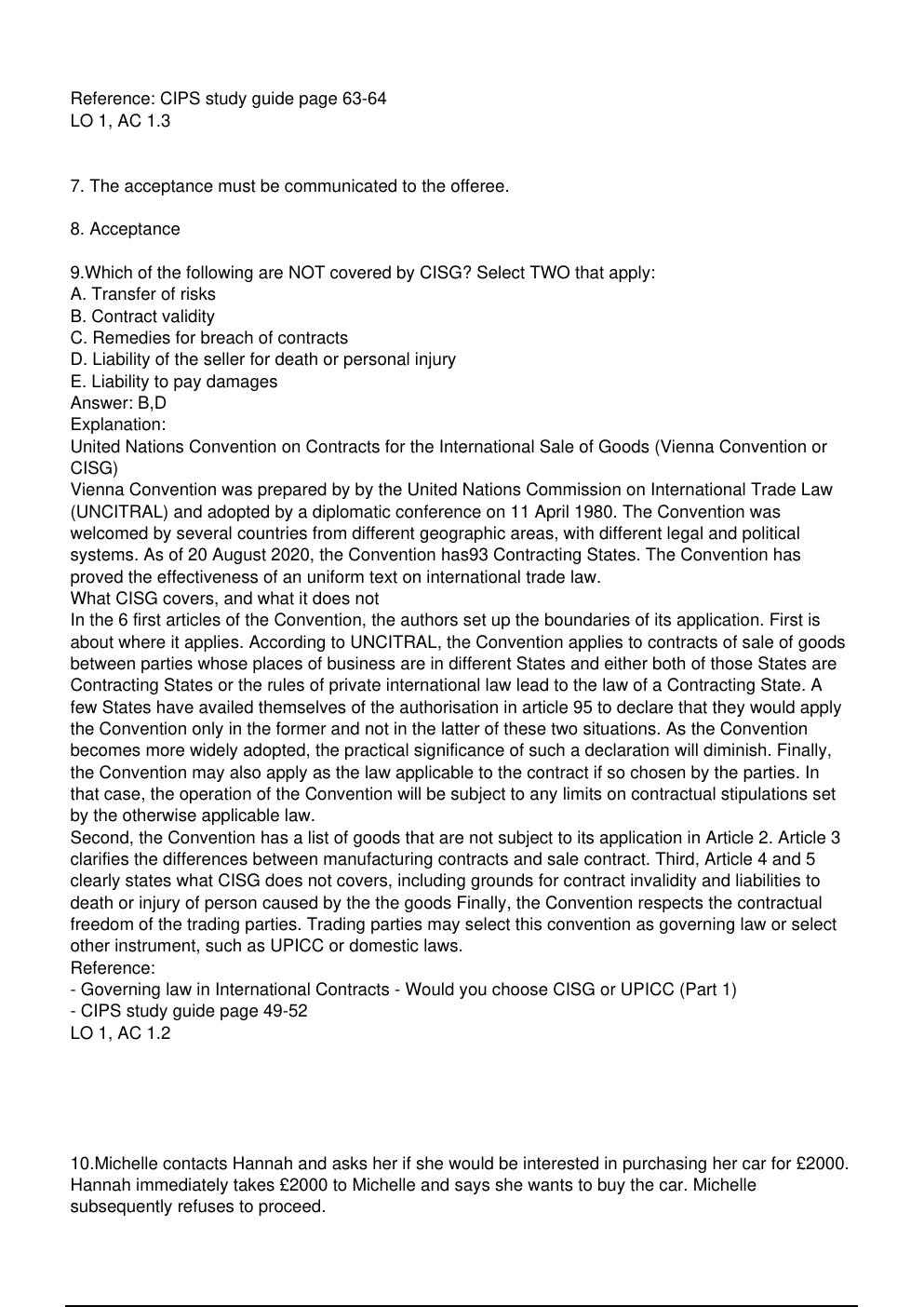
Reference: CIPS study guide page 63-64
LO 1, AC 1.3
7. The acceptance must be communicated to the offeree.
8. Acceptance
9.Which of the following are NOT covered by CISG? Select TWO that apply:
A. Transfer of risks
B. Contract validity
C. Remedies for breach of contracts
D. Liability of the seller for death or personal injury
E. Liability to pay damages
Answer: B,D
Explanation:
United Nations Convention on Contracts for the International Sale of Goods (Vienna Convention or
CISG)
Vienna Convention was prepared by by the United Nations Commission on International Trade Law
(UNCITRAL) and adopted by a diplomatic conference on 11 April 1980. The Convention was
welcomed by several countries from different geographic areas, with different legal and political
systems. As of 20 August 2020, the Convention has93 Contracting States. The Convention has
proved the effectiveness of an uniform text on international trade law.
What CISG covers, and what it does not
In the 6 first articles of the Convention, the authors set up the boundaries of its application. First is
about where it applies. According to UNCITRAL, the Convention applies to contracts of sale of goods
between parties whose places of business are in different States and either both of those States are
Contracting States or the rules of private international law lead to the law of a Contracting State. A
few States have availed themselves of the authorisation in article 95 to declare that they would apply
the Convention only in the former and not in the latter of these two situations. As the Convention
becomes more widely adopted, the practical significance of such a declaration will diminish. Finally,
the Convention may also apply as the law applicable to the contract if so chosen by the parties. In
that case, the operation of the Convention will be subject to any limits on contractual stipulations set
by the otherwise applicable law.
Second, the Convention has a list of goods that are not subject to its application in Article 2. Article 3
clarifies the differences between manufacturing contracts and sale contract. Third, Article 4 and 5
clearly states what CISG does not covers, including grounds for contract invalidity and liabilities to
death or injury of person caused by the the goods Finally, the Convention respects the contractual
freedom of the trading parties. Trading parties may select this convention as governing law or select
other instrument, such as UPICC or domestic laws.
Reference:
- Governing law in International Contracts - Would you choose CISG or UPICC (Part 1)
- CIPS study guide page 49-52
LO 1, AC 1.2
10.Michelle contacts Hannah and asks her if she would be interested in purchasing her car for £2000.
Hannah immediately takes £2000 to Michelle and says she wants to buy the car. Michelle
subsequently refuses to proceed.
Has the contract between Michelle and Hannah been made?
A. No, because Michelle has rejected Hannah's offer on buying the car
B. Yes, because both parties have full legal capability to enter into a contract
C. Yes, by her performance Hannah has accepted Michelle's offer on selling the car
D. No, because by refusing to proceed, Michelle rejects Hannah's counter-offer
[Show More]





![Preview of [PDF] [eBook] Procurement Principles and Management in the Digital Age, 12th Edition, By P](https://scholarfriends.com/storage/eBook for Procurement Principles and Management in the Digital Age, 12th Edition, By Peter Baily, David Farmer, Barry Crocker, David Jessop.png)