ACD101
Exam Practice Questions
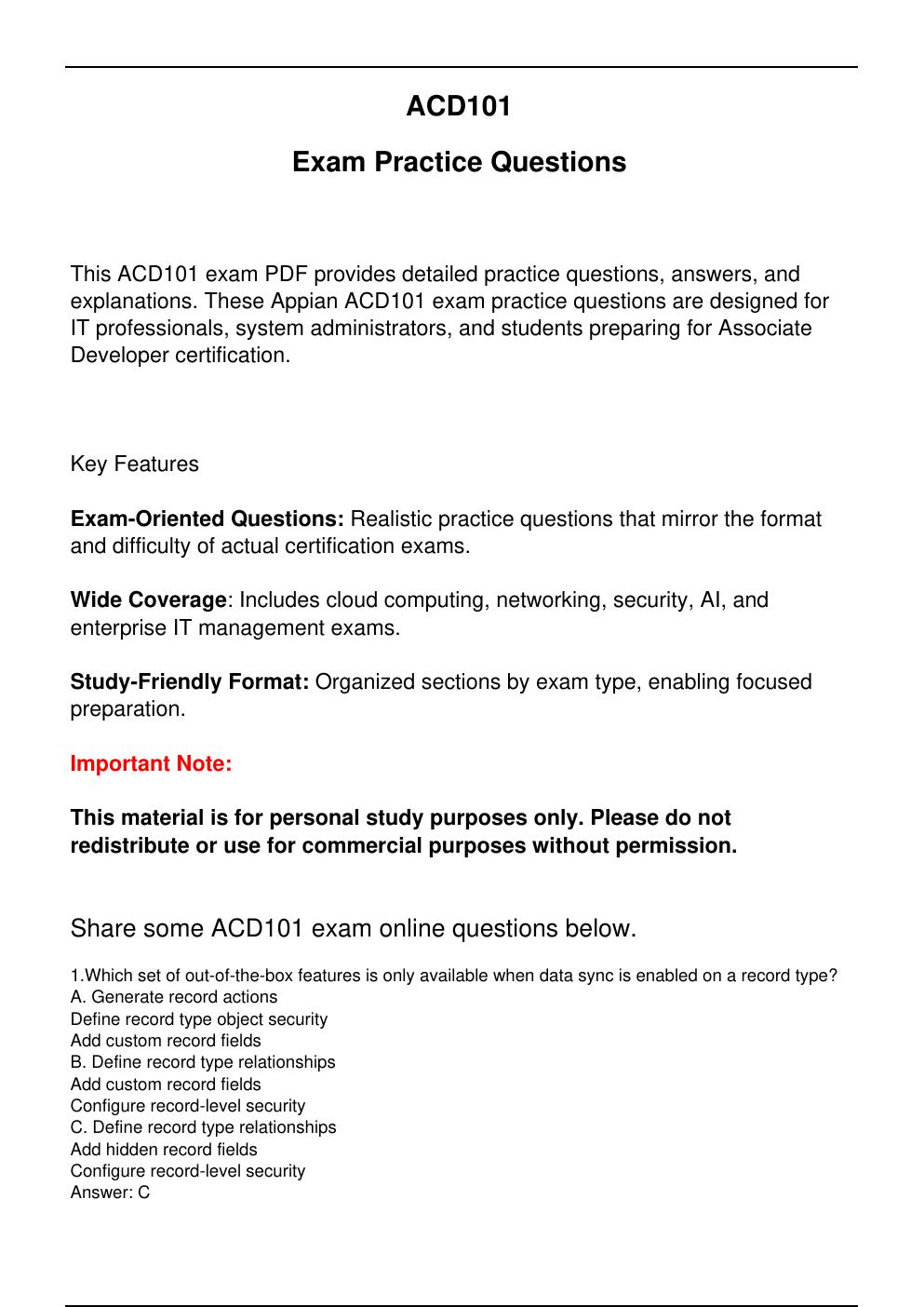
This ACD101 exam PDF provides detailed practice questions, answers, and
explanations. These Appian ACD101 exam practice questions are designed for
IT professionals, system administrator
...
ACD101
Exam Practice Questions
This ACD101 exam PDF provides detailed practice questions, answers, and
explanations. These Appian ACD101 exam practice questions are designed for
IT professionals, system administrators, and students preparing for Associate
Developer certification.
Key Features
Exam-Oriented Questions: Realistic practice questions that mirror the format
and difficulty of actual certification exams.
Wide Coverage: Includes cloud computing, networking, security, AI, and
enterprise IT management exams.
Study-Friendly Format: Organized sections by exam type, enabling focused
preparation.
Important Note:
This material is for personal study purposes only. Please do not
redistribute or use for commercial purposes without permission.
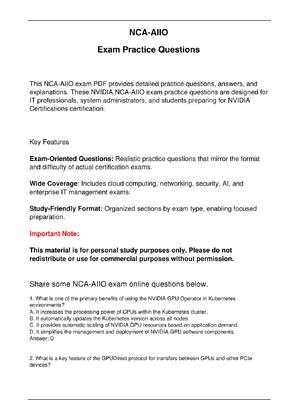
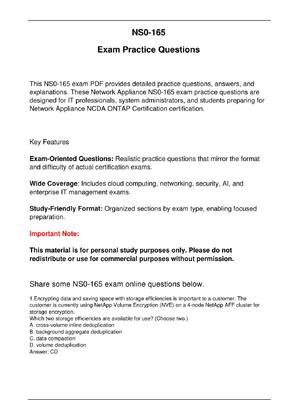
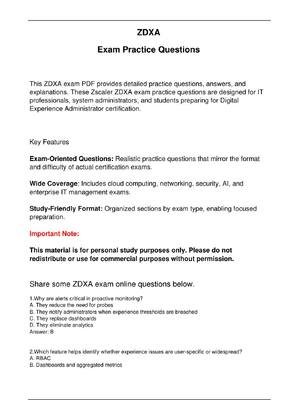
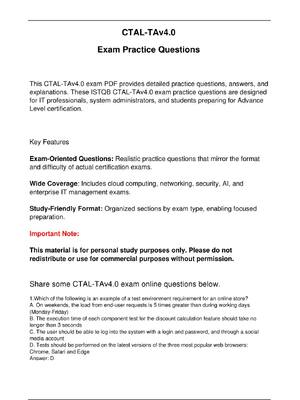
Share some ACD101 exam online questions below.
1.Which set of out-of-the-box features is only available when data sync is enabled on a record type?
A. Generate record actions
Define record type object security
Add custom record fields
B. Define record type relationships
Add custom record fields
Configure record-level security
C. Define record type relationships
Add hidden record fields
Configure record-level security
Answer: C
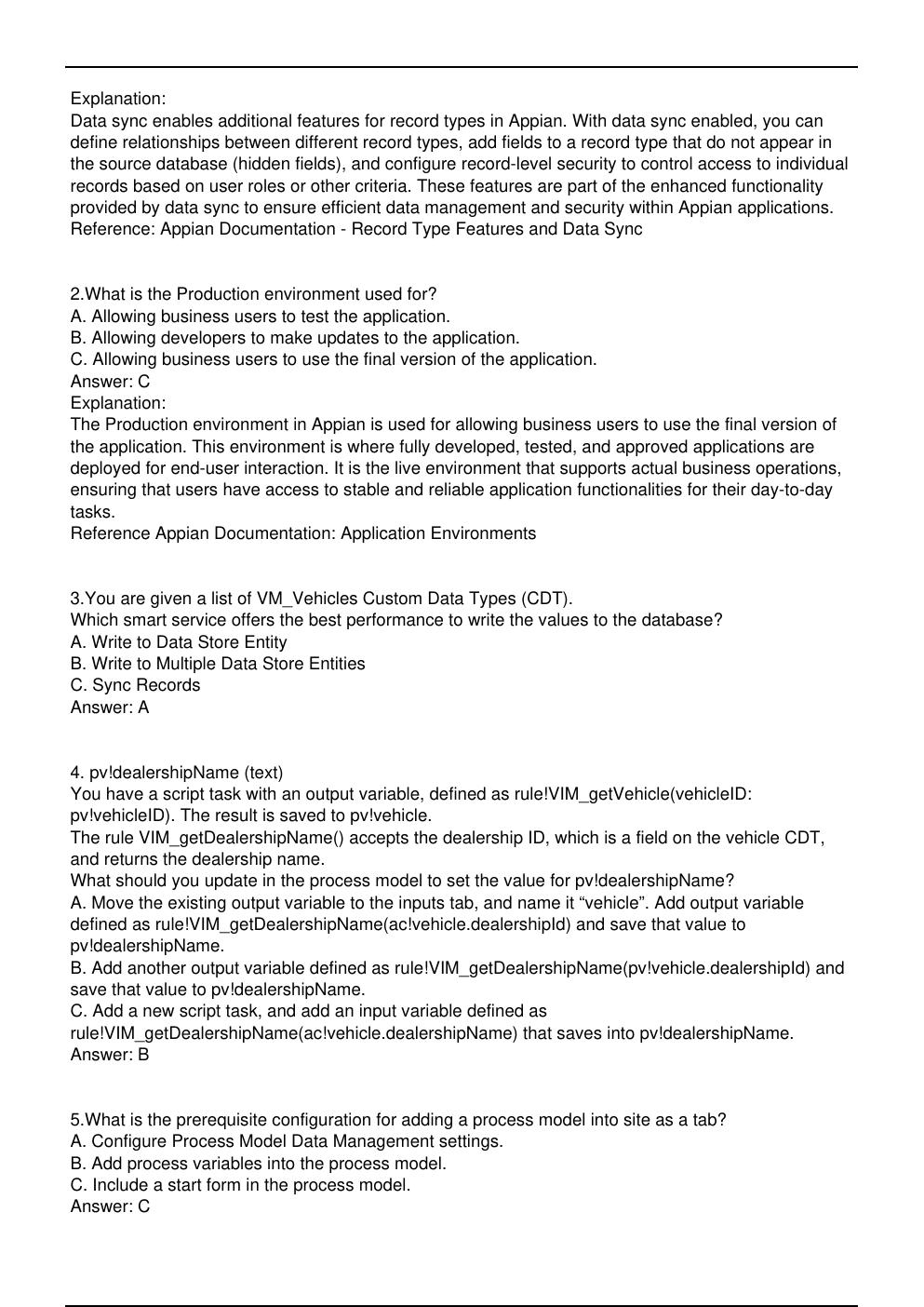
Explanation:
Data sync enables additional features for record types in Appian. With data sync enabled, you can
define relationships between different record types, add fields to a record type that do not appear in
the source database (hidden fields), and configure record-level security to control access to individual
records based on user roles or other criteria. These features are part of the enhanced functionality
provided by data sync to ensure efficient data management and security within Appian applications.
Reference: Appian Documentation - Record Type Features and Data Sync
2.What is the Production environment used for?
A. Allowing business users to test the application.
B. Allowing developers to make updates to the application.
C. Allowing business users to use the final version of the application.
Answer: C
Explanation:
The Production environment in Appian is used for allowing business users to use the final version of
the application. This environment is where fully developed, tested, and approved applications are
deployed for end-user interaction. It is the live environment that supports actual business operations,
ensuring that users have access to stable and reliable application functionalities for their day-to-day
tasks.
Reference Appian Documentation: Application Environments
3.You are given a list of VM_Vehicles Custom Data Types (CDT).
Which smart service offers the best performance to write the values to the database?
A. Write to Data Store Entity
B. Write to Multiple Data Store Entities
C. Sync Records
Answer: A
4. pv!dealershipName (text)
You have a script task with an output variable, defined as rule!VIM_getVehicle(vehicleID:
pv!vehicleID). The result is saved to pv!vehicle.
The rule VIM_getDealershipName() accepts the dealership ID, which is a field on the vehicle CDT,
and returns the dealership name.
What should you update in the process model to set the value for pv!dealershipName?
A. Move the existing output variable to the inputs tab, and name it “vehicle”. Add output variable
defined as rule!VIM_getDealershipName(ac!vehicle.dealershipId) and save that value to
pv!dealershipName.
B. Add another output variable defined as rule!VIM_getDealershipName(pv!vehicle.dealershipId) and
save that value to pv!dealershipName.
C. Add a new script task, and add an input variable defined as
rule!VIM_getDealershipName(ac!vehicle.dealershipName) that saves into pv!dealershipName.
Answer: B
[Show More]



![Preview of eBook [PDF] Advanced Technologies for Rechargeable Batteries Metal Ion, Hybrid, and Metal-](https://browseimages.nyc3.digitaloceanspaces.com/paper-images/2024/Aug/31/4CeOA98s2024-08-31-08-3766d2ac249f11f.png)
![Preview of eBook [PDF] Digital Personality A Man Forever Volume 2 Technical Aspects 1st Edition By Ku](https://browseimages.nyc3.digitaloceanspaces.com/paper-images/2024/Aug/30/t3vEGYrg2024-08-30-02-3166d1adaa38427.png)