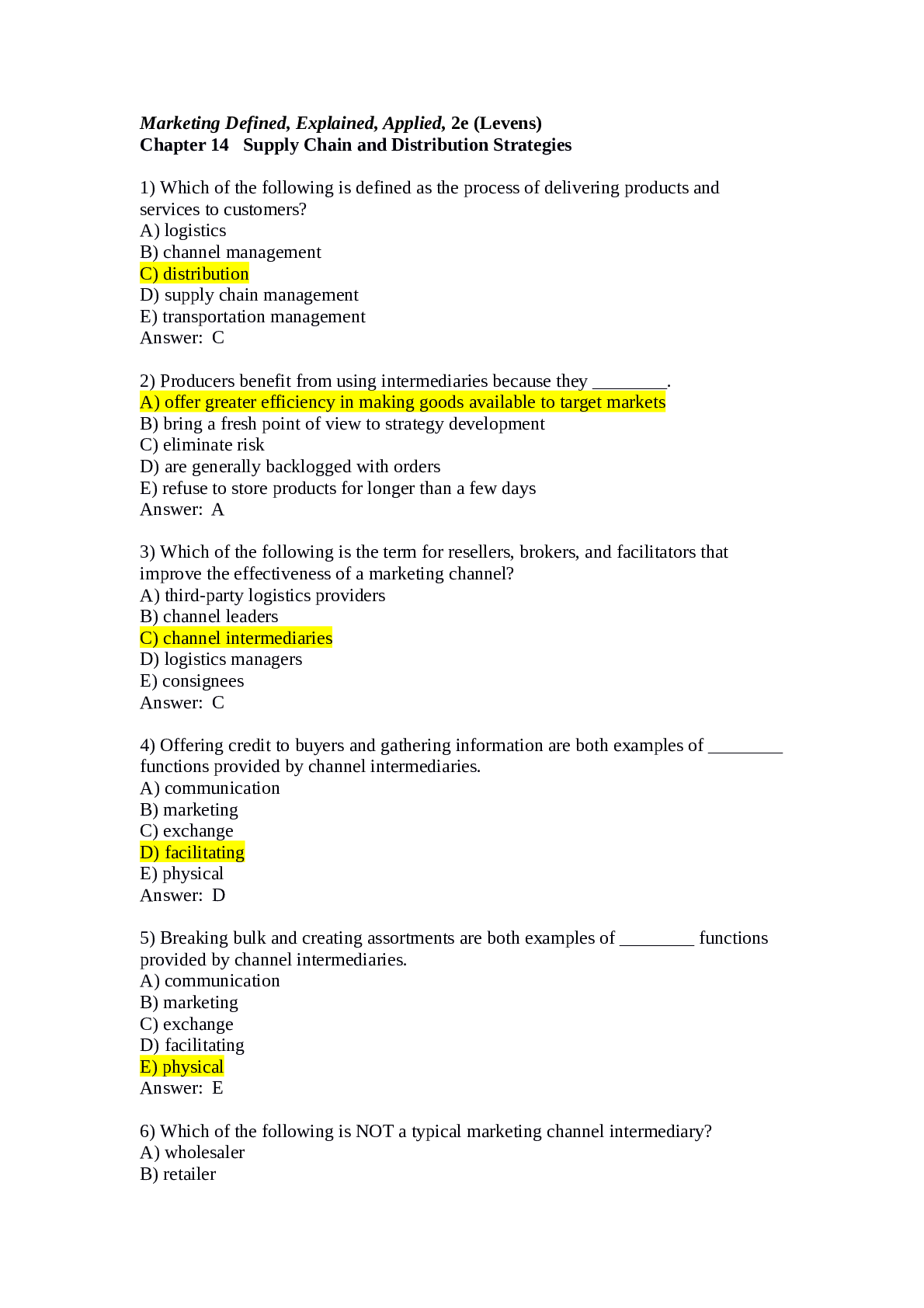
1) Which of the following is defined as the process of delivering products and
services to customers?
A) logistics
B) channel management
C) distribution
D) supply chain management
E) transportation management
Answ
...
1) Which of the following is defined as the process of delivering products and
services to customers?
A) logistics
B) channel management
C) distribution
D) supply chain management
E) transportation management
Answer: C
2) Producers benefit from using intermediaries because they ________.
A) offer greater efficiency in making goods available to target markets
B) bring a fresh point of view to strategy development
C) eliminate risk
D) are generally backlogged with orders
E) refuse to store products for longer than a few days
Answer: A
3) Which of the following is the term for resellers, brokers, and facilitators that
improve the effectiveness of a marketing channel?
A) third-party logistics providers
B) channel leaders
C) channel intermediaries
D) logistics managers
E) consignees
Answer: C
4) Offering credit to buyers and gathering information are both examples of ________
functions provided by channel intermediaries.
A) communication
B) marketing
C) exchange
D) facilitating
E) physical
Answer: D
5) Breaking bulk and creating assortments are both examples of ________ functions
provided by channel intermediaries.
A) communication
B) marketing
C) exchange
D) facilitating
E) physical
Answer: E
6) Which of the following is NOT a typical marketing channel intermediary?
A) wholesaler
B) retailer
C) facilitator
D) government agency
E) agent
Answer: D
7) ________ are intermediaries that facilitate the exchange of products but do not take
title to anything they sell.
A) Wholesalers
B) Retailers
C) Independent intermediaries
D) Merchants
E) Agents
Answer: E
8) An intermediary who ________ has purchased the goods being handled.
A) breaks bulk
B) takes title
C) creates assortments
D) takes consignments
E) selectively distributes
Answer: B
9) Which of the following should be the first step in designing a channel strategy?
A) identifying channel objectives
B) understanding the desires of the target customer
C) analyzing channel alternatives
D) evaluating intermediaries
E) exploring international opportunities
Answer: B
10) In a(n) ________ channel, the same member both produces and distributes a
product or service.
A) tiered
B) direct
C) horizontal
D) vertical
E) exclusive
Answer: B
11) To a producer of goods, a greater number of channel levels means ________ and
greater channel complexity.
A) less distance between producer and end consumer
B) less control over the distribution process
C) fewer potential channel conflicts
D) higher taxes
E) fewer channel partners
Answer: B
12) At minimum, a channel of distribution consists of a producer and a(n) ________.
A) wholesaler
B) agent
C) broker
D) intermediary
E) customer
Answer: E
13) Which of the following is an example of a complete business-to-business
channel?
A) producer to retailer to consumer
B) producer to wholesaler to retailer to consumer
C) producer to agent
D) producer to facilitator
E) producer to dealer to customer
Answer: E
14) Which of the following is in place when a manufacturer makes use of more than
one type of channel?
A) multichannel distribution system
B) intermediation
C) third-party logistics
D) supply chain management
E) vertical marketing system
Answer: A
15) When marketers determine the distribution intensity for a product, they are
determining the ________ of a channel level.
A) width
B) length
C) logistics
D) assortment
E) mode
Answer: A
16) When determining the distribution intensity, three strategies are available to
marketers: intensive, exclusive, and ________ distribution.
A) multichannel
B) selective
C) international
D) direct
E) extensive
Answer: B
17) Sometimes a producer of luxury products chooses only one or a few dealers in a
territory to distribute its products in order to maintain a sense of prestige for the
products. Generally these dealers are given a right to ________ distribution.
A) exclusive
B) selective
C) intensive
D) administered
E) corporate
[Show More]