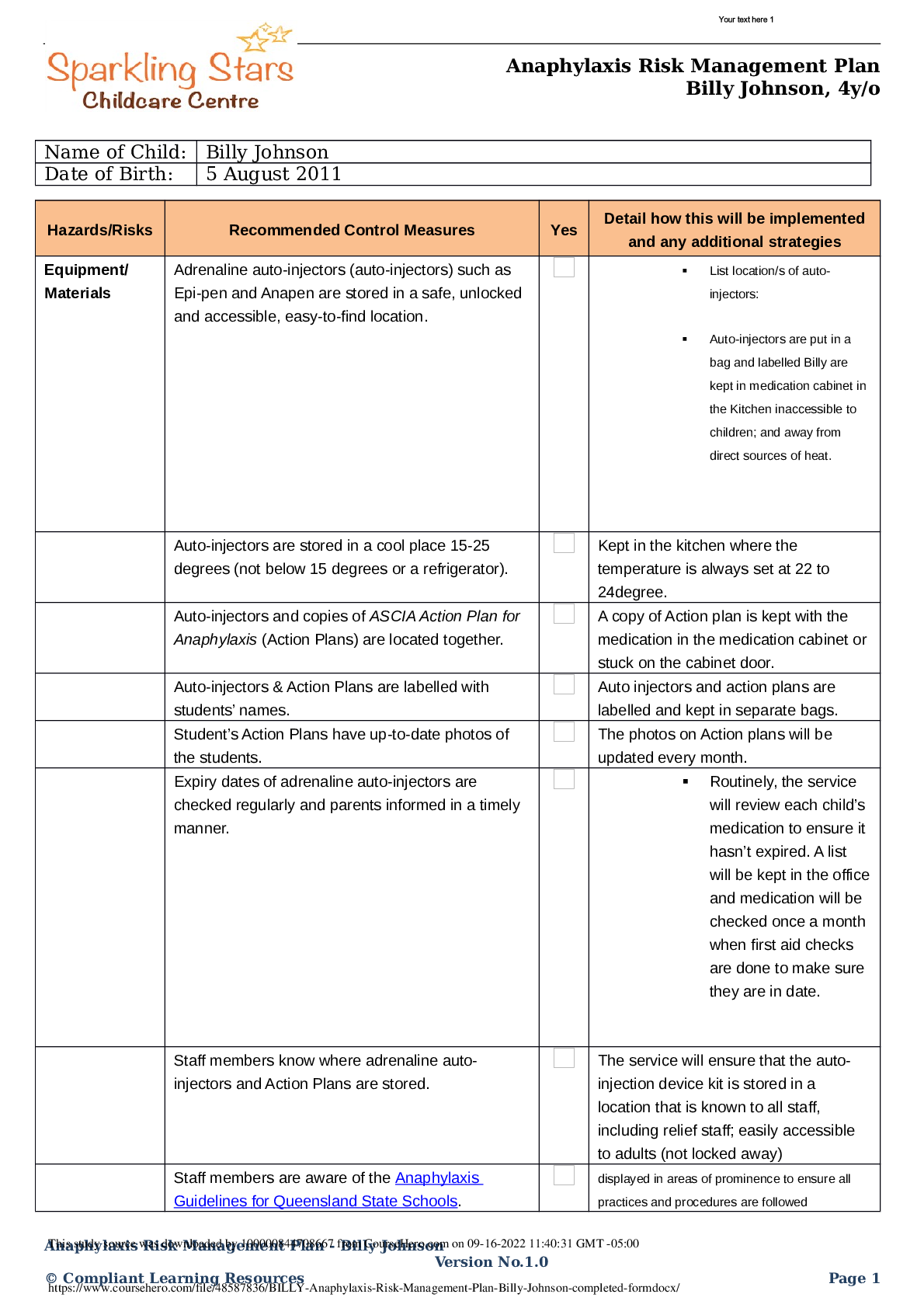
Adrenaline auto-injectors (auto-injectors) such as
Epi-pen and Anapen are stored in a safe, unlocked
and accessible, easy-to-find location-List location/s of auto-injectors: In a cupboard in the same room as the child
...
Adrenaline auto-injectors (auto-injectors) such as
Epi-pen and Anapen are stored in a safe, unlocked
and accessible, easy-to-find location-List location/s of auto-injectors: In a cupboard in the same room as the child is in and out of the reach of children.
Auto-injectors are stored in a cool place 15-25
degrees (not below 15 degrees or a refrigerator). -Keep records of refrigerator temperatures every day, if temp goes up or down than required notify to the management.
Auto-injectors and copies of ASCIA Action Plan for
Anaphylaxis (Action Plans) are located together.
Staff has strickly instruction to keep
these together all the time and there is
a slip on the bag state this note. Auto-injectors & Action Plans are labelled with students’ names. these are provided by parents and We only accept it from the parents if they are labelled, approval and signed by the doctor.
Student’s Action Plans have up-to-date photos of
the students. -photos are reviewed every year by the first aid officer and room leader.
Expiry dates of adrenaline auto-injectors are
checked regularly and parents informed in a timely
manner.
The first aid officer reviews these every
few months and parents are informed
by the room leader if need be.
Staff members know where adrenaline autoinjectors and Action Plans are stored.
Room leader explains and shows a
new staff member in their room on their
first day at centre.
Staff members are aware of the Anaphylaxis
Guidelines for Queensland State Schools.
The supervisor or room leader.need to
update staff members with this.
Students Staff members are aware of which students are at
risk of anaphylaxis and the actions required.
We are very focus on it so we ask every
staff member reads the action plan and
then signs, given by the first aid.
The school has received a copy of Action Plans for
all students at risk of anaphylaxis.
At the time of enrolment, parents
whose child at risk need to submit the
child’s action plan
Staff members are aware of the protocols for
management of a student who is not identified as
being at risk of anaphylaxis and experience a first
time reaction.
First Aid is reviewed every three
months so all staff members are aware.
Staff members know how to recognise an
anaphylactic reaction.
The First Aid course including
anaphylaxis response has to be
completed by every staff member
before joining an early childhood
[Show More]