Week one recorded introduction Week 1:
Recorded Introductions
Use Kaltura to record one 5 minute video-based professional introduction based on the
following:
Part 1: Please introduce yourself to the class. Tell abou
...
Week one recorded introduction Week 1:
Recorded Introductions
Use Kaltura to record one 5 minute video-based professional introduction based on the
following:
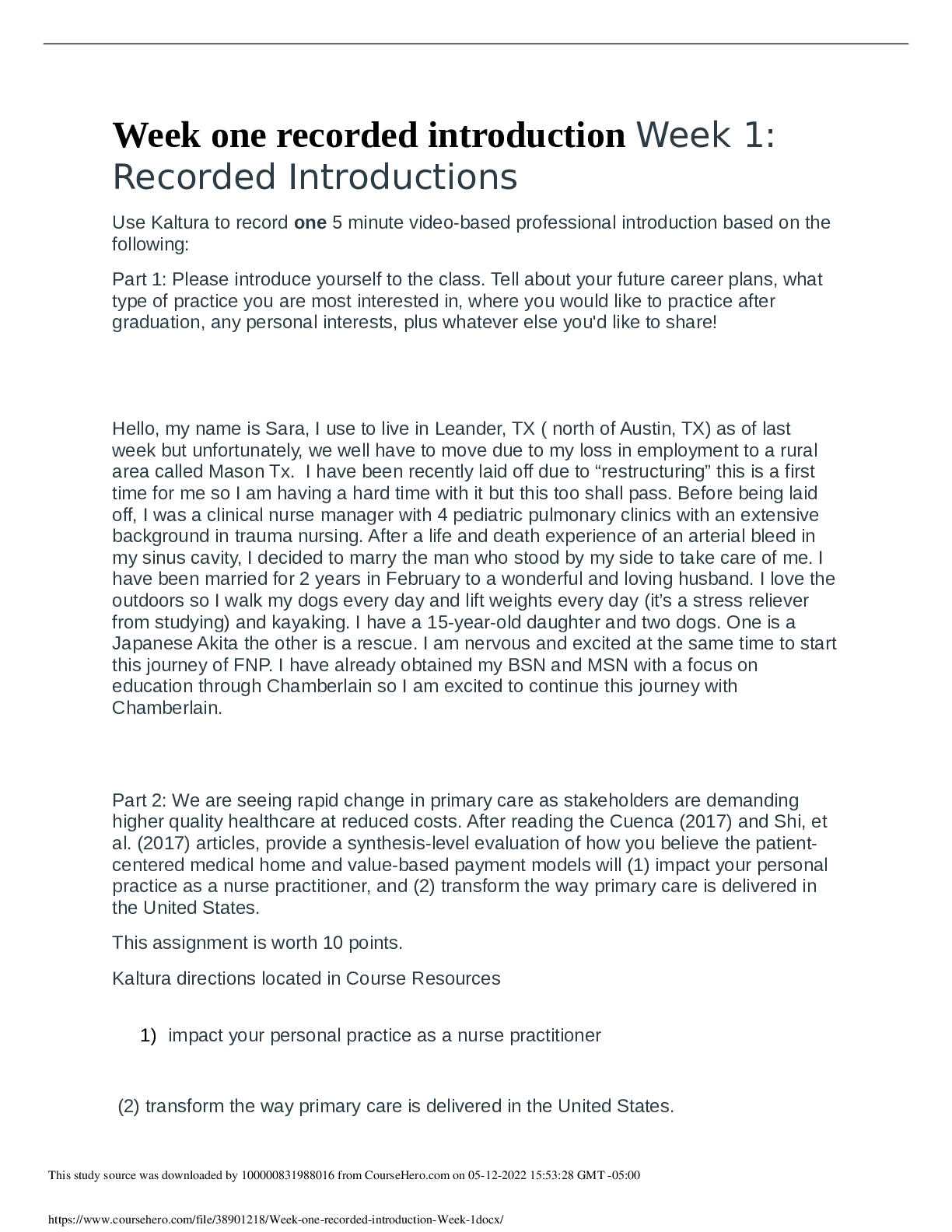
Part 1: Please introduce yourself to the class. Tell about your future career plans, what
type of practice you are most interested in, where you would like to practice after
graduation, any personal interests, plus whatever else you'd like to share!
Hello, my name is Sara, I use to live in Leander, TX ( north of Austin, TX) as of last
week but unfortunately, we well have to move due to my loss in employment to a rural
area called Mason Tx. I have been recently laid off due to “restructuring” this is a first
time for me so I am having a hard time with it but this too shall pass. Before being laid
off, I was a clinical nurse manager with 4 pediatric pulmonary clinics with an extensive
background in trauma nursing. After a life and death experience of an arterial bleed in
my sinus cavity, I decided to marry the man who stood by my side to take care of me. I
have been married for 2 years in February to a wonderful and loving husband. I love the
outdoors so I walk my dogs every day and lift weights every day (it’s a stress reliever
from studying) and kayaking. I have a 15-year-old daughter and two dogs. One is a
Japanese Akita the other is a rescue. I am nervous and excited at the same time to start
this journey of FNP. I have already obtained my BSN and MSN with a focus on
education through Chamberlain so I am excited to continue this journey with
Chamberlain.
Part 2: We are seeing rapid change in primary care as stakeholders are demanding
higher quality healthcare at reduced costs. After reading the Cuenca (2017) and Shi, et
al. (2017) articles, provide a synthesis-level evaluation of how you believe the patientcentered medical home and value-based payment models will (1) impact your personal
practice as a nurse practitioner, and (2) transform the way primary care is delivered in
the United States.
This assignment is worth 10 points.
Kaltura directions located in Course Resources
1) impact your personal practice as a nurse practitioner
(2) transform the way primary care is delivered in the United States.
This study source was downloaded by 100000831988016 from CourseHero.com on 05-12-2022 15:53:28 GMT -05:00
https://www.coursehero.com/file/38901218/Week-one-recorded-introduction-Week-1docx/
Benefits of the PCMH
The PCMH has several benefits, including cost savings, improved quality of care, and
culture change.
As nurses, we are often the first providers patients contact in acute, chronic, and
preventive care across the lifespan. It’s imperative that, as providers of primary care, we
stay current on trends and developments in our healthcare-delivery environment.
Nurses must become knowledgeable about what developing and implementing a
successful PCMH entails, and we must also become proficient in what our expected
role will be and how this role may, in fact, evolve over time—particularly as the
implementation of the Affordable Care Act unfolds. However, there is a gap in the
literature on the role of nursing and advanced practice nursing and the development
and implementation of the PCMH. Specifically, there are no current studies describing
healthcare outcomes as they relate to the role of nurses and APNs in a PCMH.
five core attributes of the PCMH as defined by the Agency for Healthcare Research and
Quality are:
Patient-centered: The PCMH supports patients in learning to manage and organize their
own care based on their preferences, and ensures that patients, families, and caregivers
are fully included in the development of their care plans. It also encourages them to
participate in quality improvement, research, and health policy efforts.
Comprehensive: The PCMH offers whole-person care from a team of providers that is
accountable for the patient’s physical and behavioral/mental health needs, including
prevention and wellness, acute care, and chronic care.
Coordinated: The PCMH ensures that care is organized across all elements of the
broader health care system, including specialty care, hospitals, home health care,
community services, and long-term care supports.
Accessible: The PCMH delivers accessible services with shorter waiting times, enhanced
in-person hours, 24/7 electroni
[Show More]






.png)






.png)



.png)

