MATH 144 Quiz Math 144.
QUESTION 1
1. Which of the following is TRUE about unsupervised learning?
I. Unsupervised learning refers to the problem of finding hidden structures within unlabeled
data.
II. Clustering tec
...
MATH 144 Quiz Math 144.
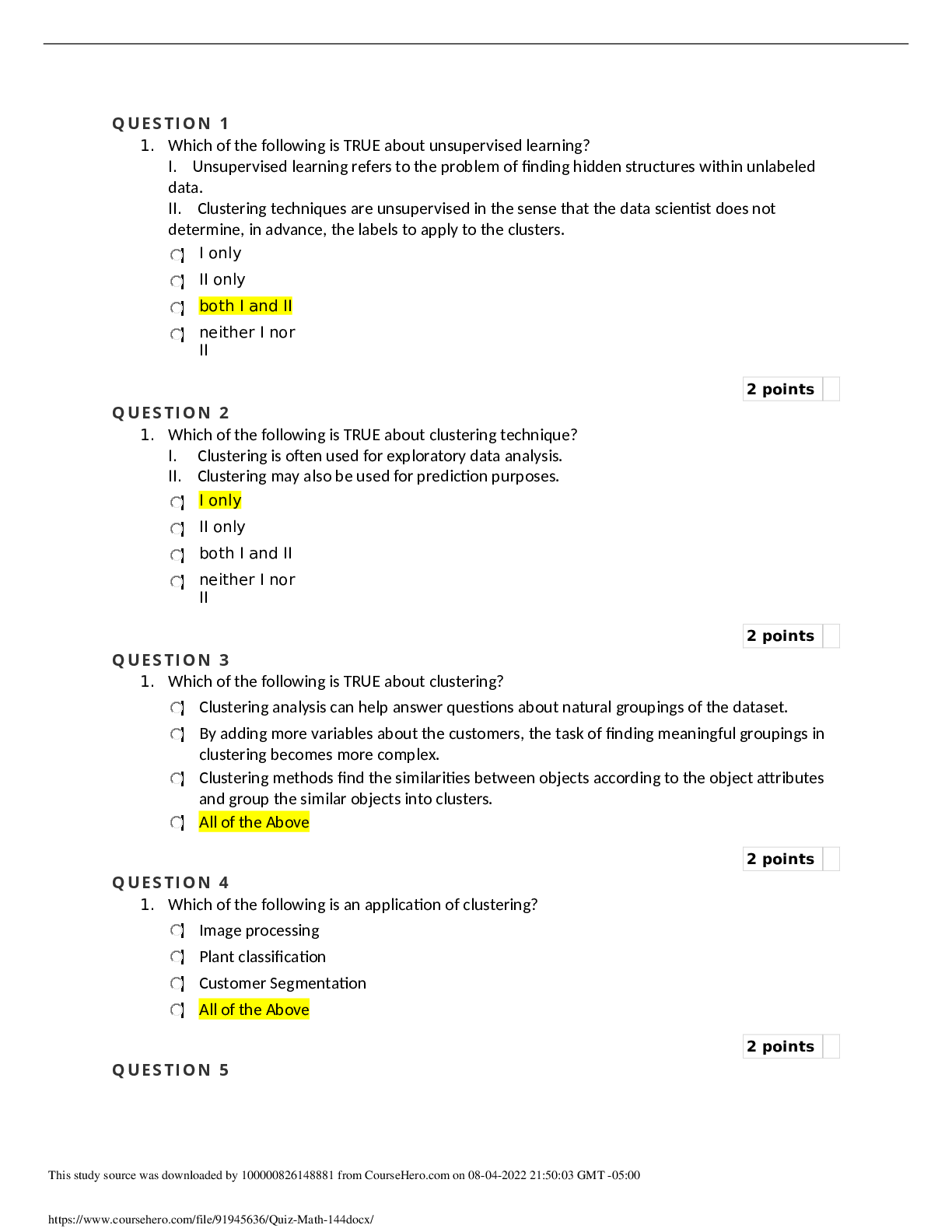
QUESTION 1
1. Which of the following is TRUE about unsupervised learning?
I. Unsupervised learning refers to the problem of finding hidden structures within unlabeled
data.
II. Clustering techniques are unsupervised in the sense that the data scientist does not
determine, in advance, the labels to apply to the clusters.
I only
II only
both I and II
neither I nor
II
2 points
QUESTION 2
1. Which of the following is TRUE about clustering technique?
I. Clustering is often used for exploratory data analysis.
II. Clustering may also be used for prediction purposes.
I only
II only
both I and II
neither I nor
II
2 points
QUESTION 3
1. Which of the following is TRUE about clustering?
Clustering analysis can help answer questions about natural groupings of the dataset.
By adding more variables about the customers, the task of finding meaningful groupings in
clustering becomes more complex.
Clustering methods find the similarities between objects according to the object attributes
and group the similar objects into clusters.
All of the Above
2 points
QUESTION 4
1. Which of the following is an application of clustering?
Image processing
Plant classification
Customer Segmentation
All of the Above
2 points
QUESTION 5
1. This is an analytical technique that identifies k clusters of objects based on the objects’ proximity
to the center of the k groups where center is the arithmetic average of n-dimensional vector of
attributes.
K-modes
K-means
K-medians
None of the Above
2 points
QUESTION 6
1. The following is ALWAYS TRUE about the k-means algorithm EXCEPT
The optimum number of clusters may be determined by examining the within sum of
squares for different values of k.
Convergence is reached when the computed centroids do not change or the centroids and
the assigned points oscillate back and forth from one iteration to the next.
The k-means results to an equal number of data points per cluster.
Centroids are recomputed for each newly defined cluster and data points are reassigned
based on the proximity to the newly computed centroids.
2 points
QUESTION 7
1. The following is a result from R when running k-means on a particular dataset on 620 high
school students with attributes regarding their grades on English, Math and Science. Based on
this result, to which cluster does a student belong whose grade for English, Math and Science
are 90, 81 and 88 respectively?
Cluster 1
Cluster 2
Cluster 3
Cannot be
determined
2 points
QUESTION 8
1. In general, the following questions should be asked whenever performing diagnostics of the
results.
Are the clusters well separated from each other?
Do any of the clusters have only a few points?
Do any of the centroids appear to be too close to each other?
All of the Above
2 points
QUESTION 9
1. Which of the following is ALWAYS TRUE about the considerations regarding the object attributes
when performing cluster analysis?
I. On the choice of which attributes to use, it is important to understand what attributes will be
known at the time a new object will be assigned to a cluster.
II. Whenever possible and based on the data, it is best to reduce the number of attributes to
the extent possible.
I only
II only
both I and II
neither I nor
II
2 points
QUESTION 10
1. Which of the following is ALWAYS TRUE about unit of measurement?
I. To remedy the issue on unit measurement, rescaling of the attributes may be done by
dividing each attribute value by its variance.
II. The choice for the unit of measurement of a particular object is important because it directly
affects the cluster membership of the data points.
I only
II only
both I and II
neither I nor
II
2 points
QUESTION 11
1. Which of the following is ALWAYS TRUE about considerations regarding the implementation of kmeans?
I. The k-means algorithm is sensitive to the starting positions of the initial centroid.
II. K-means can handle all types of variables.
I only
II only
both I and II
neither I nor
II
2 points
QUESTION 12
1. The process of identifying the appropriate value of k is referred to as finding the ‘elbow’ of the
WSS curve.
True
False
[Show More]


![Preview of eBook [PDF] Elementary Geometry for College Students 7th Edition By Daniel C. Alexander, G](https://browseimages.nyc3.digitaloceanspaces.com/paper-images/2026/05/19/FNuoi4Be2026-05-19-11-446a0ccbcb69aa3.png)
![Preview of eBook [PDF] Elementary Geometry for College Students 6th Edition By Daniel C. Alexander, G](https://browseimages.nyc3.digitaloceanspaces.com/paper-images/2026/05/19/OVoajDSU2026-05-19-11-446a0ccba317eab.png)