Information Security and Assurance –
WGU C725 Questions and Answers
Already Passed
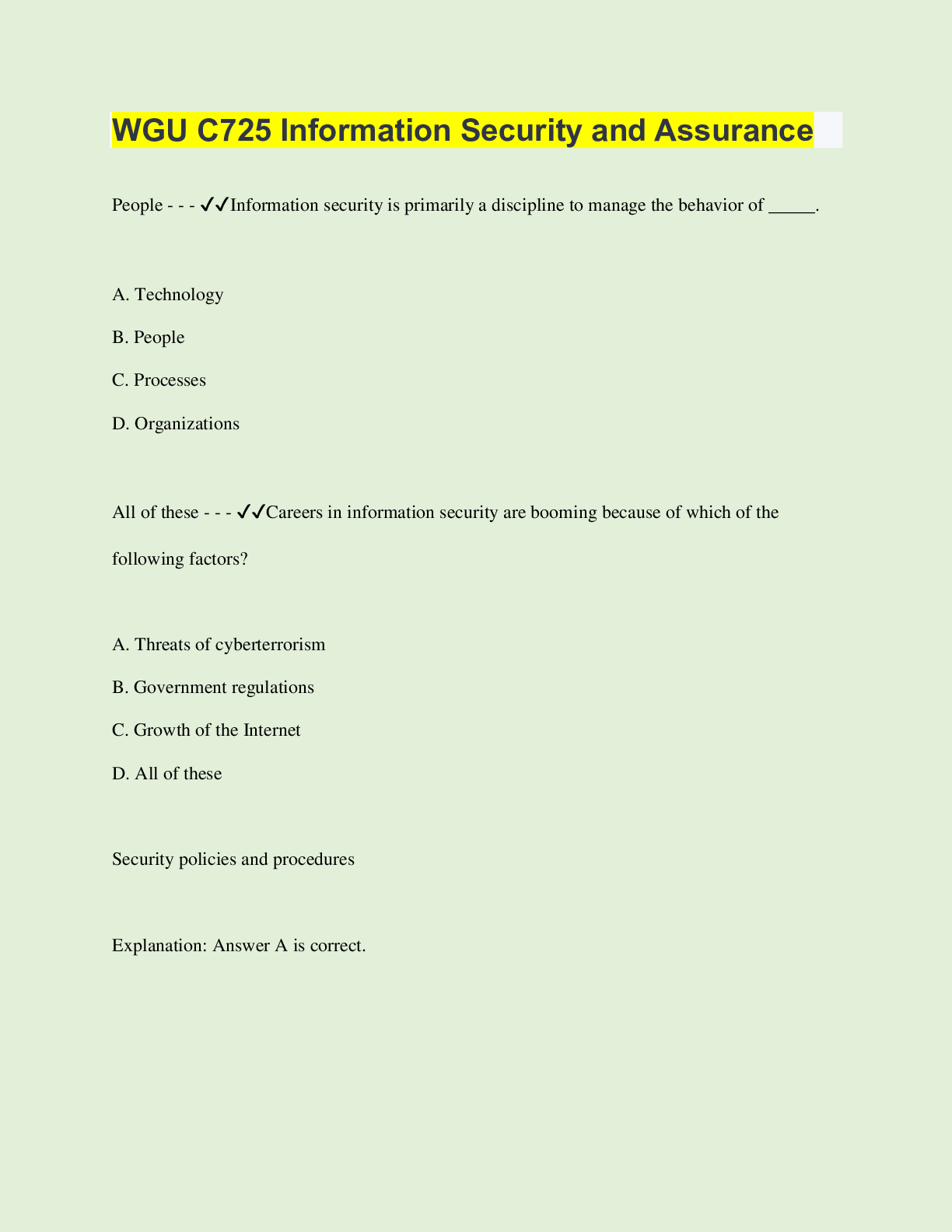
People ✔✔Information security is primarily a discipline to manage the behavior of _____.
A. Technology
B. People
C. Processes
D. O
...
Information Security and Assurance –
WGU C725 Questions and Answers
Already Passed
People ✔✔Information security is primarily a discipline to manage the behavior of _____.
A. Technology
B. People
C. Processes
D. Organizations
All of these ✔✔Careers in information security are booming because of which of the following
factors?
A. Threats of cyberterrorism
B. Government regulations
C. Growth of the Internet
D. All of these
Security policies and procedures
Explanation: Answer A is correct.
The Carnegie Melon Information Network Institute (INI) designed programs to carry out multiple
tasks including Information Security Policies. ✔✔A program for information security should
include which of the following elements?
A. Security policies and procedures
B. Intentional attacks only
C. Unintentional attacks only
D. None of these
D. All of these ✔✔The growing demand for InfoSec specialists is occurring predominantly in
which of the following types of organizations?
A. Government
B. Corporations
C. Not-for-profit foundations
D. All of these
Confidentiality ✔✔The concept of the measures used to ensure the protection of the secrecy of
data, objects, or resources.
B-Rate Safe Rating ✔✔A catchall safe rating for any box with a lock on it. This rating describes
the thickness of the steel used to make the lockbox. No actual testing is performed to gain this
rating.
C-Rate Safe Rating ✔✔This safe rating is defined as a variably thick steel box with a 1-inch-thick
door and a lock. No tests are conducted to provide this rating, either.
UL TL-15 Safe Rating ✔✔Safes with an Underwriters Laboratory rating that have passed
standardized tests as defined in Underwriters Laboratory Standard 687 using tools and an expert
group of safe-testing engineers. The safe rating label requires that the safe be constructed of 1-inch
solid steel or equivalent. The label means that the safe has been tested for a net working time of
15 minutes using "common hand tools, drills, punches hammers, and pressure applying devices."
Net working time means that when the tool comes off the safe, the clock stops. Engineers exercise
more than 50 different types of attacks that have proven effective for safecracking.
UL TL-30 Safe Rating ✔✔This Underwriters Laboratory rating testing is essentially the same as
the TL-15 testing, except for the net working time. Testers get 30 minutes and a few more tools to
help them gain access. Testing engineers usually have a safe's manufacturing blueprints and can
disassemble the safe before the test begins to see how it works.
B. Disclosure
Explanation:
Confidentiality models are primarily intended to ensure that no unauthorized access to information
is permitted and that accidental disclosure of sensitive information is not possible. ✔✔Related to
information security, confidentiality is the opposite of which of the following?
A. Closure
B. Disclosure
C. Disaster
D. Disposal
D. All of these
Explanation:
Integrity models keep data pure and trustworthy by protecting system data from intentional or
accidental changes. ✔✔Integrity models have which of the three goals:
A. Prevent unauthorized users from making modifications to data or programs
B. Prevent authorized users from making improper or unauthorized modifications
C. Maintain internal and external consistency of data and programs
D. All of these
D. All of these
Explanation:
Availability models keep data and resources available for authorized use, especially during
emergencies or disasters. ✔✔Information security professionals usually address which of these
three common challenges to availability:
A. Denial of service (DoS) due to intentional attacks or because of undiscovered flaws in
implementation (for example, a program written by a programmer who is unaware of a flaw that
could crash the program if a certain unexpected input is encountered)
B. Loss of information system capabilities because of natural disasters (fires, floods, storms, or
earthquakes) or human actions (bombs or strikes)
C. Equipment failures during normal use.
D. All of these
A. Confidentiality, integrity, and availability
Explanation:
These goals form the confidentiality, integrity, availability (CIA) triad, the basis of all security
programs. ✔✔Which of the following represents the three goals of information security?
A. Confidentiality, integrity, and availability
B. Prevention, detection, and response
C. People controls, process controls, and technology controls
D. Network security, PC security, and mainframe security
business case
Explanation:
A business case is often made to justify the start of a new project, especially a project related to
security. ✔✔Usually a documented argument or stated position in order to define a need to make
a decision or take some form of action.
top-down approach ✔✔A type of security management planning where upper, or senior,
management is responsible for initiating and defining policies for the organization.
bottom-up approach ✔✔A type of security management planning where IT staff makes security
decisions directly without input from senior management. This approach is rarely used in
organizations and is considered problematic in the IT industry.
Strategic Plan ✔✔This security plan is a long-term plan that is fairly stable. It defines the
organization's security purpose. It also helps to understand security function and align it to the
goals, mission, and objectives of the organization. It's useful for about five years if it is maintained
and updated annually. This plan also serves as the planning horizon. Long-term goals and visions
for the future are discussed this plan. This
plan should include a risk assessment.
Tactical Plan ✔✔This security plan is a midterm plan developed to provide more details on
accomplishing the goals set forth in the strategic plan or can be crafted ad hoc based upon
unpredicted events. This plan is typically useful for about a year and often prescribes and schedules
the tasks necessary to accomplish organizational goals. Some examples of these plans are project
plans, acquisition plans, hiring plans, budget plans, maintenance plans, support plans, and system
development plans.
Operational Plan ✔✔This security plan is a short-term, highly detailed plan based on the strategic
and tactical plans. It is valid or useful only for a short time. These plans must be updated often
(such as monthly or quarterly) to retain compliance with tactical plans. These plans spell out how
to accomplish the various goals of the organization. They include resource allotments, budgetary
requirements, staffing assignments, scheduling, and step-by-step or implementation procedures.
These plans include details on how the implementation processes are in compliance with the
organization's security policy. Examples of these plans are training plans, system deployment
plans, and product design plans.
Data classification ✔✔Also called classification, the primary means by which data is protected
based on its need for secrecy, sensitivity, or confidentiality. It is the process of organizing items,
objects, subjects, and so on into groups, categories, or collections with similarities.
Five levels of government/military classification ✔✔Top secret, Secret, Confidential, Sensitive
but unclassified, Unclassified.
Top Secret ✔✔The highest level of government/military data classification. The unauthorized
disclosure of top-secret data will have drastic effects and cause grave damage to national security.
This data is compartmentalized on a need-to-know basis such that a user could have this clearance
and have access to no data until the user has a need to know.
Secret ✔✔This level of government/military data classification is used for data of a restricted
nature. The unauthorized disclosure of data classified as secret will have significant effects and
cause critical damage to national security.
Confidential ✔✔This level of government/military data classification is used for data of a
sensitive, proprietary, or highly valuable nature. The unauthorized disclosure of data with this
classification level will have noticeable effects and cause serious damage to national security. This
classification is used for all data between secret and sensitive but unclassified classifications.
Sensitive But Unclassified (SBU) ✔✔This level of government/military data classification is used
for data that is for internal use or for office use only (FOUO). Often this data classification is used
to protect information that could violate the p
[Show More]
.png)
.png)

.png)
.png)
.png)
.png)
.png)
.png)
.png)
.png)
.png)
.png)
.png)