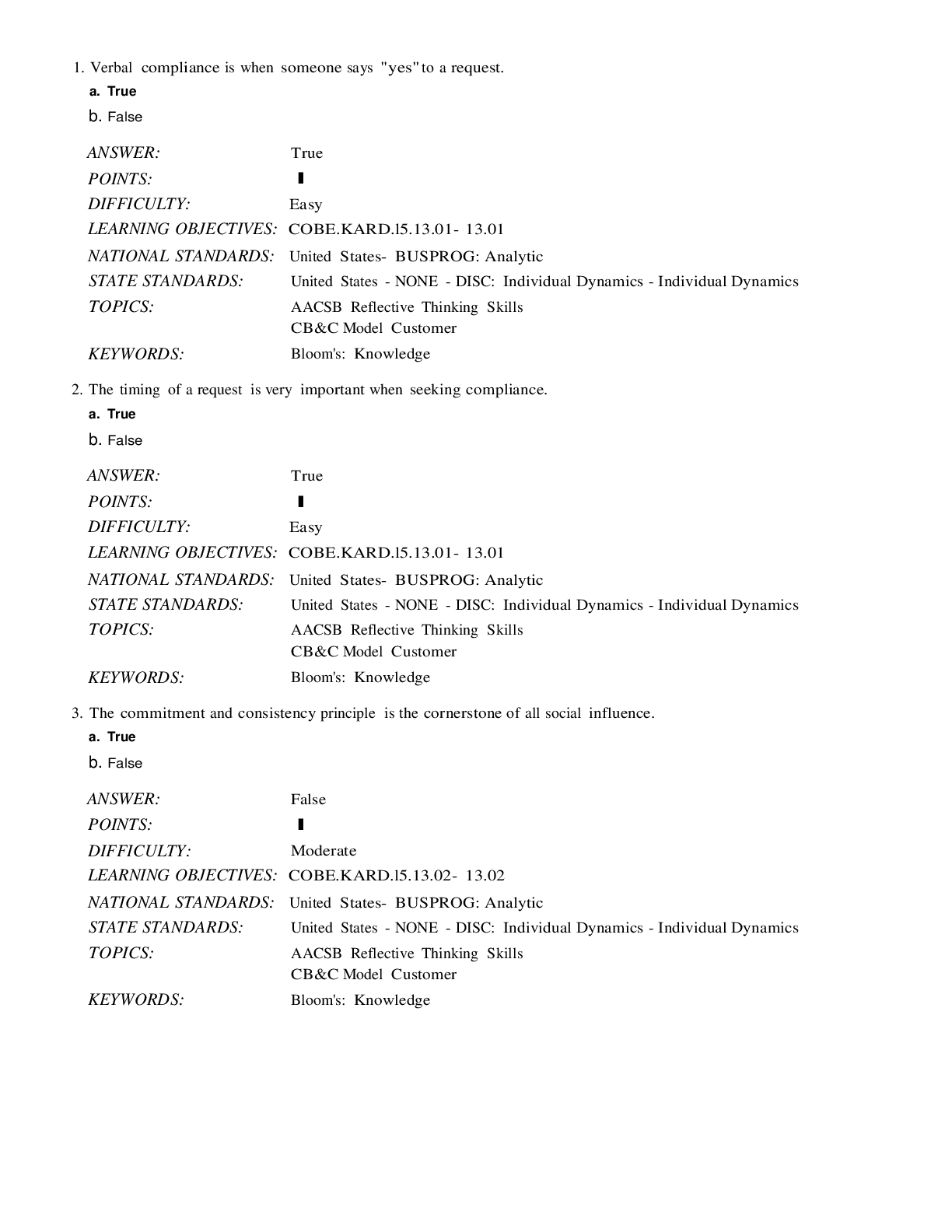
2. The timing of a request is very important when seeking compliance.
a.
b.
:
POINTS:
I
DIFFICULTY: Easy
LEARNING OBJECTIVES: COBE.KARD.l5.13.01- 13.01
NATIONAL STANDARDS: United States- B
...
2. The timing of a request is very important when seeking compliance.
a.
b.
:
POINTS:
I
DIFFICULTY: Easy
LEARNING OBJECTIVES: COBE.KARD.l5.13.01- 13.01
NATIONAL STANDARDS: United States- BUSPROG: Analytic
STATE STANDARDS: TOPICS:
KEYWORDS:
United States - NONE - DISC: Individual Dynamics - Individual Dynamics
AACSB Reflective Thinking Skills
CB&C Model Customer
Bloom's: Knowledge
3. The commitment and consistency principle is the cornerstone of all social influence.
a.
b.
: POINTS:
DIFFICULTY:
I
Moderate
LEARNING OBJECTIVES: COBE.KARD.l5.13.02- 13.02
NATIONAL STANDARDS: United States- BUSPROG: Analytic
STATE STANDARDS: TOPICS:
KEYWORDS:
United States - NONE - DISC: Individual Dynamics - Individual Dynamics
AACSB Reflective Thinking Skills
CB&C Model Customer
Bloom's: Knowledge
KEYWORDS:
CB&C Model Strategy
Bloom's: Knowledge
5. Routines and habits are performed over and over with relatively little conscious thought because people don't have time or cognitive resources to think carefully about everything they do.
a.
b.
:
POINTS:
1
DIFFICULTY: Easy
LEARNING OBJECTIVES: COBE.KARD.15.13.02- 13.02
NATIONAL STANDARDS: United States- BUSPROG: Analytic
STATE STANDARDS: TOPICS:
KEYWORDS:
United States - NONE - DISC: Individual Dynamics - Individual Dynamics
AACSB Reflective Thinking Skills
CB&C Model Customer
Bloom's: Knowledge
6. According to the because heuristic, people process all requests mindlessly, so just hearing the word "because" can trigger the heuristic.
a.
b.
:
POINTS:
1
DIFFICULTY: Challenging
LEARNING OBJECTIVES: COBE.KARD.15.13.02- 13.02
NATIONAL STANDARDS: United States- BUSPROG: Analytic
STATE STANDARDS: TOPICS:
KEYWORDS:
United States - NONE - DISC: Individual Dynamics - Individual Dynamics
AACSB Reflective Thinking Skills
CB&C Model Customer CB&C Model Marketing Plan CB&C Model Strategy
Bloom's: Comprehension
KEYWORDS:
CB&C Model Strategy
Bloom's: Knowledge
8. The foot-in-the-door technique is effective over a period of several days.
a.
b.
: POINTS:
DIFFICULTY:
1
Moderate
LEARNING OBJECTIVES: COBE.KARD.15.13.03- 13.03
NATIONAL STANDARDS: United States- BUSPROG: Analytic
STATE STANDARDS: TOPICS:
KEYWORDS:
United States - NONE - DISC: Individual Dynamics - Individual Dynamics
AACSB Reflective Thinking Skills
CB&C Model Customer CB&C Model Marketing Plan CB&C Model Strategy
Bloom's: Knowledge
9. Self-perception theory suggests that complying with small requests lead people to label themselves has helpful, reasonable people.
a.
b.
:
POINTS:
1
DIFFICULTY: Easy
LEARNING OBJECTIVES: COBE.KARD.15.13.03- 13.03
NATIONAL STANDARDS: United States- BUSPROG: Analytic
STATE STANDARDS: TOPICS:
KEYWORDS:
United States - NONE - DISC: Individual Dynamics - Individual Dynamics
AACSB Reflective Thinking Skills
CB&C Model Customer
Bloom's: Knowledge
KEYWORDS:
Bloom's: Knowledge
11. When car salespersons try to get an initial commitment from their customers and then change the deal they are using the door-in-the-face technique.
a.
b.
:
POINTS:
1
DIFFICULTY: Easy
LEARNING OBJECTIVES: COBE.KARD.l5.13.03- 13.03
NATIONAL STANDARDS: United States- BUSPROG: Analytic
STATE STANDARDS: TOPICS:
KEYWORDS:
United States - NONE - DISC: Individual Dynamics - Individual Dynamics
AACSB Reflective Thinking Skills
CB&C Model Customer CB&C Model Marketing Plan CB&C Model Promotion CB&C Model Strategy
Bloom's: Knowledge
12. The low-ball technique is generally more powerful than the foot-in-the-door technique.
a.
b.
: POINTS:
DIFFICULTY:
1
Moderate
LEARNING OBJECTIVES: COBE.KARD.l5.13.03- 13.03
NATIONAL STANDARDS: United States- BUSPROG: Analytic
STATE STANDARDS: TOPICS:
KEYWORDS:
United States - NONE - DISC: Individual Dynamics - Individual Dynamics
AACSB Reflective Thinking Skills
CB&C Model Customer CB&C Model Marketing Plan CB&C Model Strategy
Bloom's: Knowledge
13. Both the foot-in-the-door and the low-ball techniques try to gain compliance through the social influence principle of reciprocity.
a.
b.
: POINTS:
DIFFICULTY:
1
Moderate
LEARNING OBJECTIVES: COBE.KARD.15.13.03- 13.03
NATIONAL STANDARDS: United States- BUSPROG: Analytic
STATE STANDARDS: TOPICS:
KEYWORDS:
United States - NONE - DISC: Individual Dynamics - Individual Dynamics
AACSB Reflective Thinking Skills
CB&C Model Customer CB&C Model Marketing Plan CB&C Model Strategy
Bloom's: Knowledge
14. The bait-and-switch technique is illegal in the United States.
a.
b.
: POINTS:
DIFFICULTY:
1
Moderate
LEARNING OBJECTIVES: COBE.KARD.15.13.03- 13.03
NATIONAL STANDARDS: United States- BUSPROG: Analytic
STATE STANDARDS: TOPICS:
KEYWORDS:
United States - NONE - DISC: Individual Dynamics - Individual Dynamics
AACSB Ethical and Legal Understanding and Reasoning Abilities
AACSB Reflective Thinking Skills CB&C Model Marketing Plan CB&C Model Strategy
Bloom's: Knowledge
15. Research has shown that the door-in-the-face technique is actually a compare and contrast type of effect.
a.
b.
: POINTS:
DIFFICULTY:
1
Moderate
LEARNING OBJECTIVES: COBE.KARD.15.13.04- 13.04
NATIONAL STANDARDS: United States- BUSPROG: Analytic
STATE STANDARDS: TOPICS:
KEYWORDS:
United States - NONE - DISC: Individual Dynamics - Individual Dynamics
AACSB Reflective Thinking Skills
CB&C Model Customer CB&C Model Marketing Plan CB&C Model Strategy
Bloom's: Knowledge
: POINTS:
DIFFICULTY:
1
Moderate
LEARNING OBJECTIVES: COBE.KARD.l5.13.04- 13.04
NATIONAL STANDARDS: United States- BUSPROG: Analytic
STATE STANDARDS: TOPICS:
KEYWORDS:
United States - NONE - DISC: Individual Dynamics - Individual Dynamics
AACSB Reflective Thinking Skills
CB&C Model Customer CB&C Model Marketing Plan CB&C Model Strategy
Bloom's: Knowledge
17. The door-in-the-face technique becomes less effective as the time between requests increases.
a.
b.
: POINTS:
DIFFICULTY:
1
Moderate
LEARNING OBJECTIVES: COBE.KARD.l5.13.04- 13.04
NATIONAL STANDARDS: United States- BUSPROG: Analytic
STATE STANDARDS: TOPICS:
KEYWORDS:
United States - NONE - DISC: Individual Dynamics - Individual Dynamics
AACSB Reflective Thinking Skills
CB&C Model Customer CB&C Model Marketing Plan CB&C Model Strategy
Bloom's: Knowledge
18. The even-a-penny technique is equally effective in face-to-face and telemarketing contexts.
a.
b.
: POINTS:
DIFFICULTY:
1
Moderate
LEARNING OBJECTIVES: COBE.KARD.l5.13.04- 13.04
NATIONAL STANDARDS: United States- BUSPROG: Analytic
STATE STANDARDS: TOPICS:
KEYWORDS:
United States - NONE - DISC: Individual Dynamics - Individual Dynamics
AACSB Reflective Thinking Skills
CB&C Model Customer CB&C Model Marketing Plan CB&C Model Promotion CB&C Model Strategy
Bloom's: Knowledge
:
POINTS:
1
DIFFICULTY: Easy
LEARNING OBJECTIVES: COBE.KARD.l5.13.05- 13.05
NATIONAL STANDARDS: United States- BUSPROG: Analytic
STATE STANDARDS: TOPICS:
KEYWORDS:
United States - NONE - DISC: Individual Dynamics - Individual Dynamics
AACSB Reflective Thinking Skills
CB&C Model Customer CB&C Model Marketing Plan CB&C Model Strategy
Bloom's: Knowledge
20. The affmnation of the consequent helps explain the social validation effect.
a.
b.
: POINTS:
DIFFICULTY:
1
Moderate
LEARNING OBJECTIVES: COBE.KARD.l5.13.05- 13.05
NATIONAL STANDARDS: United States- BUSPROG: Analytic
STATE STANDARDS: TOPICS:
KEYWORDS:
United States - NONE - DISC: Individual Dynamics - Individual Dynamics
AACSB Reflective Thinking Skills
CB&C Model Customer CB&C Model Marketing Plan CB&C Model Strategy
Bloom's: Knowledge
21. People want scarce objects except when the objects are not perceived as higher in quality.
a.
b.
: POINTS:
DIFFICULTY:
1
Moderate
LEARNING OBJECTIVES: COBE.KARD.l5.13.05- 13.05
NATIONAL STANDARDS: United States- BUSPROG: Analytic
STATE STANDARDS: TOPICS:
KEYWORDS:
United States - NONE - DISC: Individual Dynamics - Individual Dynamics
AACSB Reflective Thinking Skills
CB&C Model Customer CB&C Model Marketing Plan CB&C Model Strategy
Bloom's: Knowledge
22. One reason that censorship (e.g., under-age drinking is illegal) often backfires is because it triggers the scarcity principle.
a.
b.
: POINTS:
DIFFICULTY:
1
Moderate
LEARNING OBJECTIVES: COBE.KARD.15.13.05- 13.05
NATIONAL STANDARDS: United States- BUSPROG: Analytic
STATE STANDARDS: TOPICS:
KEYWORDS:
United States - NONE - DISC: Individual Dynamics - Individual Dynamics
AACSB Reflective Thinking Skills
CB&C Model Customer
Bloom's: Knowledge
23. Research on the affirmation of the consequent shows that people are less likely to help a person when many other people are present.
a.
b.
: POINTS:
DIFFICULTY:
1
Moderate
LEARNING OBJECTIVES: COBE.KARD.15.13.06- 13.06
NATIONAL STANDARDS: United States- BUSPROG: Analytic
STATE STANDARDS: TOPICS:
KEYWORDS:
United States - NONE - DISC: Individual Dynamics - Individual Dynamics
AACSB Reflective Thinking Skills
CB&C Model Customer
Bloom's: Knowledge
24. Research shows that people are more likely to help someone when they perceives themselves as the only person around to help.
a.
b.
:
POINTS:
1
DIFFICULTY: Easy
LEARNING OBJECTIVES: COBE.KARD.15.13.06- 13.06
NATIONAL STANDARDS: United States- BUSPROG: Analytic
STATE STANDARDS: TOPICS:
KEYWORDS:
United States - NONE - DISC: Individual Dynamics - Individual Dynamics
AACSB Reflective Thinking Skills
CB&C Model Customer
Bloom's: Knowledge
25. People who live in individualistic (versus collectivistic) cultures tend to be more susceptible to social influence tactics.
a.
b.
:
POINTS:
I
DIFFICULTY: Challenging
LEARNING OBJECTIVES: COBE.KARD.l5.13.06- 13.06
NATIONAL STANDARDS: United States- BUSPROG: Analytic
STATE STANDARDS: TOPICS:
KEYWORDS:
United States - NONE - DISC: Individual Dynamics - Individual Dynamics
AACSB Multicultural and Diversity Understanding
AACSB Reflective Thinking Skills
CB&C Model Customer
CB&C Model International Perspective
Bloom's: Comprehension
26. The listing technique can trigger the social validation principle of social influence
a.
b.
:
POINTS:
I
DIFFICULTY: Easy
LEARNING OBJECTIVES: COBE.KARD.l5.13.06- 13.06
NATIONAL STANDARDS: United States- BUSPROG: Analytic
STATE STANDARDS: TOPICS:
KEYWORDS:
United States - NONE - DISC: Individual Dynamics - Individual Dynamics
AACSB Reflective Thinking Skills
CB&C Model Customer CB&C Model Marketing Plan CB&C Model Promotion CB&C Model Strategy
Bloom's: Knowledge
27. When trying to discourage a socially objectionable behavior (e.g., don't drink and drive), a marketer should not portray the undesirable behavior as common.
a.
b.
: POINTS:
DIFFICULTY:
1
Moderate
LEARNING OBJECTIVES: COBE.KARD.15.13.06- 13.06
NATIONAL STANDARDS: United States- BUSPROG: Analytic
STATE STANDARDS: TOPICS:
KEYWORDS:
United States - NONE - DISC: Individual Dynamics - Individual Dynamics
AACSB Reflective Thinking Skills
CB&C Model Customer CB&C Model Marketing Plan CB&C Model Promotion CB&C Model Strategy
Bloom's: Knowledge
28. Prescriptive norms tell us how we should behave.
a.
b.
:
POINTS:
1
DIFFICULTY: Easy
LEARNING OBJECTIVES: COBE.KARD.15.13.06- 13.06
NATIONAL STANDARDS: United States- BUSPROG: Analytic
STATE STANDARDS: TOPICS:
KEYWORDS:
United States - NONE - DISC: Individual Dynamics - Individual Dynamics
AACSB Reflective Thinking Skills
CB&C Model Customer
Bloom's: Knowledge
29. Attractiveness, familiarity, similarity, and authority all drive the liking principle of social influence.
a.
b.
:
POINTS:
1
DIFFICULTY: Easy
LEARNING OBJECTIVES: COBE.KARD.15.13.07- 13.07
NATIONAL STANDARDS: United States- BUSPROG: Analytic
STATE STANDARDS: TOPICS:
KEYWORDS:
United States - NONE - DISC: Individual Dynamics - Individual Dynamics
AACSB Reflective Thinking Skills
CB&C Model Customer CB&C Model Marketing Plan CB&C Model Strategy
Bloom's: Knowledge
POINTS: 1
DIFFICULTY: Easy
LEARNING OBJECTIVES: COBE.KARD.15.13.07- 13.07
NATIONAL STANDARDS: United States- BUSPROG: Analytic
STATE STANDARDS: TOPICS:
KEYWORDS:
United States - NONE - DISC: Individual Dynamics - Individual Dynamics
AACSB Reflective Thinking Skills
CB&C Model Customer
Bloom's: Knowledge
31. The mere exposure effect is tied to familiarity and liking.
a.
b.
:
POINTS:
1
DIFFICULTY: Easy
LEARNING OBJECTIVES: COBE.KARD.15.13.07- 13.07
NATIONAL STANDARDS: United States- BUSPROG: Analytic
STATE STANDARDS: TOPICS:
KEYWORDS:
United States - NONE - DISC: Individual Dynamics - Individual Dynamics
AACSB Reflective Thinking Skills
CB&C Model Customer
Bloom's: Knowledge
32. Flattery often enhances a person's liking even when we realize we are being ingratiated.
a.
b.
:
POINTS:
1
DIFFICULTY: Easy
LEARNING OBJECTIVES: COBE.KARD.15.13.07- 13.07
NATIONAL STANDARDS: United States- BUSPROG: Analytic
STATE STANDARDS: TOPICS:
KEYWORDS:
United States - NONE - DISC: Individual Dynamics - Individual Dynamics
AACSB Reflective Thinking Skills
CB&C Model Customer
Bloom's: Knowledge
POINTS: I
DIFFICULTY: Easy
LEARNING OBJECTIVES: COBE.KARD.l5.13.07- 13.07
NATIONAL STANDARDS: United States- BUSPROG: Analytic
STATE STANDARDS: TOPICS:
KEYWORDS:
United States - NONE - DISC: Individual Dynamics - Individual Dynamics
AACSB Reflective Thinking Skills
CB&C Model Customer
Bloom's: Knowledge
34. In Milgram's classic experiments on obedience to authority, only one person in a thousand administered the maximum (450 volts), potentially lethashock.
a.
b.
:
POINTS:
I
DIFFICULTY: Easy
LEARNING OBJECTIVES: COBE.KARD.l5.13.08- 13.08
NATIONAL STANDARDS: United States- BUSPROG: Analytic
STATE STANDARDS: TOPICS:
KEYWORDS:
United States - NONE - DISC: Individual Dynamics - Individual Dynamics
AACSB Reflective Thinking Skills
CB&C Model Customer
Bloom's: Knowledge
35. In Milgram's classic experiments on obedience to authority, it was shown that men are more susceptible to authority than women.
a.
b.
:
POINTS:
I
DIFFICULTY: Easy
LEARNING OBJECTIVES: COBE.KARD.l5.13.08- 13.08
NATIONAL STANDARDS: United States- BUSPROG: Analytic
STATE STANDARDS: TOPICS:
KEYWORDS:
United States - NONE - DISC: Individual Dynamics - Individual Dynamics
AACSB Reflective Thinking Skills
CB&C Model Customer
Bloom's: Knowledge
36. In Milgram's classic experiments on obedience to authority, cultural differences accounted for differences in behavior to perceived authority.
a.
b.
: POINTS:
DIFFICULTY:
1
Moderate
LEARNING OBJECTIVES: COBE.KARD.15.13.08- 13.08
NATIONAL STANDARDS: United States- BUSPROG: Analytic
STATE STANDARDS: TOPICS:
KEYWORDS:
United States - NONE - DISC: Individual Dynamics - Individual Dynamics
AACSB Reflective Thinking Skills
CB&C Model Customer
Bloom's: Knowledge
37. Which of the following statements about the concept of compliance is ?
a. Behavioral compliance is where someone carries out our request.
b. The wording of a request is very important when seeking compliance. c. Timing of a request is very important when seeking compliance.
d. Robert Cialdini has done extensive research to disprove the principles of compliance.
e. Verbal compliance indicates someone has verbally said "yes" to a compliance request.
: d
POINTS: 2
DIFFICULTY: Challenging
LEARNING OBJECTIVES: COBE.KARD.15.13.01- 13.01
NATIONAL STANDARDS: United States- BUSPROG: Analytic
STATE STANDARDS: TOPICS:
KEYWORDS:
United States - NONE - DISC: Individual Dynamics - Individual Dynamics
AACSB Reflective Thinking Skills
CB&C Model Customer
Bloom's: Comprehension
38. What principle is the cornerstone of all social influence?
a. The principle of authority
b. The principle of social proof c. The principle of liking
d. The principle of automaticity
e. The principle of commitment
: d
POINTS: 2
DIFFICULTY: Easy
LEARNING OBJECTIVES: COBE.KARD.l5.13.02- 13.02
NATIONAL STANDARDS: United States- BUSPROG: Analytic
STATE STANDARDS: TOPICS:
KEYWORDS:
United States - NONE - DISC: Individual Dynamics - Individual Dynamics
AACSB Reflective Thinking Skills
CB&C Model Customer
Bloom's: Knowledge
39. During a recent fund-raising campaign for a university, fund-raisers were told to specifically tell prospective donors that the money raised by the campaign would be used to build a new college of business building and that's why they should donate. This is an example of what type of social influence technique?
a. Low-ball technique
b. Multiple-deescalating-requests technique c. Even-a-perrny technique
d. Foot-in-the-door technique
e. Because heuristic
: e
POINTS: 2
DIFFICULTY: Challenging
LEARNING OBJECTIVES: COBE.KARD.l5.13.02- 13.02
NATIONAL STANDARDS: United States- BUSPROG: Analytic
STATE STANDARDS: TOPICS:
KEYWORDS:
United States - NONE - DISC: Individual Dynamics - Individual Dynamics
AACSB Reflective Thinking Skills
CB&C Model Customer CB&C Model Marketing Plan CB&C Model Strategy
Bloom's: Comprehension
40. One common management practice that project teams sometimes employ is to have all of the members of the team sign an informal "contract" at the beginning of the project, which says they all agree with the project goals and dedicate themselves to the success of the project. This is an example of what social influence principle?
a. Liking
b. Reciprocity
c. Social validation
d. Commitment and consistency e. None of the above is correct.
: d
POINTS: 2
DIFFICULTY: Challenging
LEARNING OBJECTIVES: COBE.KARD.l5.13.03- 13.03
NATIONAL STANDARDS: United States- BUSPROG: Analytic
STATE STANDARDS: TOPICS:
KEYWORDS:
United States - NONE - DISC: Individual Dynamics - Individual Dynamics
AACSB Reflective Thinking Skills
CB&C Model Customer
Bloom's: Comprehension
41. Research has shown that self-prophecy can increase charitable giving due to what social influence principle?
a. Liking
b. Authority
c. Social validation
d. Commitment and consistency e. Automaticity
: POINTS:
DIFFICULTY:
d
2
Moderate
LEARNING OBJECTIVES: COBE.KARD.l5.13.03- 13.03
NATIONAL STANDARDS: United States- BUSPROG: Analytic
STATE STANDARDS: TOPICS:
KEYWORDS:
United States - NONE - DISC: Individual Dynamics - Individual Dynamics
AACSB Reflective Thinking Skills
CB&C Model Customer
Bloom's: Knowledge
42. Which of the following is not an influence technique based on the social influence principle of commitment and consistency?
a. Low-ball technique b. Bait-and-switch
c. Foot-in-the-door-technique d. Door-in-the-face-technique
e. All of the above are correct.
: POINTS:
DIFFICULTY:
d
2
Moderate
LEARNING OBJECTIVES: COBE.KARD.l5.13.03- 13.03
NATIONAL STANDARDS: United States- BUSPROG: Analytic
STATE STANDARDS: TOPICS:
KEYWORDS:
United States - NONE - DISC: Individual Dynamics - Individual Dynamics
AACSB Reflective Thinking Skills
CB&C Model Customer CB&C Model Marketing Plan CB&C Model Strategy
Bloom's: Knowledge
43. First making a small request, followed by making a larger request is known as:
a. multiple-deescalating-requests technique b. even-a-perrny-will-help technique
c. foot-in-the-door-technique
d. door-in-the-face-technique e. low-ball technique
: c
POINTS: 2
DIFFICULTY: Easy
LEARNING OBJECTIVES: COBE.KARD.l5.13.03- 13.03
NATIONAL STANDARDS: United States- BUSPROG: Analytic
STATE STANDARDS: TOPICS:
KEYWORDS:
United States - NONE - DISC: Individual Dynamics - Individual Dynamics
AACSB Reflective Thinking Skills
CB&C Model Customer CB&C Model Marketing Plan CB&C Model Strategy
Bloom's: Knowledge
44. Investment counselors understand that if they can persuade a potential client to schedule an appointment and visit their office, the task of selling that person investment services becomes substantially easier. This is representative of what social influence mechanism?
a. Reciprocity principle social influence b. Even-a-perrny-will-help-technique
c. Foot-in-the-door-technique d. Door-in-the-face-technique
e. The because heuristic
: c
POINTS: 2
DIFFICULTY: Challenging
LEARNING OBJECTIVES: COBE.KARD.l5.13.03- 13.03
NATIONAL STANDARDS: United States- BUSPROG: Analytic
STATE STANDARDS: TOPICS:
KEYWORDS:
United States - NONE - DISC: Individual Dynamics - Individual Dynamics
AACSB Reflective Thinking Skills
CB&C Model Customer CB&C Model Marketing Plan CB&C Model Strategy
Bloom's: Comprehension
45. indicates that complying with a small request leads people to label themselves as helpful, good citizens or as reasonable people, and this increases the likelihood of compliance.
a. Reciprocity principle
b. Self-perception theory c. Self-prophesy theory d. Halo effect
e. Automaticity principle
: b
POINTS: 2
DIFFICULTY: Easy
LEARNING OBJECTIVES: COBE.KARD.l5.13.03- 13.03
NATIONAL STANDARDS: United States- BUSPROG: Analytic
STATE STANDARDS: TOPICS:
KEYWORDS:
United States - NONE - DISC: Individual Dynamics - Individual Dynamics
AACSB Reflective Thinking Skills
CB&C Model Customer
Bloom's: Knowledge
46. The sunk cost effect (i.e., the reluctance to give up a product or service after an investment of time, money, or effort) is most closely tied to what social influence technique?
a. Low-ball technique
b. Even-a-penny technique c. Because heuristic
d. Multiple-deescalating-requests technique
e. Door-in-the-face technique
: a
POINTS: 2
DIFFICULTY: Challenging
LEARNING OBJECTIVES: COBE.KARD.l5.13.03- 13.03
NATIONAL STANDARDS: United States- BUSPROG: Analytic
STATE STANDARDS: TOPICS:
KEYWORDS:
United States - NONE - DISC: Individual Dynamics - Individual Dynamics
AACSB Reflective Thinking Skills
CB&C Model Customer CB&C Model Marketing Plan CB&C Model Strategy
Bloom's: Comprehension
47. Many real estate agents know that if they can persuade a potential buyer to make a preliminary offer on a house, the buyer will feel committed to the purchase and hesitant to walk-away, even if the "deal" changes (such as having to pay for repairs or closing costs, etc.) This is representative of what social influence mechanism?
a. Reciprocity principle social influence b. Low-ball technique
c. Foot-in-the-door-technique
d. Door-in-the-face-technique e. The because heuristic
: b
POINTS: 2
DIFFICULTY: Challenging
LEARNING OBJECTIVES: COBE.KARD.l5.13.03- 13.03
NATIONAL STANDARDS: United States- BUSPROG: Analytic
STATE STANDARDS: TOPICS:
KEYWORDS:
United States - NONE - DISC: Individual Dynamics - Individual Dynamics
AACSB Reflective Thinking Skills
CB&C Model Customer CB&C Model Marketing Plan CB&C Model Strategy
Bloom's: Comprehension
48. Which of the following statements about social influence techniques is ?
a. The foot-in-the-door technique is more influential than the low-ball technique.
b. The bait-and-switch technique is a special case of the door-in-the-face technique. c. The low-ball technique is most effective when public commitment is obtained.
d. With the foot-in-the door technique, one behavioral request is made and then the deal changes.
e. None of the above statements are .
: c
POINTS: 2
DIFFICULTY: Challenging
LEARNING OBJECTIVES: COBE.KARD.l5.13.03- 13.03
NATIONAL STANDARDS: United States- BUSPROG: Analytic
STATE STANDARDS: TOPICS:
KEYWORDS:
United States - NONE - DISC: Individual Dynamics - Individual Dynamics
AACSB Reflective Thinking Skills
CB&C Model Customer CB&C Model Marketing Plan CB&C Model Strategy
Bloom's: Comprehension
49. Leslie is shopping for a new computer the day after Thanksgiving. She is hoping to get a good deal. The local electronics store has advertised a leading brand of computer at a 60% discount. Leslie goes to the store to purchase that computer, but when she arrives, the salesperson tries to convince her to purchase a higher priced computer with more features. This tactic is commonly known as:
a. foot-in-the-door technique b. authority principle
c. bait-and-switch technique
d. door-in-the-face technique e. scarcity principle
: c
POINTS: 2
DIFFICULTY: Challenging
LEARNING OBJECTIVES: COBE.KARD.l5.13.03- 13.03
NATIONAL STANDARDS: United States- BUSPROG: Analytic
STATE STANDARDS: TOPICS:
KEYWORDS:
United States - NONE - DISC: Individual Dynamics - Individual Dynamics
AACSB Reflective Thinking Skills
CB&C Model Customer CB&C Model Marketing Plan CB&C Model Promotion CB&C Model Strategy
Bloom's: Comprehension
50. Someone does you a favor, and you feel obligated to return it in kind. This the basis of what social influence principle?
a. Authority b. Liking
c. Commitment and consistency d. Automaticity
e. Reciprocity
: e
POINTS: 2
DIFFICULTY: Easy
LEARNING OBJECTIVES: COBE.KARD.l5.13.04- 13.04
NATIONAL STANDARDS: United States- BUSPROG: Analytic
STATE STANDARDS: TOPICS:
KEYWORDS:
United States - NONE - DISC: Individual Dynamics - Individual Dynamics
AACSB Reflective Thinking Skills
CB&C Model Customer CB&C Model Marketing Plan CB&C Model Strategy
Bloom's: Knowledge
51. Which heuristic is not a reciprocity type of social influence technique?
a. Door-in-the-face b. That's-not-all
c. Low-ball
d. Even-a-penny
e. All of the above are correct.
: POINTS:
DIFFICULTY:
c
2
Moderate
LEARNING OBJECTIVES: COBE.KARD.l5.13.04- 13.04
NATIONAL STANDARDS: United States- BUSPROG: Analytic
STATE STANDARDS: TOPICS:
KEYWORDS:
United States - NONE - DISC: Individual Dynamics - Individual Dynamics
AACSB Reflective Thinking Skills
CB&C Model Customer CB&C Model Marketing Plan CB&C Model Strategy
Bloom's: Knowledge
52. What is the social influence principle that justify's marketers' use of free samples?
a. Authority
b. Liking
c. Commitment and consistency d. Automaticity
e. Reciprocity
: POINTS:
DIFFICULTY:
e
2
Moderate
LEARNING OBJECTIVES: COBE.KARD.l5.13.04- 13.04
NATIONAL STANDARDS: United States- BUSPROG: Analytic
STATE STANDARDS: TOPICS:
KEYWORDS:
United States - NONE - DISC: Individual Dynamics - Individual Dynamics
AACSB Reflective Thinking Skills
CB&C Model Customer CB&C Model Marketing Plan CB&C Model Promotion CB&C Model Strategy
Bloom's: Knowledge
53. Which social influence principle is Coke using to appeal to consumers when it donates money to Boys & Girls
Clubs?
a. The automaticity principle
b. The social validation principle c. The reciprocity principle
d. The scarcity principle
e. None of the above is correct.
: c
POINTS: 2
DIFFICULTY: Challenging
LEARNING OBJECTIVES: COBE.KARD.l5.13.04- 13.04
NATIONAL STANDARDS: United States- BUSPROG: Analytic
STATE STANDARDS: TOPICS:
KEYWORDS:
United States - NONE - DISC: Individual Dynamics - Individual Dynamics
AACSB Reflective Thinking Skills
CB&C Model Customer CB&C Model Marketing Plan CB&C Model Strategy
Bloom's: Comprehension
54. The technique begins with an unreasonably large request. Upon rejection of the request, a more reasonable request is made.
a. foot-in-the-door b. door-in-the-face c. low-ball
d. that's-not-all
e. even-a-penny
: b
POINTS: 2
DIFFICULTY: Easy
LEARNING OBJECTIVES: COBE.KARD.l5.13.04- 13.04
NATIONAL STANDARDS: United States- BUSPROG: Analytic
STATE STANDARDS: TOPICS:
KEYWORDS:
United States - NONE - DISC: Individual Dynamics - Individual Dynamics
AACSB Reflective Thinking Skills
CB&C Model Customer CB&C Model Marketing Plan CB&C Model Strategy
Bloom's: Knowledge
55. What social influence principle is at work with the door-in-the-face technique?
a. Liking
b. Social validation c. Authority
d. Reciprocity
e. Commitment and consistency
: d
POINTS: 2
DIFFICULTY: Easy
LEARNING OBJECTIVES: COBE.KARD.l5.13.04- 13.04
NATIONAL STANDARDS: United States- BUSPROG: Analytic
STATE STANDARDS: TOPICS:
KEYWORDS:
United States - NONE - DISC: Individual Dynamics - Individual Dynamics
AACSB Reflective Thinking Skills
CB&C Model Customer CB&C Model Marketing Plan CB&C Model Strategy
Bloom's: Knowledge
56. Tim just purchased a new tread mill. Before ringing up the sale, the salesperson offers Tim an expensive 3-year warranty on the machine for $300. Tim rejects the offer. The salesperson then offers a !-year warranty for $100, which Tim accepts. This is an example of what social influence principle?
a. Liking
b. Automaticity c. Authority
d. Reciprocity
e. Commitment and consistency
: d
POINTS: 2
DIFFICULTY: Challenging
LEARNING OBJECTIVES: COBE.KARD.l5.13.04- 13.04
NATIONAL STANDARDS: United States- BUSPROG: Analytic
STATE STANDARDS: TOPICS:
KEYWORDS:
United States - NONE - DISC: Individual Dynamics - Individual Dynamics
AACSB Reflective Thinking Skills
CB&C Model Customer CB&C Model Marketing Plan CB&C Model Strategy
Bloom's: Comprehension
57. Offering free shipping on all Internet orders, offering an extended warranty on a car purchase, and selling ice cream at the grocery store for "buy one/get one" deals, are all examples of what type of social influence mechanism?
a. Multiple-deescalating-requests technique b. The halo technique
c. The liking principle
d. That's-not-all-technique e. Because heuristic
: d
POINTS: 2
DIFFICULTY: Challenging
LEARNING OBJECTIVES: COBE.KARD.l5.13.04- 13.04
NATIONAL STANDARDS: United States- BUSPROG: Analytic
STATE STANDARDS: TOPICS:
KEYWORDS:
United States - NONE - DISC: Individual Dynamics - Individual Dynamics
AACSB Reflective Thinking Skills
CB&C Model Customer CB&C Model Marketing Plan CB&C Model Promotion CB&C Model Strategy
Bloom's: Comprehension
58. What social influence principle is at work with the that's-not-all technique?
a. Liking
b. Social validation c. Authority
d. Scarcity
e. None of the above is correct.
: POINTS:
DIFFICULTY:
e
2
Moderate
LEARNING OBJECTIVES: COBE.KARD.l5.13.04- 13.04
NATIONAL STANDARDS: United States- BUSPROG: Analytic
STATE STANDARDS: TOPICS:
KEYWORDS:
United States - NONE - DISC: Individual Dynamics - Individual Dynamics
AACSB Reflective Thinking Skills
CB&C Model Customer CB&C Model Marketing Plan CB&C Model Strategy
Bloom's: Knowledge
59. The involves two separate requests: a large request followed by a smaller, more reasonable request, whereas, the involves more than two requests.
a. door-in-the-face; multiple-deescalating-requests b. foot-in-the-door; door-in-the-face
c. even-a-penny; foot-in-the-door d. foot-in-the-door; low-ball
e. door-in-the-face; bait-and-switch
: POINTS:
DIFFICULTY:
a
2
Moderate
LEARNING OBJECTIVES: COBE.KARD.l5.13.04- 13.04
NATIONAL STANDARDS: United States- BUSPROG: Analytic
STATE STANDARDS: TOPICS:
KEYWORDS:
United States - NONE - DISC: Individual Dynamics - Individual Dynamics
AACSB Reflective Thinking Skills
CB&C Model Customer CB&C Model Marketing Plan CB&C Model Strategy
Bloom's: Knowledge
60. In a recent telemarketing marketing research field experiment, researchers showed that following a request for a large amount of money (e.g., $1,000) with a second request for a smaller amount (e.g., $750), a third request for a smaller amount (e.g., $500), a fourth request for a smaller amount (e.g., $250), etc. (up to six requests if necessary), is more effective than a single request for a donation of an unspecified amount. This is an example of what social influence technique?
a. Multiple-deescalating-requests technique b. Even-a-perrny technique
c. Foot-in-the-door technique
d. Door-in-the-face technique e. Low-ball technique
: a
POINTS: 2
DIFFICULTY: Challenging
LEARNING OBJECTIVES: COBE.KARD.l5.13.04- 13.04
NATIONAL STANDARDS: United States- BUSPROG: Analytic
STATE STANDARDS: TOPICS:
KEYWORDS:
United States - NONE - DISC: Individual Dynamics - Individual Dynamics
AACSB Reflective Thinking Skills
CB&C Model Customer CB&C Model Marketing Plan CB&C Model Research CB&C Model Strategy
Bloom's: Comprehension
61. The scarcity principle is based on what type logic?
a. Self-prophesy b. Self-perception c. The halo effect
d. Affmnation of the consequent
e. None of the above is correct.
: POINTS:
DIFFICULTY:
d
2
Moderate
LEARNING OBJECTIVES: COBE.KARD.l5.13.05- 13.05
NATIONAL STANDARDS: United States- BUSPROG: Analytic
STATE STANDARDS: TOPICS:
KEYWORDS:
United States - NONE - DISC: Individual Dynamics - Individual Dynamics
AACSB Reflective Thinking Skills
CB&C Model Customer
Bloom's: Knowledge
62. The is the premise that because valuable objects are rare, rare objects must be valuable. a. automaticity principle
b. endowment effect c. halo effect
d. affmnation of the consequent
e. None of the above is correct.
: d
POINTS: 2
DIFFICULTY: Easy
LEARNING OBJECTIVES: COBE.KARD.l5.13.05- 13.05
NATIONAL STANDARDS: United States- BUSPROG: Analytic
STATE STANDARDS: TOPICS:
KEYWORDS:
United States - NONE - DISC: Individual Dynamics - Individual Dynamics
AACSB Reflective Thinking Skills
CB&C Model Customer
Bloom's: Knowledge
63. When watchmakers manufacture their watches in limited editions, which social influence principle are they hoping will influence the consumer?
a. Automaticity b. Authority
c. Reciprocity
d. Liking
e. Scarcity
: POINTS:
DIFFICULTY:
e
2
Moderate
LEARNING OBJECTIVES: COBE.KARD.l5.13.05- 13.05
NATIONAL STANDARDS: United States- BUSPROG: Analytic
STATE STANDARDS: TOPICS:
KEYWORDS:
United States - NONE - DISC: Individual Dynamics - Individual Dynamics
AACSB Reflective Thinking Skills
CB&C Model Customer CB&C Model Distribution CB&C Model Marketing Plan CB&C Model Strategy
Bloom's: Knowledge
64. A large newspaper did a story on a recent sales tactic: Dozens of fast-talking salespersons call thousands of people every day. In the opening call, a salesperson claims to represent an impressive-sounding company. A second follow up call involves a sales pitch on the profits to be made and the salesperson tells the customer it is no longer possible to invest. A third call gives the customer a chance to invest. Which social influence principle is applied here?
a. Automaticity b. Authority
c. Reciprocity
d. Liking
e. Scarcity
: e
POINTS: 2
DIFFICULTY: Challenging
LEARNING OBJECTIVES: COBE.KARD.l5.13.05- 13.05
NATIONAL STANDARDS: United States- BUSPROG: Analytic
STATE STANDARDS: TOPICS:
KEYWORDS:
United States - NONE - DISC: Individual Dynamics - Individual Dynamics
AACSB Reflective Thinking Skills
CB&C Model Customer CB&C Model Marketing Plan CB&C Model Strategy
Bloom's: Comprehension
65. The principle maintains that the perceived validity of an idea is positively correlated with the number of people supporting the idea.
a. commitment and consistency b. reciprocity
c. social validation
d. liking
e. authority
: POINTS:
DIFFICULTY:
c
2
Moderate
LEARNING OBJECTIVES: COBE.KARD.l5.13.06- 13.06
NATIONAL STANDARDS: United States- BUSPROG: Analytic
STATE STANDARDS: TOPICS:
KEYWORDS:
United States - NONE - DISC: Individual Dynamics - Individual Dynamics
AACSB Reflective Thinking Skills
CB&C Model Customer
Bloom's: Knowledge
66. Many sitcoms on TV use canned laughter. Research has shown that jokes are rated as funnier when they are accompanied by canned Iaugher than when they are not, even though most people have negative opinions about canned Iaugher and most people say it is easy to detect canned laughter. Which social influence principle is involved here?
a. Commitment and consistency b. Reciprocity
c. Social validation d. Scarcity
e. Authority
: c
POINTS: 2
DIFFICULTY: Challenging
LEARNING OBJECTIVES: COBE.KARD.l5.13.06- 13.06
NATIONAL STANDARDS: United States- BUSPROG: Analytic
STATE STANDARDS: TOPICS:
KEYWORDS:
United States - NONE - DISC: Individual Dynamics - Individual Dynamics
AACSB Reflective Thinking Skills
CB&C Model Customer CB&C Model Marketing Plan CB&C Model Strategy
Bloom's: Comprehension
67. Sales people who sell insurance, software, or other types of services frequently show potential customers stacks of letters from satisfied customers. This tactic applies to which principle of compliance?
a. Commitment and consistency b. Reciprocity
c. Social validation d. Scarcity
e. Authority
: c
POINTS: 2
DIFFICULTY: Challenging
LEARNING OBJECTIVES: COBE.KARD.l5.13.06- 13.06
NATIONAL STANDARDS: United States- BUSPROG: Analytic
STATE STANDARDS: TOPICS:
KEYWORDS:
United States - NONE - DISC: Individual Dynamics - Individual Dynamics
AACSB Reflective Thinking Skills
CB&C Model Customer CB&C Model Marketing Plan CB&C Model Strategy
Bloom's: Comprehension
68. When a marketer labels a product as a "best seller" or tells prospective buyers that "everyone is buying this product," the marketer is trying to trigger:
a. commitment and consistency b. diffusion of responsibility
c. descriptive norms
d. affrrrnation of the consequent
e. injunctive norms
: c
POINTS: 2
DIFFICULTY: Challenging
LEARNING OBJECTIVES: COBE.KARD.l5.13.06- 13.06
NATIONAL STANDARDS: United States- BUSPROG: Analytic
STATE STANDARDS: TOPICS:
KEYWORDS:
United States - NONE - DISC: Individual Dynamics - Individual Dynamics
AACSB Reflective Thinking Skills
CB&C Model Customer CB&C Model Marketing Plan CB&C Model Promotion CB&C Model Strategy
Bloom's: Comprehension
69. Which of the following is not one of the factors that drives liking in social influence?
a. Attractiveness b. Similarity
c. Ingratiation d. Familiarity
e. All of the above are factors.
: POINTS:
DIFFICULTY:
e
2
Moderate
LEARNING OBJECTIVES: COBE.KARD.l5.13.07- 13.07
NATIONAL STANDARDS: United States- BUSPROG: Analytic
STATE STANDARDS: TOPICS:
KEYWORDS:
United States - NONE - DISC: Individual Dynamics - Individual Dynamics
AACSB Reflective Thinking Skills
CB&C Model Customer
Bloom's: Knowledge
70. The mere exposure effect is most closely associated with what social influence principle?
a. Authority
b. Liking
c. Social validation d. Automaticity
e. None of the above is correct.
: POINTS:
DIFFICULTY:
b
2
Moderate
LEARNING OBJECTIVES: COBE.KARD.l5.13.07- 13.07
NATIONAL STANDARDS: United States- BUSPROG: Analytic
STATE STANDARDS: TOPICS:
KEYWORDS:
United States - NONE - DISC: Individual Dynamics - Individual Dynamics
AACSB Reflective Thinking Skills
CB&C Model Customer CB&C Model Marketing Plan CB&C Model Strategy
Bloom's: Knowledge
71. Mary is extremely pretty, but most people think she is also very kind, and funny, and smart; people just seem to like her. Mary may be the fortunate recipient of what effect?
a. Social validation effect
b. Positive association effect c. Mere exposure effect
d. Halo effect
e. Ingratiation effect
: d
POINTS: 2
DIFFICULTY: Challenging
LEARNING OBJECTIVES: COBE.KARD.l5.13.07- 13.07
NATIONAL STANDARDS: United States- BUSPROG: Analytic
STATE STANDARDS: TOPICS:
KEYWORDS:
United States - NONE - DISC: Individual Dynamics - Individual Dynamics
AACSB Reflective Thinking Skills
CB&C Model Customer
Bloom's: Comprehension
72. Fans of sports teams like to wear clothing and accessories that carry the team name, colors, and logos. This creates an indirect association with team. This desire for association can best be explained by what social influence principle?
a. Automaticity b. Scarcity
c. Reciprocity
d. Socmlvalidation
e. Liking
: e
POINTS: 2
DIFFICULTY: Challenging
LEARNING OBJECTIVES: COBE.KARD.l5.13.07- 13.07
NATIONAL STANDARDS: United States- BUSPROG: Analytic
STATE STANDARDS: TOPICS:
KEYWORDS:
United States - NONE - DISC: Individual Dynamics - Individual Dynamics
AACSB Reflective Thinking Skills
CB&C Model Customer
Bloom's: Comprehension
73. The Johnson and Johnson Company needed to find a way to effectively improve teamwork in their product research division. One technique they used to generate cohesion was by having employees wear orange on Fridays. From a social influence perspective, this tactic was an example of:
a. automaticity b. reciprocity
c. authority
d. liking
e. None of the above is correct.
: d
POINTS: 2
DIFFICULTY: Challenging
LEARNING OBJECTIVES: COBE.KARD.l5.13.07- 13.07
NATIONAL STANDARDS: United States- BUSPROG: Analytic
STATE STANDARDS: TOPICS:
KEYWORDS:
United States - NONE - DISC: Individual Dynamics - Individual Dynamics
AACSB Reflective Thinking Skills
CB&C Model Customer
CB&C Model Strategy
Bloom's: Comprehension
74. Recalling the Milgram obedience experiments discussed in your readings, what was Milgram actually trying to prove?
a. Peer pressure- going against the crowd- is a powerful persuasive tool. b. Flattery often enhances a person's likability.
c. Only one person in a thousand would administer the maximum (450 volts), potentially lethal, shock during the experiment.
d. Cultural differences from country-to-country account for differences in behavior to perceived authority figures.
e. Men are more susceptible to authority than women.
: d
POINTS: 2
DIFFICULTY: Challenging
LEARNING OBJECTIVES: COBE.KARD.l5.13.08- 13.08
NATIONAL STANDARDS: United States- BUSPROG: Analytic
STATE STANDARDS: TOPICS:
KEYWORDS:
United States - NONE - DISC: Individual Dynamics - Individual Dynamics
AACSB Reflective Thinking Skills
CB&C Model Customer
Bloom's: Comprehension
75. Recalling the Milgram obedience experiments discussed in your readings, what did Milgram conclude from his experiments?
a. Peer pressure- going against the crowd- is a powerful persuasive tool. b. Blind obedience to authority can happen anywhere.
c. Only one person in a thousand would administer the maximum (450 volts), potentially lethal, shock during the experiment.
d. Cultural differences from country-to-country account for differences in behavior to perceived authority figures.
e. Men are more susceptible to authority than women.
: b
POINTS: 2
DIFFICULTY: Challenging
LEARNING OBJECTIVES: COBE.KARD.l5.13.08- 13.08
NATIONAL STANDARDS: United States- BUSPROG: Analytic
STATE STANDARDS: TOPICS:
KEYWORDS:
United States - NONE - DISC: Individual Dynamics - Individual Dynamics
AACSB Reflective Thinking Skills
CB&C Model Customer
Bloom's: Comprehension
76. Describe the because heuristic.
77. Draw on the automaticity principle to explain Langer et al.’s (1978) findings depicted below:
78. List the social influence techniques associated with the commitment and consistency principle of social influence.
79. Briefly explain why self-perception theory helps explain the foot-in-the-door technique.
80. How are the door-in-the-face and the foot-in-the-door techniques different from each other?
81. Design and describe an experiment to test the social influence principle of reciprocity.
82. Why should fund-raising groups consider using the even-a-penny technique?
83. Why would a toy manufacture purposely limit production of a toy during the Christmas season?
84. What implications does the social validation principle hold for advertisers?
85. Imagine you work for an advertising agency, and Target Stores Inc., the well-known national retailer, is your client.
They have come to you for a new television advertisement. Specifically, Target is interested in using the social influence principle of social validation in the campaign. Given this, provide an example of what this advertisement might look like (i.e., a discussion of theme and/or tactic that clearly shows you know what social validation principle
is and how to apply it in advertising).
86. What are the four major factors that drive the Liking Principle?
87. How might a salesperson use the liking principle to his or her advantage.
88. How could a marketer use the authority principle to its advantage?
[Show More]



![Preview of Economics Today: 20th Edition, By Roger LeRoy Miller [SOLUTIONS MANUAL]](https://scholarfriends.com/storage/SM Economics Today, 20th Edition, By Roger LeRoy Miller.png)

![Preview of eBook [PDF] Managing Human Resources 19th Edition By Scott Snell,Shad Morris](https://browseimages.nyc3.digitaloceanspaces.com/paper-images/2025/Jan/21/fckJAKDm2025-01-21-03-15678f8fd102950.png)