Week 3 Quiz (number 1)
• Question 1
0 out of 0.5 points
In the ___ stage of Cross’s Nigrescence Model, individuals develop
secure and positive internalization of African American identity.
• Question 2
0.5 out of 0
...
Week 3 Quiz (number 1)
• Question 1
0 out of 0.5 points
In the ___ stage of Cross’s Nigrescence Model, individuals develop
secure and positive internalization of African American identity.
• Question 2
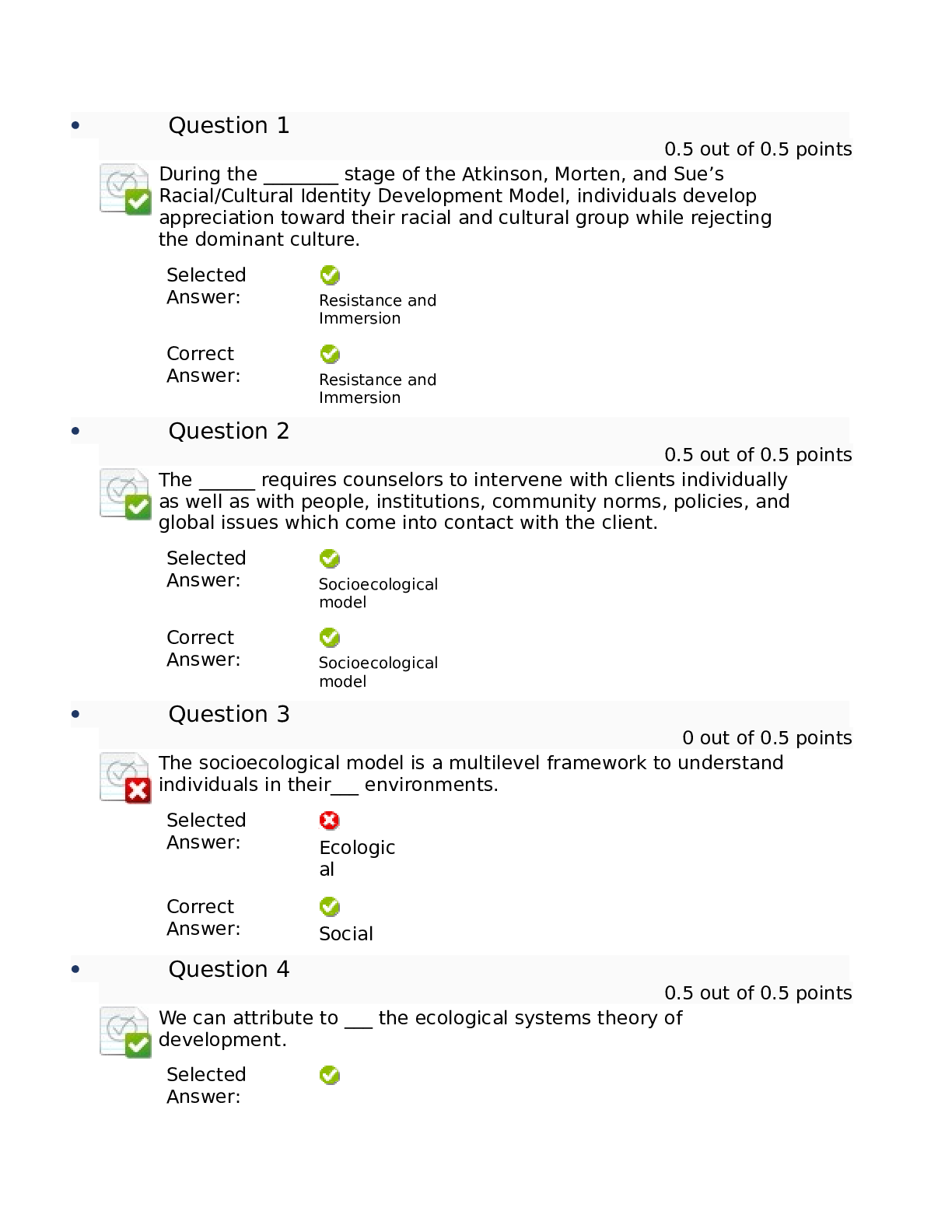
0.5 out of 0.5 points
During the ________ stage of the Atkinson, Morten, and Sue’s
Racial/Cultural Identity Development Model, individuals develop
appreciation toward their racial and cultural group while rejecting the
dominant culture.
• Question 3
0.5 out of 0.5 points
In the _____ stage of Helm’s People of Color Racial Identity Model,
individuals integrate their racial identity with other aspects of selfidentity.
• Question 4
0.5 out of 0.5 points
______ is a social category that people give meaning to, such as race,
ethnicity, gender, affectional orientation, age, ability status, religion,
spirituality, and social class.
• Question 5
0.5 out of 0.5 points
Intersectionality is:
Selected
Answer: How various social constructions such as race, ethnicity,
gender, sexual orientation, economic status, religion,
spirituality, and disability status collectively encompass
• Question 6
0.5 out of 0.5 points
In the pre-encounter stage of Cross’ Nigrescence Model, individuals:
• Question 7
0.5 out of 0.5 points
We can attribute to ___ the ecological systems theory of development.
• Question 8
0.5 out of 0.5 points
The U.S. has been called the most diverse country in the world.
Counseling a client from a different social and/or cultural background
is known as:
• Question 9
0.5 out of 0.5 points
_____ is the process of high levels of societal oppression and stigma
for members of historically marginalized groups leading to negative
health outcomes.
• Question 10
0.5 out of 0.5 points
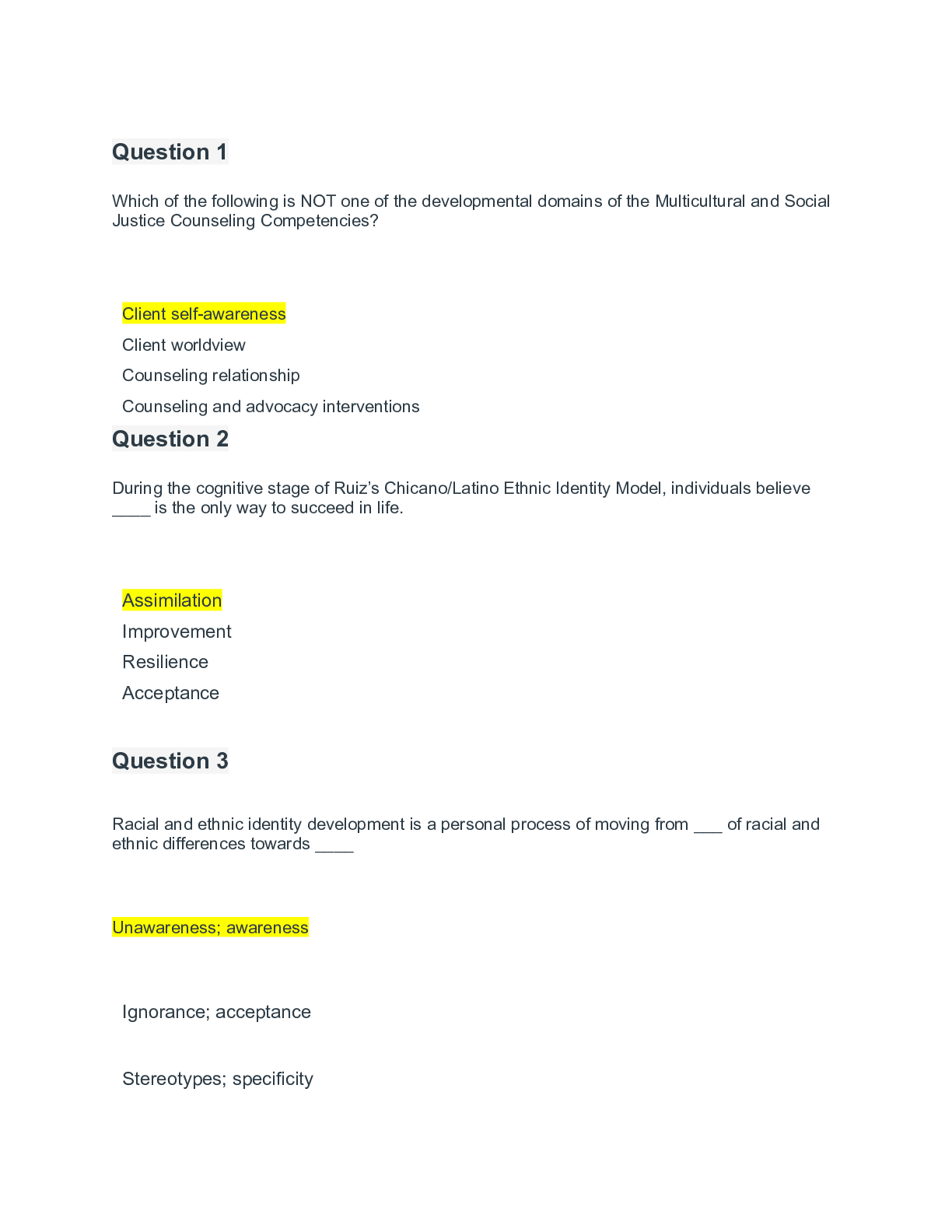
Racial and ethnic identity development is a personal process of
moving from ___ of racial and ethnic differences towards ____.
0.5 out of 0.5 points
In Phinney’s Ethnic Identity Development Model, ____ stage is a result
of successful exploration of ethnic identity:
• Question 12
0.5 out of 0.5 points
According to the Multicultural and Social Justice Competencies,
cultural and social justice competence is ____ and _____.
• Question 13
0.5 out of 0.5 points
During the cognitive stage of Ruiz’s Chicano/Latino Ethnic Identity
Model, individuals believe ____ is the only way to succeed in life.
• Question 14
0.5 out of 0.5 points
What does the “R” in the ADDRESSING-GSA model refer to?
• Question 15
0.5 out of 0.5 points
Intersectionality is:
• Question 16
0.5 out of 0.5 points
The Multicultural and Social Justice Counseling Competencies were
derived from…
• Question 17
0.5 out of 0.5 points
Culture refers to:
• Question 18
0.5 out of 0.5 points
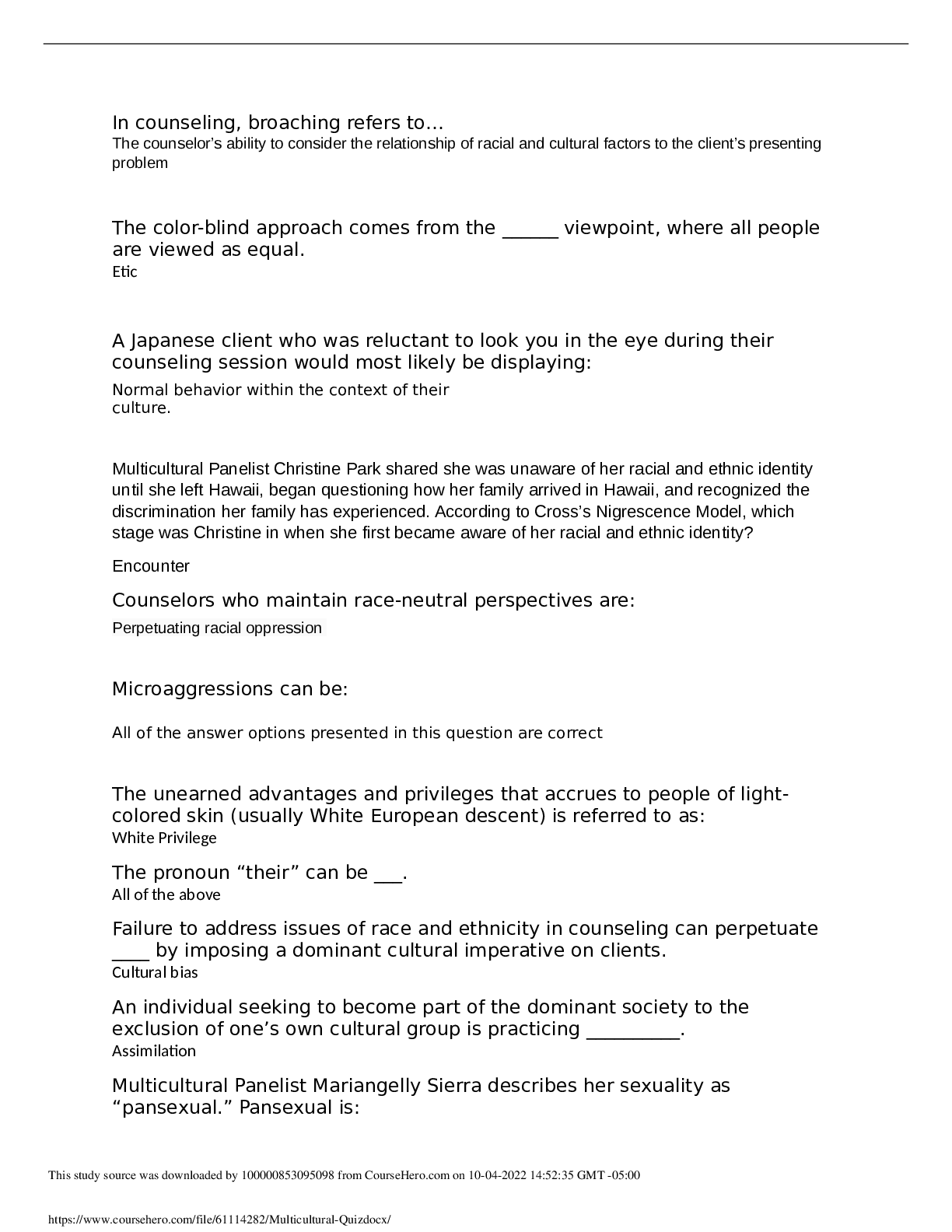
Microaggressions can be:
• Question 19
0.5 out of 0.5 points
The socioecological model is a multilevel framework to understand
individuals in their___ environments.
• Question 20
0.5 out of 0.5 points
The socioecological model focuses on five levels of influence
contributing to health behavior, including the
1) intrapersonal,
2) interpersonal,
3) institutional,
4) community, and
5) public policy.
The Multicultural and Social Justice Counseling Competencies add the
sixth level, ___.
Week 3 Quiz (number 2)
• Question 1
0.5 out of 0.5 points
In the contact stage of Helm’s White Racial Identity Development
Model, individuals:
• Question 2
0.5 out of 0.5 points
The original Multicultural Counseling Competencies, developed in
1992, include three competencies:
1) Attitudes and beliefs,
2) Knowledge, and
3) Skills.
What is the fourth competency added in the 2015 Multicultural and
Social Justice Competencies?
n
• Question 3
0.5 out of 0.5 points
Intersectionality is:
• Question 4
0.5 out of 0.5 points
The socioecological model includes the following spheres EXCEPT:
• Question 5
0.5 out of 0.5 points
Kimberlé Crenshaw began to use the term intersectionality to…
• Question 6
0.5 out of 0.5 points
During the ________ stage of the Atkinson, Morten, and Sue’s
Racial/Cultural Identity Development Model, individuals develop
appreciation toward their racial and cultural group while rejecting the
dominant culture.
• Question 7
0.5 out of 0.5 points
______ is a social category that people give meaning to, such as race,
ethnicity, gender, affectional orientation, age, ability status, religion,
spirituality, and social class.
• Question 8
0.5 out of 0.5 points
In the _____ stage of Helm’s People of Color Racial Identity Model,
individuals integrate their racial identity with other aspects of selfidentity.
• Question 9
0.5 out of 0.5 points
The ______ requires counselors to intervene with clients individually as
well as with people, institutions, community norms, policies, and
global issues which come into contact with the client.
• Question 10
0.5 out of 0.5 points
In the ___ stage of Cross’s Nigrescence Model, individuals develop
secure and positive internalization of African American identity.
• Question 11
0.5 out of 0.5 points
Microaggressions can be:
• Question 12
0.5 out of 0.5 points
_____ is the process of high levels of societal oppression and stigma
for members of historically marginalized groups leading to negative
health outcomes.
• Question 13
0.5 out of 0.5 points
We can attribute to ___ the ecological systems theory of development.
• Question 14
0.5 out of 0.5 points
In Phinney’s Ethnic Identity Development Model, ____ stage is a result
of successful exploration of ethnic identity:
• Question 15
0.5 out of 0.5 points
Which of the following is considered a part of culture?
• Question 16
0.5 out of 0.5 points
At the ____ level, oppression can be based on dehumanizing
interpersonal interactions with others that occur over time. At the ___
level, oppression manifests itself in the form of rules, policies, laws,
and institutions that create inequities for marginalized individuals.
• Question 17
0.5 out of 0.5 points
The Multicultural and Social Justice Counseling Competencies were
derived from…
• Question 18
0.5 out of 0.5 points
Racial and ethnic identity development is a personal process of
moving from ___ of racial and ethnic differences towards ____.
• Question 19
0.5 out of 0.5 points
During the cognitive stage of Ruiz’s Chicano/Latino Ethnic Identity
Model, individuals believe ____ is the only way to succeed in life.
• Question 20
0.5 out of 0.5 points
The socioecological model is a multilevel framework to understand
individuals in their___ environments.
[Show More]