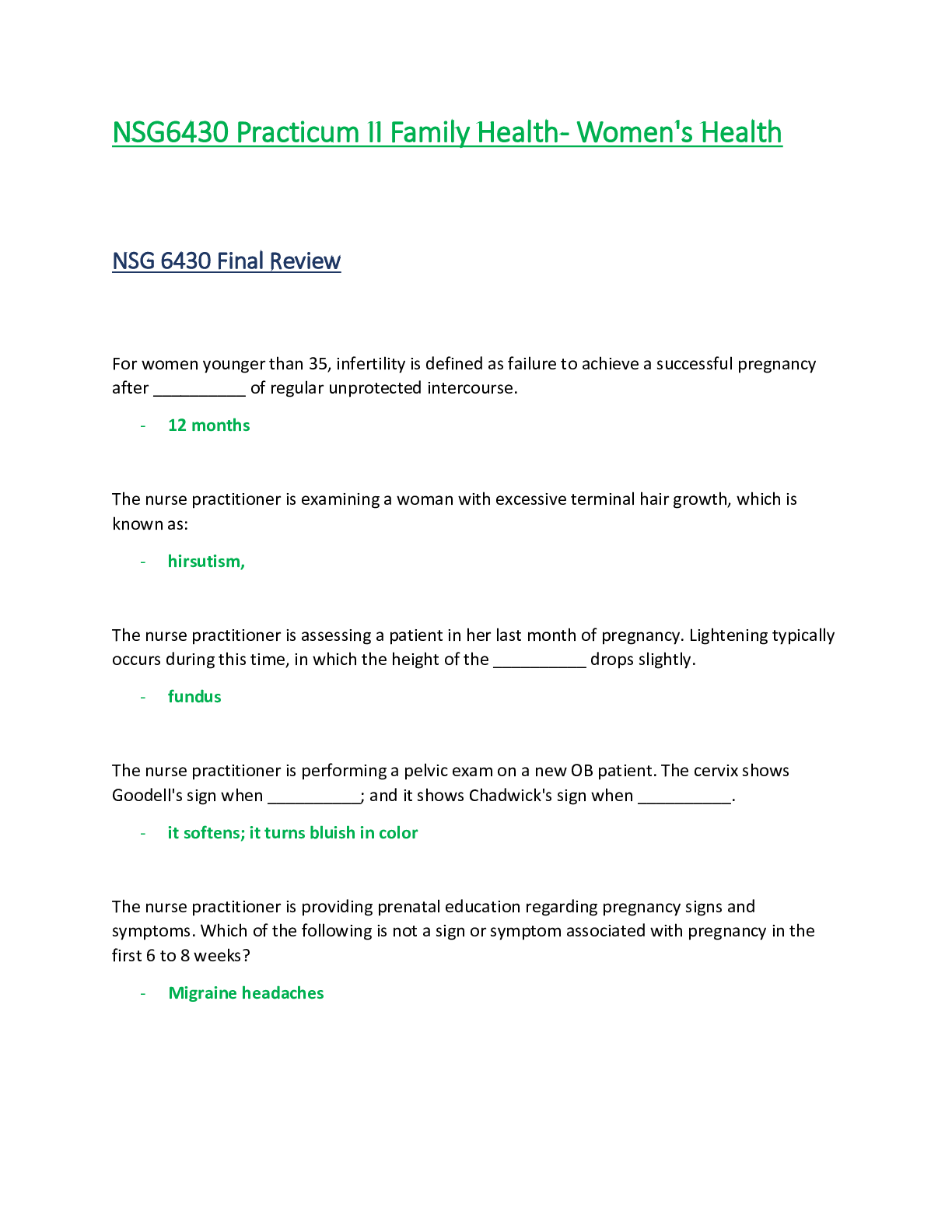
NSG6430 Final Exam South University NSG 6430 Final Exam
Study Guide:
NSG6430 Final Exam South University NSG 6430 Final Exam
Study Guide:
Question 1 The nurse practitioner is performing a bimanual exam on
a new OB
...
NSG6430 Final Exam South University NSG 6430 Final Exam
Study Guide:
NSG6430 Final Exam South University NSG 6430 Final Exam
Study Guide:
Question 1 The nurse practitioner is performing a bimanual exam on
a new OB patient and notices that the lower portion of the patient’s
uterus is soft. This is known as:
: A) Hegar's Sign B) Chadwick's Sign C) Nightingale's Sign D)
Goodell's Sign
Question 2 Your female patient presents for vaginal discharge with
an odor, and has noticed painless “bumps” on her vaginal area.
Sexual history includes past male partners and her current female
partner. On exam you note beefy red papules and an ulcerative lesion
on her vulva, granular tissue and scarring, and inguinal adenopathy.
You suspect she has:
A) HSV-2 B) Granuloma Inguinale C) Chancroid D) Molluscum
Contagiosum
Question 3 The nurse practitioner knows that a highly valuable
assessment tool for evaluating urinary incontinence and contributing
factors in daily life is:
A) the interview B) a voiding diary C) the physical exam D) the
patient's response to non-pharmacologic treatments
Question 4 The nurse practitioner is counseling a 57 year-old patient
with urinary incontinence. The patient desires to try nonpharmacological, non-invasive methods of treatment at this time.Which of the following should be included in the patient's plan of care?
Select all that apply.
A. Bladder training B. Kegel exercises C. Eliminate caffeine and
alcohol consumption D. Use of bulking agents
Question 5 The physical examination of any woman suspected of
being abused or battered includes all of the following except:
A) a thorough inspection for signs of injury, past and present B) a
physical assessment just like that of any other adult female C) a focus
on the patient's physical appearance, not her behavior D) the use of
body maps and diagrams to accurately portray the patient's physical
condition
Question 6 The most effective means of obtaining the history of
abuse is to use a communication model that:
A) avoids having the patient's children present during the discussion
B) signals someone is interested and that the woman is not alone C)
emphasizes the belief that violence is not acceptable, no matter what
the batterer might have said to the patient D) allows the patient to talk
without interruption and with time to relate, emphasize, and repeat her
full story
Question 7 Clinicians should routinely consider intimate partner
violence (IPV) as a possible diagnosis for women who present with all
of the following except:
A) chronic stress-related symptoms B) denial of any physical health
problems C) central nervous system (CNS) symptoms D) gynecologic
problems, especially multiple onesQuestion 8 The factors that enable women to enjoy and control their
sexual and reproductive lives, including a physical and emotional state
of well-being and the quality of sexual and other close relationships,
make up a woman's:
A) sexual health B) gender identit C) gender role behaviors D)
psychosocial orientation
Question 9 Which one of the following is not among the ways
clinicians can provide a welcoming, safe environment for Lesbian,
Gay, Bixsexual, or Transgender (LGBT) patients?
A) Avoid the heterosexual assumption by using gender-neutral
language. B) Explain whether and how information will be documented
in the patient's medical record. C) Ignore the sexual status or gender
identity of all patients. D) Offer mainstream referrals that are culturally
sensitive to SGMs.
Question 10 Which one of the following is the definition of the term
"gender identity"?
A) People who respond erotically to both sexes B) A self-label,
regardless of biologic or natal sex C) People who are similar in age,
class, and sexual status D) A label for behavior not usually associated
with one's natal sex
Question 11 Which one of the following statements about sexually
transmitted infections (STIs) is false?
A) Lesbians are at very low risk for development of STIs and vaginal
infections. B) HIV has been identified in case studies of women who
report sex only with women. C) Transgender women (Male to Female)
have extremely high rates of HIV infection. D) Risky behaviors for
STIs include sex during menses.Question 12 Among the midlife health issues of women, the number
one cause of mortality in the United States is:
A) primary osteoporosis B) cardiovascular disease C) overweight and
obesity D) cancer
Question 13 Lifestyle approaches to manage menopause related
vasomotor symptoms include:
A) sleeping more than 8 hours per night B) avoiding spicy foods, hot
drinks, caffeine, and alcohol C) decreasing levels of physical activity
D) more than 1,000 international units/day of vitamin E
Question 14 The standard for managing moderate to severe
menopausal symptoms is:
A) lifestyle changes, such as dieting and exercising B) nonhormone
products, such as antidepressant medications C) alternative care,
such as acupuncture, combined with organic herbs D) prescription
systemic hormone products, such as estrogen and progestogen
Question 15 The nurse practitioner is managing an adolescent with a
4 cm functional ovarian cyst that was confirmed on a recent
ultrasound. What plan of care should be anticipated for this patient?
A) Repeat bimanual exam in 1 week B) Refer for surgical consult C)
Repeat ultrasound in 2 months D) Stop all ovulatory inhibitor meds
Question 16 Non-pharmacologic therapy for chronic pelvic pain
includes the following: Select all that apply.A) Vitamin B6 B) Physical therapy C) Aerobic and nonaerobic exercise
D) Antidepressants
Question 17 The nurse practitioner understands that all of the
following organisms are responsible for infection of the Bartholin's
gland except:
A) Streptococcus faecalis B) Klebsiella C) Staphylococcus aureus
D) E. Coli
Question 18 Treatment of a large, symptomatic Bartholin's cyst
includes all of the following except:
A) Sitz baths B) Incision and drainage C) Topical corticosteroids D)
Antibiotics
Question 19 A 44 year-old African American female presents with
complaints of menorrhagia x 15 months. Pelvic ultrasound confirms
the presence of a large intramural leiomyomata. The nurse practitioner
should discuss all of the following options with the patient except:
A) GnRH agonist therapy B) Referral for surgical consult C) Progestin
therapy D) Estrogen therapy
Question 20 The nurse practitioner is treating a patient with Elimite
for scabies. The proper instructions to the patient should include:
A) All household contacts should be treated with Elimite regardless of
symptoms. B) The medication should be taken orally in one single
dose and repeated in 2 weeks. C) Apply only to the body area
infested with scabies and repeat treatment in 5 days. D) Apply to
all areas of the body from the neck down, wash off after 8 to 14
hours, then repeat treatment in one weekQuestion 21 The nurse practitioner understands that the proper
management of an asymptomatic woman with a small fibroid should
include:
A) Start combination COC therapy. B) Repeat ultrasound in 3-4
months. C) Reassess in 6 to 12 months. D) Refer for
myomectomy.
Question 22 The nurse practitioner is teaching a patient about
pediculosis. Which of the following statements by the nurse
practitioner is correct?
A) Nits can survive in hot and humid climates up to 21 days.” B)
“Adult pubic lice can survive 72 hours off their host.” C) “Pruritus
is not a common manifestation.” D) “The condition is treated with
Permethrin cream.”
Question 23 All of the following medications may be used for
neuropathic pain management of vulvodynia, except:
A) Neurontin B) SSRIs C) Methotrexate D) Tricyclics
Question 24 The nurse practitioner understands that which of the
following lab tests is appropriate for the patient who presents with
symptoms of dysesthetic vulvodynia?
A) RPR B) Pap smear C) Wet mount D) Endometrial biopsy
Question 25 Which of the following is a common antibiotic for
treatment of an infected Bartholin's cyst?
A) Minocycline B) Levaquin C) Bactrim D) AmpicillinQuestion 26 (2.5 points) The patient presents with complaints of a
painful, swollen lump in her vaginal area. She reports difficulty sitting
and walking due to the pain. Which of the following is a likely
diagnosis for this patient?
Question 26 options: Syphilis chancre Lichen Planus Genital Wart
Bartholin's cyst
Question 27 (2.5 points) The nurse practitioner understands that
which of the following are differential diagnoses in an adult female
patient with acute pelvic pain. Select all that apply:
Question 27 options: A) Ectopic pregnancy B) Appendicitis C)
Ovarian cyst with rupture D) Pelvic Congestion Syndrome
Question 28 (2.5 points) When women experience mild premenstrual
symptoms, such as mild breast tenderness, abdominal bloating, and
mild weight gain from water retention, this is known as:
Question 28 options: Luteal phase deficiency Premenstrual
dysmorphic disorder Premenstrual syndrome Follicular phase
deficiency
Question 29 (2.5 points) A patient with intraductal papilloma will
commonly present with a chief complaint of:
Question 29 options: A palpable mass Bloody nipple discharge
Bilateral milky discharge Mild localized pain
Question 30 (2.5 points) The nurse practitioner understands that the
necessary screening techniques in a patient suspicious of ovarian
cancer should include the following: Select all that apply.Question 30 options: CA-125 Transvaginal ultrasound Bimanual
pelvic exam Pap smear
Question 31 (2.5 points) Early symptoms experienced by a woman
with ovarian cancer include all of the following except:
Question 31 options: Vague abdominal pain Abdominal bloating
Fatigue Unexplained weight gain
Question 32 (2.5 points) The nurse practitioner is evaluating a
patient's risk of ovarian cancer. All of the following factors are
associated with an increased risk for ovarian cancer except:
Question 32 options: First degree relative with ovarian cancer BRCA
-1 and 2 mutations Obesity Oral Contraceptive Use
Question 33 (2.5 points) Patient education for condylomataacuminata
should include all the following except:
Question 33 options: The cause of the condition is a virus of the HPV
type Sexual partners should be checked and condoms used to
decrease incidence of transmission Treatment and elimination of
visible warts is a sign of cure, and transmission will not occur The
virus does not always cause a lesion, subclinical infection may occur
Question 34 (2.5 points) Tina is evaluated and diagnosed with
Molluscum Contagiosum. The nurse practitioner understands that
clinical presentation of this disease is characterized by:
Question 34 options: Fleshy, papular skin colored lesions with
indented centers that contain white curdlike material. Ulcerated
ragged edge lesions that are painful Clusters of vesicles that itch andare painful to palpation Painless fleshy clusters of growths that
resemble grapes or cauliflower
Question 35 (2.5 points) Sara is 72 years old and has been a widow
for 12 years. She presents for her yearly well woman exam. Sara has
not been sexually active since age 60. She has had regular pap
screenings in her life and has had no abnormal pap tests. Sara asks if
she needs a Pap test. Your response would be:
Question 35 options: Yes, you need a Pap test with HPV testing every
5 years. Yes, you should have a Pap test every 3 years. No, you do
not need a Pap test or a pelvic exam again, unless you notice a
vaginal discharge, have discomforts, or anything out of the ordinary.
No, you do not need a Pap test, but I do recommend we do a pelvic
exam to assess for abnormalities.
Question 36 (2.5 points) Misty presents with a painful “sores” in her
perineal area, dysuria and dyspareunia. On exam she has 2 shallow
ulcerated lesions on the right labia majora and one on the left. She
also presents with enlarged inguinal lymph nodes. Based on these
findings you suspect she has:
Question 36 options: HSV-2 Genital warts Chancroid Syphilis lesions
Question 37 (2.5 points) Which of the following is not true for HIV
infection evaluation?
Question 37 options: The CDC recommends HIV testing for all
persons seeking evaluation for STIs. HIV evaluation is recommended
if a patient has a history of unprotected sex with a previously
incarcerated male, an uncircumcised male, or participates in anal
penetration. If a patient is fearful they have been exposed to HIV, but
denies all risk factors, it is not recommended to test for HIV. Aids is
caused by HIV, mainly by sexual contact (anal, vaginal, or oral),contaminated blood and blood products, contaminated semen used
for artificial insemination, intrauterine acquisition, and breastmilk.
Question 38 (2.5 points) The nurse practitioner understands that the
risk factors for developing vaginal candidiasis include which of the
following?
Question 38 options: Hypoglycemia A diet high in refined sugar Use
of Vit C supplement A habit of consuming live culture yogurt several
times a week
Question 39 (2.5 points) Cindy presents to your clinic for STI testing
after realizing her current boyfriend has been seeing other women.
She states she was told that one of the women has hepatitis B. Your
patient education regarding hepatitis B includes all the following
except:
Question 39 options: Hepatitis B is transmitted enterically Hepatitis B
has an incubation period of 6 weeks to 6 months Hepatitis B surface
antigen (HBsAG) indicates if the patient has hepatitis B infection
Hepatitis B infection primarily affects the liver
Question 40 (2.5 points) Stacy has made an appointment at your
clinic for c/o dysuria. During the HPI she explains, “My bottom hurts
when I pee, and I have bumps there”. She has never had this before
and is worried. She denies fever, although she feels “a little like I have
the flu” explaining she has a headache and feels achy and tired. She
denies exposure to a STI noting she and her partner have been
monogamous for 6 years. On exam you notice a cluster of painful
vesicles adjacent to the vaginal introitus. The most likely diagnosis is:
[Show More]









.png)