NR599
FINAL STUDY GUIDE
● Ethical decision making
○ When making choices about ethical issues based on the standards of right
vs wrong.
○ It requires a systematic framework for addressing the complex and often
contr
...
NR599
FINAL STUDY GUIDE
● Ethical decision making
○ When making choices about ethical issues based on the standards of right
vs wrong.
○ It requires a systematic framework for addressing the complex and often
controversial moral questions.
● Bioethical standards
○ The study of healthcare ethics
○ Bioethics takes on relevant ethical problems seen by healthcare providers
in relation to care
● Telehealth
○ wide range of health services that are delivered by telecommunications
ready tools, such as telephone, videophone, and computer
○ is needed to help fill the nursing shortage allowing nursing to see more
patients quicker, as well as the aging population
○ Telecommunication technologies used to deliver health-related services or
to connect patients and healthcare providers to maximize patients‘ health
status.
○ A relatively new term in the medical/nursing vocabulary, referring to a wide
range of health services that are delivered by telecommunications-ready
tools such as the telephone, videophone, and computer.
● Medical Applications
○ Software developed for medical purposes, including home medical monitoring
system, medical databases for healthcare professionals, etc.
● Medical Devices
○ is any device intended to be used for medical purposes
● FDA Oversight for Medical Devices
● Privacy
○ An important issue related to personal information
○ Restricted access of patient information or data
● Confidentiality
○ To ensure that all personal information is protected by ensuring that
limited access is only given to those who are authorized to view that
information.
■ Protecting privacy of personal information or data● Cybersecurity
○ the state of being protected against the criminal or unauthorized use of
electronic data, or the measures taken to achieve this.
○ With the expansion of technology. Facilities are taken more precautions to
prevent cyber attacks. With the move towards advancing cybersecurity is
important, technology continues to grow.
○ Ensure all systems are adequately protected and patients remain safe
from harm
○ NI are frequently called on to evaluate the safety and effectiveness of new
devices and software.
● Computer-aided translators
○ is a form of language translation in which a human translator uses
computer hardware to support and facilitate the translation process.
● HIPPA
○ was established in the U.S. in 1996 to protect an individual's personal health care
information.
○ Signed by Pres. Bill Clinton
○ Healthcare institutions are required to meet all standards and comply with the
appropriate security measures in order to safeguard patient data.
○ Four parts to HIPAA's Administrative Simplification
■ Electronic transactions and code sets standards requirements.
■ Privacy requirements.
■ Security requirements.
■ National identifier requirements.
● ICD-10 Coding
○ An alphanumeric code used by doctors, health insurance companies, and public
health agencies across the world to represent diagnoses.
○ The system offers accurate and up-to-date procedure codes to improve health care
cost and ensure fair reimbursement policies
○ The current codes specifically help healthcare providers to identify patients in
need of immediate disease management and to tailor effective disease
management programs.
■ Similarly ICD and CPT coding go together
● Is a medical code set that is used to report medical, surgical, and
diagnostic procedures and services to entities such as physicians,
health insurance companies and accreditation organizations.
● Evaluation and Management Coding
○ Is a medical coding process in support of medical billing○ Practicing health care providers in the United States must use E/M coding
to be reimbursed by Medicare, Medicaid programs, or private insurance
for patient encounters.
● Reimbursement Coding
○ Is based on claims and documentation filed by providers using medical diagnosis
and procedure codes.
○ Commercial payers must use standards defined by the U.S. Department of Health
and Human Services (HHS) but are largely regulated state-by-state.
● Clinical Support Tools
○ are designed to help sift through enormous amounts of digital data to suggest next
steps for treatments, alert providers to available information they may not have
seen, or catch potential problems, such as dangerous medication interactions
○ Such as CDS clinical decision support, a program used by providers.
○ Or various applications use by healthcare professionals to allow for communicate
between provider to provider and provider to patient
○ The tools are all used to benefit patient outcome
● Workflow analysis
○ Not an optional part of clinical implementations, but rather a necessity for
safe patient care fostered by technology.
○ The ultimate goal of workflow analysis is not to ―pave the cow path,‖ but
rather to create a future-state solution that maximizes the use of
technology and eliminates non–value-added activities.
○ Although many tools and methods can be used to accomplish workflow
redesign, the best method is the one that complements the organization
and supports the work of clinicians.
○ needs to be done as well as working in optimization (moving conditions
past their current state into a more effective method of performing.
WEEK FIVE READING/ KEY POINTS
Key points from the lessons and modules
● Clinical Decision Support (CDS)
○ Generate patient specific interventions, assessments and
recommendations
○ CDS tools existed prior to development of EHRs
○ The primary goal of implementing a CDS tool is to leverage data and the
scientific evidence to help guide appropriate decision making
● CDS improving healthcare
○ Reducing clinical variation and duplicative testing
○ Ensuring patient safety○ Avoiding complications that may result in readmissions
○ Create alerts about drug-drug interactions
○ Drug allergy contraindications
● CDS challenging healthcare
○ Alarm fatigue
○ Clinical burnout
○ Occur with poorly implemented CDS features
○ Financial burden
● Workflow Design
○ Used to describe the action or execution of a series of tasks in a
prescribed sequence
○ Progression of steps (tasks, events, interactions) that constitute a work
process
○ In a sequential workflow, each step depends on the occurrence of the
previous step; in a parallel workflow, two or more steps can occur
concurrently.
○ Nursing informatics is uniquely positioned to engage in the analysis and
redesign of processes and tasks surrounding the use of technology.
● Changes in workflow, poor system design and usability issues, lack of
understanding about these systems and their capabilities, user errors and system
errors, and lack of defined protocols can all lead to process breakdowns and
errors.
McGonigle Chapter 13
● EHR and information systems provide POC decision support to prevent medical
errors to save lives and money
● Workflow must be considered before implementing technology or it can be more
dangerous
○ Computerized provider order entry (CPOE) focuses on considering the
workflow
● Barriers to implement technology: cost & length of time to incorporate it, frequent
upgrades interrupting the workflow
● American Recovery and Reinvestment Act (ARRA)- used financial incentives to
implement Meaningful Use (MU) rules and regulations
○ Stage 1: data capturing and sharing
○ Stage 2: advanced clinical processes
○ Stage 3: improve outcomes
● Medicare Access and CHIP Reauthorization Act of 2015 (MACRA) took over and
created a quality payment program (QPP) to replace Medicare reporting
programs○ Merit Based Incentive Payment (MIPS or Alternative Payment Models
(APM) to allow clinicians to choose what suites their needs the best,
simplify process for achievement, align with Health IT Certification criteria,
emphasize interoperability, information exchange, security measures, and
patient access to information, reduce number of measures, and exempt
clinicians from reporting if EHR is not applicable to their practice
● Hospitals have small profit margins so they need to work smarter and not harder
with the help of technology to keep the margins from getting smaller
○ Workflow analysis needs to be done as well as working in optimization
(moving conditions past their current state into a more effective method of
performing.
● More research is needed in the area of financial implications of workflow
inefficiencies and their impact on patient care
○ This is hard due to lack of standardized terminology in this area
● Workflow redesign- one of the fundamental skills sets that make up the discipline
of an informatics nurse
● Process owners: those that directly engage in the workflow to be analyzed and
redesigned
● Six Sigma or Lean Departments: efficient and effective delivery of care
○ Key underpinning is the removal of waste
● Variation: when workers perform the same function in different ways- should be
eliminated when possible
● Involve operational staff when possible to ensure the buy-in of staff
● To move from current state to future state gap analysis is necessary-- zeros in on
the major areas most affected by the change
● Chapter 13 Workflow and Beyond Meaningful Use
○ Alternative Payment Models (APM)‘s
■ The Reauthorization Act of 2015 (MACRA) reformed Medicare
payments by making changes that created a quality payment
program (QPP) to replace the hodgepodge system of Medicare
reporting programs.
■ The MACRA QPP has two paths—merit-based payment system
(MIPS) or alternative payment models (APMs)—that will be in effect
through 2021 and beyond.
■ The APMs are not just incentives, but fundamental changes in how
we pay for health care in the United States. It is these models,
particularly those dealing with total cost of care, that have the
potential to fundamentally alter the value we receive from health
care.
○ Clinical transformation■ The complete alteration of the clinical environment; widespread
change accompanies transformational activities, and clinical
transformation implies that the manner in which work is carried out
and the outcomes achieved are completely different from the prior
state, which is not always true in the case of simply implementing
technology.
■ Technology can be used to launch or in conjunction with a clinical
transformation initiative; however, the implementation of technology
alone is not justifiably transformational ability. Therefore, this term
should be used cautiously to describe redesign efforts.
○ Events
■ Occurrences that might be significant to other objects in a system
or to external agents
■ for example, creating a laboratory request is an example of a
healthcare event in a laboratory application.
■ An event is defined and could be a triggering event for the task or
workflow; a task or workflow can have several triggering events.
○ Information systems
■ The manual and/or automated components of system of users or
people, recorded data, and actions used to process the data into
information for a user, group of users, or an organization.
○ Lean
■ Lean and Six Sigma are a complementary combination of activities
that focus on doing the right steps and actions (Lean) and doing
them right the first time
○ Medical home models
■ An information technology platform that enables the seamless
exchange of important patient information among many providers in
a healthcare system.
■ Typically the primary care physician (medical home) initiates the
collection of patient data, coordinates the care of the patient, and
helps to maintain the accuracy of such data.
■ Other care providers access the information and add to it as they
provide services to patients.
○ Medicare Access and CHIP Reauthorization Act of 2015 (MACRA)
■ An act that reformed Medicare payment by making changes that
created a quality payment program (QPP) to replace the
hodgepodge system of Medicare reporting programs.
○ Metrics■ Measurements or a set of measurements to quantify performance;
they provide understanding about the performance of a process or
function.
■ Typically, within clinical technology projects, one identifies and
collects specific metrics about the performance of the technology or
metrics that capture the level of participation or adoption. Equally
important is the need for process performance metrics.
■ Process metrics are collected at the initial stage of a project or
problem identification.
○ Process analysis
■ Breaking down the work process into a sequential series of steps
that can be examined and assessed to improve effectiveness and
efficiency; explains how work takes place, gets done, or how it can
be done.
○ Process map
■ A visual depiction of the output of workflow analysis process.
○ Process owners
■ Those persons who directly engage in the workflow to be analyzed
and redesigned and have the ultimate responsibility for the
performance of the process.
■ These individuals can speak about the intricacy of the process,
including process variations from the normal.
○ Qualified Clinical Data Registries (QCDRs)
■ Introduced for the Physician Quality Reporting System (PQRS)
beginning in 2014, a QCDR will complete the collection and
submission of PQRS quality measures data on behalf of individual
eligible professionals (EPs) and PQRS group practices.
■ For 2016, a QCDR is a Centers for Medicare and Medicaid
Services–approved entity that collects medical and/or clinical data
for the purpose of patient and disease tracking to foster
improvement in the quality of care provided to patients.
○ Quality
■ A level or grade of excellence; relative merit; a distinct or essential
characteristic, attribute, or property.
○ Quality payment program (QPP)
■ To replace the hodgepodge system of Medicare reporting programs
○ Six Sigma
■ Business management tactic that seeks to improve the quality of
process outputs by identifying and removing the causes of errors
and reducing inconsistency and variability in processes○ Workflow/Work process
■ A progression of steps (tasks, events, and interactions) that
constitute a work process; involve two or more persons; and create
or add value to the organization‘s activities.
■ In a sequential workflow, each step depends on the occurrence of
the previous step; in a parallel workflow, two or more steps can
occur concurrently.
■ The term ―workflow‖ is sometimes used interchangeably with
―process‖ or ―process flow,‖ particularly in the context of
implementations.
■ A sequence of connected steps in the work of a person or team of
people—that is, the process or flow of work within an organization;
a virtual illustration of the ―real‖ work or steps (flow) that workers
enact to complete their tasks (work).
■ The purpose of examining and redesigning workflow is to
streamline the work process by removing any unnecessary steps
that do not add value or might even hinder the flow of work.
○ Workflow analysis
■ Not an optional part of clinical implementations, but rather a
necessity for safe patient care fostered by technology.
■ The ultimate goal of workflow analysis is not to ―pave the cow path,‖
but rather to create a future-state solution that maximizes the use of
technology and eliminates non–value-added activities.
■ Although many tools and methods can be used to accomplish
workflow redesign, the best method is the one that complements
the organization and supports the work of clinicians.
McBride, S., & Tietze, M. (2018).
● Chapter 6 Computers in Health Care
○ application software
■ generally has a purpose or function specific to its use (e.g.,
accounting/financial applications
○ Database
■ are defined as a large collection of data organized for rapid search
and retrieval
○ hardware
○ hardware configuration■ Various system settings that allow for computers or other hardware
to work
○ human factors
■ the field of study focused on understanding human elements of
systems, in which ‗systems‘ may be defined as software, medical
devices, computer technology, and organizations
○ network typology
■ Network topology is the arrangement of the elements of a
communication network.
■ Network topology can describe the arrangement of various types of
telecommunication networks, including command and control radio
networks, industrial field busses and computer networks.
● Tree network
○ one builds off the switch and connects a switch to
switch, and this configuration works using the
Internet.
■ Expansion is available with this network
● Star network
○ Typically connected via a switch or hub, with a limited
number of computers on the network
● Ring network
○ set up in a circular configuration with the signals
transmitting around the ring until the envelope
containing the data, or package of information, finds
the designated address.
○ Difficult to add to a computer
○ When one computer goes down the whole network
goes down
● Bus network
○ Bus configurations are dependent on the total length
of the network and the distance the computers are
spaced within the network.
○ Total distance, number of computers, and spacing are
relevant to the efficiency with a bus configuration.
■ Various networks have pros and cons depending on the
configuration.
○ programming languages
■ is a mechanism for transforming information into a computer in the
form of machine code, which instructs the computer to do some
type of task■ First generation
● Referred to as the ―low language‖
● consists of binary 0s and 1s
■ Second generation
● One step higher and constitutes assembly languages that
use reserved words and symbols that have special and
unique meaning
● It is considered a low-level language similar to machine
language
● Uses symbolic operation code to represent the machine
operation code
● The assembly code is specific to the machines, including
computers
■ Third generation
● Intended to be easier to use, and higher level languages
provided a programmer-friendly language.
● Some examples of this type of code include FORTRAN,
BASIC, Pascal, and the C-family
■ Fourth generation
● More in line with the ―human language‖ and therefore easier
to work with than 3GL
● Domain-specific and high-productivity languages and include
aspects such as database queries and report generators, as
well as GUI creators, database programming, and scripts.
● Many of the 4GL are data oriented and use structured query
language (SQL) developed by IBM and also adopted by the
American National Standards Institute
■ Fifth generation
● Utilize visual tools to support programming
● One such frequently used language is Visual Basic
● 5GL to be a type of constraint logic or problem-solvingbased programming
● PROLOG is a programming language that fits into this
description
○ Query
■ computer languages used to make queries in databases and
information systems
■ programming language that requests and retrieves data from
database and information systems by sending queries
○ reports○ Software types
■ Business software
● Used by and for specific business functions in healthcare
● Embedded within the EHR
■ Messaging software
● Used to exchange files and messages between systems
remotely
● Healthcare systems require encryption of data to meet
HIPAA regulatory requirements when using communications
■ Data-management software
● Source software with the primary function of managing a
database in a particular structure, usually relational or object
oriented
■ Graphics software
● allows the end user to manipulate graphic images on the
computer
■ Simulation software
● allows the end user to model real phenomena with a set of
mathematical formulas used in healthcare professional
training to simulate events rather than have students
practice on patients
■ Gaming software
● uses interaction with a user interface to generate visual
feedback on a video device
■ Spreadsheet software
● allows data to be analyzed in a tabular format with data
organized in rows and columns that can be manipulated by
formulas
■ Word processors
● performs processing of text (words) to compose, edit,
format, or print written material
■ Workflow software
● reflect a process or steps within a process that provides
functionality to create workflows with a diagram-based
graphical designer approach
■ Presentation software
● used to create slide presentations that allow typesetting and
graphical design to create a professional-looking
presentation quickly
○ system software■ Used to start and run a computer
■ is related to what the software does within the computer system to
support the use of the computer
○ Usability
■ The degree to which something is able or fit to be used
● Chapter 19 Clinical Decision Support System
○ CDS: provides clinicians, staff, patients, or other individuals with
knowledge and person-specific information, intelligently filtered or
presented at appropriate times to enhance healthcare
○ Successful implementation is done using leadership, executive support,
and interprofessional teams representing stakeholders most impacted by
changes to workflow
○ Five rights framework: right information (what), right person (who), right
CDS information format (how), right channel (where), right point in the
workflow (when)
○ Key strategy within HITECH and MU act
○ Primary goal of CDS is to leverage data and the scientific evidence to help
guide appropriate decision making
○ Predictive vs prescriptive analytics
■ Predictive: take available data and apply logic or algorithm to
calculate the likelihood of an event (falls risk tool)
■ Prescriptive: lead the clinician on a defined pathway to address the
identified issue (hundreds of data points to give a weighted sepsis
score- trigger a sepsis guideline order set)
○ Qualitative evaluation strategy after implementing CDS program may
include focus groups or surveys-- Quantitative measures include flow
charts and may be used to report back to leadership
○ CDS teams must design and deploy CDSS‘s so they are most helpful for
their purposes as EHR directly from the vendor do not automatically
capture certain information to find trends and suggest interventions
■ Finding common ground terminology is important as what one thing
means to IT staff is something totally different from a doctor or even
different to the nurse
■ The team must work together, as clinicians can have unrealistic
expectation for the capability of technology/computer, and the
informatics team needs to know what is important to the front line
staff
○ The most important issue with regard to liability/legal concerns is whether
CDS tools are well designed and well implemented, but clinicians are heldto the same level of accountability with the EHR as with the paper-based
record- alerts should be clinically relevant
■ Also recommended that a stronger government regulation of CDS
and the development of clinical practice guidelines
○ Challenges to implementing CDS
■ Timing of when to receive alerts within provider workflow
■ Speed and ease of access to alerts
■ Autonomy desired by clinician related to how much control end
users have over their response to CDS (whether the CDS alert is a
hard stop preventing them from moving forward in the EHR until
alert is addressed & whether it takes significant effort to override
WEEK SIX READING/ KEY POINTS
● McGonigle Chapter 18 Telenursing and remote access telehealth
○ Telehealth: wide range of health services that are delivered by
telecommunications ready tools, such as telephone, videophone, and
computer
○ Foundation of knowledge model and home telehealth
■ Knowledge acquisition: receiving information from telehealth device
such as vital signs taken in home and patients response to
customized questions- information goes to remote server and
accessed by telehealth nurse
■ Knowledge processing: take vital signs, subjective data, with pt
history to get picture of the clinical situation
■ Knowledge generation: uses nursing skills & knowledge along with
information from the patient to decide the best course of action to
take and acts on the data. The nurse will reflect upon the situation
to see if any more information needs to be gathered or if the
physician needs to be consulted regarding tx plan. Additional
questions may be asked if needed.
■ Knowledge dissemination: may include calling the doctor,obtaining
change in med order, calling pt to notify of the change, education,
continued monitoring
○ Allow easier and faster access to patients conditions ex. Pt‘s response to
medications in hours rather than in days
○ Telehealth is needed to help fill the nursing shortage allowing nursing to
see more patients quicker, as well as the aging population (⅘50+ years
old live with at least one chronic disease or condition). The amount of
chronic conditions and number of people affected by chronic conditions isexpected to continue rising-- ⅓ of people of all ages have limited ability to
go to school or live independently due to chronic conditions
○ The U.S healthcare system spends $1.4 trillion each year on conventional
medical care and will increase in the coming decades-- one solution is to
develop a new clinical model for American health care that includes
technology
○ Telemedicine: use of medical information exchanged from one site to
another via electronic communications to improve patients health status--
Telehealth is similar but is a broader definition that does not always
involve clinical services
○ Telehealth: use of technology to deliver healthcare, health information, or
health education at a distance
■ Ex: teleradiology- test results are forwarded to another facility for dx
○ Store and forward telehealth transmissions: digital images, video, audio,
and clinical data are captured and stored on the client computer or devicethen data are transmitted securely to a specialist or clinician at another
location where they are studied, if applicable they will transmit it back
○ Real-time telehealth: telecommunications link to provide live interaction to
take place
○ Telephony: telephone monitoring, most basic type of telehealth
● McBride Chapter 7 EHR and POC technology
○ Adoption
■ refers to how well the staff and users actually use and embrace the
system as part of their routine daily activities
■ Adoption of the EHR by stakeholders, including leadership,
clinicians, support staff, and patients, aligns with more mature
stages in accordance with the diffusion of an innovation theoretical
framework
■ Today, the adoption of EHRs has become routine, given that most
organizations and providers have an EHR
○ barcode medication administration
■ Have removed many of the process and human factor effects of
patient care, leading to a reduction in errors and improved quality
■ Medication is prepared and delivered to the patient by scanning the
patient‘s armband and the medication, after which an electronic
process occurs that verifies the five rights of medication
administration using a barcode reader.
○ early adopters■ Early adopters may also be champions, nursing informaticists, or
superusers, and represent about 13.5% of the organization‘s
population
■ They may also be users who are engaged and ready to start using
the system to its fullest potential and offer a positive response on
the implementation
■ Early adopters look for the bugs in the system and seek to find
solutions
■ They are willing to support the system with their peers and other
staff, and to promote the use of the system.
■ They follow the defined workflows and ask questions in areas of
uncertainty
■ Early adopters may look for better ways to perform specific
workflows, if they feel the workflows are not optimized or could
work better
■ They are supportive of the system but are also realistic in their
approach, yet they remain positive while looking for solutions to
problems or issues.
○ electronic health record
■ Is the systematized collection of patient and population electronicallystored health information in a digital format
■ These records can be shared across different health care settings
■ EHRs are real-time, patient-centered records that make information
available instantly and securely to authorized users
○ Evaluation
■ An evaluation of how effective the adoption of an EHR has been
can be measured through qualitative studies, such as surveys,
questionnaires, focus groups or ethnographic observational
methods, staff interviews, and workflow analysis before and after
the implementation of the system.
■ An evaluation of the implementation should be done by all
members of the project team, as well as by the staff using the
system
○ Implementation
■ The implementation of an EHR follows a very specific process
called SDLC
■ SDLC is used by engineers and developers in creating systems,
but it is also the accepted process for managing a project, such as
an EHR implementation, from decision making, to beginning a
project, to the completion of the project■ An SDLC approach has a definite time frame—a beginning or
initiation point and an end or closure point. This section reviews the
SDLC approach to EHR implementation
■ There are several different constructs for managing projects of the
magnitude and scope of an EHR implementation, but SDLC follows
a very specific group of activities defined within each phase, thus
further defining the project steps and requirements
■ During the implementation phase, policies and procedures are
written to define the workflows, training materials are developed,
and testing is completed
■ The actual implementation, or ―go-live,‖ occurs at a point and time
that is usually supported by the builders, developers, and
superusers for a specific time period
○ Innovators
■ Innovators on average account for about 2.5% of the
organization‘s population and may include nursing informaticists,
champions, and superusers
■ They embrace the technology and understand the potential of the
EHR and the ability to expand the infrastructure with new
innovations to further improve safety and quality of patient care, as
well as the clinician experience
■ They seek to help define the system and are often testers involved
in the design of the workflows
■ Innovators often are innovators in other areas of their lives
■ Innovators constantly push for advanced functionality of the
system, pushing the limits of the system and creatively thinking of
ways to improve existing workflows and functionality.
○ Interoperability
■ Interoperability describes the extent to which systems and devices
can exchange data and interpret that shared data
■ Interoperability is becoming more prominent and more robust in its
use, due to advancement of standards, such as FHIR, and
application program interface (API), which easily link data between
multiple sources.
■ Systems can work together synergistically to enhance health
information management, as well as reduce redundancy or data
collection, allowing for aggregation of data for analytics and
reporting■ Among systems is what makes it possible to have different
applications within an organization and also allows sharing of data
between organizations, providers, or other stakeholders
○ Laggards
■ They are the most resistant to the use of anything new, resisting
change of any type
■ They express concern about patient safety and may talk about
changing jobs or leaving the workforce altogether rather than adjust
to the new methods
■ Laggards need a lot of support from superusers as well as direction
from management to use the system
■ They are concerned about their own ability to use the EHR, as well
as experience a feeling of loss of control in the many changes that
are occurring
○ point-of-care technology
■ Encompasses the devices and systems that support health-care
professionals in their daily activities of monitoring patients, caring for
them, and documenting their health progress
○ Rogers‘s Diffusion of Innovations model
■ Rogers proposes that four main elements influence the spread of a new
idea
● the innovation itself
● communication channels
● time
● social system
■ This process relies heavily on human capital
● McBride Chapter 10 Evaluation methods and strategies for EHR
● McBride Chapter 16 Telehealth and mobile health
WEEK SEVEN READING/ KEY POINTS
● McGonigle Chapter 5 Ethical Applications of Informatics
○ Alternatives
■ Having a choice between two or more options available
○ Anti Principlism
■ Theory that comes with expansion of technological changes in
recent years and the rise in ethical dilemmas that occur due to
changes
■ Those against principlism include those who claim that its principles
do not represent a theoretical approach
○ Applications (Apps)■ Software used on a mobile device.
○ Autonomy
■ The right a person has to choose for him or herself
○ Beneficence
■ Actions performed that benefit the welfare of others
○ Bioethics
■ The study of healthcare ethics
■ Bioethics takes on relevant ethical problems seen by healthcare
providers in relation to care
○ Bioinformatics
■ The use of science (computer, information and cognitive) in relation
to the human genome.
■ An interdisciplinary science that applies computer and information
sciences to solve biological problems.
○ Care ethics
■ An ethical approach to solving moral dilemmas in healthcare that is
based on relationships and interactions or caring for others
○ Casuist approach
■ An approach to ethical decision making that grew out of the
concern for methods of examining ethical dilemmas
■ Casuistry is a specific ethical reasoning method that analyzes the
facts of a case in a sound, logical, and ordered or structured
manner.
○ Confidentiality
■ To ensure that all personal information is protected by ensuring that
limited access is only given to those who are authorized to view
that information.
○ Consequences
■ Outcome resulted in ones decision making
○ Courage
■ having the strength to face difficulty
○ Decision making
■ Outcome of our intellectual processing
○ Decision support
■ Recommendations for interventions based on computerized care
protocols.
■ The decision support recommendations may include such items as
additional screenings, medication interactions, or drug and dosage
monitoring.
○ Duty■ One‘s feeling of being obligated to carry out specific tasks based on
one‘s rank
○ Ethical decision making
■ When making choices about ethical issues based on the standards
of right vs wrong.
■ It requires a systematic framework for addressing the complex and
often controversial moral questions.
○ Ethical dilemma
■ A difficult issue that requires the use of standards to solve issues.
Ethically challenged.
○ Ethical, social, and legal implications
■ Understanding of the ethical, social, or legal connections of an
issue that relate to a moral question of right and wrong.
○ Ethicists
■ Experts in ungrounded judgments of other people
■ Ethicists understand that made the best decision that they could
based on the specific situation and stakeholders
○ Ethics
■ A process of examining moral questions and understanding the
difference between right and wrong.
○ Eudaemonistic
■ Ethical evaluation that involves consideration of which actions lead
to being a happy person
○ Fidelity
■ The extent to which a simulation mimics the processes of a real
environment
○ Good
■ The outcomes wanted in ethics
○ Google Glass
■ A computer that you can wear from Google that can take pictures,
play video, and display text messages with no one knowing
○ Harm
■ Physical or mental injury
■ Unfavorable outcome in ethics.
○ Justice
■ Fairness
○ Liberty
■ Having independence
■ Not being controlled
○ Moral dilemmas■ Situations where there is no clear proof of one of the options being
morally wrong or right
○ Moral rights
■ Ethical privilege
○ Morals
■ Social conventions about right and wrong human conduct that are
socially constructed and tacitly agreed upon to be right
○ Negligence
■ Not upholding the standards of care, posing risk that can be
careless or unreasonable
○ Nicomachean
■ An approach to ethical thinking based on the work of Aristotle.
○ Nonmaleficence
■ The act of doing no harm
○ Principlism
■ A foundation for ethical decision making by rational individuals and
beliefs
○ Privacy
■ An important issue related to personal information
■ Restricted access of patient information or data
○ Rights
■ Privileges
■ Include the right to privacy and confidentiality
○ Security
■ Protection from danger or loss
○ Self-control
■ Self-discipline
■ Strength of will
○ Smartphones
■ A cell phone that has limited personal digital assistant capabilities
■ Smartphones have limited personal computer functionality
○ Social media
■ Communication that promote real-time information exchange.
○ Standards
■ Benchmarks, rules, principles.
○ Truth
■ Fact, certainty or fidelity
○ Uncertainty
■ Insecurity or vagueness
○ Values■ Important beliefs that provide principles for behaviors and beliefs.
○ Veracity
■ Having the right to the truth
○ Virtue
■ A ideal toward which we should strive that provides for the full
development of our humanity.
■ Attitude that enables us to be and to act in ways that develop our
highest potential
■ examples are honesty, courage, compassion and fairness. They
become characteristics of a person
■ The virtuous person is the ethical person.
○ Virtue ethics
■ Theory that suggests individuals use power to bring about human
benefit
■ Consider the needs of others and the responsibility to meet those
needs.
○ Wisdom
■ Knowledge applied in a practical way or translated into actions
■ Use of knowledge and experience to heighten common sense and
insight so as to exercise sound judgment in practical matters
● McGonigle Chapter 8 Legislative Aspects of Nursing Informatics: HITECH and
HIPAA
○ Access
■ The ability to retrieve data
○ Agency for Healthcare Research and Quality
■ An US agency that supports research initiatives
○ American National Standards Institute
■ An organization that promotes consensus on norms and guidelines
related to the assessment of health agencies
○ Centers for Medicare and Medicaid Services
■ The largest health insurer in the US, particularly for home
healthcare services and for the elderly in relation to healthcare
services.
○ Certified EHR technology
■ An electronic health record (EHR) that meets specific governmental
standards for the type of record involved
■ The standards that are meant to be met are set by federal
regulations
○ Civil monetary penalties
■ Fines laid out by the Social Security Act■ In which the Secretary of Health and Human Services can use for
many types of non adherent conduct.
○ Compliance
■ Correctly following the rules
○ Confidentiality
■ Protecting privacy of personal information or data
○ Enterprise integration
■ Electronically linking healthcare providers and plans to improve
electronic exchange and use of health information among all of
those involved in care.
○ Entities
■ Distinct and independent existence
○ Gramm-Leach-Bliley Act
■ Federal legislation in the United States that controls how financial
institutions handle the private information they collect from
individuals
○ Health disparities
■ The health status differences between different groups of people,
especially minorities and nonminorities.
■ The gap between the different people is an ongoing problem even
with the advances in technology and healthcare practices
○ Health Insurance Portability and Accountability Act
■ Law signed by Pres. B. Clinton in addressing the need for
standards to regulate and safeguard health information and making
provisions for health insurance coverage for employed persons who
change jobs.
○ Health Level Seven
■ A Standards developing organization that is committed to
developing standard terminologies for information technology that
support interoperability of healthcare information management
systems
○ Healthcare-associated infections
■ Infections that patients acquire while being treated in a healthcare
facility
○ International Standards Organization
■ A nongovernmental group that connects and bridges the public and
private sectors to develop and publish international standards that
assimilate the latest expert knowledge
■ The goal being to provide practical tools for tracking economic,
environmental, and societal challenges○ National Institute of Standards and Technology
■ A nonregulatory federal agency within the U.S. Department of
Commerce that was founded in 1901
■ Its mission is to promote U.S. innovation and industrial
competitiveness by advancing measurement science, standards,
and technology in ways that enhance economic security and
improve the quality of life.
○ Office of Civil Rights
■ Part of the U.S. Department of Health and Human Services and
responsible for enforcing the Health Insurance Portability and
Accountability Act.
■ It provides significant information and guidance to clinicians who
must comply with the Privacy and Security Rules.
■ It has been tracking complaints and investigating violations since
2003.
○ Office of the National Coordinator for Health Information Technology
■ An office within the U.S. Department of Health and Human Services
that was established through the HITECH Act.
■ The ONC is headed by the national coordinator, who is responsible
for overseeing the development of a nationwide health information
technology infrastructure that supports the use and exchange of
information.
○ Open Systems Interconnection
■ A model of standardization for communications in a network
developed to ensure that various programs would work efficiently
with one another.
○ Policies
■ Basic principles that guide behavior and performance and are
enforced.
○ Protected health information
■ Any and all information about a person‘s health that is tied to any
type of personal identification.
○ Qualified electronic health record
■ An electronic record containing health-related information on an
individual, which consists of the individual‘s demographic and
clinical health information, including medical history and a list of
health problems, and supports entry of physician orders.
■ A qualified electronic health record can capture and query
information relevant to healthcare quality and exchange electronichealth information with and assimilate such information from other
sources to provide support for clinical decision making.
○ Sarbanes-Oxley Act
■ Legislation that was put in place to protect shareholders as well as
the public from deceptive accounting practices in organizations.
○ Standards-developing organizations
■ Organizations that create guidelines to help healthcare facilities to
collect and exchange secure protected health information.
○ Treatment/payment/operations
■ The treatment of patients, the payment for services, or the
operations of the entity.
■ Providers and other covered entities were not originally required to
include in the accounting any disclosures that were made to
facilitate the treatment of patients, the payment for services, or the
operations of the entity.
■ This exception ended in January 2011 for providers that recently
implemented electronic health record (EHR) systems.
■ For those providers with EHR systems that were implemented
before passage of the HITECH Act, the TPO exception ended in
January 2014.
■ It is easy to understand why this exception ended: Because all
providers must implement comprehensive EHR systems, it will be
very easy to generate an electronic record with an accounting of
anyone who accessed a patient‘s record.
● McGonigle Chapter 12 Electronic Security
○ Antivirus software
■ A computer program that is designed to recognize and neutralize
computer viruses
○ Authentication
■ Processes to serve to authenticate or prove who is accessing the
system
○ Baiting
■ Tricking a user to load an infected physical device onto their
computer by leaving it in a public area such as a copy room
■ The user loads the device to try to identify its owner
○ Biometrics
■ Study of processes or means to uniquely recognize individual users
based on one or more intrinsic physical or behavioral
characteristics.■ Authentication devices that recognize thumb prints, retinal patterns,
or facial patterns are available.
○ Brute force attack
■ A technique where software creates many possible combinations of
characters in an attempt to guess passwords to gain access to an
network or a computer.
○ Firewall
■ A tool commonly used by organizations to protect their corporate
networks when they are attached to the Internet.
■ A firewall can be either hardware or software, or a combination of
the two. It examines all incoming messages or traffic to the
network.
■ The firewall can be set up to allow only messages from known
senders into the corporate network; it can also be set up to look at
outgoing information from the corporate network.
○ Flash drives
■ Small, removable storage devices.
○ Hackers
■ Computer-savvy individuals most commonly thought of as
malicious people who hack, or break, through security to steal or
alter data and information
○ Integrity
■ Quality and accuracy
■ People have confidence that the information they are provided is, in
fact, true.
○ Intrusion detection devices
■ hardware and software that allow groups to monitor who is using its
network and which files that user has accessed.
○ Intrusion detection system
■ Method of security that uses both hardware and software detection
devices as a system that can be set up to monitor a single
computer or network.
○ Jump drives
■ Small, removable storage devices.
○ Malicious code
■ Software that includes spyware, viruses and worms
○ Malicious insiders
■ Insiders who sabotage or add malicious code or gets into systems
to cause damage or to steal data and information.
○ Malware■ A malicious program or software that infects a device and is
intended to steal information, take control or destroy data,
information, or the device.
○ Mask
■ Method that a proxy server uses to protect the identity of a
corporation‘s employees while they are surfing the World Wide
Web
■ The proxy server keeps track of which employees are using which
masks and directs the traffic appropriately.
○ Negligent insider
■ Someone is a good but careless employee who unintentionally
exposes a network to security vulnerabilities by ignoring or
forgetting about proper security procedures
○ Network
■ Connections of computers that can be local or organizationally
based, joined together into a local area network, on a wider area
scope
○ Network accessibility
■ The ability of the network to be accessed by the right user to obtain
what that person needs when he or she needs it
○ Network availability
■ The state in which network information is accessible when needed.
○ Network security
■ The specific precautions taken to ensure that the integrity of a
network is safe from unauthorized entry and that the data and
information stored on the network are accessible only by authorized
users
○ Phishing
■ An attempt to steal information by manipulating the recipient of an
e-mail or phone call to provide passwords or other private
information.
○ Proxy server
■ Hardware security tool to help protect an organization against
security breaches.
○ Ransomware
■ A specific type of malware that cripples the computer network until
a ransom is paid by the organization whose network was
compromised.
○ Scareware■ An e-mail designed to scare the user into believing that their
computer has been infected
■ The hacker seeks to gain remote access to the computer to ―fix‖ it.
○ Secure information
■ Information that is protected from error, unauthorized access, and
other threats that can compromise its integrity and safety
○ Security breaches
■ security violations
○ Shoulder surfing
■ Watching over someone‘s back as he or she is working on a
computer
○ Social engineering
■ The manipulation of a relationship based on one‘s position in an
organization
■ For example, someone attempting to access a network may
pretend to be an employee from the corporate information
technology office
○ Spear phishing
■ A targeting phishing scheme that takes advantage of specific
information provided in an organization‘s directory
○ Spyware
■ A program that may contain malicious code that may attack or
attempt to ―take over‖ a computer.
○ Trojan horses
■ Malicious code, capable of replicating within a computer, that is
hidden in data thats looks to be safe
○ Viruses
■ Malicious codes that attach to an existing program and execute its
harmful script when opened
○ Worms
■ Forms of malicious code
■ Self-replicating computer programs that use a network to send
multiple copies of itself to other computers
○ Zero day attack
■ A technique where a hacker searches for and exploits software
vulnerabilities before the vendor is able to release a patch or a fix.
● McBride Chapter 14 Privacy and Security in a Ubiquitous Health Information
Technology World
○ civil monetary penalties (CMPs)■ authorizes the Secretary of Health and Human Services to impose civil
money penalties, an assessment, and program exclusion for various forms
of fraud and abuse involving the Medicare and Medicaid programs
○ Cloud
■ is internet based computing that allows client computers to access shared
resources, software, and information from servers on the web/cloud.
■ The cloud technology reduces these costs for consumers and IT by
improving clinical and quality outcomes for patients.
○ covered entity (CE)
■ a health plan or a healthcare clearinghouse or a healthcare provider who
transmits any health information in electronic form in connection with a
transaction covered by HITECH.
○ Cybersecurity
■ the state of being protected against the criminal or unauthorized
use of electronic data, or the measures taken to achieve this.
■ With the expansion of technology. Facilities are taken more
precautions to prevent cyber attacks. With the move towards
advancing cybersecurity is important, technology continues to grow.
○ Decision-assisting
■ tools provide important support for healthcare professions decisionmaking through integration of patient information with evidence.
○ 837 institutional format
■ is the standard format used by institutional providers to transmit health
care claims electronically.
○ health informatics environment
■ Data is transformed into information that is then used to better inform and
develop programs.
■ Imagine a physician taking a patient's home environment into account
when making a diagnosis.
○ protected health information (PHI)
■ Any info in a medical record that can be used to identify an individual,
and that was created, used, or disclosed in the course of providing a health
care service, such as a diagnosis or treatment.
○ Robotics
■ the branch of technology that deals with the design, construction,
operation, and application of robots.
■ Robotics mimics that of human action
○ Security
■ means safety, as well as the measures taken to be safe or protected■ With technology security if a major issue, the risk having patient feel
exposed and unprotected is a concern
○ social media
■ websites and applications that enable users to create and share
content or to participate in social networking.
■ Various places are taking action to reduce social media breaches
■ And ensuring that nurses are accountable for their actions related
to patient health information
○ Telehealth
■ Telecommunication technologies used to deliver health-related
services or to connect patients and healthcare providers to
maximize patients‘ health status.
■ A relatively new term in the medical/nursing vocabulary, referring to
a wide range of health services that are delivered by
telecommunications-ready tools such as the telephone,
videophone, and computer.
○ Texting
■ Used on mobile device and is an area that will allow for more
vulnerability of sharing the knowledge of patient information
○ Transactions
■ an exchange or interaction between people
■ Discussing the use of electronic transactions or billing or coding
used to share or input information
○ ubiquitous computing
■ Is a concept in software engineering and computer science where
computing is made to appear anytime and everywhere.
■ In contrast to desktop computing, ubiquitous computing can occur
using any device, in any location, and in any format
○ Vulnerabilities
■ State of being exposed to the possibility of being attacked or
harmed, either physically or emotionally.
■ Security breaches are related to vulnerabilities created by human
errors
● McBride Chapter 27 "Big Data" and Advanced Analytics
○ advanced analytics
■ Is a part of data science that uses high-level methods and tools to focus on
projecting future trends, events, and behaviors
■ Can improve healthcare costs and help shape the reform of clinical
patient care
○ big data■ Serves to provide solutions in public health, such as the ability to
predict future healthcare needs of a population or infectious
disease outbreaks
■ May also be used to improve disease detection by providing
comprehensive information, trends, and comparisons that result in
increased accuracy for initial diagnoses.
■ This could result in reduced medical errors such as those resulting
from misdiagnosis or omissions of care.
○ cognitive computing
■ Big data and cognitive computing analyses of data can deliver
information in ―real time‖ to clinicians.
■ describes technology platforms that, broadly speaking, are based
on the scientific disciplines of artificial intelligence and signal
processing.
■ technology can rapidly analyze large masses of data, generate
insights not attainable by traditional analytics, and produce
―actionable responses‖ based on evidence
■ cognitive systems can utilize big data to think and learn, thus
processing information much faster than a human while identifying
patterns, trends, and evidence-based solutions.
○ data mining
■ has been defined as mining data and information from large
databases and is often associated with machine learning or
advanced analytics techniques
■ is also defined as a method in computer science that is used to
discover patterns and trends within large data sets.
■ Data-mining techniques contain many specialized classifications
and subclassifications involving various methods that intersect with
artificial intelligence, machine learning, statistics, and database
systems
○ data scientist
■ to describe the competencies required as ―part hacker, part
analyst, part communicator‖
■ is focused on using analytics to solve problems, and the data
scientist has the competencies to understand how to ―fish out
answers to important business questions from today‘s tsunami of
unstructured information‖
○ machine learning
■ defined as ―the science and technology of systems that learn from
data‖● These systems present challenges with adoption and
implementation of technology that require nursing expertise
and leadership given the impact on clinical and operational
workflows often managed by nursing
○ unstructured data
■ Unstructured data is information that either does not have a predefined data model or is not organized in a pre-defined manner
■ Unstructured information is typically text-heavy, but may contain
data such as dates, numbers, and facts as well.
○ Watson project
■ Was originally built to demonstrate its advanced natural language
processing, knowledge representation, machine learning, and information
retrieval processes in the context of the game Jeopardy
■ Cognitive computing systems, such as IBM Watson, have the potential to
transform healthcare with improved efficiencies and reduced costs that
ultimately lead to better patient outcomes.
■ demonstrate the feasibility and positive impact that cognitive
computing tools can have on a clinical setting
■ The use of advanced analytics will face challenges in the
healthcare environment with implications for nursing practice.
● McBride Chapter 29 Enhancing Cybersecurity in New and Emerging Health
Informatics Environments
○ Bitcoin
■ peer-to-peer digital currency system that allows currency to be sent
directly from one party to another without the need for a financial
institution managing the transaction, and as such provides
anonymity to the parties involved in the transaction
■ bitcoin and blockchain technology was initially adopted by criminals
as a way of avoiding money laundering detection by law
enforcement authorities; however, the value of the blockchain
storage method was soon realized for its commercial value and
was enhanced by a number of companies working together in an
open forum to adapt to the more rigorous requirements of business
and healthcare.
○ Blockchain
■ derives its name from its chronological structure
■ The structure is enforced through a chain of forward and backward
pointers that record the hashes of the previous and of the next
record in the chain.■ Once a transaction is written to the blockchain data store, it
becomes a link in the chain and is never erased.
■ If a mistake occurs, another transaction is posted that corrects the
problem, leaving the mistake and the correction permanently
recorded for full transparency.
■ Blockchain for business and healthcare differs from the original
blockchain technology in four key areas:
● Identity over anonymity
○ Identity was kept a secret but now identify is known
by there is a specific name that goes with each
business that is only known by the business.
● Selective endorsement over proof of work
○ Transactions are endorsement, not needed to be kept
because identity is known
● Assets over cryptocurrency
○ Assets of all types are kept, while with bitcoin only
asset tracked is cryptocurrency
● Speed and scale
○ The original could only handle a small amount, the
new transactions are made to transform various
amounts at top speed.
○ cloud computing
■ creates a set of vulnerabilities
■ is the on-demand availability of computer system resources,
especially data storage and computing power, without direct active
management by the user.
■ The term is generally used to describe data centers available to
many users over the Internet.
○ cloud health
○ cognitive security systems
■ is the application of AI technologies patterned on human thought
processes to detect threats and protect physical and digital systems.
■ Such attacks, sometimes referred to as cognitive hacking, are designed to
affect people's behaviors in a way that serves the attacker's purpose.
○ data breaches
■ Is the intentional or unintentional release of secure or
private/confidential information to an untrusted environment.
■ Can be caused by human error.
WEEK EIGHT READING/ KEY POINTS● McGonigle: Chapter 14 The Electronic Health Record and Clinical Informatics
○ Administrative processes
■ The processes used by administration, such as the electronic
scheduling, billing, and claims management systems including
electronic scheduling for inpatient and outpatient visits and
procedures, electronic insurance eligibility validation, claim
authorization and prior approval, identification of possible research
study participants, and drug recall support.
○ American Recovery and Reinvestment Act of 2009 (ARRA)
■ An economic stimulus package enacted in February 2009 that was
intended to create jobs and promote investment and consumer
spending during the recession.
■ Also referred to as the Stimulus or Recovery Act
○ Connectivity
■ Ability to hook up to the electronic resources necessary to meet the
user‘s needs. The ability to use computer networks to link to people
and resources.
■ The unbiased transmission or transport of Internet Protocol packets
between two endpoints.
○ Decision support
■ Recommendations for interventions based on computerized care
protocols. The decision support recommendations may include
such items as additional screenings, medication interactions, or
drug and dosage monitoring.
○ Electronic communication
■ Exchange of information, electronically
○ Electronic health records
■ Computer-based data warehouses or repositories of information
regarding the health status of a client
■ They are the systematic documentation of a client‘s health status
and health care in a secured digital format, meaning that they can
be processed, stored, transmitted, and accessed by authorized
interdisciplinary professionals for the purpose of supporting
efficiency.
○ Health Information Technology for Economic and Clinical Health Act of
2009 (HITECH)
■ Under this act, healthcare organizations can qualify for financial
incentives based on the level of meaningful use achieved
■ the HITECH Act specifically incentivizes health organizations and
providers to become ―meaningful users.‖○ Interoperability
■ Ability of various systems and organizations to work together to
exchange information
○ Order entry management
■ A program that allows a clinician to enter medication and other care
orders directly into a computer, including orders for laboratory,
microbiology, pathology, radiology, nursing, and medicine; supply
orders; ancillary services; and consults.
○ Patient support
■ The total array of tools and software that can be used to provide
information and assistance to help meet the healthcare needs of
consumers
○ Population health management
■ A term adopted by healthcare management companies to express
their goal of achieving optimal health outcomes at a reasonable
cost
■ The management process involves data collection and trend
analyses that are used to predict clinical outcomes in a group of
people.
○ Reporting
■ The act of using of documents or information system outputs to
convey information to stakeholders
○ Results management
■ An approach to evaluating the outcomes of a process to determine
whether that process was useful or valuable
● McBride Chapter 12 National Standards for Health Information Technology
○ American Society for Testing Materials (ASTM)
■ One of the leading clinical document standard
■ The result being the Continuity of Care Document
■ Standards organization that develops and publishes voluntary
consensus technical standards for a wide range of materials,
products, systems, and services
○ clinical document architecture (CDA)
■ One of the other leading clinical document standard
■ Provides the markup standardization that indicates the structure
and semantics of the clinical document specifically for the purpose
of standardizing clinical information to be exchanged both between
and across care settings
■ Contain information such as admissions and discharge summaries,
imaging, and pathology reports■ An XML-based markup standard intended to specify the encoding,
structure and semantics of clinical documents for exchange.
○ code sets
■ Used are the diagnostic and procedural coding or classification
systems.
● As code sets change and are updated, mapping
maintenance considerations are important to data integrity
● Updates to code sets are not always on the same time
schedule
○ common data standards
■ A goal of the industry is also to attain semantic interoperability
■ Semantic interoperability requires that the meaning of the
information is understood as the data are exchanged
○ continuity-of-care document
■ Is built using HL7 Clinical Document Architecture (CDA) elements and
contains data that is defined by the ASTM Continuity of Care Record
(CCR)
■ An XML-based markup standard intended to specify the encoding,
structure, and semantics of a patient summary clinical document for
exchange
○ continuity-of-care record
■ A standard for the creation of electronic summaries of patient health
■ Its aim is to improve the quality of healthcare and to reduce medical errors
by making current information readily available to physicians.
○ current procedural terminology (CPT)
■ Refers to a set of medical codes used by physicians, allied health
professionals, nonphysician practitioners, hospitals, outpatient facilities,
and laboratories to describe the procedures and services they perform
○ data mapping
■ Is defined as the process of linking interoperable components from
one system to another, involving mapping ―one component to
another,‖ and is an essential component for interoperability
○ data standards
■ Are a fundamental building block that the industry must address to
fully realize the potential of the information technology (IT)
infrastructure implemented under the Health Information
Technology for Economic and Clinical Health (HITECH) Act and to
capitalize on subsequent development, including global expansion
of standards
■ are the rules by which data are described and recorded■ In order to share, exchange, and understand data, we must standardize the
format as well as the meaning
○ de facto standards
■ Is a custom or convention that has achieved a dominant position by public
acceptance or market forces
○ Digital Imaging and Communications in Medicine
■ Is the standard for the communication and management of medical
imaging information and related data
○ government-mandated standards
■ Standards that are decided and accepted by the government
○ Health Level 7
■ A not-for-profit, American National Standards Institute
● a set of international standards for transfer of clinical and
administrative data between software applications used by various
healthcare providers
● These standards focus on the application layer, which is "layer 7"
in the OSI model
○ health information service provider (HISP)
■ Is an accredited network service operator that enables nationwide clinical
data exchange using Direct Secure Messaging
○ ICD-9-CM
■ is the official system of assigning codes to diagnoses and procedures
associated with hospital utilization in the United States
■ Consists of: a tabular list containing a numerical list of the disease code
numbers; an alphabetical index to the disease entries
○ ICD-10-CM
■ Is the standard transaction code set for diagnostic purposes under the
Health Insurance Portability and Accountability Act (HIPAA)
■ It is used to track health care statistics/disease burden, quality outcomes,
mortality statistics and billing
○ Institute of Electrical and Electronics Engineers (IEEE)
■ Is the world's largest technical professional organization dedicated to
advancing technology for the benefit of humanity
■ Is a professional association for electronic engineering and electrical
engineering
○ Logical Observation Identifiers Names and Codes (LOINC)
■ Is a database and universal standard for identifying medical laboratory
observations
○ Messaging■ Used to communicate diagnostic and therapeutic information on
digital images and associated data.
○ Multipurpose Internet Mail Extensions
■ is an Internet standard that extends the format of email messages to
support text in character sets other than ASCII
○ NANDA International
■ Is a professional organization of nurses interested in standardized nursing
terminology
○ National Council for Prescription Drug Programs (NCPDP)
■ The membership provides healthcare business solutions through education
and standards
○ National Drug File-Reference Terminology (NDF-RT)
■ It organizes the drug list into a formal representation
■ Is used for modeling drug characteristics including ingredients, chemical
structure, dose form, physiologic effect, mechanism of action,
pharmacokinetics, and related diseases
○ nursing interventions classification (NIC)
■ the nursing treatments that are performed by the nurses, based on the
clinical judgement and knowledge, to improve the outcomes in the
patients
■ NIC include the therapeutic interventions, which are directly implemented
on the patient
○ nursing outcomes classification (NOC)
■ is a classification system which describes patient outcomes sensitive to
nursing intervention.
■ The NOC is a system to evaluate the effects of nursing care as a part of the
nursing process
○ RxNorm
■ US-specific terminology in medicine that contains all medications
available on the US market
■ It can also be used in personal health records applications
○ Systematized Nomenclature of Medicine (SNOMED)
■ Is a systematic, computer-processable collection of medical terms, in
human and veterinary medicine
■ Provides codes, terms, synonyms and definitions which cover anatomy,
diseases, findings, procedures, microorganisms, substances, etc.
○ Unified Medical Language System (UMLS)
■ is a set of files and software that brings together many health and
biomedical vocabularies and standards to enable interoperability
between computer systems○ X12
■ Messaging standards developed to transmit data between two
entities referred to as ―trading partners‖ in the HIPAA legislation
● McBride Chapter 18 Data Management and Analytics: The Foundations for
Improvement
○ Foundations of improvement: data management, analytics, and measures
○ Master data management: coordination of people, practices, and
automation
○ Data warehouse: retrospective store of data set up to report trends, offer
comparisons, and provide strategic analysis
■ Does not change with time
■ Maintains aggregate and detail level data
■ Centralizes data collection for the intended purpose & provides
data marts within the infrastructure
● Data mart: subsection of the data warehouse that stores
data for a very specific intended purpose
○ Clinical or operational data: Accumulates clinical and operational data
from many systems to assist clinicians in managing patient care at the
point of care
■ Expected to shift and change with time
○ When designing a data-analysis strategy the analyst needs to determine
what it is that is needed for analysis
■ Measurement theory: conceptual foundation of all scientific
decisions- basis for all evidenced based practice
● The goal of measurement is to accurately evaluate a
phenomenon of interest and reduce concepts to operational
definitions with numeric values
■ Levels of measurement- nominal, ordinal, interval, and ratio data--
once classified the level of measurement specifies which statistical
operation can be properly used
● Nominal: numbers assigned represent an objects
membership in one of a set of mutually exclusive,
exhaustive, and unorderable categories (categorical data)
● Ordinal: numbers assigned represent an objects
membership in one of a set of mutually exclusive and
exhaustive categories that can be ordered according to the
amount of the attribute possessed (categorical data)
● Interval: numbers assigned represent an objects
membership in one of a set of mutually exclusive and
exhaustive categories that can be ordered and are equallyspaced regarding the magnitude of the attribute under
consideration (continuous variable or scale)
● Ratio: same as the interval, but also the distance from an
absolute zero point is known (continuous variable or scale)
○ Operationalizing a measure: outlines precisely how a measure will be
constructed
■ Variable: quantity that may assume any set of values (gender-m or
f)
■ Dependent variable: outcome of interest
■ Independent variable: related to the dependent variable of interest
or may be an intervention that is manipulated in a study
■ Intervention: process measure that impacts the outcome measure
○ Quality of data
■ May take into consideration: consistency of data, completeness,
conformity to standard, accuracy, duplication, and overall integrity
○ A data exploration analysis provides a variety of visual and numerical
summaries of data and can be performed by all cases, a subject of cases,
or separately for groups of cases
■ To perform an analysis the analyst screens the data, examines the
data file for outliers, and checks assumptions one might have
relating to the data
○ Data transformation: requires manipulation of the original data to answer
the questions of interest
■ Collapse data into age groups, deriving an outcome from source
data such as mapping discharge status codes to a mortality
measure of yes or no
○ Data mapping: matching between a source and a target such as two
databases that contain the same data elements but call them by two
different names
○ Inferential statistics involves deriving information from a sample data set
about a given population of care and setting up a model to validly describe
the population
○ Parameter estimates: either a single number estimate or a point estimate
and an interval estimate or range of parameters
■ Point estimates: mean, median, variance, and standard deviationgives a value as an estimate of the population
■ Common range estimate is is confidence interval- range of values
that are likely to contain the point estimate ( or parameter) with
some probability○ Normal distribution: bell shaped curve in which the mean median and
mode converge in the center of the curve- is important for the following
reasons:
■ Most distributions are not perfectly normal, most variables
approximate normality
■ Many inferential statistics assume a normal distribution is present
■ The normal curve is a probability distribution and addresses the
likelihood of deriving a particular outcomes when sampling from the
population that is normally distributed
○ Common cause variation is inherent in the process itself and it is also
called ―noise‖ or random variation
○ Special cause variation in a process is identified by one or more data
points varying in an unpredictable manner from a cause that is not
inherent in the process
■ A process is in statistical control only if the common cause variation
is present- one way to determine whether a process in healthcare is
in control is through the use of control charts which represents a
picture of a process over time
○ BI refers to the processes and technologies used to obtain timely, valuable
insights into business and clinical data
■ Descriptive (reports, graphs, dashboards, alerts), predictive
(predictive models based on some outcomes such as mortality or
30 day readmissions to the hospital), and prescriptive
(mathematical models, linear programming and constraint
programming)
■ Advantages include more accessible data than ever before, ease of
implementation, robust access control and security, and a simple
learning curve
[Show More]


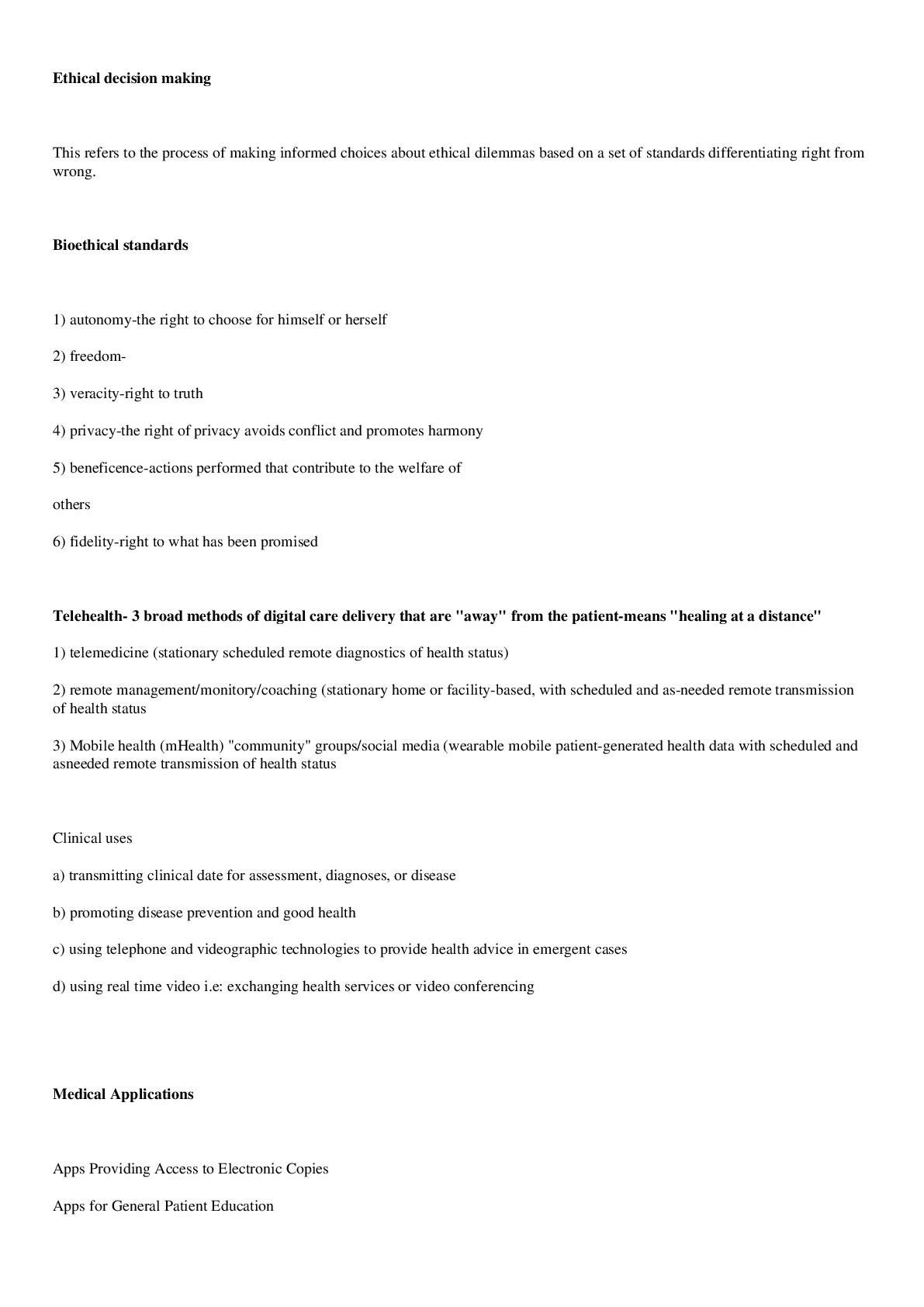


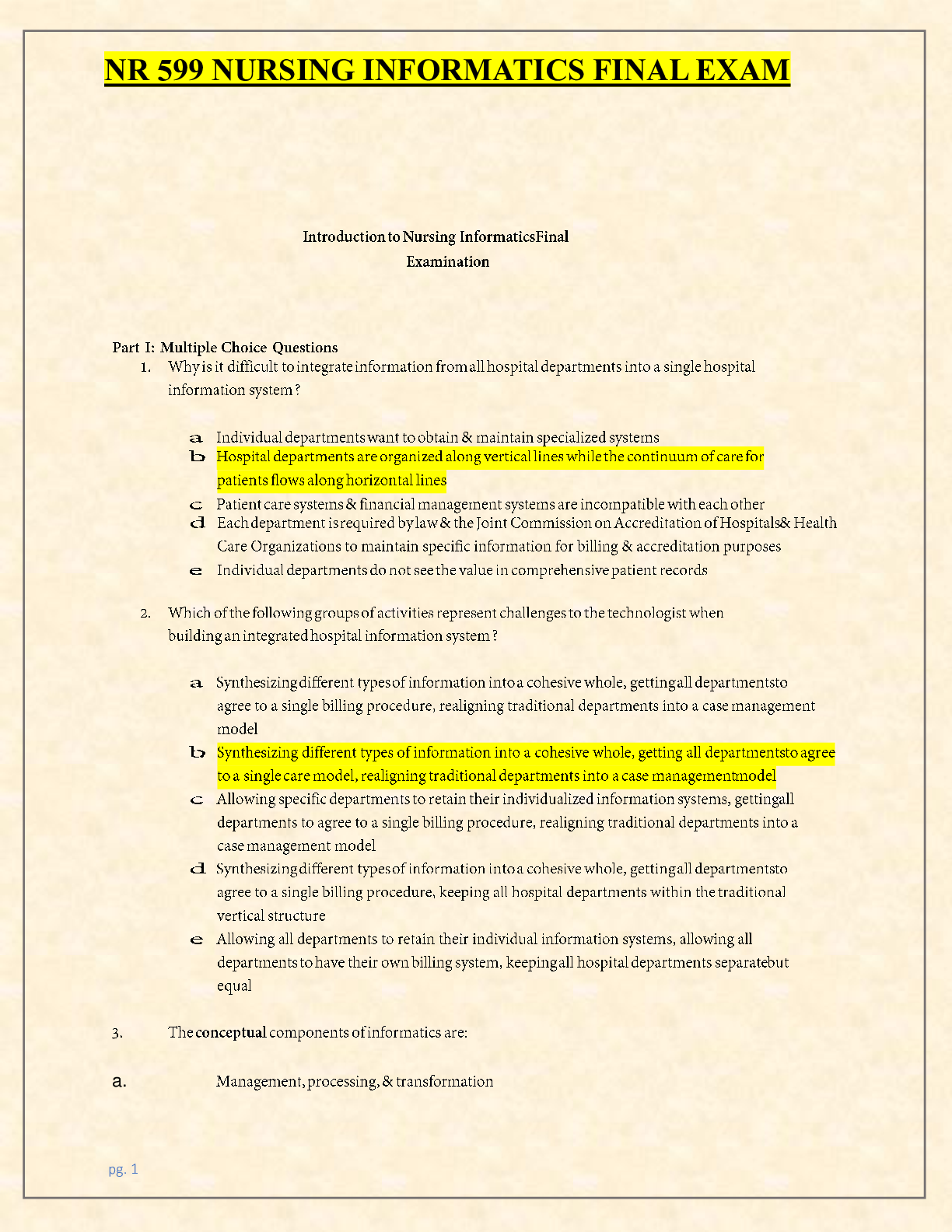
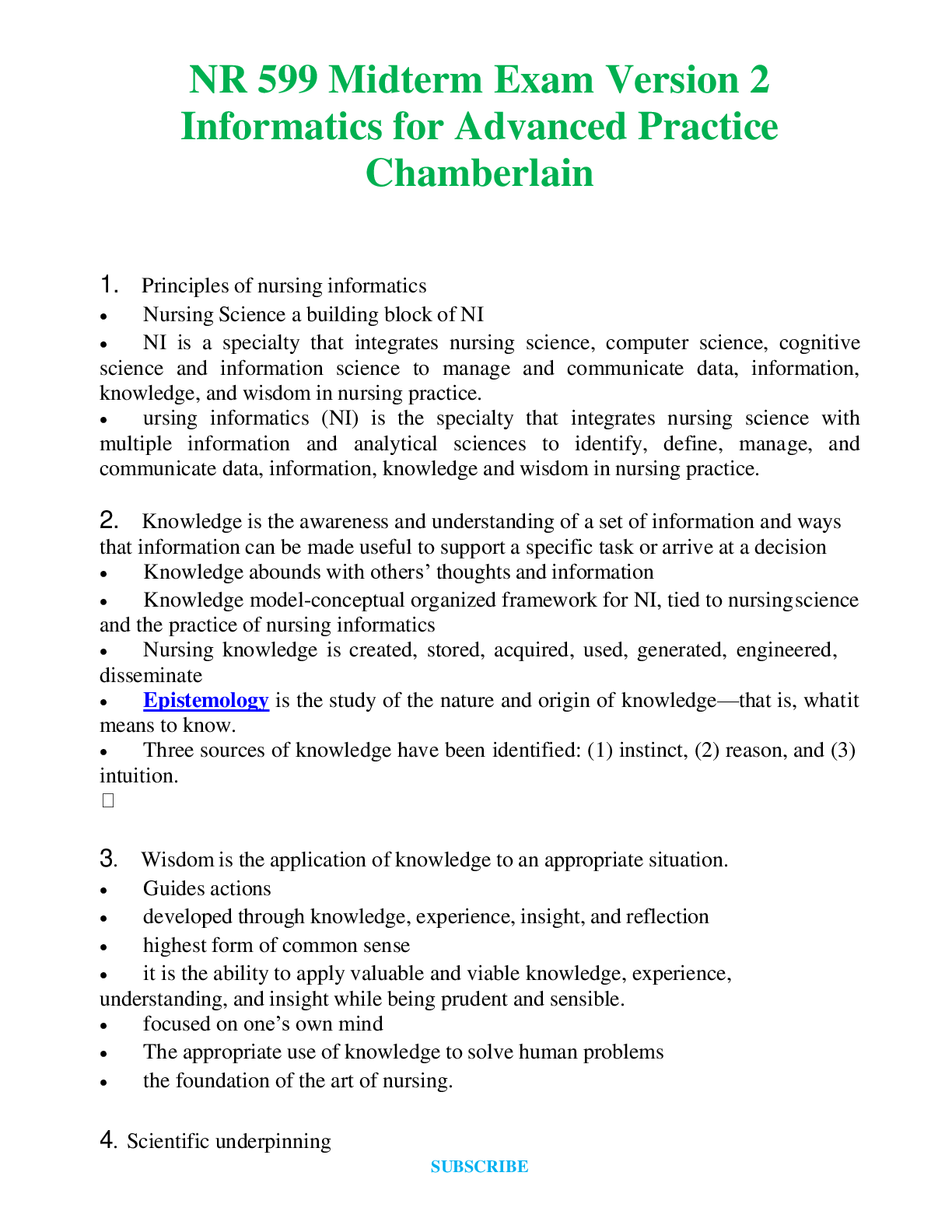
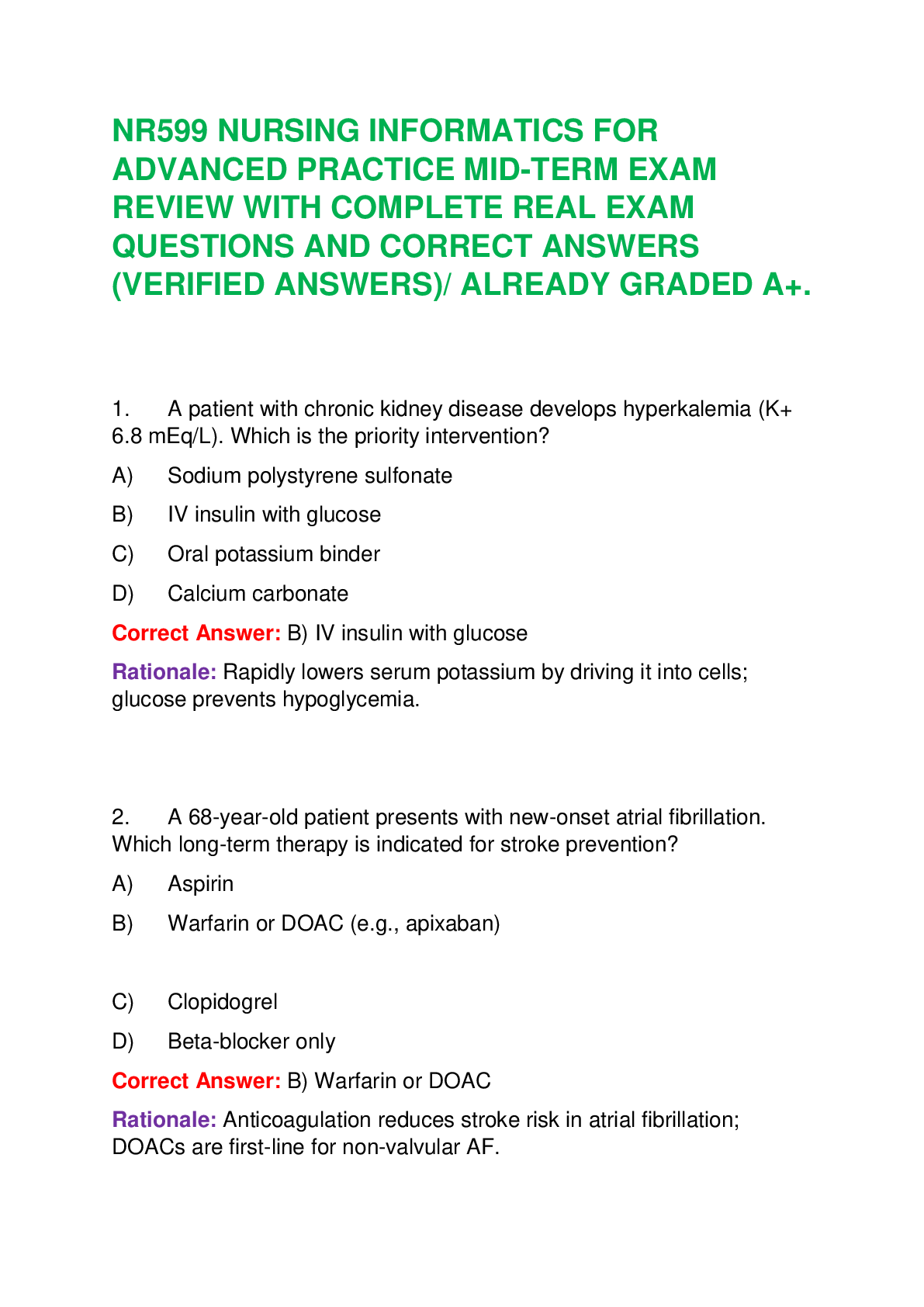









.png)