CHEM 115 Week 7 Answers
Review – Week 7
Question 1
Correct
Marked out of 1
Flag question
Question text
To form the molecule below, dehydration takes place at C1 of the pentose ring and at an N-H hydrogen at pos
...
CHEM 115 Week 7 Answers
Review – Week 7
Question 1
Correct
Marked out of 1
Flag question
Question text
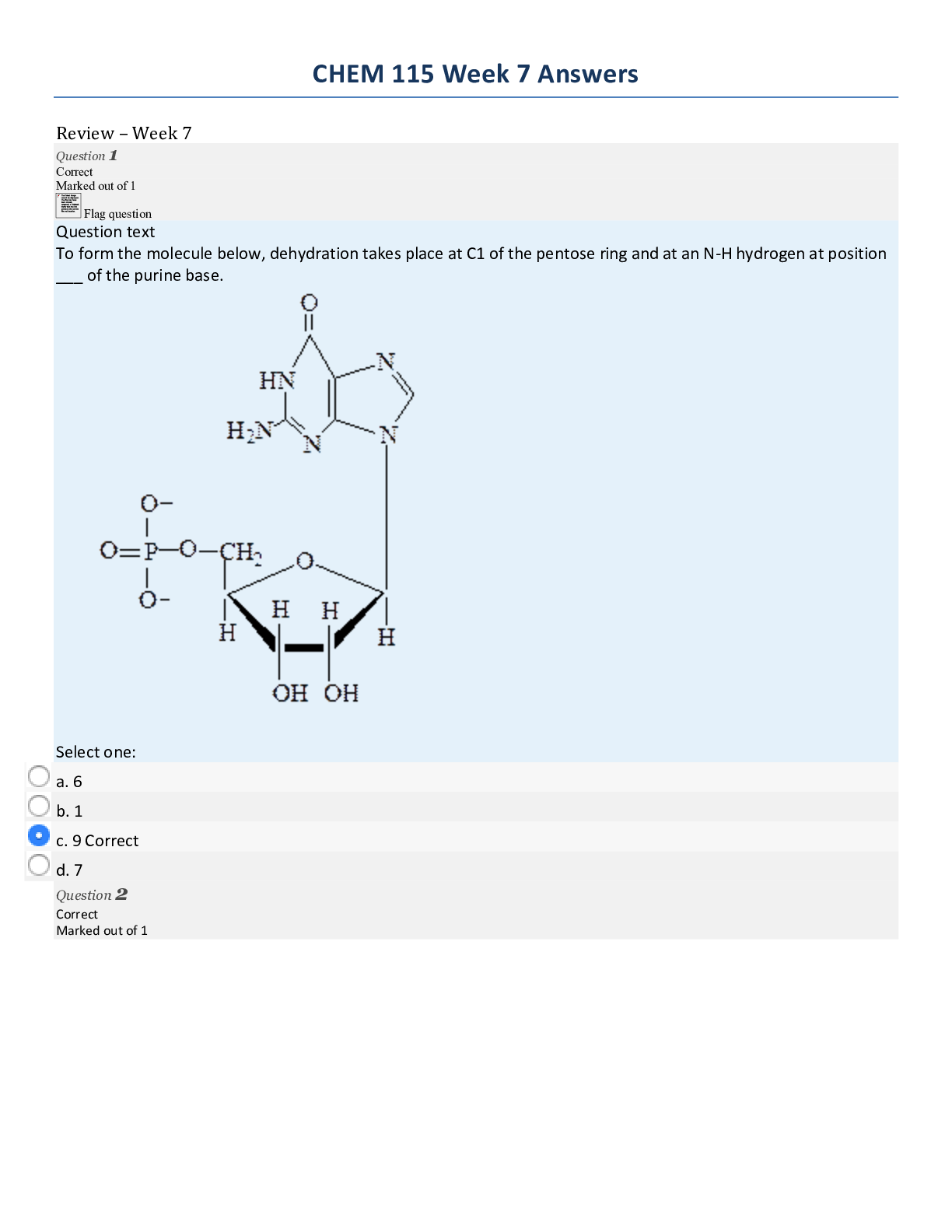
To form the molecule below, dehydration takes place at C1 of the pentose ring and at an N-H hydrogen at position ___ of the purine base.
Select one:
a. 6
b. 1
c. 9 Correct
d. 7
Question 2
Correct
Marked out of 1
Flag question
Question text
Two strands of DNA are held in position relative to each other by means of ___.
Select one:
a. covalent bonds
b. ionic bonds
c. disulfide bonds
d. hydrogen bonding Correct
Question 3
Correct
Marked out of 1
Flag question
Question text
DNA and RNA
Select one:
a. differ in both their monosaccharide and nitrogen base components. CORRECT
b. contain the same nitrogen bases, but different monosaccharides.
c. have the same composition, except for the monosaccharides.
d. are both produced by animals, but RNA is not produced by plants.
Question 4
Correct
Marked out of 1
Flag question
Question text
Replication begins at a point in the DNA called the ___.
Select one:
a. promoter site
b. origin CORRECT
c. template strand
d. transcription site
Question 5
Correct
Marked out of 1
Flag question
Question text
Among the mechanisms Escherichia coli has for the control of β-galactosidase production is
Select one:
a. that the combination of cAMP and CAP restricts the ability of RNA polymerase to function.
b. the presence of the lac operon necessary for the production of the enzyme to be halted reducing overproduction.
CORRECT ANSWER B
c. that glucose must be absent and galactose present for the production to begin.
d. that the speed with which the enzyme is produced is accelerated by the presence of both galactose and glucose.
Question 6
Correct
Marked out of 1
Flag question
Question text
Polynucleotides have definite 5’ and 3’ ends (terminus).
Select one:
True CORRECT
False
Question 7
Correct
Marked out of 1
Flag question
Question text
The ___ has a "cloverleaf" shape and carries the amino acids to the site of protein synthesis.
Select one:
a. transfer RNA CORRECT
b. messenger RNA
c. ribosomal RNA
d. transfer DNA
Question 8
Correct
Marked out of 1
Flag question
Question text
The following is a sugar found in nucleic acids:
It is ___ and is found in the nucleic acid ___.
Select one:
a. ribose/DNA
b. 2-deoxyribose/DNA CORRECT
c. ribose/RNA
d. 2-deoxyribose/RNA
Question 9
Correct
Marked out of 1
Flag question
Question text
A group of genes under control of one promoter site is a(n) ___.
Select one:
a. recombinant DNA
b. operon CORRECT
c. reverse transcription
d. mutation
Question 10
Correct
Marked out of 1
Flag question
Question text
A nucleoside triphosphate contains two phosphoanhydride bonds.
Select one:
True CORRECT
False
Question 11
Correct
Marked out of 1
Flag question
Question text
A characteristic of RNA that is not shared with DNA is
Select one:
a. RNA is not found in the nucleus of cells; DNA is found in the nucleus.
b. the backbone of RNA does not contain phosphate.
c. RNA substitutes A for C in the base pairings.
d. RNA molecules are composed of a single strand. CORRECT
Question 12
Correct
Marked out of 1
Flag question
Question text
Although the primary structures of proteins and DNA are defined in the same manner, the secondary structures are not. The secondary structure of DNA is
Select one:
a. the β-helix formed by the strand
b. the sheets of DNA molecules laying side-by-side
c. the globular portions of the DNA structure
d. the double helix CORRECT
Question 13
Correct
Marked out of 1
Remove flag
Question text
The following structure is known as a ___.
Select one:
a. nucleoside
b. nucleotide CORRECT
c. polynucleotide
d. oligonucleotide
Question 14
Correct
Marked out of 1
Flag question
Question text
The bases adenine, guanine, and uracil are used in both DNA and RNA nucleotides.
Select one:
True
False CORRECT
Question 15
Correct
Marked out of 1
Flag question
Question text
A cyclic nucleotide is produced when
Select one:
a. the monosaccharide in the nucleotide is in the closed form.
b. the nitrogen base is in the cyclic form.
c. the phosphate attaches to the monosaccharide and the base.
d. the phosphate attaches to the monosaccharide in two places. CORRECT
Question 16
Correct
Marked out of 1
Flag question
Question text
Which of the following organic bases is found in DNA and not in RNA?
Select one:
a. guanine
b. cytosine
c. thymine CORRECT
d. uracil
Question 17
Correct
Marked out of 1
Flag question
Question text
When a purine or pyrimidine base is combined with a sugar residue such as ribose or deoxyribose, the resulting compound is known as a ___.
Select one:
a. nucleoside CORRECT
b. nucleotide
c. polynucleotide
d. oligonucleotide
Question 18
Correct
Marked out of 1
Flag question
Question text
tRNA is a type of RNA that is responsible for
Select one:
a. transferring the information for protein synthesis from DNA to the ribosomes.
b. supplying amino acids to the site of protein synthesis. CORRECT
c. carrying the newly formed protein out of the nucleus of the cell.
d. cutting long proteins into shorter molecules when the proteins are needed by the cell.
Question 19
Correct
Marked out of 1
Flag question
Question text
If BRCA1 and BRCA2 genes are defective
Select one:
a. the probability of breast cancer is increased for women, but not for men.
b. the genes can be repaired by recombinational repair.
c. the probability of having breast cancer is nearly 100%.
d. the risk of having breast cancer rises from below 15% to as much as 85%. CORRECT
Question 20
Correct
Marked out of 1
Flag question
Question text
Transgenic goats have had human genes inserted into their DNA that code for the production of which of following serum protein anticoagulants?
Select one:
a. thrombin
b. hemoglobin
c. antithrombin CORRECT
d. insulin
Question 21
Correct
Marked out of 1
Flag question
Question text
A metabolic pathway in which the product of one reaction is the reactant in the next reaction in a continuous series is defined as a ___ pathway.
Select one:
a. linear CORRECT
b. circular
c. spiral
d. coupled
Question 22
Correct
Marked out of 1
Flag question
Question text
Glycogen can be broken down to form glucose 1-phosphate, which is directly involved in glycolysis.
Select one:
True CORRECT
False
Question 23
Correct
Marked out of 1
Flag question
Question text
Most of triglyceride digestion occurs in the ___.
Select one:
a. mouth
b. stomach
c. small intestine CORRECT
d. liver
Question 24
Correct
Marked out of 1
Flag question
Question text
The compounds needed to start the citric acid cycle are
Select one:
a. acetyl-CoA and citrate.
b. isocitrate and NAD+.
c. acetyl-CoA and NADH.
d. acetyl-CoA and oxaloacetate. CORRECT
Question 25
Correct
Marked out of 1
Flag question
Question text
One step in the catabolism of glucose involves the conversion of glucose 6-phosphate into ___.
Select one:
a. glucose
b. fructose 6-phosphate CORRECT
c. glucose 3-phosphate
d. pyruvate
Question 26
Correct
Marked out of 1
Flag question
Question text
The digestion of proteins begins in the stomach with hydrolysis being catalyzed by ___.
Select one:
a. chymotrypsin
b. pepsin CORRECT
c. amylase
d. lipase
Question 27
Correct
Marked out of 1
Flag question
Question text
During glycolysis and under aerobic conditions, pyruvate is converted into ___.
Select one:
a. lactate
b. acetyl-CoA CORRECT
c. ketones
d. ADP
Question 28
Correct
Marked out of 1
Flag question
Question text
Amylase
Select one:
a. is an enzyme that continues functioning in the stomach.
b. is the only enzyme in the saliva that hydrolyzes proteins.
c. is a carbohydrate easily digested in the stomach.
d. catalyzes hydrolysis of some of the bonds in amylose. CORRECT
Question 29
Correct
Marked out of 1
Flag question
Question text
___ takes place in the cytoplasm while ___ takes place in the mitochondria.
Select one:
a. Citric acid cycle/electron transport chain
b. Electron transport chain/glycolysis
c. Citric acid cycle/glycolysis
d. Glycolysis/citric acid cycle CORRECT
Question 30
Correct
Marked out of 1
Flag question
Question text
In a coupled reaction of a metabolic pathway, a spontaneous reaction provides the energy needed by a nonspontaneous one.
Select one:
True CORRECT
False
Question 31
Correct
Marked out of 1
Flag question
Question text
A metabolic pathway in which a series of reactions is used to repeatedly break down or build up a molecule is defined as a ___ pathway.
Select one:
a. linear
b. circular
c. spiral CORRECT
d. coupled
Question 32
Correct
Marked out of 1
Flag question
Question text
Lipogenesis
Select one:
a. produces fatty acids by means of a spiral pathway.
b. produces fatty acids by joining two carbon atoms at a time.
c. does not produce all of the fatty acids required by humans.
d. All of these answer choices are correct. CORRECT
Question 33
Correct
Marked out of 1
Flag question
Question text
Which choice is a goal of catabolism?
Select one:
a. the production of heat
b. the attachment of the coenzyme A residue
c. the generation of ATP molecules CORRECT
d. the production of two-carbon fragments
Question 34
Correct
Marked out of 1
Flag question
Question text
How do the monosaccharides produced during digestion get into the circulatory system?
Select one:
a. They are absorbed by the cells in the intestinal lining and are released into the blood. CORRECT
b. They are absorbed by the cells in the stomach lining and released into the blood.
c. They are able to move between the cells of the stomach lining directly into the blood.
d. They are transported by the action of the cell membranes of the digestive tract.
Question 35
Correct
Marked out of 1
Flag question
Question text
Gluconeogenesis is a process by which glucose is produced
Select one:
a. in the liver from noncarbohydrate sources. CORRECT
b. in the mitochondrion if there is an excess of fructose.
c. by the enzymes located on the cristae.
d. by exactly reversing the process of glycolysis.
Question 36
Correct
Marked out of 1
Flag question
Question text
The amount of energy obtained from hydrolysis of ATP is
Select one:
a. -11.8 kcal.
b. - 36 kcal.
c. -4.5 kcal.
d. -7.3 kcal. CORRECT
Question 37
Correct
Marked out of 1
Flag question
Question text
Glycolysis is controlled in steps:
Select one:
a. 1, 2, and 3
b. 2, 5 and 7
c. 1, 3 and 10 CORRECT
d. 3, 5 and 8
Question 38
Correct
Marked out of 1
Flag question
Question text
Which of the following products are formed in one pass through the -oxidation spiral when a fatty acyl-CoA is shortened by two carbon atoms?
Select one:
a. NADH and pyruvate
b. FADH2 and pyruvate
c. NADH and FADH2 CORRECT
d. ATP and glycogen
Question 39
Correct
Marked out of 1
Flag question
Question text
The acetyl-CoA from the fatty acid catabolism enters the ___ whereas the reduced coenzymes NADH and FADH2 enter ___.
Select one:
a. citric acid cycle/the electron transport chain CORRECT
b. electron transport chain/glycolysis
c. citric acid cycle/glycolysis
d. glycolysis/the citric acid cycle
Question 40
Correct
Marked out of 1
Flag question
Question text
The citric acid cycle has which step as a main control?
Select one:
a. step 3, isocitrate α-ketoglutarate CORRECT
b. step 1, acetyl-CoA citrate
c. step 7, fumarate malate
d. step 8, malate oxaloacetate
Question 1
Correct
Marked out of 1
Flag question
Question text
The process by which DNA unwinds and synthesizes a copy of new DNA is known as ___.
Select one:
a. replication
b. transcription
c. translation
d. reverse transcription
Question 2
Correct
Marked out of 1
Flag question
Question text
___ is any permanent change in the primary structure of DNA.
Select one:
a. Recombinant DNA
b. Gene expression
c. Operon
d. Mutation
Question 3
Correct
Marked out of 1
Flag question
Question text
If DNA is heated and then cooled,
Select one:
a. the DNA becomes denatured and then renatured.
b. the DNA becomes denatured and then twists into new shapes.
c. the strands of DNA separate and then come together end to end.
d. the strands of DNA establish more chemical bonds than before the heating.
Question 4
Correct
Marked out of 1
Flag question
Question text
Which of the following organic bases is found in RNA and not in DNA?
Select one:
a. guanine
b. cytosine
c. thymine
d. uracil
Question 5
Correct
Marked out of 1
Flag question
Question text
DNA polymerase is an enzyme involved in which process?
Select one:
a. replication
b. transcription
c. translation
d. reverse transcription
Question 6
Correct
Marked out of 1
Flag question
Question text
Which of the following determines the primary structure of both DNA and RNA?
Select one:
a. the sequence of sugar molecules
b. complimentary base pairing
c. coiling of the helices into a tight, compact shape
d. the sequence of nucleotide residues
Question 7
Correct
Marked out of 1
Flag question
Question text
In the double strand of DNA, the sugar-phosphate backbones with their negatively charged phosphate groups are on the inside and the bases are on the outside.
Select one:
True
False
Question 8
Correct
Marked out of 1
Flag question
Question text
Which of the following organic bases is a purine derivative?
Select one:
a. Cytosine
b. Thymine
c. Pyrimidine
d. Guanine
Question 9
Correct
Marked out of 1
Flag question
Question text
The triphosphate in ATP is linked to C-5’ of the ribose by
Select one:
a. a β-N-glycosidic linkage.
b. a phosphoester bond.
c. a peptide bond.
d. a hydrogen bond.
Question 10
Correct
Marked out of 1
Flag question
Question text
What is present in a nucleotide that is not found in a nucleoside?
Select one:
a. a phosphate
b. a monosaccharide
c. an alcohol group
d. a nitrogen base
Question 12
Correct
Marked out of 1
Flag question
Question text
Which of the following sequence of bases in the DNA strand will be complimentary to the single DNA strand shown here to produce a double strand?
3’ G-C-T-T-A-G-G-A-T 5’
Select one:
a. 5’ G-A-T-T-A-G-G-A-A 5’
b. 5’ C-G-A-A-T-C-C-T-A 3’
c. 3’ C-C-G-T-G-G-G-A-T 5’
d. 3’ G-C-T-T-A-G-G-A-T 5’
Question 21
Correct
Marked out of 1
Flag question
Question text
Where in a cell do the formation of acetyl-CoA and the citric acid cycle occur?
Select one:
a. cytoplasm
b. mitochondria
c. nucleus
d. lysosome
Question 22
Correct
Marked out of 1
Flag question
Question text
Catabolism reactions are those that produce more complex molecules from the simpler molecules along with a release of energy.
Select one:
True
False
Question 23
Correct
Marked out of 1
Flag question
Question text
Sometimes the reduction of oxygen to water is incomplete, resulting in
Select one:
a. a greater production of ATP because there are more hydrogen ions present.
b. toxic products, which are superoxide or hydrogen peroxide.
c. a greater production of FADH2 from the extra hydrogen ions.
d. hydrogen gas, which can be excreted and does not build up.
Question 24
Correct
Marked out of 1
Flag question
Question text
___ is defined as the reactions that break down large molecules into small ones and release energy in the form of ATP.
Select one:
a. Metabolism
b. Catabolism
c. Anabolism
d. Hydrolysis
Question 25
Correct
Marked out of 1
Flag question
Question text
If acetyl-CoA concentrations reach too high levels,
Select one:
a. ketone bodies can be produced leading to a toxic condition.
b. the citric acid cycle increases in reaction rate to use the excess acetyl-CoA.
c. pathways other than the citric acid cycle activate to remove the excess acetyl-CoA.
d. the ketone bodies are stored in special cells and used as a source of energy when required.
Question 26
Correct
Marked out of 1
Flag question
Question text
In a cell, fatty acid biosynthesis occurs in ___.
Select one:
a. mitochondria
b. the cytoplasm
c. the nucleus
d. lysosome
Question 27
Correct
Marked out of 1
Flag question
Question text
Which of the choices below present products of the citric acid cycle?
Select one:
a. ATP, ADP, and CO2
b. NADH, FADH2, and GTP
c. FAD, NAD+, ADP, and H2O
d. CO2, H2O, ATP, and GTP, and NAD+
Week 7 Quiz
Question 1
Correct
Marked out of 1
Flag question
Question text
The following image is a sugar found in nucleic acids:
It is ___ and is found in the nucleic acid ___.
Select one:
a. ribose/DNA
b. deoxyribose/DNA
c. ribose/RNA correct
d. deoxyribose/RNA
Question 2
Correct
Marked out of 1
Flag question
Question text
The function of RNA polymerase is to
Select one:
a. cause the RNA molecule to increase in length during protein production.
b. cause the RNA molecule to coil into a shape that helps in DNA replication.
c. disrupt the double helix by isolating one strand from the other. CORRECT
d. synthesize an RNA molecule that remains attached to the DNA.
Question 3
Correct
Marked out of 1
Flag question
Question text
Thymine is a base found in RNA and not in DNA.
Select one:
True
False CORRECT
Question 4
Correct
Marked out of 1
Flag question
Question text
The structures of DNA and RNA
Select one:
a. alternate monosaccharide and phosphate components.
b. have a nitrogen base projecting off each monosaccharide.
c. are due to the chemical bond between the nitrogen base and the phosphate
d. have alternate monosaccharide and phosphate components and have a nitrogen base projecting off each monosaccharide. CORRECT
Question 5
Correct
Marked out of 1
Flag question
Question text
Which is involved in expression?
Select one:
a. replication
b. transcription
c. translation
d. both transcription and translation CORRECT
Question 6
Correct
Marked out of 1
Flag question
Question text
The allosteric enzyme phospofructokinase is switched off by ___.
Select one:
a. glucose
b. isocitrate
c. AMP
d. ATP CORRECT
Question 7
Correct
Marked out of 1
Flag question
Question text
The location in the cell where ATP is produced is the ___.
Select one:
a. mitochondria CORRECT
b. lysosome
c. nucleus
d. cell membrane
Question 8
Correct
Marked out of 1
Flag question
Question text
The total NADH produced in one citric acid cycle are ___.
Select one:
a. 3 CORRECT
b. 2
c. 4
d. 6
Question 9
Correct
Marked out of 1
Flag question
Question text
___ is the sum of all of the reactions that take place in a living thing.
Select one:
a. Metabolism CORRECT
b. Catabolism
c. Anabolism
d. Hydrolysis
Question 10
Correct
Marked out of 1
Flag question
Question text
The fatty acids produced from the hydrolysis of triglycerides can
Select one:
a. be used to enter directly into glycolysis, producing extra ATP.
b. be oxidized to produce acetyl-CoA, which enters the citric acid cycle. CORRECT
c. produce glucose by a pathway separate from gluconeogenesis.
d. be modified to undergo either glycolysis or gluconeogenesis.
Question 1
Correct
Marked out of 1
Flag question
Question text
How many bonds are broken when the following molecule is completely hydrolyzed?
Select one:
a. 2
b. 1
c. 3
d. 4
Question 2
Correct
Marked out of 1
Flag question
Question text
Chromatin is a molecule that
Select one:
a. is produced from chromosomes during early cell reproduction.
b. coils and folds to become a chromosome before cell division occurs.
c. is a special form of DNA where protein interacts with the nitrogen bases.
d. is a special part of the tertiary structure of DNA composed of a single helix.
Question 3
Correct
Marked out of 1
Flag question
Question text
The following structure represents which of the following nucleotides?
Select one:
a. UMP
b. GDP
c. GTP
d. ATP
Question 4
Correct
Marked out of 1
Flag question
Question text
The following image is a sugar found in nucleic acids:
It is ___ and is found in the nucleic acid ___.
Select one:
a. ribose/DNA
b. deoxyribose/DNA
c. ribose/RNA
d. deoxyribose/RNA
Question 6
Correct
Marked out of 1
Flag question
Question text
___ is exclusively used to for reductive biosynthesis reactions.
Select one:
a. NADPH
b. ATP
c. ADP
d. NAD+
Question 7
Correct
Marked out of 1
Flag question
Question text
During oxidative deamination
Select one:
a. ammonium ions are removed from one amino acid and placed on another amino acid.
b. oxygen reacts with the amino acid releasing nitrogen-oxygen compounds.
c. new compounds are produced by the addition of a carboxyl group.
d. potentially toxic ammonium ions are produced.
[Show More]