EARLY CHILDHOOD E08.V.9.1Lesson 4 Exam
Lesson 4 Exam
Question 1 2.5 / 2.5 points
If two teachers are working together to provide consistent supervision of a class of 16 – 18 children, those children are probably:
...
EARLY CHILDHOOD E08.V.9.1Lesson 4 Exam
Lesson 4 Exam
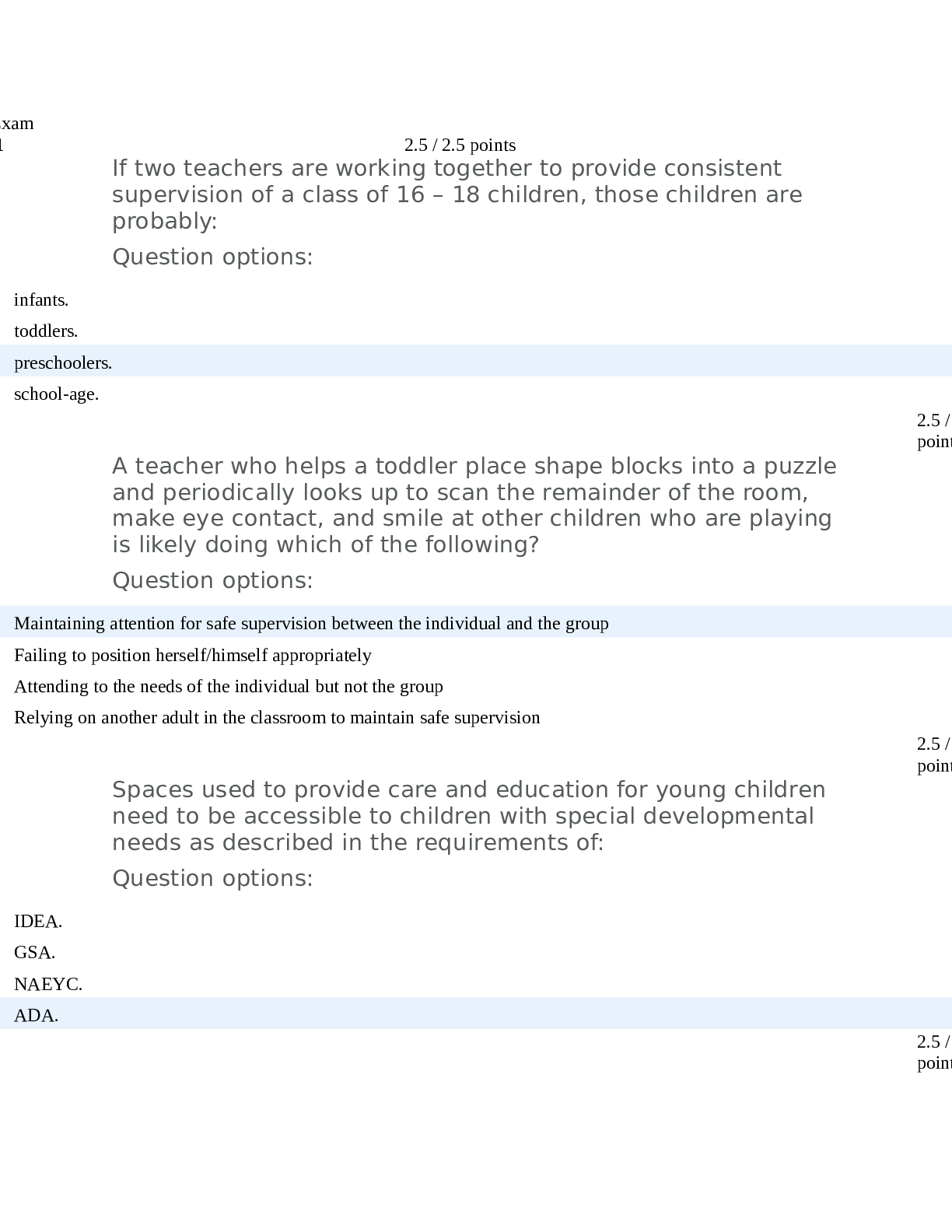
Question 1 2.5 / 2.5 points
If two teachers are working together to provide consistent supervision of a class of 16 – 18 children, those children are probably:
Question options:
Question 2 2.5 / 2.5 points
A teacher who helps a toddler place shape blocks into a puzzle and periodically looks up to scan the remainder of the room, make eye contact, and smile at other children who are playing is likely doing which of the following?
Question options:
Question 3 2.5 / 2.5 points
Spaces used to provide care and education for young children need to be accessible to children with special developmental needs as described in the requirements of:
Question options:
Question 4 2.5 / 2.5 points
All states and the District of Columbia are required to monitor child care in which of the following ways?
Question options:
Question 5 2.5 / 2.5 points
Dividing the children's play area into zones is helpful during outside
playtime that is:
Question options:
Question 6 2.5 / 2.5 points
If children respond with frustration during a block of playtime because they don't want to transition, what should a teacher do?
Question options:
Question 7 2.5 / 2.5 points
Which of the following factors is least likely to be related to fatality rates due to injuries?
Question options:
Question 8 2.5 / 2.5 points
Which of the following approaches would help teach a safety message to a misbehaving toddler?
Question options:
Question 9 2.5 / 2.5 points
Children feel protected and free from worry about their physical and emotional safety when early childhood classrooms are seen as a/an:
Question options:
Question 10 2.5 / 2.5 points
Which of the following statements is true regarding the safety of bus transportation for preschool children according to research?
Question options:
Question 11 2.5 / 2.5 points
A teacher who is considering safe and smooth arrival times in a preschool group will:
Question options:
Question 12 2.5 / 2.5 points
Where are more bus fatalities likely to occur?
Question options:
Question 13 2.5 / 2.5 points
What is the earliest age a child can be out of sound supervision for short periods of time according to NAEYC?
Question options:
Question 14 02.5/ 2.5 points
Which of the following age groups has the highest number of deaths due to motor vehicle and traffic accidents?
Question options:
Question 15 2.5 / 2.5 points
Stricter standards designed to increase the quality and safety of children's settings have the potential to push some children into settings that are less safe because:
Question options:
Question 16 2.5 / 2.5 points
If a child is absent without notification what is the recommended teacher approach?
Question options:
Call the family to ask about the reason for the absence.
Wait to see if the child is absent more than one day, then contact the family.
Inform the director to record the absence.
When the child returns remind the family that you prefer notifications in the future.
Question 17 2.5 / 2.5 points
Which age group experiences the highest overall injury rate for any age group under the age of 15?
Question options:
Birth to 1 year
1 to 4years old
5 to 9 years old
9 to 15 years old
Question 18 0 / 2.5 points
Which of the following statements is FALSE?
Question options:
Unintentional injuries can result in a potentially disabling outcome.
Unintentional injuries include accidents associated with learning new
skills (falling when you learn to walk).
Unintentional injuries are the leading cause of death in early childhood.
Unintentional injuries are over-reported because children are so vulnerable.
Question 19 2.5 / 2.5 points
Maslow's Hierarchy of Needs is a reminder of the important contribution teachers make because it emphasizes the:
Question options:
need to address children's cultural practices.
building blocks of social and emotional development in early childhood.
importance of modeling desired behaviors.
essential role of physical and emotional safety in the classroom to promote children's well-being.
Question 20 2.5 / 2.5 points
Which of the following age groups has the highest number of deaths due to drowning?
Question options:
Birth to 1 year
1 to 4yearsold
5 to 9 years old
9 to 15 years old
Lesson 3 Exam
Question 21 2.5 / 2.5 points
Recognition of symptoms of disease helps teachers:
Question options:
diagnose disease.
offer recommendations for treatment.
plan management strategies in the classroom to stop the spread of disease.
carefully monitor some children more than others.
Question 22 2.5 / 2.5 points
Of the three most common groups of childhood infections, which of the following is NOT a symptom?
Question options:
Diarrhea
Muscle spasms
Vomiting
Skin infections or rashes
Question 23 2.5 / 2.5 points
Children under age 6 can become carriers of which disease without developing any symptoms?
Question options:
Hepatitis A
Influenza
Rotavirus
Tetanus
Question 24 2.5 / 2.5 points
If a child develops an itchy red and bumpy rash between the fingers, on wrists or elbows, on the waistline, thighs, genitalia, and buttocks he/she is exhibiting symptoms of:
Question options:
ringworm.
staph infection.
impetigo.
scabies.
Question 25 2.5 / 2.5 points
Each of the following statements is true regarding incubation periods EXCEPT:
Question options:
there is great variability of incubation periods.
the period of contagiousness matches the incubation period.
the time between the child's first exposure to an infectious agent and when the first symptom of illness appears is called the incubation period.
the incubation period helps teachers know how long to watch for the spread of the disease.
Question 26 2.5 / 2.5 points
Blood-borne infections that may be found in childcare settings include all of the following EXCEPT:
Question options:
tuberculosis.
HIV.
Hepatitis B.
Hepatitis C.
Question 27 2.5 / 2.5 points
Skin infections can be caused by bacteria, viruses, parasites, and:
Question options:
pollen.
airborne contaminants.
bruising.
fungi.
Question 28 2.5 / 2.5 points
Which of the following is true of children who are adopted internationally?
Question options:
They are required to have documentation showing basic immunizations.
They must have a medical examination in their country of origin before coming to the United
States.
They must have a medical examination in the United States within 72 hours of arriving.
They are not required to have a medical examination before entrance into preschool.
Question 29 2.5 / 2.5 points
Children should be excluded from school if they have:
Question options:
head lice.
ringworm.
pertussis.
HIV.
Question 30 2.5 / 2.5 points
Sneezing on some blocks that are touched a few minutes later by another
child is an example of:
Question options:
indirect contact.
airborne transmission.
fecal-oral transmission.
bloodborne transmission.
Question 31 2.5 / 2.5 points
Which of the following diseases may be 4 to 6 times greater in children who are adopted internationally as opposed to children born in the United States?
Question options:
Viral hepatitis
Tuberculosis
Intestinal infections
HIV
Question 32 2.5 / 2.5 points
Each of the following is true about tetanus EXCEPT:
Question options:
the tetanus bacteria form spores that are deposited in soil and cannot survive more than a few months.
bacteria usually enter the body through a puncture wound.
teachers need tetanus boosters to maintain their own immunity.
the bacteria is commonly found in the gut of farm animals
Question 33 2.5 / 2.5 points
Which of the following infections are NOT dangerous to the fetus of a mother exposed to them?
Question options:
Chickenpox
Athlete's foot
Coxsackie virus
Fifth disease
Question 34 2.5 / 2.5 points
Which of the following is NOT a parasite?
Question options:
Scabies
Head lice
Ringworm
Intestinal worms
Question 35 2.5 / 2.5 points
If a teacher is asked to administer complementary and alternative medicine to children such as herbal supplements for common colds, he/she should:
Question options:
refuse to administer the medicine before checking with a doctor.
encourage the parents to administer the medicine at home only.
use the proper procedure for administration of medicines.
encourage a different treatment.
Question 36 2.5 / 2.5 points
Which of the following should be avoided when treating chicken pox in infants and children?
Question options:
Aspirin
Acetaminophen
Over-the-counter antihistamine
Ibuprofen
Question 37 0 / 2.5 points
Infectious diseases are caused by:
Question options:
viruses.
spores.
germs.
parasites.
Question 38 2.5 / 2.5 points
Keeping skin cuts and scrapes clean and dry is more likely to prevent:
Question options:
MRSA—methicillin-resistant Staphylococcus aureus.
hepatitis B.
hepatitis C.
HIV.
Question 39 2.5 / 2.5 points
Which of the following is not a vaccine-preventable disease?
Question options:
Pertussis (Whooping cough)
Conjunctivitis
Measles
Tetanus
Question 40 0 / 2.5 points
Each of the following statements is true about common colds EXCEPT:
Question options:
the best way to interrupt the cycle of infection is to wash hands frequently.
some cold viruses can survive on contaminated objects for up to one day.
children should be encouraged to cough into their hands rather than the air.
children younger than age 6 experience between six to eight colds a year.





.png)