*NURSING > QUESTIONS & ANSWERS > NSG 5003: Week 1 Review Questions-Pathophysiology Week 1 Review Questions (All)
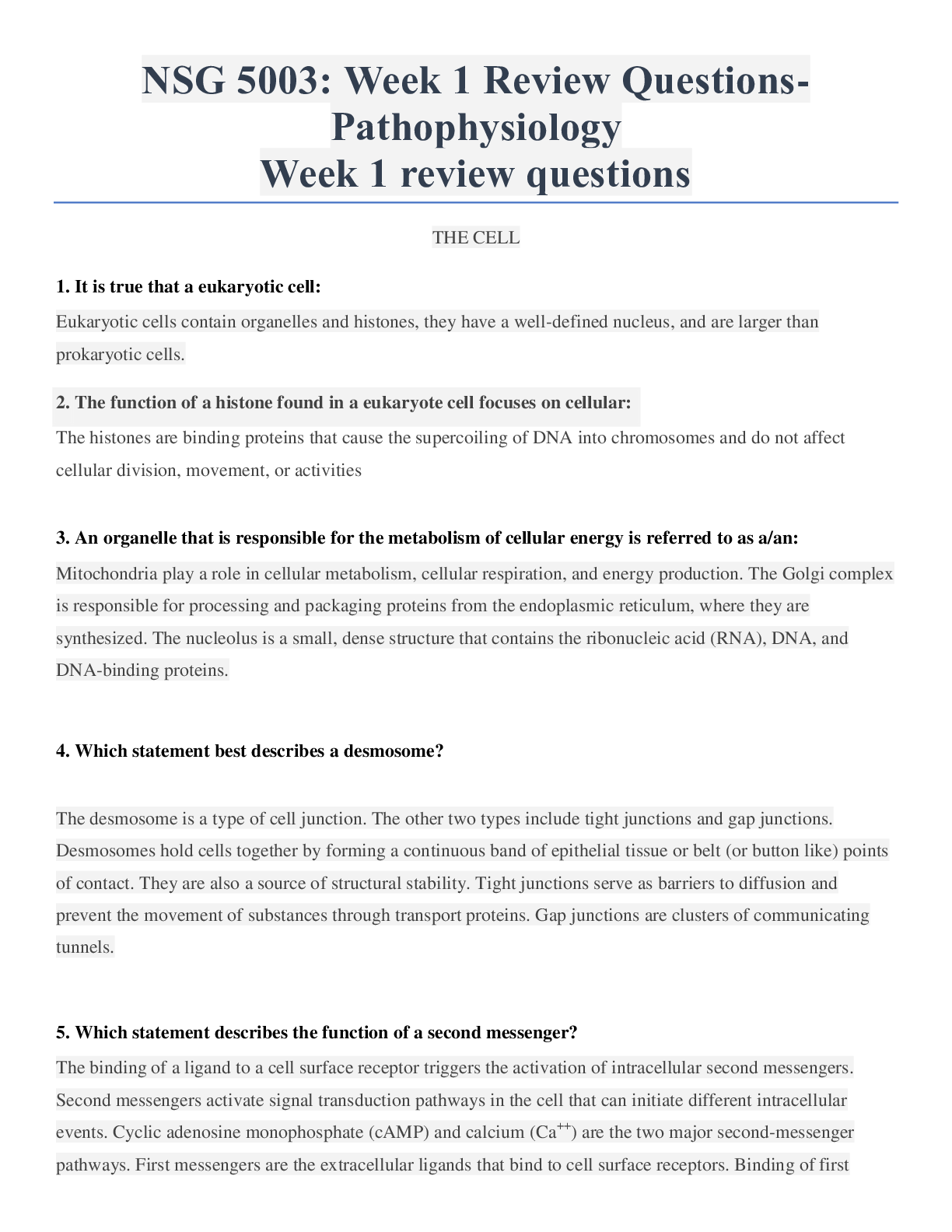
THE CELL 1. It is true that a eukaryotic cell: 2. The function of a histone found in a eukaryote cell focuses on cellular: 3. An organelle that is responsible for the metabolism of cellular ... energy is referred to as a/an: 4. Which statement best describes a desmosome? 5. Which statement describes the function of a second messenger? 6. Which statement is correct regarding cellular energy? 7. Movement of a solute molecule from an area of high concentration to an area of low concentration is called: 8. Which of the following is an example of an energy-releasing process? 9. Which of the following describes the term chemotaxis? 10. Which of the following describes an amphipathic molecule? 11. Which of the following are functions of a protein? (Select all that apply.) 12. Which of the following is the most common cause of cellular injury? 13. Which chemical interferes with the excretion of urate while affecting the nervous and hematopoietic systems? 14. A collection of blood that is located between the skull and the dura is called a/an: 15. The possible diagnosis of shaken baby syndrome is supported when an infant brought to the emergency department is found to have which type of cerebral hematoma? 16. Which term describes a tear or rip of the skin with a jagged and irregular edge? 17. Which term describes oxygen failing to reach the blood? 18. Heat exhaustion is defined as: 19. Which statement regarding altitude and illness is true? 20. Which form of necrosis is associated with tuberculous infections? 21. Which statements are true regarding apoptosis? (Select all that apply.) 22. When considering water balance, which statement is the correct balance? 23. It is true that hyperchloremia: 24. It is true that hyponatremia: 25. Which statement is true regarding potassium balance? 26. Which statement is true regarding hypokalemia? 27. Hypernatremia is defined as levels above: 28. Which statement is true regarding magnesium? 29. Which statement describes acidemia? 30. Common causes of edema formation (increased filtration of fluid from capillaries and lymph into surrounding tissues) include which of the following? (Select all that apply.) 31. Which of the following are clinical manifestations of hypokalemia? (Select all that apply.) 32. Which treatments are appropriate for hyperkalemia? (Select all that apply.) GENES AND GENE-ENVIRONMENT 1. Which term describes the deoxyribonucleic acid (DNA) subunit of one deoxyribose molecule, one phosphate group, and one base? 2. Which statement is true regarding termination codons? 3. Which statement describes the function of DNA polymerase? 4. Which statement is true regarding protein synthesis? 5. Which statement is true regarding base pairs? 6. Which term describes the sequence for the beginning of a gene? 7. Which statement is true regarding chromosomes? 8. Which term describes a cell that does not contain a multiple of 23 chromosomes? 9. Which term describes an allele with an observable effect? 10. Which statement is true regarding autosomal dominant gene transmission? 11. Which statement is true regarding autosomal recessive inheritance? 12. What is the definition of incidence rate? 13. Which statement is true regarding the risks of developing a disease? 14. Which statement describes a monozygotic twin? 15. Which statement regarding coronary heart disease is true? 16. Which statement regarding hypertension is true? 17. Which gene is linked with breast cancer? 18. Which statement is true regarding type II diabetes? 19. Which statement is true regarding Alzheimer disease? 20. Which of the following are congenital diseases? (Select all that apply.) 21. Which gene is often seen in retinoblastoma? 22. 5-azacytidine has been used as a therapeutic drug in the treatment of which disease process? 23. Which characteristic supports the diagnosis of Angelman syndrome? 24. Children with Beckwith-Wiedemann syndrome are at risk for the development of: 25. Noncoding RNAs have been shown to regulate gene expression by which mechanisms? (Select all that apply.) 26. Which features are associated with Prader-Willi syndrome? (Select all that apply.) MECHANISMS OF SELF DEFENSE 1. Which of the following is an example of a physical barrier? 2. Which statement is true regarding the inflammatory response? 3. Which complement factor is considered an anaphylatoxin? 4. Which receptor is expressed on macrophages and facilitates recognition and phagocytosis of bacterial pathogens 5. Which statement regarding mast cells is true? 6. Which term describes an acidic sulfur-containing lipid that produces effects similar to histamine? 7. Which statement is true regarding neutrophils? 8. What biochemical messenger is produced by macrophages and lymphocytes in response to a bacterial pathogen? 9. Chronic inflammation is characterized by a(an): 10. Which of the following are not natural barriers? (Select all that apply.) 11. Which characteristics are observable of vascular injury and inflammation? (Select all that apply.) 12. Which pathways activate the complement system? (Select all that apply.) 13. Which functions of the clotting system are exhibited at the site of injury or inflammation? (Select all that apply.) 14. Which of the following are systemic effects of inflammation? (Select all that apply.) 15. Which is a foreign or nonself substance? 16. Which statement is true regarding the immune response in humans? 17. Which statement best describes the cells and their functions in the humoral arm of the immune system? 18. Which term describes the type of immunity that occurs when preformed antibodies are transferred from a donor to a recipient? 19. What is the precise portion of the antigen that is configured for recognition and binding of an antibody? 20. Which antigen is too small to initiate an immune response? 21. Which statement is true regarding immunoglobulin A (IgA) antibodies? 22. It is true that immunoglobulin E (IgE) is: 23. Which statement is true regarding aging and the immune system function? 24. Which criteria influence the degree of immunogenicity? (Select all that apply.) 25. Which of the following are molecular classes of immunoglobulins? (Select all that apply.) 26. Which definition is true? 27. Which statement is true regarding hypersensitivity reactions? 28. Which statement best describes a type I reaction? 29. What antibody binds to a mast cell? 30. Which statement is true regarding atopic individuals? 31. Which statement is true of serum sickness? 32. The Arthus reaction is an example of which type of sensitivity reaction? 33. Which statement is true regarding a type IV allergic reaction? 34. Which is an example of an alloimmune disease? 35. Which statement is true regarding unmatched packed red blood cell (RBC) transfusions? 36. Histamine release leads to which of the following? (Select all that apply.) 37. Which term describes an agent's ability to produce disease? 38. Which statement is true regarding bacteremia? 39. Which statement regarding viruses is true? 40. Which statement regarding fever is true? 41. What contributes to antibiotic-resistant pathogens? 42. The stages of pathologic infection include which of the following? (Select all that apply.) 43. Which of the following are mechanisms of antigenic variation? (Select all that apply.) 44. Which mechanisms are used by viruses to evade the immune response? (Select all that apply.) 45. What is the definition of the reactive response? 46. A stress response is initiated in what part of the nervous system? 47. A stress response results in the stimulation of which sympathetic nervous system receptors? 48. Which statement is true regarding the effects of circulating epinephrine in the body? 49. Which statement is true regarding how cortisol reacts when activated by ACTH? 50. Which statement is true regarding the immune system in response to stress? 51. Which of the following is a function of norepinephrine? 52. Which statement regarding corticotropin-releasing hormone (CRH) and its influence on the immune system is true? 53. Which statement is true regarding stress and the immune system? 54. Which of the following are stages in the development of the general adaptation syndrome? (Select all that apply.) [Show More]
Last updated: 3 years ago
Preview 1 out of 20 pages
Buy this document to get the full access instantly
Instant Download Access after purchase
Buy NowInstant download
We Accept:
Can't find what you want? Try our AI powered Search
Connected school, study & course
About the document
Uploaded On
Jun 17, 2020
Number of pages
20
Written in
All
This document has been written for:
Uploaded
Jun 17, 2020
Downloads
0
Views
96
Scholarfriends.com Online Platform by Browsegrades Inc. 651N South Broad St, Middletown DE. United States.
We're available through e-mail, Twitter, Facebook, and live chat.
FAQ
Questions? Leave a message!
Copyright © Scholarfriends · High quality services·