Law > DISCUSSION POST > New England LawWI D01WET I Schenkel (Walsh) OUTLINE (All)
New England LawWI D01WET I Schenkel (Walsh) OUTLINE
Document Content and Description Below
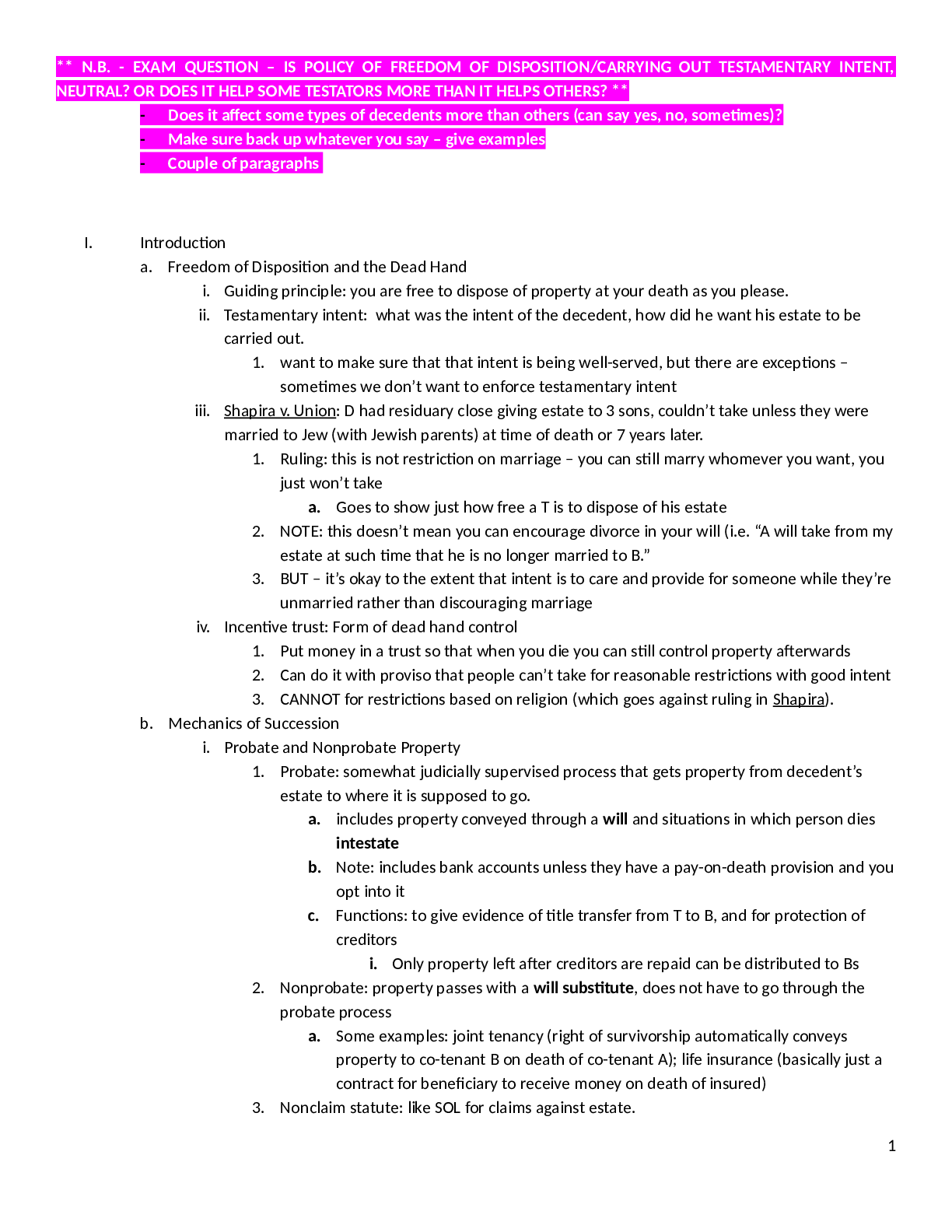
N.B. - EXAM QUESTION – IS POLICY OF FREEDOM OF DISPOSITION/CARRYING OUT TESTAMENTARY INTENT, NEUTRAL? OR DOES IT HELP SOME TESTATORS MORE THAN IT HELPS OTHERS? ** - Does it affect some types of de ... cedents more than others (can say yes, no, sometimes)? - Make sure back up whatever you say – give examples - Couple of paragraphs I. Introduction a. Freedom of Disposition and the Dead Hand i. Guiding principle: you are free to dispose of property at your death as you please. ii. Testamentary intent: what was the intent of the decedent, how did he want his estate to be carried out. 1. want to make sure that that intent is being well-served, but there are exceptions – sometimes we don’t want to enforce testamentary intent iii. Shapira v. Union: D had residuary close giving estate to 3 sons, couldn’t take unless they were married to Jew (with Jewish parents) at time of death or 7 years later. 1. Ruling: this is not restriction on marriage – you can still marry whomever you want, you just won’t take a. Goes to show just how free a T is to dispose of his estate 2. NOTE: this doesn’t mean you can encourage divorce in your will (i.e. “A will take from my estate at such time that he is no longer married to B.” 3. BUT – it’s okay to the extent that intent is to care and provide for someone while they’re unmarried rather than discouraging marriage iv. Incentive trust: Form of dead hand control 1. Put money in a trust so that when you die you can still control property afterwards 2. Can do it with proviso that people can’t take for reasonable restrictions with good intent 3. CANNOT for restrictions based on religion (which goes against ruling in Shapira). b. Mechanics of Succession i. Probate and Nonprobate Property 1. Probate: somewhat judicially supervised process that gets property from decedent’s estate to where it is supposed to go. a. includes property conveyed through a will and situations in which person dies intestate b. Note: includes bank accounts unless they have a pay-on-death provision and you opt into it c. Functions: to give evidence of title transfer from T to B, and for protection of creditors i. Only property left after creditors are repaid can be distributed to Bs 2. Nonprobate: property passes with a will substitute, does not have to go through the probate process a. Some examples: joint tenancy (right of survivorship automatically conveys property to co-tenant B on death of co-tenant A); life insurance (basically just a contract for beneficiary to receive money on death of insured) 3. Nonclaim statute: like SOL for claims against estate. 1a. Purpose: to set time period for credits to bring claim – if you don’t bring claim within right time then it is forever barred. b. BUT if creditor is one who should be reasonably known by the executor, their claim is protected ii. Probate Administration 1. Personal representative – fiduciary responsibility to estate a. if intestacy – administrator i. Property descends to heirs thru intestacy ii. B’s are called heirs or next of kin iii. statutes are called statutes of descent and distribution b. if will – executor 2. Real property – T devises (gives) his devises (RP) to devisee (B) 3. Personal property – T bequeaths (gives) his bequests (PP) to legatee (B) 4. Jurisdiction a. Primary jurisdiction over a will is state where T domiciled at death b. Ancillary jurisdiction over real property devised by will is state where RP is located 5. Letters authorizing person to act on behalf of estate are issued a. If will – letters testamentary (to executor) b. If intestacy – letters of administration (to administrator) 6. Form of proceedings a. Common form (informal) – no notice or process issued to any person b. Solemn form(formal) – notice to interested parties given by citation so they have opportunity to come in and object c. Professional Responsibility i. Duties to Intended Beneficiaries 1. Simpson v. Calivas – Atty drafted T’s will. T wanted to leave life estate in house to wife and rest of estate to son, but atty used “homestead” which gave all land to wife. a. Issue: Is attorney who drafts will liable to beneficiaries of estate? i. Old rule – no. only owe a duty to someone if they are in privity to a contract. ii. New rule – owe duty to client you contract with, but also intended beneficiaries iii. MAJORITY RULE: Estate planning lawyers are held liable to th [Show More]
Last updated: 3 years ago
Preview 1 out of 39 pages
Buy this document to get the full access instantly
Instant Download Access after purchase
Buy NowInstant download
We Accept:

Reviews( 0 )
$8.00
Can't find what you want? Try our AI powered Search
Document information
Connected school, study & course
About the document
Uploaded On
Apr 26, 2021
Number of pages
39
Written in
All

Additional information
This document has been written for:
Uploaded
Apr 26, 2021
Downloads
0
Views
136