Exam
Name___________________________________
MULTIPLE CHOICE. Choose the one alternative that best completes the statement or answers the question.
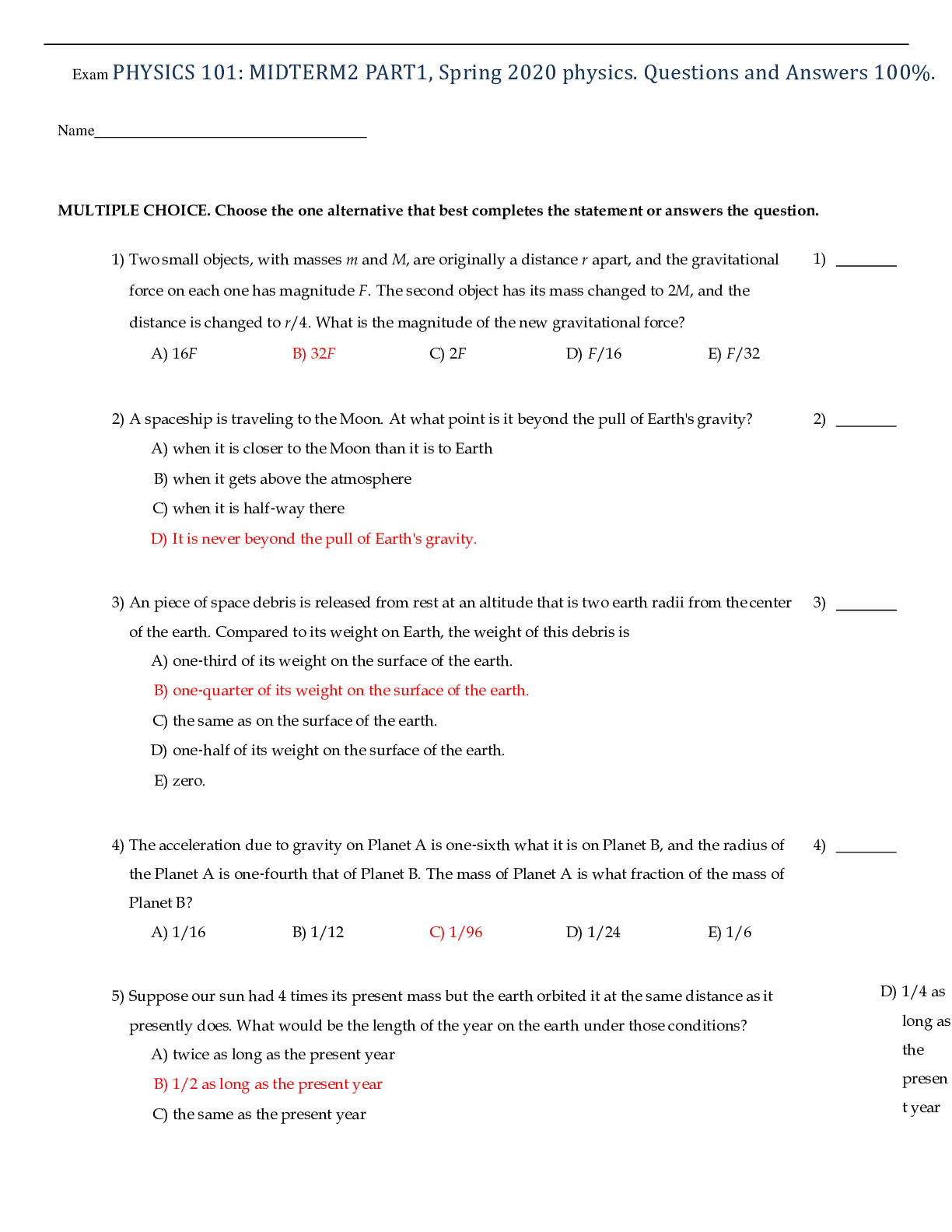
1) Two small objects, with masses m and M, are originally a distance
...
Exam
Name___________________________________
MULTIPLE CHOICE. Choose the one alternative that best completes the statement or answers the question.
1) Two small objects, with masses m and M, are originally a distance r apart, and the gravitational
force on each one has magnitude F. The second object has its mass changed to 2M, and the
distance is changed to r/4. What is the magnitude of the new gravitational force?
A) 16F B) 32F C) 2F D) F/16 E) F/32
1)
2) A spaceship is traveling to the Moon. At what point is it beyond the pull of Earth's gravity?
A) when it is closer to the Moon than it is to Earth
B) when it gets above the atmosphere
C) when it is half-way there
D) It is never beyond the pull of Earth's gravity.
2)
3) An piece of space debris is released from rest at an altitude that is two earth radii from the center
of the earth. Compared to its weight on Earth, the weight of this debris is
A) one-third of its weight on the surface of the earth.
B) one-quarter of its weight on the surface of the earth.
C) the same as on the surface of the earth.
D) one-half of its weight on the surface of the earth.
E) zero.
3)
4) The acceleration due to gravity on Planet A is one-sixth what it is on Planet B, and the radius of
the Planet A is one-fourth that of Planet B. The mass of Planet A is what fraction of the mass of
Planet B?
A) 1/16 B) 1/12 C) 1/96 D) 1/24 E) 1/6
4)
5) Suppose our sun had 4 times its present mass but the earth orbited it at the same distance as it
presently does. What would be the length of the year on the earth under those conditions?
A) twice as long as the present year
B) 1/2 as long as the present year
C) the same as the present year
D) 1/4 as long as the present year
E) four times as long as the present year
5)
6) Halley's Comet is in a highly elliptical orbit around the sun. Therefore the orbital speed of
Halley's Comet, while traveling around the sun,
A) is zero at two points in the orbit. B) increases as it nears the Sun.
C) decreases as it nears the Sun. D) is constant.
6)
7) Satellite A has twice the mass of satellite B, and moves at the same orbital distance from Earth as
satellite B. Compare the speeds of the two satellites.
A) The speed of B is one-fourth the speed of A.
B) The speed of B is twice the speed of A.
C) The speed of B is equal to the speed of A.
D) The speed of B is one-half the speed of A.
E) The speed of B is four times the speed of A.
7)
1
This study resource was
shared via CourseHero.com8) Planet A has twice the mass of Planet B. From this information, what can we conclude about the
acceleration due to gravity at the surface of Planet A compared to that at the surface of Planet B?
A) The acceleration due to gravity on Planet A is the same as the acceleration due to gravity
on Planet B.
B) The acceleration due to gravity on Planet A must be twice as great as the acceleration due
to gravity on Planet B.
C) The acceleration due to gravity on Planet A must be four times as great as the acceleration
due to gravity on Planet B.
D) The acceleration due to gravity on Planet A is greater than the acceleration due to gravity
on Planet B, but we cannot say how much greater.
E) We cannot conclude anything about the acceleration due to gravity on Planet A without
knowing the radii of the two planets.
8)
9) Two planets have the same surface gravity, but planet B has twice the mass of planet A. If planet
A has radius r, what is the radius of planet B?
A) r/ 2 B) r 2 C) 2r D) r E) 4r
9)
10) You are making a circular turn in your car on a horizontal road when you hit a big patch of ice,
causing the force of friction between the tires and the road to become zero. While the car is on
the ice, it
A) moves along a straight-line path away from the center of the circle.
B) continues to follow a circular path, but with a radius larger than the original radius.
C) moves along a straight-line path in its original direction.
D) moves along a straight-line path toward the center of the circle.
E) moves along a path that is neither straight nor circular.
10)
11) A 250-kg motorcycle goes around an unbanked turn of radius 13.7 m at a steady 96.5 km/h.
What is the magnitude of the net force on the motorcycle?
A) 2.95 × 10³ N B) 4.31 × 10⁴ N C) 719 N D) 1.31 × 10⁴ N
11)
12) A particularly scary roller coaster contains a loop-the-loop in which the car and rider are
completely upside down. If the radius of the loop is 13.2 m, with what minimum speed must
the car traverse the loop so that the rider does not fall out while upside down at the top?
Assume the rider is not strapped to the car.
A) 11.4 m/s B) 10.1 m/s C) 12.5 m/s D) 14.9 m/s
12)
13) A 0.50-kg toy is attached to the end of a 1.0-m very light string. The toy is whirled in a
horizontal circular path on a frictionless tabletop. If the maximum tension that the string can
withstand without breaking is 350 N. What is the maximum speed the mass can have without
breaking the string?
A) 700 m/s B) 26 m/s C) 13 m/s D) 19 m/s
13)
14) A jet plane flying 600 m/s experiences an acceleration of 4.0 g when pulling out of a circular
dive. What is the radius of curvature of the circular part of the path in which the plane is flying?
A) 640 m B) 9200 m C) 7100 m D) 1200 m
14)
2
This study resource was
shared via CourseHero.com15) A car moving at a steady 10 m/s on a level highway encounters a bump that has a circular
cross-section with a radius of 30 m. The car maintains its speed over the bump. What is the
normal force exerted by the seat of the car on a 60.0-kg passenger when the car is at the top of
the bump?
A) 790 N B) 200 N C) 590 N D) 390 N E) 490 N
15)
16) A car moving at a steady 10 m/s on a level highway encounters a depression that has a circular
cross-section with a radius of 30 m. The car maintains its speed as it drives through the
depression. What is the normal force exerted by the seat of the car on a 60.0-kg passenger when
the car is at the bottom of the depression?
A) 200 N B) 590 N C) 790 N D) 390 N E) 490 N
16)
17) A highway curve of radius 100 m, banked at an angle of 45°, may be negotiated without friction
at a speed of
A) 31 m/s. B) 22 m/s. C) 67 m/s. D) 44 m/s.
17)
SHORT ANSWER. Write the word or phrase that best completes each statement or answers the question.
18) What is the magnitude of the gravitational force that two small 7.00-kg balls exert on
each other when they are 35.0 cm apart? (G = 6.67 × 10⁻¹¹ N ∙ m2/kg2)
18)
MULTIPLE CHOICE. Choose the one alternative that best completes the statement or answers the question.
19) What would be the weight of a 59.1-kg astronaut on a planet with the same density as Earth and
having twice Earth's radius?
A) 1200 N B) 290 N C) 1160 N D) 580 N E) 2320 N
19)
20) Planet Z-34 has a mass equal to one-third that of Earth and a radius equal to one-third that of
Earth. With g representing, as usual, the acceleration due to gravity at the surface of Earth, the
acceleration due to gravity at the surface of Z-34 is
A) g/9. B) g/3. C) 6g. D) 3g. E) 9g.
20)
21) An object weighs 432 N on the surface of the earth. The earth has radius R. If the object is raised
to a height of 3R above the earth's surface, what is its weight?
A) 144 N B) 108 N C) 27.0 N D) 48.0 N E) 305 N
21)
22) Suppose NASA wants a satellite to revolve around Earth 5 times a day. What should be the
radius of its orbit if we neglect the presence of the Moon? (G = 6.67 × 10⁻¹¹ N ∙ m2/kg2, Mearth
= 5.97 × 1024 kg)
A) 0.69 × 10⁷ m B) 7.22 × 10⁷ m C) 2.11 × 10⁷ m D) 1.44 × 10⁷ m
22)
23) The captain of a spaceship orbiting planet X discovers that to remain in orbit at 410 kmfrom the
planet's center, she needs to maintain a speed of 68 m/s. What is the mass of planet X? (G = 6.67
× 10-11 N ∙ m2/kg2)
A) 2.8 × 10¹⁹ kg B) 4.2 × 10¹⁴ kg C) 4.2 × 10¹⁷ kg D) 2.8 × 10¹⁶ kg
23)
3
This study resource was
shared via CourseHero.com24) Find the orbital speed of an ice cube in the rings of Saturn. The mass of Saturn is 5.68 x 1026 kg,
and use an orbital radius of 1.00 x 10⁵ km. (G = 6.67 × 10⁻¹¹ N ∙ m2/kg2)
A) 19.5 km/s B) 13.8 km/s C) 27.5 km/s D) 9.40 km/s
24)
SHORT ANSWER. Write the word or phrase that best completes each statement or answers the question.
25) The International Space Station is orbiting at an altitude of about 370 km above the
earth's surface. The mass of the earth is 5.97 × 1024 kg, the radius of the earth is 6.38 ×
106 m, and G = 6.67 × 10⁻¹¹ N ∙ m2/kg2. Assume a circular orbit.
(a) What is the period of the International Space Station's orbit?
(b) What is the speed of the International Space Station in its orbit?
25)
MULTIPLE CHOICE. Choose the one alternative that best completes the statement or answers the question.
26) Europa, a satellite of Jupiter, has an orbital diameter of 1.34 × 10⁹ m and a period of 3.55 days.
What is the mass of Jupiter? (G = 6.67 × 10⁻¹¹ N ∙ m2/kg2)
A) 1.65 × 1027 kg
B) 1.53 × 1027 kg
C) 3.08 × 1027 kg
D) 1.89 × 1027 kg
E) 1.07 × 1027 kg
26)
27) A satellite of mass M takes time T to orbit a planet. If the satellite had twice as much mass, the
time for it to orbit the planet at the same altitude would be
A) T/2. B) T. C) 2T. D) 4T. E) T/4.
27)
4
[Show More]