Als-Con-201
Exam Practice Questions
This Als-Con-201 exam PDF provides detailed practice questions, answers, and
explanations. These Salesforce Als-Con-201 exam practice questions are
designed for IT professionals, s
...
Als-Con-201
Exam Practice Questions
This Als-Con-201 exam PDF provides detailed practice questions, answers, and
explanations. These Salesforce Als-Con-201 exam practice questions are
designed for IT professionals, system administrators, and students preparing for
Salesforce Consultant certification.
Key Features
Exam-Oriented Questions: Realistic practice questions that mirror the format
and difficulty of actual certification exams.
Wide Coverage: Includes cloud computing, networking, security, AI, and
enterprise IT management exams.
Study-Friendly Format: Organized sections by exam type, enabling focused
preparation.
Important Note:
This material is for personal study purposes only. Please do not
redistribute or use for commercial purposes without permission.
Share some Als-Con-201 exam online questions below.
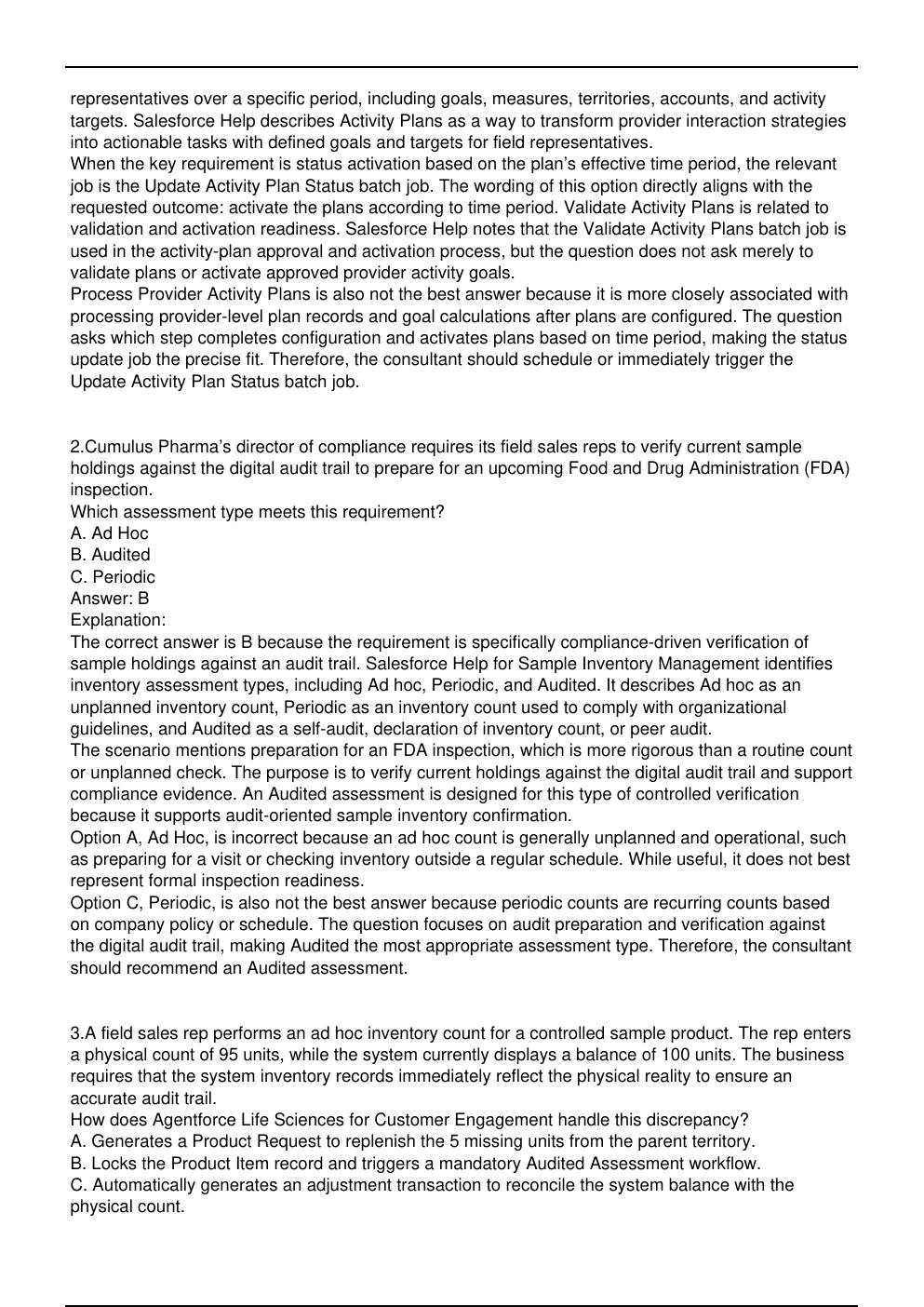
1.An Agentforce Life Sciences Consultant at Cumulus Pharma needs to complete the Activity Plan
configurations aligned with the company’s objectives and activate the plans based on the time
period.
Which step meets this requirement?
A. Schedule or immediately trigger the Validate Activity Plans batch job.
B. Schedule or immediately trigger the Process Provider Activity Plans batch job.
C. Schedule or immediately trigger the Update Activity Plan Status batch job.
Answer: C
Explanation:
Option C is the best answer because the requirement is specifically to activate Activity Plans based
on the time period. In Life Sciences Cloud, Activity Plans define activity goals for sales
representatives over a specific period, including goals, measures, territories, accounts, and activity
targets. Salesforce Help describes Activity Plans as a way to transform provider interaction strategies
into actionable tasks with defined goals and targets for field representatives.
When the key requirement is status activation based on the plan’s effective time period, the relevant
job is the Update Activity Plan Status batch job. The wording of this option directly aligns with the
requested outcome: activate the plans according to time period. Validate Activity Plans is related to
validation and activation readiness. Salesforce Help notes that the Validate Activity Plans batch job is
used in the activity-plan approval and activation process, but the question does not ask merely to
validate plans or activate approved provider activity goals.
Process Provider Activity Plans is also not the best answer because it is more closely associated with
processing provider-level plan records and goal calculations after plans are configured. The question
asks which step completes configuration and activates plans based on time period, making the status
update job the precise fit. Therefore, the consultant should schedule or immediately trigger the
Update Activity Plan Status batch job.
2.Cumulus Pharma’s director of compliance requires its field sales reps to verify current sample
holdings against the digital audit trail to prepare for an upcoming Food and Drug Administration (FDA)
inspection.
Which assessment type meets this requirement?
A. Ad Hoc
B. Audited
C. Periodic
Answer: B
Explanation:
The correct answer is B because the requirement is specifically compliance-driven verification of
sample holdings against an audit trail. Salesforce Help for Sample Inventory Management identifies
inventory assessment types, including Ad hoc, Periodic, and Audited. It describes Ad hoc as an
unplanned inventory count, Periodic as an inventory count used to comply with organizational
guidelines, and Audited as a self-audit, declaration of inventory count, or peer audit.
The scenario mentions preparation for an FDA inspection, which is more rigorous than a routine count
or unplanned check. The purpose is to verify current holdings against the digital audit trail and support
compliance evidence. An Audited assessment is designed for this type of controlled verification
because it supports audit-oriented sample inventory confirmation.
Option A, Ad Hoc, is incorrect because an ad hoc count is generally unplanned and operational, such
as preparing for a visit or checking inventory outside a regular schedule. While useful, it does not best
represent formal inspection readiness.
Option C, Periodic, is also not the best answer because periodic counts are recurring counts based
on company policy or schedule. The question focuses on audit preparation and verification against
the digital audit trail, making Audited the most appropriate assessment type. Therefore, the consultant
should recommend an Audited assessment.
3.A field sales rep performs an ad hoc inventory count for a controlled sample product. The rep enters
a physical count of 95 units, while the system currently displays a balance of 100 units. The business
requires that the system inventory records immediately reflect the physical reality to ensure an
accurate audit trail.
How does Agentforce Life Sciences for Customer Engagement handle this discrepancy?
A. Generates a Product Request to replenish the 5 missing units from the parent territory.
B. Locks the Product Item record and triggers a mandatory Audited Assessment workflow.
C. Automatically generates an adjustment transaction to reconcile the system balance with the
physical count.
Answer: C
Explanation:
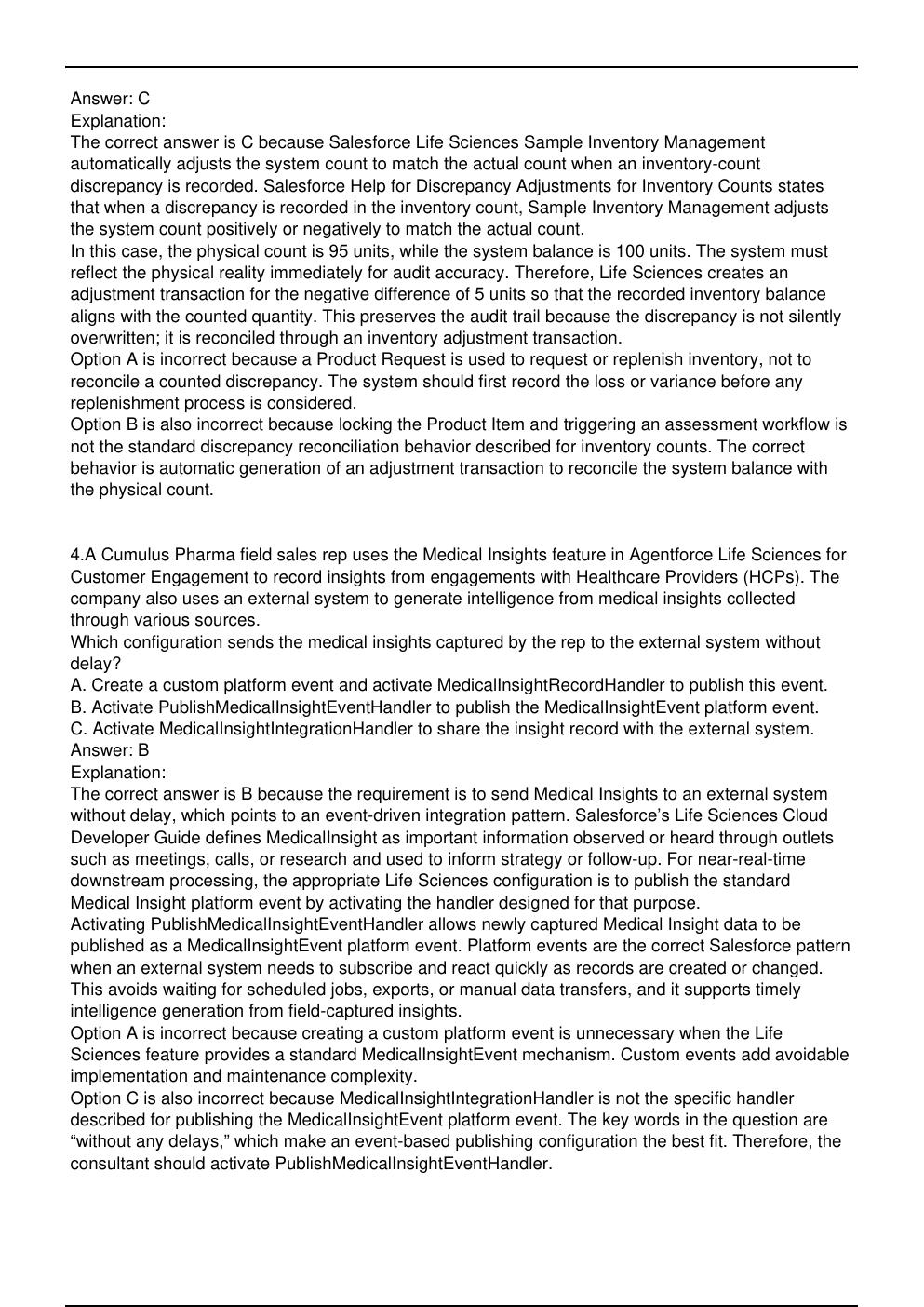
The correct answer is C because Salesforce Life Sciences Sample Inventory Management
automatically adjusts the system count to match the actual count when an inventory-count
discrepancy is recorded. Salesforce Help for Discrepancy Adjustments for Inventory Counts states
that when a discrepancy is recorded in the inventory count, Sample Inventory Management adjusts
the system count positively or negatively to match the actual count.
In this case, the physical count is 95 units, while the system balance is 100 units. The system must
reflect the physical reality immediately for audit accuracy. Therefore, Life Sciences creates an
adjustment transaction for the negative difference of 5 units so that the recorded inventory balance
aligns with the counted quantity. This preserves the audit trail because the discrepancy is not silently
overwritten; it is reconciled through an inventory adjustment transaction.
Option A is incorrect because a Product Request is used to request or replenish inventory, not to
reconcile a counted discrepancy. The system should first record the loss or variance before any
replenishment process is considered.
Option B is also incorrect because locking the Product Item and triggering an assessment workflow is
not the standard discrepancy reconciliation behavior described for inventory counts. The correct
behavior is automatic generation of an adjustment transaction to reconcile the system balance with
the physical count.
[Show More]









![Preview of [PDF] [eBook] Procurement Principles and Management in the Digital Age, 12th Edition, By P](https://scholarfriends.com/storage/eBook for Procurement Principles and Management in the Digital Age, 12th Edition, By Peter Baily, David Farmer, Barry Crocker, David Jessop.png)