CEHPC
Exam Practice Questions
This CEHPC exam PDF provides detailed practice questions, answers, and
explanations. These CertiProf CEHPC exam practice questions are designed for
IT professionals, system administrator
...
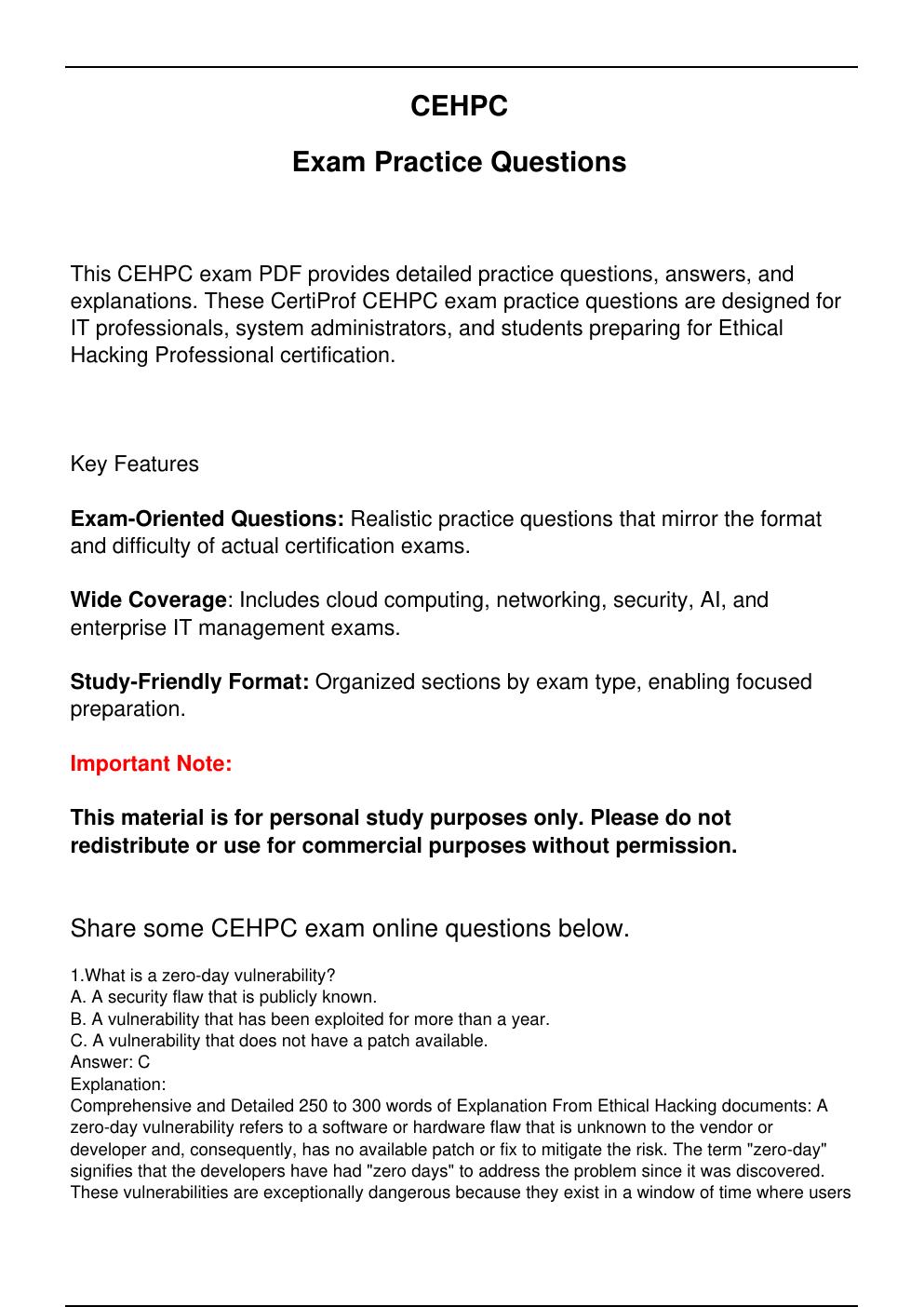
CEHPC
Exam Practice Questions
This CEHPC exam PDF provides detailed practice questions, answers, and
explanations. These CertiProf CEHPC exam practice questions are designed for
IT professionals, system administrators, and students preparing for Ethical
Hacking Professional certification.
Key Features
Exam-Oriented Questions: Realistic practice questions that mirror the format
and difficulty of actual certification exams.
Wide Coverage: Includes cloud computing, networking, security, AI, and
enterprise IT management exams.
Study-Friendly Format: Organized sections by exam type, enabling focused
preparation.
Important Note:
This material is for personal study purposes only. Please do not
redistribute or use for commercial purposes without permission.
Share some CEHPC exam online questions below.
1.What is a zero-day vulnerability?
A. A security flaw that is publicly known.
B. A vulnerability that has been exploited for more than a year.
C. A vulnerability that does not have a patch available.
Answer: C
Explanation:
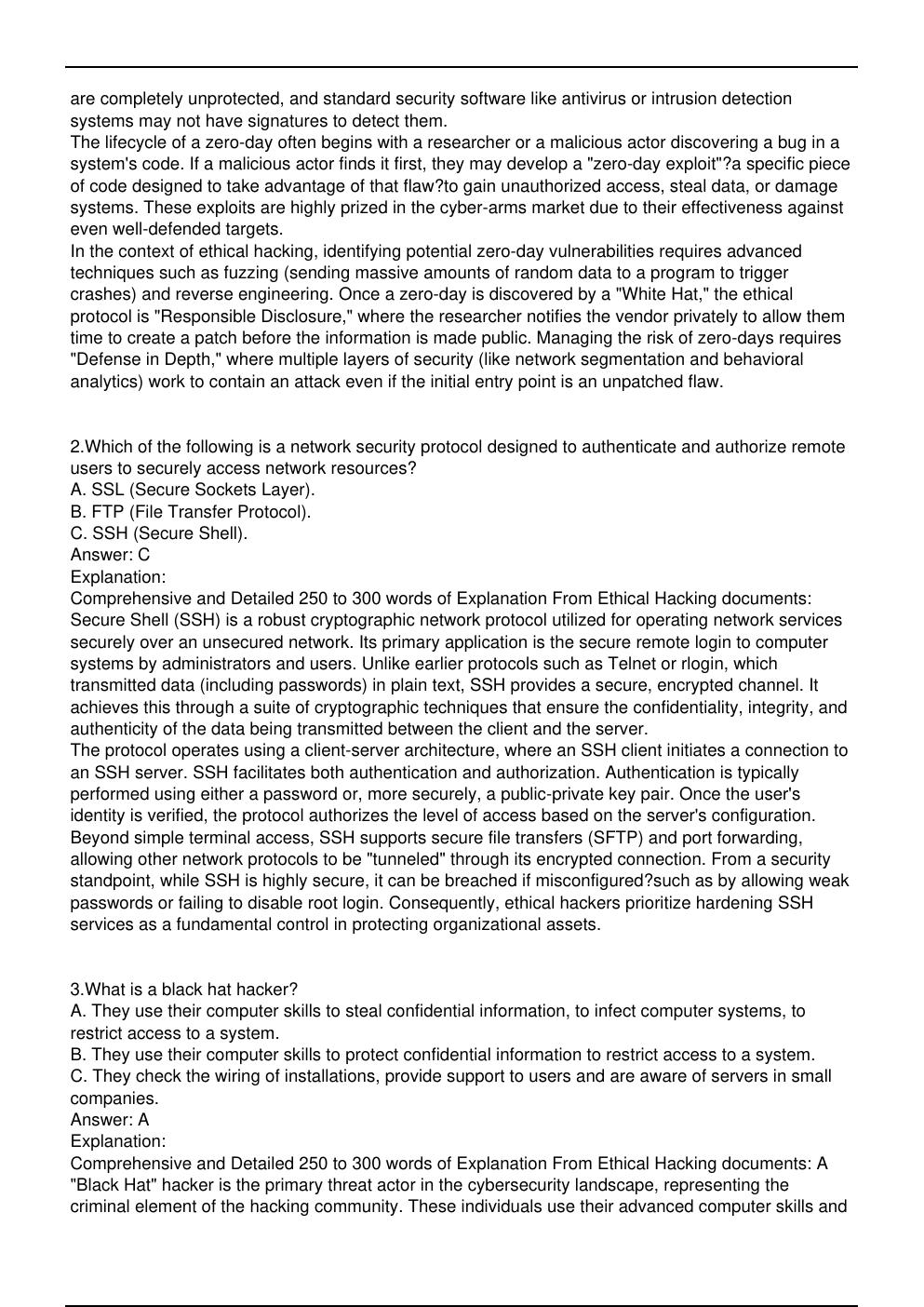
Comprehensive and Detailed 250 to 300 words of Explanation From Ethical Hacking documents: A
zero-day vulnerability refers to a software or hardware flaw that is unknown to the vendor or
developer and, consequently, has no available patch or fix to mitigate the risk. The term "zero-day"
signifies that the developers have had "zero days" to address the problem since it was discovered.
These vulnerabilities are exceptionally dangerous because they exist in a window of time where users
are completely unprotected, and standard security software like antivirus or intrusion detection
systems may not have signatures to detect them.
The lifecycle of a zero-day often begins with a researcher or a malicious actor discovering a bug in a
system's code. If a malicious actor finds it first, they may develop a "zero-day exploit"?a specific piece
of code designed to take advantage of that flaw?to gain unauthorized access, steal data, or damage
systems. These exploits are highly prized in the cyber-arms market due to their effectiveness against
even well-defended targets.
In the context of ethical hacking, identifying potential zero-day vulnerabilities requires advanced
techniques such as fuzzing (sending massive amounts of random data to a program to trigger
crashes) and reverse engineering. Once a zero-day is discovered by a "White Hat," the ethical
protocol is "Responsible Disclosure," where the researcher notifies the vendor privately to allow them
time to create a patch before the information is made public. Managing the risk of zero-days requires
"Defense in Depth," where multiple layers of security (like network segmentation and behavioral
analytics) work to contain an attack even if the initial entry point is an unpatched flaw.
2.Which of the following is a network security protocol designed to authenticate and authorize remote
users to securely access network resources?
A. SSL (Secure Sockets Layer).
B. FTP (File Transfer Protocol).
C. SSH (Secure Shell).
Answer: C
Explanation:
Comprehensive and Detailed 250 to 300 words of Explanation From Ethical Hacking documents:
Secure Shell (SSH) is a robust cryptographic network protocol utilized for operating network services
securely over an unsecured network. Its primary application is the secure remote login to computer
systems by administrators and users. Unlike earlier protocols such as Telnet or rlogin, which
transmitted data (including passwords) in plain text, SSH provides a secure, encrypted channel. It
achieves this through a suite of cryptographic techniques that ensure the confidentiality, integrity, and
authenticity of the data being transmitted between the client and the server.
The protocol operates using a client-server architecture, where an SSH client initiates a connection to
an SSH server. SSH facilitates both authentication and authorization. Authentication is typically
performed using either a password or, more securely, a public-private key pair. Once the user's
identity is verified, the protocol authorizes the level of access based on the server's configuration.
Beyond simple terminal access, SSH supports secure file transfers (SFTP) and port forwarding,
allowing other network protocols to be "tunneled" through its encrypted connection. From a security
standpoint, while SSH is highly secure, it can be breached if misconfigured?such as by allowing weak
passwords or failing to disable root login. Consequently, ethical hackers prioritize hardening SSH
services as a fundamental control in protecting organizational assets.
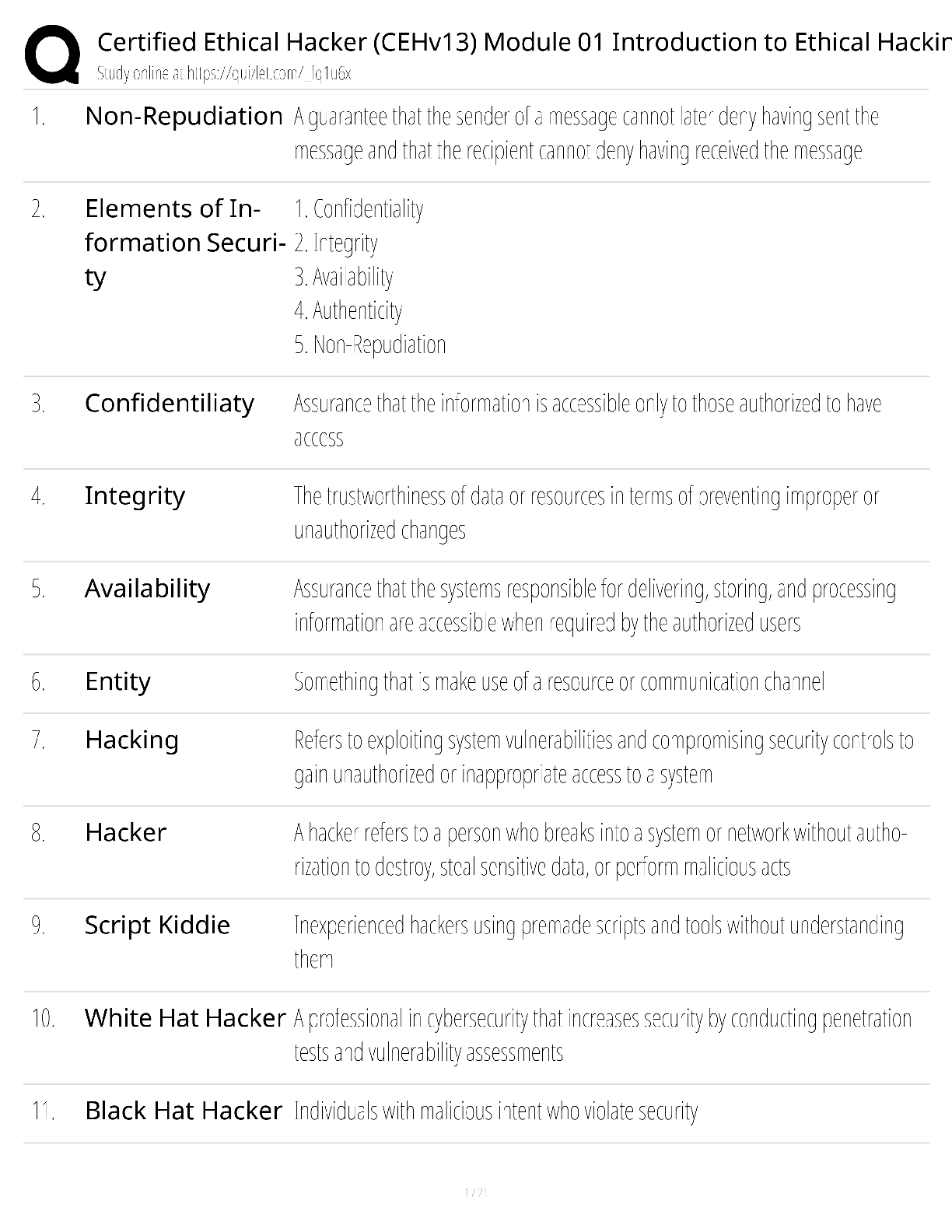
3.What is a black hat hacker?
A. They use their computer skills to steal confidential information, to infect computer systems, to
restrict access to a system.
B. They use their computer skills to protect confidential information to restrict access to a system.
C. They check the wiring of installations, provide support to users and are aware of servers in small
companies.
Answer: A
Explanation:
Comprehensive and Detailed 250 to 300 words of Explanation From Ethical Hacking documents: A
"Black Hat" hacker is the primary threat actor in the cybersecurity landscape, representing the
criminal element of the hacking community. These individuals use their advanced computer skills and
technical knowledge with malicious intent to breach security defenses. Their goals typically involve
stealing confidential information, infecting computer systems with malware, or restricting access to a
system (as seen in DDoS or ransomware attacks) for personal gain, financial profit, or ideological
reasons.
Black Hat hackers operate without authorization and often hide their tracks through anonymization
tools like VPNs, Tor, and proxy chains. Their methodology involves finding and exploiting
vulnerabilities?often "Zero-Day" flaws that the vendor is not yet aware of?to gain a foothold in a target
network. Once inside, they may engage in corporate espionage, sell stolen data on the dark web, or
hold an organization's operations hostage.
[Show More]


![Preview of eBook [PDF] Advanced Technologies for Rechargeable Batteries Metal Ion, Hybrid, and Metal-](https://browseimages.nyc3.digitaloceanspaces.com/paper-images/2024/Aug/31/4CeOA98s2024-08-31-08-3766d2ac249f11f.png)
![Preview of eBook [PDF] Digital Personality A Man Forever Volume 2 Technical Aspects 1st Edition By Ku](https://browseimages.nyc3.digitaloceanspaces.com/paper-images/2024/Aug/30/t3vEGYrg2024-08-30-02-3166d1adaa38427.png)