AP-205
Exam Practice Questions
This AP-205 exam PDF provides detailed practice questions, answers, and
explanations. These Salesforce AP-205 exam practice questions are designed
for IT professionals, system administr
...
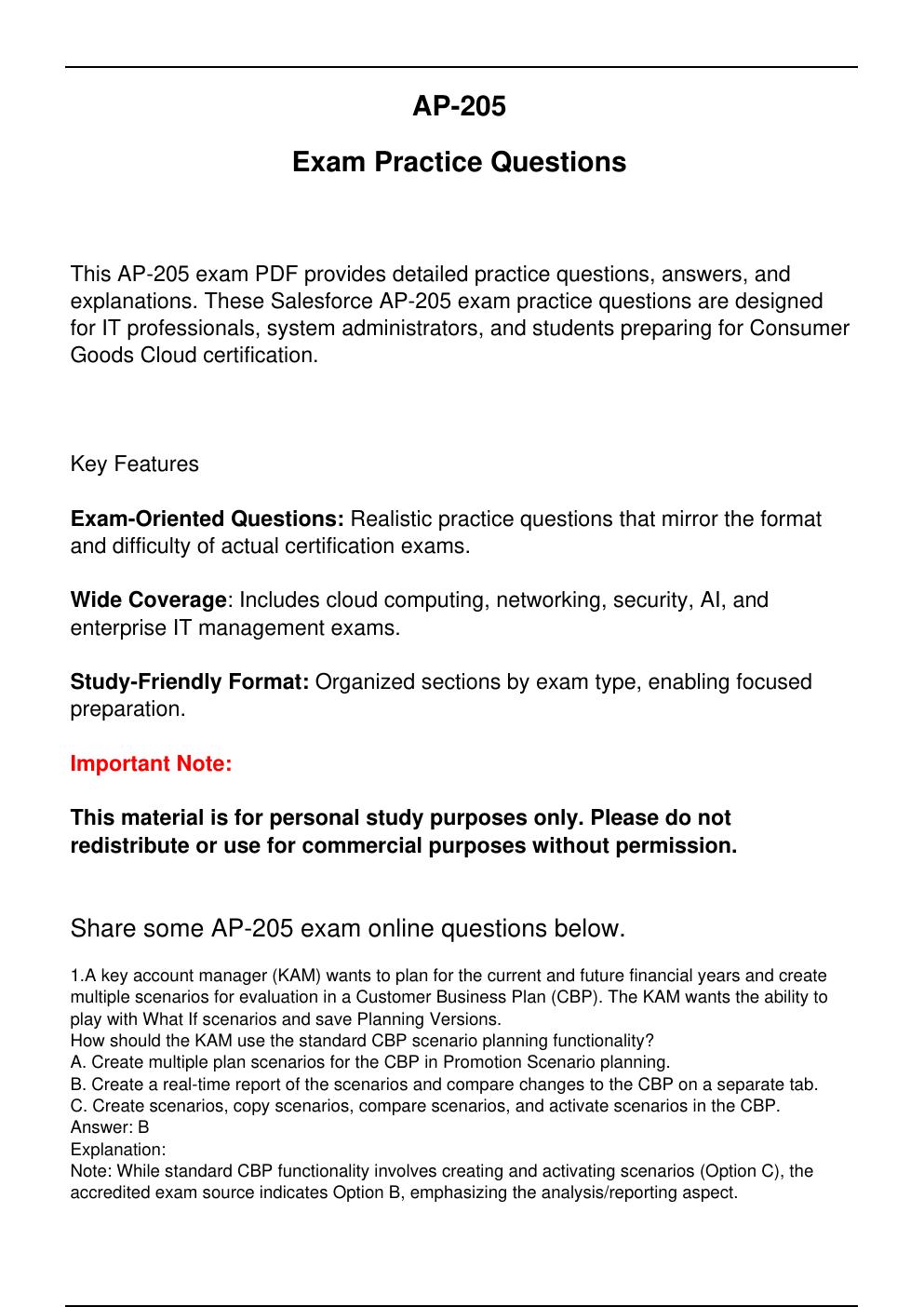
AP-205
Exam Practice Questions
This AP-205 exam PDF provides detailed practice questions, answers, and
explanations. These Salesforce AP-205 exam practice questions are designed
for IT professionals, system administrators, and students preparing for Consumer
Goods Cloud certification.
Key Features
Exam-Oriented Questions: Realistic practice questions that mirror the format
and difficulty of actual certification exams.
Wide Coverage: Includes cloud computing, networking, security, AI, and
enterprise IT management exams.
Study-Friendly Format: Organized sections by exam type, enabling focused
preparation.
Important Note:
This material is for personal study purposes only. Please do not
redistribute or use for commercial purposes without permission.
Share some AP-205 exam online questions below.
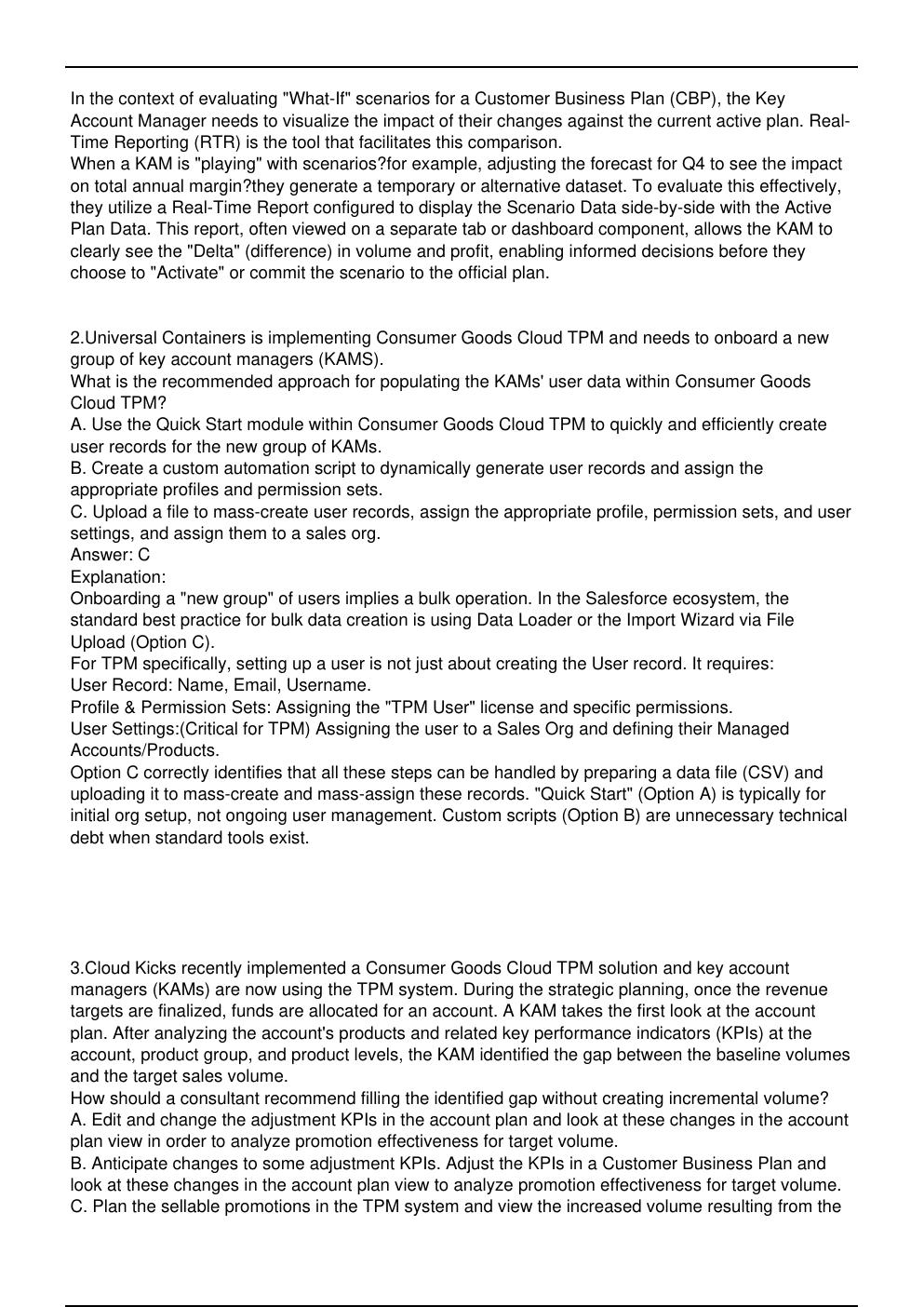
1.A key account manager (KAM) wants to plan for the current and future financial years and create
multiple scenarios for evaluation in a Customer Business Plan (CBP). The KAM wants the ability to
play with What If scenarios and save Planning Versions.
How should the KAM use the standard CBP scenario planning functionality?
A. Create multiple plan scenarios for the CBP in Promotion Scenario planning.
B. Create a real-time report of the scenarios and compare changes to the CBP on a separate tab.
C. Create scenarios, copy scenarios, compare scenarios, and activate scenarios in the CBP.
Answer: B
Explanation:
Note: While standard CBP functionality involves creating and activating scenarios (Option C), the
accredited exam source indicates Option B, emphasizing the analysis/reporting aspect.
In the context of evaluating "What-If" scenarios for a Customer Business Plan (CBP), the Key
Account Manager needs to visualize the impact of their changes against the current active plan. RealTime Reporting (RTR) is the tool that facilitates this comparison.
When a KAM is "playing" with scenarios?for example, adjusting the forecast for Q4 to see the impact
on total annual margin?they generate a temporary or alternative dataset. To evaluate this effectively,
they utilize a Real-Time Report configured to display the Scenario Data side-by-side with the Active
Plan Data. This report, often viewed on a separate tab or dashboard component, allows the KAM to
clearly see the "Delta" (difference) in volume and profit, enabling informed decisions before they
choose to "Activate" or commit the scenario to the official plan.
2.Universal Containers is implementing Consumer Goods Cloud TPM and needs to onboard a new
group of key account managers (KAMS).
What is the recommended approach for populating the KAMs' user data within Consumer Goods
Cloud TPM?
A. Use the Quick Start module within Consumer Goods Cloud TPM to quickly and efficiently create
user records for the new group of KAMs.
B. Create a custom automation script to dynamically generate user records and assign the
appropriate profiles and permission sets.
C. Upload a file to mass-create user records, assign the appropriate profile, permission sets, and user
settings, and assign them to a sales org.
Answer: C
Explanation:
Onboarding a "new group" of users implies a bulk operation. In the Salesforce ecosystem, the
standard best practice for bulk data creation is using Data Loader or the Import Wizard via File
Upload (Option C).
For TPM specifically, setting up a user is not just about creating the User record. It requires:
User Record: Name, Email, Username.
Profile & Permission Sets: Assigning the "TPM User" license and specific permissions.
User Settings:(Critical for TPM) Assigning the user to a Sales Org and defining their Managed
Accounts/Products.
Option C correctly identifies that all these steps can be handled by preparing a data file (CSV) and
uploading it to mass-create and mass-assign these records. "Quick Start" (Option A) is typically for
initial org setup, not ongoing user management. Custom scripts (Option B) are unnecessary technical
debt when standard tools exist.
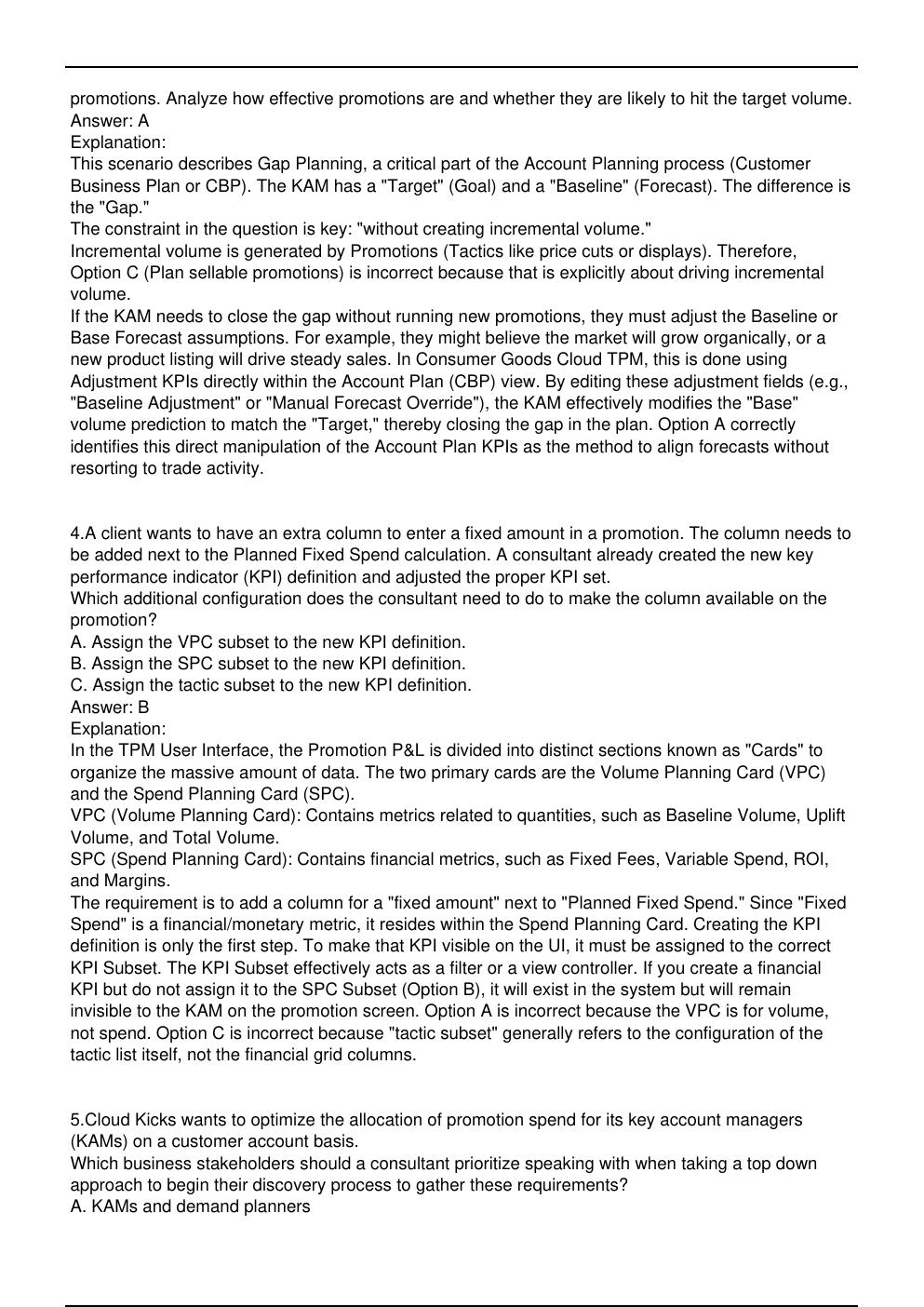
3.Cloud Kicks recently implemented a Consumer Goods Cloud TPM solution and key account
managers (KAMs) are now using the TP
[Show More]

![Preview of eBook [PDF] Advanced Technologies for Rechargeable Batteries Metal Ion, Hybrid, and Metal-](https://browseimages.nyc3.digitaloceanspaces.com/paper-images/2024/Aug/31/4CeOA98s2024-08-31-08-3766d2ac249f11f.png)
![Preview of eBook [PDF] Digital Personality A Man Forever Volume 2 Technical Aspects 1st Edition By Ku](https://browseimages.nyc3.digitaloceanspaces.com/paper-images/2024/Aug/30/t3vEGYrg2024-08-30-02-3166d1adaa38427.png)