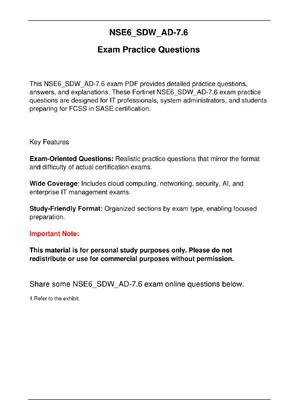
Archer Expert Exam Practice Questions
This Archer Expert exam PDF provides detailed practice questions, answers, and
explanations. These Archer Archer Expert exam practice questions are designed
for IT professionals,
...
Archer Expert Exam Practice Questions
This Archer Expert exam PDF provides detailed practice questions, answers, and
explanations. These Archer Archer Expert exam practice questions are designed
for IT professionals, system administrators, and students preparing for Archer
Certified Administrator certification.
Key Features
Exam-Oriented Questions: Realistic practice questions that mirror the format
and difficulty of actual certification exams.
Wide Coverage: Includes cloud computing, networking, security, AI, and
enterprise IT management exams.
Study-Friendly Format: Organized sections by exam type, enabling focused
preparation.
Important Note:
This material is for personal study purposes only. Please do not
redistribute or use for commercial purposes without permission.
Share some Archer Expert exam online questions below.
1.Which of the following Advanced Search features would allow you to build a top-down
organizational hierarchy of all employees in the Contacts Application?
A. Internal References and Directional Search
B. External References and Enforce Relationships
C. Drill Down Reporting
D. Statistical Search
Answer: A
Explanation:
To build a hierarchical view within a single application (like a "Manager" field in the Contacts
application that points back to another record in the Contacts application), Archer utilizes Internal
References. As taught in the Archer Administration II Advanced Search module, when an application
references itself, you can use Directional Search logic to traverse the hierarchy.
By configuring the search to look "Upstream" or "Downstream" through the internal reference, Archer
can recursively find all subordinates under a manager or all managers above an employee. This
allows the system to flatten a complex organizational tree into a readable report. External References
(Option B) are used between different applications, and Statistical Search (Option D) is used for
mathematical aggregations (Sum, Count, Average). Only the combination of Internal References and
Directional Search provides the specialized recursive logic required to map out a multi-level
organizational hierarchy.
2.Which would be an accurate function(s) description for Archer LDAP Synchronization?
A. None of these answer are correct
B. Updates user profile data and deactivates accounts based on LDAP changes
C. Only creates accounts for new users found on the LDAP server
D. Only associates Archer users/groups with domain users/groups
Answer: B
Explanation:
In Archer, the LDAP Synchronization process is a comprehensive identity management tool.
According to the Archer Administration II curriculum, its primary purpose is to ensure that the Archer
user database mirrors the corporate directory (Active Directory/LDAP). It is not limited to just creating
accounts or linking groups; its most critical function is the automation of the user lifecycle.
When the sync runs, it checks for changes in the LDAP source. If a user’s department or email
changes in Active Directory, Archer updates the user profile data accordingly. Most importantly for
security, if a user is disabled or removed from the LDAP group/OU being synced, Archer can
automatically deactivate the account (or move it to a "terminated" status) based on the "Missing
Person" configuration in the LDAP setup. This prevents unauthorized access by former employees.
Options C and D are "Only" statements that describe small portions of the tool's capability, whereas
Option B captures the ongoing maintenance and security synchronization that is the hallmark of the
Archer LDAP service.
3.What is the main difference between an environment and an instance in Archer?
A. An environment and an instance are the same.
B. An environment is a single system, and an instance is a collection of systems.
C. An environment can host multiple instances, and each instance has its own database and file
repository.
D. An instance can host multiple environments.
Answer: C
Explanation:
Understanding the Archer hierarchy is fundamental to system administration. As detailed in the
Archer Administration II curriculum and the Archer Control Panel (ACP)guides, an Environment refers
to the overall installation of the Archer software on a set of servers (Web, Services, and Database).
Within a single environment, an administrator can host multiple Instances. Each instance represents a
logically isolated "tenant" with its own unique Instance Database, File Repository (for attachments),
and set of users. For example, an organization might have one environment that hosts a "Production"
instance, a "UAT" instance, and a "Training" instance. This architecture allows organizations to share
the same server hardware and software binaries while keeping the data and configurations of
different business units or development stages completely separate and secure from one another.
4.Which action is recommended before updating an Archer Advanced Workflow?
A. Open the application and deactivate Advanced Workflow before making changes to the workflow
[Show More]

![Preview of eBook [PDF] Advanced Technologies for Rechargeable Batteries Metal Ion, Hybrid, and Metal-](https://browseimages.nyc3.digitaloceanspaces.com/paper-images/2024/Aug/31/4CeOA98s2024-08-31-08-3766d2ac249f11f.png)
![Preview of eBook [PDF] Digital Personality A Man Forever Volume 2 Technical Aspects 1st Edition By Ku](https://browseimages.nyc3.digitaloceanspaces.com/paper-images/2024/Aug/30/t3vEGYrg2024-08-30-02-3166d1adaa38427.png)