Health Care > QUESTIONS & ANSWERS > Parasympathetic Nervous System. 99 Questions and Answers. Includes Answers Explanations/Rationale. (All)
Parasympathetic Nervous System. 99 Questions and Answers. Includes Answers Explanations/Rationale.
Document Content and Description Below
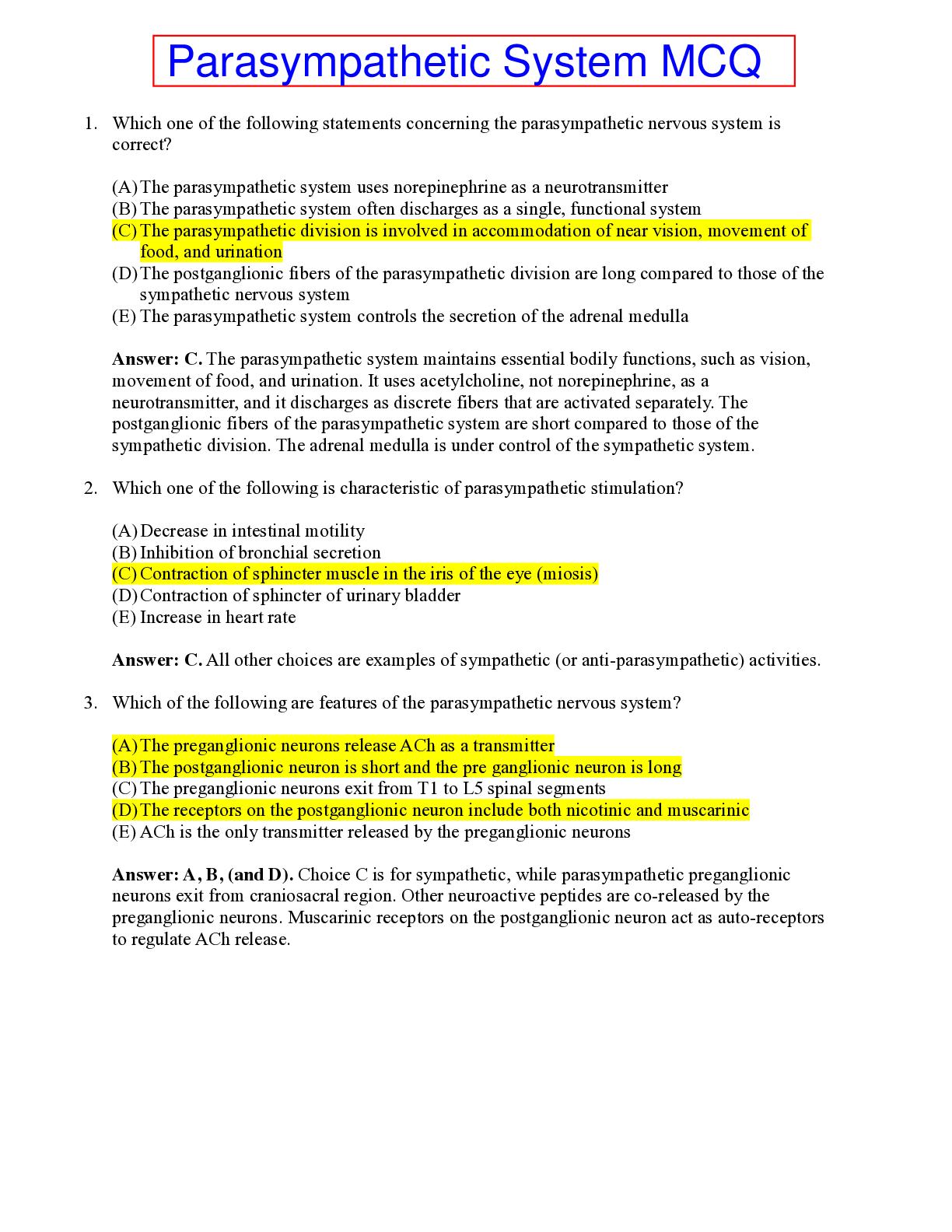
1. Which one of the following statements concerning the parasympathetic nervous system is correct? (A)The parasympathetic system uses norepinephrine as a neurotransmitter (B) The parasympathetic sy ... stem often discharges as a single, functional system (C) The parasympathetic division is involved in accommodation of near vision, movement of food, and urination (D)The postganglionic fibers of the parasympathetic division are long compared to those of the sympathetic nervous system (E) The parasympathetic system controls the secretion of the adrenal medulla 2. 2. Which one of the following is characteristic of parasympathetic stimulation? (A)Decrease in intestinal motility (B) Inhibition of bronchial secretion (C) Contraction of sphincter muscle in the iris of the eye (miosis) (D)Contraction of sphincter of urinary bladder (E) Increase in heart rate 3. 3. Which of the following are features of the parasympathetic nervous system? (A)The preganglionic neurons release ACh as a transmitter (B) The postganglionic neuron is short and the pre ganglionic neuron is long (C) The preganglionic neurons exit from T1 to L5 spinal segments (D)The receptors on the postganglionic neuron include both nicotinic and muscarinic (E) ACh is the only transmitter released by the preganglionic neurons 4. 4. Parasympathetic nervous system is different from sympathetic nervous system in majority of cases. Which of below is NOT one? (A)Length of preganglionic neurons (B) Length of postganglionic neurons (C) Major transmitters released by postganglionic fibers (D)Types of receptors at ganglions (E) Types of receptors at neuroaffector junctional (F) All of the above (G)None of the above 5. 5. Which of the following is a feature of the sympathetic, but not the parasympathetic nervous system? (A)Ganglia located in the effector organs (B) Long preganglionic neurons (C) Preganglionic neurons release norepinephrine (D)Preganglionic neurons release ACh (E) Preganglionic neurons originate in the thoracolumbar spinal cord (F) Postganglionic neurons release epinephrine (G)Postganglionic neurons release ACh 6. Which of the following are features of the sympathetic nervous system? (A)Both epinephrine and norepinephrine are released from the postganglionic fibers (B) Cranial nerve III contains some parasympathetic fibers emanating from the Edinger Westphal nucleus (C) Preganglionic fibers synapse very close to the effector organ innervated by the postganglionic neuron (D)Preganglionic sympathetic neurons release norepinephrine as the transmitter (E) The cell bodies of the postganglionic neurons have alpha 2 receptors on them 6. . 7. What is the endogenous ligand that binds to the nicotinic receptor (NN) of the nervous system (or sometimes called N2)? (A)Methacholine (B) Acetylcholine (C) Choline (D)Succinylcholine (E) Bethanechol 7. 8. Of the following options, in which is the autonomic receptor predominantly NN cholinergic? (A)Vascular smooth muscle (B) Salivary glands (C) Skeletal muscle (D)SA node of the heart (E) Superior cervical ganglion Answer: E. NN is a ganglionic receptor. All other choices are target organs (effectors). 9. What is the main transmitter released by a post ganglionic sympathetic neuron? (A)Epinephrine (B) Neuropeptide Y (C) Norepinephrine (D)Acetylcholine 10. Which of the following statements are correct regarding the somatic nervous system? (A)In the somatic system there are no ganglia outside the spinal cord (B) The cell bodies of the motor fibers are found in the anterior horn of the spinal cord (C) The junction between the motor nerve and the skeletal muscle is referred to as the neuromuscular junction (D)Skeletal muscle possess receptors that when activated cause muscles to relax (E) The nicotinic receptors on skeletal muscles are identical to the nicotinic receptors at the autonomic ganglia 8. 11. Which of the following statements regarding cholinergic receptors are correct? (A)M2 receptors are found on the heart whereas on the GIT smooth muscle M3 receptors are predominant (B) Activation of M2 receptor leads to activation of Gs and an increase in cellular cAMP (C) M1 receptors are found in the CNS (D)Activation of nicotinic receptors leads to an increase in cell membrane permeability to Na+ (E) Both nicotinic and muscarinic receptors are ionotropic 12. Which of the following statements regarding adrenergic receptors are correct? (A)β1 stimulation leads to an increase in cAMP via Gs (B) β2 stimulation leads to an increase in cAMP via Gs (C) β2 stimulation leads to a relaxation of smooth muscle (D)α1 stimulation actives Gq and leads to IP3 and DAG production (E) α2 stimulation leads to opening of Ca2+ channels mediated by Gi (F) all adrenergic receptors are G protein coupled 9. 13. The activation of muscarinic receptors in bronchiolar smooth muscle is associated with... (A)Activation of adenylyl cyclase (B) Decrease in cAMP formation mediated by G-proteins (C) Increase in IP3 and DAG (D)Inhibition of protein kinase C (E) Opening of Na+/K+ cation channels 14. Which adrenergic receptor produces its stimulatory effects by the formation of inositol 1,4,5- triphosphate (IP3) and an increase in intracellular [Ca2+]? (A)α1 receptors (B) α2 receptors (C) β1 receptors (D)β2 receptors (E) Muscarinic receptors (F) Nicotinic receptors 10. 15. Which muscarinic receptors are Gq mediated and lead to a rise in intracellular calcium? (A)M1 (B) M2 (C) M3 (D)M4 (E) M5 16. Activation of M receptors on the SA node leads to… (A)Ca2+ uptake to SR (B) Closure of voltage gated Ca2+ channels (C) Opening of voltage gated Na+ channels (D)Phosphorylation of ICa and If channels (E) Opening of K+ channels 11. . 17. Which one of the following events is most likely to happen after M2 receptor stimulation? (A)Hyperpolarization of the cell membrane (B) Closure of K+ channels (C) Increased free cAMP levels (D)Direct opening of ligand gated Na+ channels (E) IP3 and DAG production 18. Bradycardia is typical with increased parasympathetic tone. Which receptor mediates this response? (A)NM (B) M2 (C) M1 (D)NN (E) M3 (F) M5 (G)M4 19. A 42-year-old female with pheochromocytoma is treated with phenoxybenzamine to lower her blood pressure. What is the mechanism of this action of the drug? (A)Increasing cAMP (B) Decreasing cAMP (C) Increasing IP3/Ca2+ (D)Decreasing IP3/Ca2+ (E) Opening Na+/K+ channel (F) Closing of Na+/K+ channel . 20. In chemical synapses that involve a so-called second messenger, typically a G-protein linked to the postsynaptic receptor is activated when neurotransmitter binds to that receptor. Which of the following represents an activity performed by the activated second messenger? (A) Closure of a membrane channel for sodium or potassium (B) Activation of cyclic AMP or cyclic GMP (C) Inactivation of enzymes that initiate biochemical reactions in the postsynaptic neuron (D) Inactivation of gene transcription in the postsynaptic neuron 21. When activated by β-adrenergic receptors, the G protein… (A)Activates phospholipase C (B) Activates adenylate cyclase (C) Activates protein kinase C (D)Converts guanosine diphosphate (GDP) to guanosine triphosphate (GTP) (E) Stimulates the release of Ca2+ from sarcoplasmic reticulum (SR) 22. Which of the following autonomic drugs acts by stimulating adenylate cyclase? (A)Atropine (B) Succinylcholine (C) Tubocurarine (D)Norepinephrine (E) Phentolamine (F) Phenylephrine (G)Propranolol 23. Activation of prejunctional α2 receptors on sympathetic nerve endings is associated with... (A)Activation of adenylyl cyclase (B) Decrease in cAMP formation (C) Increase in IP3 and DAG (D)Inhibition of protein kinase C (E) Opening of Na+/K+ cation channels 24. The production of cyclic guanosine monophosphate (cGMP) is associated with the postsynaptic effect of… (A)Acetylcholine (ACh) (B) Epinephrine (C) γ-aminobutryric acid (GABA) (D)Glutamate (E) Nitric oxide 25. Which of the following pairs are correct regarding the receptor activated and the physiological effect stimulated? (A)M3 / skeletal muscle contraction (NM) (B) M3 / decreased intraocular pressure (C) M1 / smooth muscle contraction (M3) (D)NN / ciliary muscle contraction (M3) (E) M3 / renal blood vessel constriction (α1) (F) M2 / increased AV conduction of the heart (β1) 26. Which of the following statements correctly pair the adrenergic receptor with the physiological response it mediates? (A)β3 / increased glycogenolysis (β2) (B) β2 / dilation of renal blood vessels (D) (C) α2 / reduction in ACh release (D)β1 / ciliary muscle contraction (E) α1 / coronary vasodilation (β2) (F) β2 / uterine relaxation 27. Which of the following pairs are correct regarding receptor stimulation and effect? (A) β1 / uterine relaxation (β2) (B) M2 / salivation (M3) (C) α1 / accommodation of near vision (M3) (D) M3 / gastric secretion increase (E) α1 / smooth muscle contraction (F) β1 / renin release from kidney (G) α1 / erection (M3/NO) (H) M2 / GIT smooth muscle relaxation (β2) (I) α1 / detrusor muscle contraction (M3) (J) β2 / bronchodilation (K) β3 / increased lipolysis (L) M3 / mydriasis (α1) (M) α1 / inhibition of insulin secretion from Islets (α2) (N) M3 / bladder trigone (internal sphincter) contraction (α1) (O) β1 / positive chronotropic effect on the heart (P) α2 / feedback inhibition of NE 28. Which of the following pairs are matched regarding the post receptor mechanism and physiological effect? (A)Increased IP3/DAG / skeletal muscle contraction (B) Opening of Na+ channels / smooth muscle contraction (C) Opening ligand gated K+ channels / contraction of vascular smooth muscle (D)Opening voltage gated Ca2+ channels / slowing of heart rate (E) Increased cAMP / smooth muscle relaxation Cholinergic Agonist 29. Nasal, lacrimal, salivary, and gastrointestinal glands are stimulated by which of the following substances? (A) Acetylcholine (B) Norepinephrine (C) Epinephrine (D) Serotonin (E) Dopamine 30. Which of the following responses is mediated by parasympathetic muscarinic receptors? (A)Dilation of bronchiolar smooth muscle (B) Erection (C) Ejaculation (D)Constriction of GI sphincters (E) Increased cardiac contractility 31. Which one of the following effects is not caused by the drinking of soda that contains bethanechol? (A)Bradycardia (B) Bronchospasm (C) Diarrhea (D)Hypertension (E) Lacrimation 32. Which one of the following correctly matches the cholinergic neurotransmitter with the receptor type and physiological response? Neurotransmitter Receptor Response (A)acetylcholine muscarinic decreased intestinal motility (B) norepinephrine beta-2 bronchodilation (C) acetylcholine (D)epinephrine nicotinic alpha-1 ganglion cell stimulation vasodilation vasoconstriction (E) norepinephrine alpha-1 Answer: C. Choice A is opposite response. Choice B, D and E are not cholinergic. 33. Which muscarinic receptor is expressed and mediates parasympathetic responses in a wide variety of different tissues? (A)M1 (B) M2 (C) M3 (D)M4 (E) M5 34. Vagal stimulation causes bradycardia, which can be blocked by... (A)Propranolol (β antagonist) (B) Atropine (M antagonist) (C) Prazosin (α antagonist) (D)Phenylephrine (α1 agonist) (E) Albuterol (β2 agonist) 35. During your time studying medicine at Grenada you decide to take a course in scuba diving. Unfortunately you are susceptible to sea-sickness so you take scopolamine (acts in a similar manner to atropine) to try and prevent this. As you board the boat you begin to feel heart palpitations, this would most likely be due to: (A)Stimulation of beta receptors (B) Stimulation of alpha receptors (C) Stimulation of muscarinic receptors (D)Inhibition of beta receptors (E) Inhibition of muscarinic receptors 36. Urination in the human subject is decreased by... (A)Acetylcholine (B) Atropine (C) Edrophonium (D)Nicotine (E) Neostigmine . 37. A 67-year-old woman presents for her annual gynecological examination. Her major complain is leaking urine, which she has had for 20 years. She has started wearing pads because it seems to be getting worse. It used to happen with coughing, sneezing, or jogging, but now she had the urge to urinate throughout the day and night with some leakage during sleep, as well. She takes insulin for her diabetes, a diuretic for her hypertension, and a baby aspirin daily. Urinalysis is positive for bacteria. Administration of which of the following drugs may mitigate her incontinence? (A)Acetylcholine (B) Anticholinergic (C) Antiestrogens (D)α-Adrenergic blockers (E) β-Blockers 38. Drugs that stimulate specific adrenergic receptors are called sympathomimetic drugs. Which of the following is a sympathomimetic drug? (A) Prazosin (B) Phentolamine (C) Propranolol (D) L-dopa (E) Phenylephrine 39. Remedies for nasal stuffiness often contain which one of the following drugs? (A)Albuterol (β2 agonist) (B) Atropine (M antagonist) (C) Dobutamine (β1 agonist) (D)Phenylephrine (α1 agonist) (E) Prazosin (α antagonist) 40. Which autonomic receptor mediates an increase in heart rate? (A)Adrenergic α receptors (B) Adrenergic β1 receptors (C) Adrenergic β2 receptors (D)Cholinergic muscarinic receptors (E) Cholinergic nicotinic receptors 41. A 68-year-old male presents to the emergency department with acute heart failure. You decided that his patient requires immediate drug therapy to improve his cardiac function. Which one of the following drugs would be most beneficial? (A)Albuterol (β2 agonist) (B) Propranolol (β antagonist) (C) Dobutamine (β1 agonist) (D)Phenylephrine (α1 agonist) (E) Prazosin (α antagonist) 42. Which substance activates adrenergic alpha and beta receptors equally well? (A) Acetylcholine (B) Norepinephrine (C) Epinephrine (D) Serotonin (E) Dopamine 43. The concept of “autonomic tone” is quite advantageous because it allows the nervous system to have much finer control over the function of an organ or organ system. This is exemplified in the control of systemic arterioles. Which of the following actions would lead to vasodilation of systemic arterioles? (A) Increased activity of preganglionic parasympathetic neurons (B) Decreased activity of postganglionic parasympathetic neurons (C) Increased activity of postganglionic sympathetic neurons (D) Decreased activity of postganglionic sympathetic neurons (E) Increased activity of preganglionic sympathetic neurons 44. A patient is prescribed a drug that caused dizziness on standing and a stuffy nose. The dizziness only occurred when he started the drug. Most likely drug is? (A)Albuterol (B) Prazosin (C) Phenylephrine (D)Propranolol (E) Amphetamine 45. What type of drug would increase insulin release from the Islet of the pancreas? (A)β1 agonist (B) α2 agonist (C) α2 antagonist (D)α1 antagonist (E) α1 agonist (F) β1 antagonist 46. Following a myocardial infarct, a 40-year-old male patient is being treated prophylactically with propranolol. In terms of adverse effects of the drug, which of the following is most likely to occur with use of this specific β blocker? (A)Bradycardia, mydriasis, and sweating (B) Bronchoconstriction, hyperglycemia, and hypotension (C) Hypoglycemia, hyperlipidemia, and sedation (D)Micturition, and mydriasis (E) Migraine headaches and AV block 47. A drug is prescribed to a type I diabetic. The drug was for a cardiovascular disorder. 3 days later the patient was comatose and hypoglycemic and brought to ER. Following glucose infusion he recovered but was surprised since he always knew the signs of a hypoglycemic event and was careful to avoid them by drinking eating frequently. What was the likely drug? (A)Phenylephrine (B) Propranolol (C) Iproniazid (D)Albuterol (E) Phentolamine 48. A 66-year-old male with chronic hypertension is treated with prazosin. The treatment successfully decreases his blood pressure to within the normal range. What is the mechanism of the drug's action? (A)Inhibition of β1receptors in the SA node (B) Inhibition of β2 receptors in the SA node (C) Stimulation of M receptors in the SA node (D)Stimulation of N receptors in the SA node (E) Inhibition of β1 receptors in ventricular muscle (F) Stimulation of β1 receptors in ventricular muscle (G)Inhibition of α1 receptors in ventricular muscle (H)Stimulation of α1 receptors in the SA node (I) Inhibition of α1 receptors in the SA node (J) Inhibition of α1 receptors on vascular smooth muscle (K)Stimulation of α1 receptors on vascular smooth muscle (L) Stimulation of α2 receptors on vascular smooth muscle 49. During a routine physical examination, a 35-year-old man is found to have a blood pressure of 170/105 mm Hg. History reveals episodes of headache accompanied by palpitations, diaphoresis, and anxiety. A diagnosis of pheochromocytoma is made after documentation of catecholamine excess in lab work and an MRI reveals a right adrenal mass. Which of the following should be administered preoperatively to control blood pressure in this patient? (A)An α-adrenergic agonist (B) A β-adrenergic agonist (C) An α-adrenergic antagonist (D)A glycoprotein IIb/IIIa antagonist 50. The sweat glands and piloerector muscles of hairy skin are innervated by which of the following fiber types? (A) Cholinergic postganglionic parasympathetic fibers (B) Cholinergic postganglionic sympathetic fibers (C) Adrenergic preganglionic parasympathetic fibers (D) Adrenergic postganglionic sympathetic fibers (E) Adrenergic preganglionic sympathetic fibers 51. Although the sympathetic nervous system is often activated in such a way that it leads to mass activation of sympathetic responses throughout the body, it can also be activated to produce relatively discrete responses. Which of the following is an example of a local or discrete sympathetic action? (A) Heating of a patch of skin causes a relatively restricted vasodilation in the heated region (B) Food in the mouth causes salivation (C) Emptying of the bladder may cause reflexive emptying of the bowel (D) Dust particle in the eye causes increased tear fluid release (E) Bright light introduced into one eye or vasoconstriction of blood vessels that occurs upon warming or cooling of a patch of skin. 52. Which type of cholinergic receptor is found at synapses between preganglionic and postganglionic neurons of the sympathetic system? (A) Muscarinic (B) Nicotinic (C) Alpha (D) Beta1 (E) Beta2 53. Which autonomic receptor mediates secretion of epinephrine by the adrenal medulla? (A)Adrenergic α receptors (B) Adrenergic β1 receptors (C) Adrenergic β2 receptors (D)Cholinergic muscarinic receptors (E) Cholinergic nicotinic receptors 54. Which one of the following sites is characterized by adrenergic neurohumoral transmission? (A)Parasympathetic preganglionic fibers (B) Sympathetic postganglionic fibers (C) Sympathetic fibers in the adrenal medulla (D)Synaptic fibers in the eccrine gland (E) Parasympathetic postganglionic nerve endings 55. Ocular effects that include mydriasis and fixed far vision are characteristic of... (A)Atropine (B) Neostigmine (C) Phentolamine (D)Phenylephrine (E) Propranolol 56. Pupillary diameter of an eye was increased after the topical application of... (A)Acetylcholine (B) Neostigmine (C) Bethanechol (D)Phenylephrine (E) Albuterol 57. A patient with an acute attack of glaucoma is treated with pilocarpine. The primary reason for its effectiveness in this condition is its... (A)Action to terminate acetylcholinesterase (B) Selectivity for nicotinic receptors (C) Ability to inhibit secretions, such as tears, saliva, and sweat (D)Ability to lower intraocular pressure 58. All of the following drugs would reduce intraocular pressure except… (A)Atropine (B) Bethanechol (C) Physostigmine (D)Neostigmine 59. Which of the following may precipitate an attack of open-angle glaucoma if instilled into the eye? (A)Neostigmine (B) Atropine (C) Bethanechol (D)Parathion 60. A number of pharmacological treatments can slow the progression of open-angle glaucoma. Which one of the following statements about such drug therapy is accurate? (A)β blockers cause ciliary muscle contraction, increasing aqueous humor outflow (B) Cholinomimetics decrease the secretion of aqueous humor (C) Topical use of nonselective β blockers can worsen asthma (D)Activation of α receptors leads to miosis (E) Topical use of AChE inhibitors leads to mydriasis 61. A patient comes into your office in the initial stages of an asthma attack. Which one of the following drugs would be a best immediate treatment? (A)Prazosin (B) Albuterol (C) Atropine (D)Propranolol (E) Dobutamine 62. Administration of which of the following drugs is contraindicated in a 10-year-old child with a history of asthma? (A)Albuterol (B) Epinephrine (C) Atropine (D)Norepinephrine (E) Propranolol 63. A 50-year-old male farm worker is brought to the emergency room. He was found confused in the orchard and since then has lost consciousness. His heart rate is 45 and his blood pressure is 80/40 mmHg. He is sweating and salivating profusely. Which of the following treatments is indicated? (A)Neostigmine (B) Norepinephrine (C) Imipramine (D)Atropine (E) Edrophonium 64. A soldier's unit has come under attack with a nerve agent. He symptoms exhibited are skeletal muscle paralysis, profuse bronchial secretions, miosis, bradycardia, and convulsions. The alarm indicates exposure to an organophosphate. What is the correct treatment? (A)Do nothing until you can confirm the nature of the nerve agent (B) Administer atropine, and attempt to confirm the nature of the nerve agent (C) Administer atropine and 2-PAM (pralidoxime) (D)Administer 2-PAM (pralidoxime) 65. An 18-year-old male, who became ill after eating mushrooms, is brought to the emergency department, where he is treated for muscarinic poisoning. Which of the following signs consistent with muscarinic poisoning? (A)Skeletal muscle contractures (B) Bradycardia (C) Dilation of the pupils (D)Hypertension 66. An 11-year-old boy was brought to the ER by some of his friends because he “started going crazy” after eating seeds from a plant while “trying to get high.” The boy was incoherent;; his skin was hot and dry. His pupils were dilated and unresponsive to light. Blood pressure was 180/100 mmHg, pulse 150, and rectal temperature of 40°C. The presumptive diagnosis was drug toxicity due to the ingestion of a compound similar to... (A)Cannabis (B) Digoxin (C) Atropine (D)Nicotine (E) Parathion 67. A 5 year old boy who had eaten berries in the garden was brought to the ER. The child was tachycardic (HR-120 bpm) and had raised body temperature (101°F). The pupils were grossly dilated. The most appropriate antidote is… (A)Atropine (B) Propranolol (C) Physostigmine (D)Tubocurarine 68. The increased muscle strength observed during the Tensilon test is due to an increase in which of the following? (A) Amount of acetylcholine (ACh) released from the motor nerves (B) Levels of ACh at the muscle end-plates (C) Number of ACh receptors on the muscle end-plates (D) Synthesis of norepinephrine 69. What is the most likely basis for the symptoms described in the patient from the above question? (A) Autoimmune response (B) Botulinum toxicity (C) Depletion of voltage-gated Ca2+ channels in certain motor neurons (D) Development of macro motor units following recovery from poliomyelitis 70. Which of the following drugs would likely alleviate this above patient’s symptoms? (A) Atropine (B) Botulinum toxin antiserum (C) Curare (D) Halothane (E) Neostigmine 71. A patient being diagnosed for myasthenia gravis would be expected to have improve neuromuscular function after being treated with... (A)Botulinus toxin (B) Edrophonium (C) Atropine (D)Succinylcholine (E) Neostigmine 72. A colleague with myasthenia gravis wants you to assist him to the ER because he is weak and has found it difficult to titrate his drug dosage because he has had the “flu.” You note that he has slight temperature, shallow respiration, and a gray-blue skin pallor. Because you know about the problem of distinguishing between cholinergic excess and under treatment in the myasthenic patient, you would probably recommend that your colleague be given... (A)Albuterol (B) Edrophonium (C) Propranolol (D)Neostigmine (E) Succinylcholine 73. A 12-year-old boy presents with a 4-month history of diminished vision and diplopia. He also experiences tiredness toward the end of the day. There are no other symptoms. On examination, the patient has ptosis of the left eye that improves after a period of sleep. Clinical examination is otherwise normal. There is no evidence of weakness of any other muscles. Additional testing indicates the presence of anti-acetylcholine antibodies in the plasma, a normal thyroid function test, and a normal CT scan of the brain and orbit. What is the initial diagnosis? (A) Astrocytoma (B) Graves disease (C) Hashimoto thyroiditis (D) Juvenile myasthenia gravis (E) Multiple sclerosis 74. A 35-year-old woman is seen by a neurologist to evaluate her incapacitating muscle weakness. The neurologist suspects myasthenia gravis and decides to confirm his diagnosis by administering a drug that increases the force of muscle contraction in patients with myasthenia gravis. Caution is advised when administering the drug to patients with heart disease because bradycardia may develop. Which of the following most likely explains the ability of the drug to increase the force of muscle contraction in patients with myasthenia gravis? (A)Increasing the amount of acetylcholine (ACh) released by α-motoneurons (B) Increasing the affinity of the skeletal muscle acetylcholine receptors to acetylcholine (C) Increasing the α-motoneuron discharge rate (D)Decreasing the metabolic breakdown rate of acetylcholine (E) Decreasing the concentration of calcium in the extracellular fluid 75. Based on these findings, which of the following is the most likely cause of this patient’s leg weakness? (A) Acetylcholinesterase deficiency (B) Blockade of postsynaptic acetylcholine receptors (C) Impaired presynaptic voltage-sensitive Ca2+ influx (D) Inhibition of Ca2+ re-uptake into the sarcoplasmic reticulum (E) Reduced acetylcholine synthesis 76. A preliminary diagnosis is confirmed by the presence of which of the following? (A) Antibodies against the acetylcholine receptor (B) Antibodies against the voltage-sensitive Ca2+ channel (C) Mutation in the gene that codes for the ryanodine receptor (D) Relatively few vesicles in the presynaptic terminal (E) Residual acetylcholine in the neuromuscular junction 77. The molecular mechanism underlying these symptoms is most similar to which of the following? (A) Acetylcholine (B) Botulinum toxin (C) Curare (D) Neostigmine (E) Tetrodotoxin cell membrane. Tetrodotoxin blocks voltage-sensitive Na+ channels, impacting both the initiation and the propagation of action potentials in the motor neuron. Both ACh and neostigmine stimulate muscle contraction. Muscle Relaxant 78. Succinylcholine causes paralysis of skeletal muscle because it… (A)Blocks nicotinic receptors at the end plate (B) Causes depolarizing blockade of the end plate (C) Blocks Ca2+ uptake by the cell (D)Blocks calcium release from the SR 79. The prolonged apnea sometimes seen in patients who had undergone an operation in which succinylcholine was employed as a muscle relaxant has been shown to be due to... (A)Urinary atony (B) Depressed levels of plasma cholinesterase (C) A mutation in acetylcholinesterase (D)A mutation in the nicotinic receptor at the neuromuscular junction 80. A 62-year-old male with COPD presents to the emergency room in respiratory distress. The attending physician uses succinylcholine to produce skeletal muscle relaxation prior to tracheal intubation. Soon after infusion of the succinylcholine, the patient develops a severe bradycardia. Which of the following drugs would counteract the bradycardia without affecting muscle relaxation? (A)Curare (B) Atropine (C) Epinephrine (D)Acetylcholine (E) Dopamine 81. Cardiovascular effects of a new drug (X) that activates autonomic receptors caused BP drop from 120/80 to 110/50, and HR increase from 60/min to 120/min. The most probable receptor affinities of drug X are... (A)α1, α2 (B) α1, α2, β1 (C) β1, β2 (D)M2 (E) NM 82. A 38-year-old male has recently started monotherapy for mild hypertension. At his most recent office visit, he complains of tiredness and not being able to complete 3 sets of tennis. Which one of the following drugs is the most likely to be taking for hypertension? (A)Albuterol (β2 agonist) (B) Propranolol (β antagonist) (C) Dobutamine (β1 agonist) (D)Phenylephrine (α1 agonist) (E) Atropine (M antagonist) 83. A 60-year-old asthmatic male comes in for a checkup and complains that he is having some difficulty in “starting to urinate.” His blood pressure is high and his prostate is slightly enlarged. Which of the following medications would be useful in treating his complains? (A)Albuterol (β2 agonist) (B) Propranolol (β antagonist) (C) Dobutamine (β1 agonist) (D)Phenylephrine (α1 agonist) (E) Prazosin (α antagonist) 84. Reflex tachycardia is most likely to occur after the systemic administration of... (A)Albuterol (B) Succinylcholine (C) Phenylephrine (D)Propranolol (E) Dobutamine 85. Which of the following statements are correct regarding the synthesis and breakdown of acetylcholine? (A)Acetylcholine is synthesized from choline and acetate, catalyzed by choline acetyltransferase (B) Acetylcholine is stored in vesicles and released by exocytosis (C) Choline is taken up into the pre-synaptic fibers by a transporter that can be blocked by botulinum toxin (D)The trigger for the release of ACh from the nerve terminal is an increase in intracellular Na+ (E) Acetylcholine is broken down by cholinesterases in the pre-synaptic neuron terminal 86. Which of the following statements are correct regarding the synthesis and breakdown of norepinephrine? (A)L-DOPA is taken up into the vesicles by VMAT which is referred to as uptake 1 (B) The enzyme phenylethanolamine methyl transferase is found on both pre-synaptic sympathetic fibers and the adrenal medulla (C) Tyrosine hydroxylase converts tyrosine to dopamine (D)Some norepinephrine is metabolized by monoamine oxidase in the synaptic cleft (E) The actions of norepinephrine are mainly terminated by NE breakdown in the synaptic cleft (F) The transporter that moves norepinephrine back into the nerve terminal from the synaptic cleft is called NET and is referred to as uptake 1 87. Release of synaptic transmitter by exocytosis would be blocked most effectively by preventing the… (A)Propagation of the action potential into the nerve terminal membrane (B) Depolarization of the nerve terminal membrane (C) Flow of Na+ into the nerve terminal membrane (D)Flow of K+ out of the nerve terminal membrane (E) Flow of Ca2+ into the nerve terminal membrane 88. A 25 year old woman was diagnosed with spasmodic torticollis, a painful persistent spasm of the sternocleidomastoid muscle. She was treated with botulinum toxin, it is effective because… (A)Prevents ACh release (B) Blocks autonomic ganglion transmission (C) Activates muscarinic receptors (D)Blocks nicotinic receptors at the end plate (E) Activates nicotinic receptors at the end plate 89. A 64 year old man was diagnosed with Alzheimer’s disease and medication was prescribed. The drug prescribed is most likely effective because… (A)Stimulates M3 (B) Activates nicotinic (C) Blocks M1 (D)Blocks ACh breakdown (E) Blocks nicotinic 90. A patient with depression is prescribed imipramine. It is effective because… (A)Blocks uptake of NE via NET1 (B) Blocks breakdown of NE (C) Releases NE from pre-synaptic vesicles (D)Activates post synaptic α and β receptors in CNS (E) Blocks α2 receptors 91. What are MAO inhibitors used for? (A)Dementia (B) ADHD (C) Tachyarrhythmia (D)Depression (E) Hypertension. 92. A patient was warned not to eat cheese, beans, yeast products or red wine because of interactions with his drugs. Which drug was he likely on? (A)Phenylephrine (B) Dobutamine (C) Imipramine (D)Prazosin (E) Non selective MAO inhibitor 93. Overuse of certain decongestants that are indirect-acting sympathomimetics can lead to a diminished response. Tachyphylaxis in such cases is most probably due to... (A)Blockade of prejunctional adrenoceptors (B) Compensatory cholinergic response (C) Induction of the metabolism of the applied drug (D)Inhibition of impulse conduction in sympathetic nerves (E) Reduced stores of available neurotransmitter [Show More]
Last updated: 3 years ago
Preview 1 out of 27 pages
Buy this document to get the full access instantly
Instant Download Access after purchase
Buy NowInstant download
We Accept:

Reviews( 0 )
$12.50
Can't find what you want? Try our AI powered Search
Document information
Connected school, study & course
About the document
Uploaded On
May 05, 2021
Number of pages
27
Written in
All

Additional information
This document has been written for:
Uploaded
May 05, 2021
Downloads
1
Views
178



.png)
.png)
.png)
.png)
.png)
.png)
.png)