NUR 1600 PRIORITIZATION
EXAM
Question 1 See full question
Several hours into a shift, a nurse on a very busy medical-surgical unit privately asks
the charge nurse to change her assignment. She is frustrated because s
...
NUR 1600 PRIORITIZATION
EXAM
Question 1 See full question
Several hours into a shift, a nurse on a very busy medical-surgical unit privately asks
the charge nurse to change her assignment. She is frustrated because she has had to
devote so much time and energy to helping a newly licensed nurse provide discharge
teaching for clients with diabetes mellitus. The charge nurse should:
Correct response:
offer to assist with the discharge teaching needs.
Explanation:
Staff members need to know the charge nurse is a supportive leader who respects their
honesty and stands behind them. By offering to help with discharge teaching, the
charge nurse is actively engaging with her staff at a time of need. Changing all the
assignments on this extremely busy floor would be counterproductive. Insisting that the
staff member follow through with her assignment disrespects her request and genuine
need. Providing a float nurse could help, but there are no guarantees a float nurse is
available.
Remediation:
Discharge
Question 2 See full question
During chemotherapy, an oncology client has a nursing diagnosis of Impaired oral
mucous membrane related to decreased nutrition and immunosuppression secondary to
the cytotoxic effects of chemotherapy. Which nursing intervention is most likely to
decrease the pain of stomatitis
Correct response:
Providing a solution of viscous lidocaine for use as a mouth rinse
Explanation:
To decrease the pain of stomatitis, the nurse should provide a solution of hydrogen
viscous lidocaine for the client to use as a mouth rinse. (Commercially prepared
mouthwashes contain alcohol and may cause dryness and irritation of the oral mucosa.)
The nurse also may administer systemic analgesics as ordered. Stomatitis occurs 7 to
10 days after chemotherapy begins; thus, stopping chemotherapy wouldn't be helpful orpractical. Instead, the nurse should stay alert for this potential problem to ensure prompt
treatment. Monitoring platelet and leukocyte counts may help prevent bleeding and
infection but wouldn't decrease pain in this highly susceptible client. Checking for signs
and symptoms of stomatitis also wouldn't decrease the pain.
Remediation:
Impaired Oral Membrane
Question 3 See full question
A nurse has been caring for an adolescent client in a residential facility. The child has
been through a series of foster placements since infancy with no success in any
placement until the age of 7 when placed with a middle-aged single woman. The client
thrived there until the woman was killed in a car accident. The client attempted suicide
after her foster mother died in response to the loss and the child was placed in the
residential facility. The nurse has become close to this client and wants to help her
address her issues and move on with her life. Which comment to the manager
demonstrates that the nurse understands the client’s issues and is able to respond
appropriately to the client’s needs?
You Selected:
"It is difficult for her to love and trust again after her losses. In this facility, she
can learn to deal with her loss in a less emotionally charged environment than a
foster home."
Explanation:
The severe emotional trauma the girl has experienced will likely make it difficult for her
to be successful in an adoptive placement at the present time, whether that placement
is with someone she knows (the nurse) or another adoptive family. Additionally,
adoption by the nurse is inappropriate because it blurs the lines between her
professional and personal life and is likely to confuse the client. It is clear that the client
has many issues and that love alone is not likely to solve all her problems. Treatment at
the residential facility will allow her to work through emotional issues in a more
therapeutic environment. Though not currently ready for adoption, she may be ready for
adoption in the future after sufficient treatment.
Question 4 See full question
A client is about to undergo cardiac catheterization for which he signed an informed
consent. As the nurse enters the room to administer sedation for the procedure, the
client states, "I'm really worried about having this open heart surgery." Based on this
statement, how should the nurse proceed?
Correct response:
Withhold the medication and notify the physician immediately.
Explanation:The nurse should withhold the medication and notify the physician that the client does
not understand the procedure. The physician then has the obligation to explain the
procedure better to the client and determine whether or not the client understands. If the
client does not understand, he cannot give a true informed consent. If the medication is
administered before the physician explains the procedure, the sedation may interfere
with the client's ability to clearly understand the procedure. The nurse may not just
medicate the client and document the finding; the physician must be notified. The
procedure does not need to be cancelled, only postponed until the client receives more
education and is able to give informed consent.
Remediation:
Decisional Conflict
Question 5 See full question
Which action associated with restraint use on a confused client can be delegated to an
unlicensed healthcare worker/nursing assistant?
Completion of range of motion on limbs restrained
Question 1 See full question
Four clients have been admitted to the cardiac intensive care unit after experiencing
acute myocardial infarctions. Each client has sustained a percentage of cardiac
damage. Which client is most in need of interventions to prevent the development of
cardiogenic shock?
Correct response:
The client with 40% damage
Explanation:
At least 40% of the heart muscle must be involved for cardiogenic shock to develop. In
most circumstances, the heart can compensate for up to 25% damage. An infarction
involving 70% of the heart would have likely already caused cardiogenic shock.
Question 2 See full question
The nurse is providing postoperative care to a client with sickle cell anemia. What is the
most important intervention for the nurse to include in the plan of care?
Correct response:
Increasing fluids
Explanation:
The main surgical risk of anesthesia is hypoxia. Emotional stress, demands of wound
healing, and the potential for infection can each increase the sickling phenomenon.
Increased fluids are encouraged because hydration promotes hemodilution, anddecreases sickling. Preparing the child psychologically to decrease fear will minimize
undue emotional stress, but is not a priority. Deep coughing is encouraged to promote
pulmonary hygiene and prevent respiratory tract infection. Analgesics are used to
control wound pain and to prevent abdominal splinting and decreased ventilation.
Remediation:
A hospitalized client, with a productive cough, chills, and night sweats is suspected of
having active tuberculosis (TB). What is the nurse’s most important intervention?
You Selected:
Maintain the client on respiratory isolation
Correct response:
Maintain the client on respiratory isolation
Explanation:
This client is showing signs and symptoms of active TB and, because of the productive
cough, is highly contagious. He should be admitted to the hospital and placed in
respiratory isolation. Three sputum cultures should be obtained to confirm the
diagnosis.
Question 4 See full question
The nurse is caring for a client with type 1 diabetes mellitus. At 3:00 AM, the nurse finds
the client disoriented to time and place, diaphoretic, and complaining of palpitations.
What is the nurse’s priority intervention?
You Selected:
Check blood glucose level
Correct response:
Check blood glucose level
Explanation:
Check the blood glucose level first when symptoms arise, then proceed with treatment
according to the results. If the client is hypoglycemic, administration of a simple
carbohydrate is appropriate. If the client is conscious, the carbohydrate may be given
orally. If consciousness is altered, subcutaneous or intramuscular glucagon is
appropriate. This client is showing symptoms of hypoglycemia, additional insulin would
further lower the blood glucose.
Remediation:
Diabetes Mellitus (Type 1), Long-Term CareQuestion 5 See full question
A two-month-old infant arrives with a heart rate of 180 bpm and a temperature of 103.1°
F (39.5° C) rectally. What is the most appropriate initial nursing intervention?
You Selected:
Give acetaminophen
Correct response:
Give acetaminophen
Explanation:
Acetaminophen should be given to decrease the temperature. A heart rate of 180/bpm
is normal in an infant with a fever. A tepid sponge bath may be given to help decrease
the temperature and calm the infant. Carotid massage, and placing the infant’s hands in
cold water are attempts to decrease the heart rate through vagal maneuvers. This will
not work because the source of the increased heart rate is fever. Fluid intake is
encouraged after the acetaminophen is given to help replace insensible fluid losses.
Remediation:
Acetaminophen
Question 6 See full question
A 19-month-old child with croup is crying as a nurse tries to auscultate breath sounds.
What is the nurse’s most appropriate intervention?
You Selected:
Hand the stethoscope to the child to examine before auscultating his lungs
Correct response:
Hand the stethoscope to the child to examine before auscultating his lungs
Explanation:
Children at this age are very curious. Encouraging the child to play with the stethoscope
will distract him and help gain trust so that the nurse will be able to auscultate the lungs.
Ignoring the child’s crying may only upset him more, and will not help the nurse gain his
trust. The nurse should ask the parents to help quiet and comfort the child. Asking the
parents to leave may only upset the child more. The nurse should speak to the child in a
soft, comforting tone of voice.
Question 7 See full question
A client in early labor tells the nurse that she has a thick, yellow discharge from both of
her breasts. What is the nurse’s most appropriate intervention?You Selected:
Inform the client that the discharge is colostrum, and a normal finding
Explanation: After the fourth month, colostrum may be expressed. The breasts normally
produce colostrum for the first few days after birth. Milk production begins one to three
days postpartum. A clinical breast examination isn’t usually indicated in the intrapartum
setting. Although a culture may be indicated, it requires advanced assessment as well
as a medical order.
Remediation:
Breast Care For Non-Nursing Mothers
Question 8 See full question
Which nursing intervention is priority for an infant during the first 24 hours following
surgery for cleft lip repair?
Correct response:
Carefully clean the suture line after feedings to reduce the risk of infection
Explanation:
The suture line must be carefully cleaned with a sterile solution after each feeding to
reduce the risk of infection, which could adversely affect the healing and cosmetic
results. The infant shouldn’t be placed in the prone position, because this puts pressure
on the incision and may affect healing. Anticipatory care should be provided to reduce
the risk of the infant crying, which puts strain on the incision. Pacifiers and other firm
objects should not be placed in the infant’s mouth because they can disrupt the suture
line.
Remediation:
Question 9 See full question
A nurse on a maternity unit witnesses a mother slapping the face of her crying neonate.
What is the nurse’s priority action?
Correct response:
Take the neonate to the nursery, inform the health care provider of what was
witnessed, and notify social services
Explanation:
The neonate’s safety and protection are the nurse’s first priority. The nurse should
immediately take the neonate to the nursery and inform the health care provider of the
abuse. As an advocate for the neonate, the nurse provides the health care provider with
an opportunity to examine the child for injuries. The nurse should not confront the client.Observing the mother for further incidents may be part of the revised care plan,
however this incident requires immediate intervention.
Question 10 See full question
Two hours after starting total enteral nutrition (TEN) through a nasogastric tube, a client
starts to have abdominal distention. Which action should the nurse take first?
Correct response:
Stop the feeding
Explanation:
Clients receiving TEN are at risk for abdominal distention due to rapid feeding or
delayed emptying of the stomach contents. The nurse should stop the feeding to
prevent further distention and then continue to assess the cause of the distention.
Aspirating the stomach contents and repositioning the tube may be necessary but are
not the priority. A client receiving a nasogastric tube feeding should be placed in an
upright or Fowler’s position to prevent the risk of aspiration.
Question 1 See full question
Which client would benefit most from information explaining the importance of receiving
an annual Papanicolaou (PAP) test?
Correct response:
A client infected with the human papillomavirus (HPV)
Explanation:
HPV causes genital warts, which are associated with an increased incidence of cervical
cancer. Recurrent candidiasis, pregnancy before age 20, and the use of oral
contraceptives have not been shown to increase the risk of cervical cancer.
Remediation:
Question 2 See full question
A client with schizophrenia has been stable for some time. What action is most
important for preventing relapse?
Correct response:
Consistently taking prescribed medications
Explanation:
Although all of the choices are important for preventing relapse, compliance with the
medication regimen is the priority in the treatment of schizophrenia.
Remediation:Question 3 See full question
The nurse is caring for a client struggling with alcohol dependence. It is most important
for the nurse to:
Correct response:
avoid blaming or preaching to the client.
Explanation:
Blaming or preaching to the client causes negativity and prevents the client from
hearing what the nurse has to say. Speaking briefly to the client may not allow time for
adequate communication. Perfectionism doesn’t tend to be an issue. Determining if
nonverbal communication will be more effective is better suited to a client with cognitive
impairment.
Remediation:
Question 4 See full question
A client is admitted to the labor and delivery unit for birth of a known anencephalic fetus.
What is the most appropriate intervention by the nurse?
You Selected:
Provide privacy and emotional support
Correct response:
Provide privacy and emotional support
Explanation:
Providing privacy and support is an appropriate therapeutic intervention for the client
and family to grieve their loss. Fetal heart tones are rarely assessed in a client with an
anencephalic fetus. Most fetuses will not survive due to a lack of cerebral function.
Reassuring the client that she will get pregnant again dismisses how she feels about
her current loss, and also provides false reassurance.
Question 5 See full question
The nurse is assessing a client 22 hours after a cesarean birth. Which assessment
finding would require immediate action by the nurse?
You Selected:
Heart rate of 132 beats/min and blood pressure of 84/60 mmHg
Correct response:
Heart rate of 132 beats/min and blood pressure of 84/60 mmHgExplanation:
Tachycardia and hypotension may be signs of hemorrhage. An oral temperature of
100.2° F (37.9º C) may be due to dehydration, if it occurs on the first postpartum day. A
gush of blood from the vagina when a client stands is a normal finding on the first
postpartum day. Reports of abdominal pain and cramping are expected following
cesarean birth.
Question 1 See full question
A client displays signs associated with a possible ruptured aortic aneurysm. What is the
priority nursing intervention?
Correct response:
Prepare the client for surgical intervention
Explanation:
When the vessel ruptures, prompt surgery is required for it’s repair. Antihypertensive
medications and beta-adrenergic blockers can help control hypertension, reducing the
risk of rupture. An aortogram is a diagnostic tool used to detect an aneurysm.
Remediation:
Question 2 See full question
A 22-year-old client with quadriplegia in supine position is apprehensive and flushed,
with a blood pressure of 210/100 mmHg and heart rate of 50 bpm. Which nursing
intervention should be done first?
Correct response:
Raise the head of the bed immediately to 90 degrees
Explanation:
Anxiety, flushing above the level of the lesion, piloerection, hypertension, and
bradycardia are symptoms of autonomic dysreflexia, typically caused by such noxious
stimuli as a full bladder, fecal impaction, or pressure ulcer. Putting the client flat will
cause the blood pressure to increase more. The indwelling urinary catheter should be
assessed immediately after the head of the bed is raised. Nitroglycerin is given to
relieve chest pain and reduce preload. It isn’t used for hypertension or dysreflexia.
Question 3 See full question
A nurse is instructing an unlicensed assistive personnel (UAP) on the proper care of a
client in Buck’s extension traction following a fracture of the left fibula. Which
observation would indicate that teaching has been effective?
Correct response:
The weights are allowed to hang freely over the end of the bed.Explanation:
In Buck’s traction, the weights should hang freely without touching the bed or floor.
Lifting the weights would break the traction. The client should be moved up in bed,
allowing the weight to move freely along with the client. The leg should be kept in
straight alignment. Performing ankle rotation exercises could cause the leg to go out of
alignment.
)
Question 4 See full question
The nurse is planning care for a child admitted to the pediatric unit with neonatal
bronchopulmonary dysplasia (chronic lung disease). Which intervention should the
nurse perform first?
You Selected:
Provide humidified oxygen
Correct response:
Provide humidified oxygen
Explanation:
Tachypnea, dyspnea, and wheezing are intermittently or chronically present, secondary
to airway obstruction and increased airway resistance. Giving humidified oxygen will
help keep the airways moist and liquefy secretions. Fluid restriction may be ordered to
decrease secondary problems such as heart failure, but it is not in all cases. The
palivizumab vaccine is recommended in children with chronic lung disease to prevent
respiratory syncytial viral (RSV) infection. It is typically given during RSV season. The
ambient air temperature should be kept in a neutral thermal zone to decrease oxygen
consumption.
Question 5 See full question
A three-year-old child is given a preliminary diagnosis of acute epiglottitis. Which initial
nursing intervention is most appropriate?
Have emergency airway equipment readily available
Explanation:
With acute epiglottitis, the glottal structures become edematous. Emergency airway
equipment and humidified oxygen should be readily available. The nurse should not
attempt to visualize the epiglottis, use tongue blades or throat culture swabs, which can
cause the epiglottis to spasm, and totally occlude the airway. Throat inspection shouldonly be attempted when immediate intubation or tracheostomy can be performed in the
event of further or complete obstruction. The child should always remain in a position
that provides the most comfort, security and ease of breathing. The child will often
assumes a classic tripod posture with the trunk leaning forward, neck hyperextended,
and chin thrust forward.
Question 6 See full question
Which nursing intervention is priority for a pregnant adolescent during her first
trimester?
Correct response:
Refer the client to a dietitian for nutritional counseling
Explanation:
Adolescents are at risk for delivering low-birth-weight neonates. Nutritional counseling
should be a priority for these clients to ensure proper fetal development. A pregnant
adolescent is not likely to deliver a macrosomic neonate. The final head size of the fetus
is unknown at this time. Adolescents are not at increased risk for developing gestational
diabetes or placenta previa.
Question 7 See full question
A client is admitted to the labor and delivery unit in labor with blood flowing down her
legs. What would be the priority nursing intervention?
Correct response:
Monitor fetal heart tones
Explanation:
Monitoring fetal heart tones would be the priority, due to a possible placenta previa or
abruptio placentae. Although an indwelling catheter may be placed, it is not a priority
intervention.
Remediation:
Question 8 See full question
A nurse is teaching a group of parents about recurrent urinary tract infections (UTIs) in
their children. What is the priority educational goal for this group of parents?
Correct response:
Parents will identify ways of preventing UTIs
Explanation:Prevention is the most important goal of teaching about primary and recurrent UTIs. The
most preventive measures are simple hygienic practices that should be a routine part of
daily care. Treatment, detection, and testing are all important, but are not the priority
goal.
Question 9 See full question
A client with a panic disorder is having difficulty falling asleep. Which nursing
intervention should be performed first?
Correct response:
Teach the client progressive relaxation
Explanation:
Relaxation techniques work very well with a client showing anxiety. If this doesn’t work,
then contacting the psychotherapist, diversionary activities, and pharmacological
interventions would be in order.
Remediation:
Question 10 See full question
A nurse finds a client crying after she was told by the health care provider that she is to
start hemodialysis to treat her acute renal failure. What is the nurse’s most important
intervention?
Correct response:
Sit quietly with the client
Explanation:
Sitting with the client shows compassion and concern and may help the nurse establish
therapeutic communication. Making a referral doesn’t allow the client to explore feelings
with the nurse. The nurse can’t guarantee the acute renal failure is temporary.
Discussing the client’s other abilities diverts the emphasis from the client’s primary
issue.
Question 1 See full question
In which circumstance may the nurse legally and ethically disclose confidential
information about a client?
A taxi driver's diagnosis of an uncontrolled seizure disorder to a state agency
Explanation:
Question 2 See full questionA charge nurse tells a new nurse, "You really need to get your skills up to speed." The
statement hurts and embarrasses the new nurse. How can she best handle the
situation?
Correct response:
Ask for a private meeting to explore the charge nurse's concerns in detail.
Explanation:
Question 3 See full question
Which nursing diagnosis takes highest priority for a child in the early stages of burn
recovery?
Correct response:
Risk for infection
Question 4 See full question
A nurse feels that a 5-year-old boy in her care is showing signs and symptoms of
diabetes mellitus. The nurse should:
Correct response:
gather supporting evidence and contact the physician with her concerns.
Explanation:
Remediation:
Question 5 See full question
A nurse is caring for a school-age child with cerebral palsy. The child has difficulty
eating using regular utensils and requires a lot of assistance. Which referral is most
appropriate?
Correct response:
Occupational therapist
Explanation:
Remediation:
Question 6 See full question
A nurse-manager for a community health organization is planning for the home health
needs of an 8-year-old child who requires around-the-clock care by nursing assistants.
The nurse-manager knows that when working with a nursing assistant, she must:
Correct response: provide written instructions, education, and ongoing supervision.
Explanation:
Question 8 See full question
A nurse caring for a client who had a stroke is using the unit's new computerized
documentation system. The nurse uses the information technology appropriately when
she:
.
Correct response:
documents medications after administration.
Question 9 See full question
When creating a program to decrease the primary cause of disability and death in
children, the nurse should:
Correct response:
teach health and safety practices to children and their parents.
Explanation:
Question 10 See full question
During a home visit to an elderly client with mild dementia, the client's daughter reports
that she has one major problem with her mother. She says, "She sleeps most of the day
and is up most of the night. I cannot get a decent night's sleep anymore." Which
suggestions should the nurse make to the daughter? Select all that apply.
Correct response:
Establish a set routine for rising, hygiene, meals, short rest periods, and
bedtime.
Engage the client in simple, brief exercises or a short walk when she gets
drowsy during the day.
Promote relaxation before bedtime with a warm bath or relaxing music.
Question 11 See full question
An elderly client is being admitted to same-day surgery for cataract extraction. The
client has several diamond rings. The nurse should explain to the client that:Correct response:
the rings will be placed in an envelope, the client will sign the envelope, and the
envelope will be placed in a safe.
Question 13 See full question
Nurse researchers have proposed a study to examine the efficacy of a new wound care
product. Which of the following aspects of the methodology demonstrates that the
nurses are attempting to maintain the ethical principle of nonmaleficence?
Correct response:
The nurses are taking every responsible measure to ensure that no participants
experience impaired wound healing as a result of the study intervention.
Explanation:
Question 16 See full question
A client is discharged to a heart rehabilitation program. What lifestyle changes would be
appropriate for the nurse to review?
Correct response:
Reduced cholesterol levels, progressive activity levels, and coping strategies
Question 17 See full question
A woman who delivered her last infant by caesarean section is admitted to the hospital
at term with contractions every 5 minutes. The health care provider (HCP) intends to
have her undergo ―a trial labor.‖ The nurse explains to the client that:
Correct response:
labor progress will be evaluated continually to determine appropriate progress
for a vaginal delivery.
Explanation:
A trial labor in this context means that the woman is allowed to go into labor, and her
progress is assessed by cervical dilation and effacement as well as fetal descent
evaluated to determine whether to allow the labor to progress to delivery. If there are
indications that labor is not progressing, other means of delivery are considered. Labor
stimulation is used cautiously and may not be safe. The presence of contractions every
5 minutes indicates true labor. If fetal distress is noted and an emergency cesarean
section cannot be done immediately, tocolytic agents may be considered to stop
contractions.
Question 18 See full questionA nurse admitted a client with ulcerative colitis. A case manager is visiting the client and
wants to discuss care. What is the nurse’s understanding of the case manager?
Correct response:
The case manager collaborates care among all health care partners with the
client in the center.
Question 20 See full question
Which statement is a correct reason for nurses to become culturally sensitive and
develop their cultural competency skills?
.
Correct response:
Cultural sensitivity and consideration of client diversity are necessary to provide
ethical nursing care.
Question 1 See full question
A nurse is caring for a 14-month-old infant being treated for an upper respiratory
infection. The physician would like to order a series of X-rays for the infant, who has
been in a foster home for 4 months. How should the nurse obtain consent?
Correct response:
Obtain consent from the foster parents.
Explanation:
Foster parents have the right to consent to medical care of minors in their care. The
parents of a minor in foster care don't have authority to make decisions regarding his
care. The nurse should call Child Protective Services only if she has concerns about a
foster parent's authenticity. The nurse needn't notify the director of nursing unless
complications occur.
Question 2 See full question
Which action is the priority when assessing a suicidal client who has ingested a handful
of unknown pills?
Correct response:
Determining if the client's physical condition is life-threatening
Explanation:
If the client's physical condition is life-threatening, the priority is to treat the medical
condition. Any compromise to the client's airway, breathing, or circulation must be
addressed immediately. It's also imperative to determine the time of ingestion becausethis may determine treatment. The psychiatric evaluation, which includes intent to harm
oneself, adequate support system, and history, can be performed after the client is
medically stable.
Question 3 See full question
A client is scheduled to undergo an exploratory laparoscopy. The registered nurse (RN)
asks the licensed practical nurse (LPN) to prepare the client for surgery. The RN must
confirm that the LPN has specialized training before delegating which task?
Correct response:
Initiating I.V. therapy, as ordered
Explanation:
The RN must confirm that the LPN has specialized I.V. training before asking her to
begin I.V. therapy for this client. Initiating I.V. therapy is beyond the usual scope of
practice for an LPN. Weighing the client, teaching coughing and deep breathing
exercises, and teaching the client how to collect a urine specimen are within the scope
of LPN practice and don't require additional training.
Question 4 See full question
A nurse caring for a group of clients on the neurological floor is working with a nursing
assistant and a licensed practical nurse (LPN). Their client care assignment consists of
a client with new-onset seizure activity, a client with Alzheimer's disease, and a client
who experienced a stroke. While administering medications, the registered nurse
receives a call from the intensive care unit (ICU), saying a client who underwent a
craniotomy 24 hours ago must be transferred to make room for a new admission. The
ancillary staff is providing morning care and assisting clients with breakfast. How should
the nurse direct the staff to facilitate a timely transfer?
Correct response:
Ask the nursing assistant to finish providing care to the clients and the LPN to
administer the remaining medications so the registered nurse can accept the
client from the ICU.
Explanation:
Question 5 See full question
A 17-year-old unmarried primigravida at 10 weeks’ gestation tells the nurse that her
family does not have much money and her dad just got laid off from his job. What
should the nurse do?
Correct response:
Refer the client to a social worker for enrollment in a food assistance program.
Explanation:The nurse should refer the client to a social worker for assistance in enrolling in a food
assistance program.
Question 6 See full question
The client has returned to the surgery unit from the postanesthesia care unit (PACU).
The client’s respirations are rapid and shallow, the pulse is 120 bpm, and the blood
pressure is 88/52 mm Hg. The client’s level of consciousness is declining. The nurse
should first:
Correct response:
call the rapid response team (RRT)/medical emergency team.
Explanation:
The nurse should first call the rapid response team (RRT) or medical emergency team
that provides a team approach to evaluate and treat immediately clients with alterations
in vital signs or neurological deterioration. The client’s vital signs have changed since
the client was in the PACU, and immediate action is required to manage the changes;
Question 7 See full question
A nurse is caring for a client who is receiving hospice care at home. The client’s
neighbors have been calling the nurse to inquire about the client’s condition. The nurse
should tell the callers:
Correct response:
"Please call the client's sister"
Explanation:
The family is in the best position to give the information they elect to disclose to friends
and community members. The hospice nurse and the oncologist must maintain client
confidentiality and follow privacy guidelines for release of confidential information.
Therefore, disclosing any information about the client’s condition would be
inappropriate.
Question 8 See full question
A child with meningococcal meningitis is being admitted to the pediatric unit. In
preparation for the child's arrival, the nurse should first?
Correct response:
institute droplet precautions.
Explanation:
The child with meningococcal meningitis requires droplet precautions for at least the
first 24 hours after effective therapy is initiated to reduce the risk of transmission to
others on the unit. After the child has been placed on droplet precautions, other actions,such as taking the child’s vital signs, asking about medication allergies, and inquiring
about the health of siblings at home, can be performed.
Question 9 See full question
A nurse is caring for a client who is well known in society. A person inquires about the
medical details of the client, saying that he is a family member. The nurse reveals the
requested information. Later, the nurse comes to know that the inquirer was not a family
member. Which of the following ethical rules of professional–client relationships has the
nurse violated?
You Selected:
Confidentiality.
Correct response:
Confidentiality.
Explanation:
The nurse has violated the principle of confidentiality by revealing the client’s personal
medical information to a third person. Confidentiality is a professional duty and a legal
obligation. What is documented in the client’s record is accessible only to those
providing care to that client. The nurse’s action does not violate rules of veracity, fidelity,
and privacy. Fidelity means being faithful to one’s commitments and promises. Veracity
means telling the truth, which is essential to the integrity of the client–provider
relationship.
Remediation:
Question 10 See full question
A client who just underwent a mastectomy is due to arrive at the post-surgical care unit.
Which of the following actions should the nurse prioritize when attempting to establish
an effective relationship with the client?
You Selected:
Assess the client's knowledge of her activity limitations.
Correct response:
Recognize and address the client's anxiety.
Explanation:
An early priority when admitting a client to a unit and establishing a relationship is to
recognize and take steps to reduce anxiety. Assessing and addressing learning needs
are important goals but should be addressed after the client has been settled on the
unit. HIPAA should have been explained to the client earlier in her admission.
Remediation: General Patient Care, PACU
Question 11 See full question
Professional regulations and laws that govern nursing practice are in place for which of
the following reasons?
You Selected:
To protect the safety of the public
Correct response:
To protect the safety of the public
Explanation:
Question 12 See full question
During a taped shift report, the evening nurse reports that a client has been ―annoying
all evening, and has been demanding and on the call bell constantly.‖ The nurse
manager of the unit overhears this part of the report. Which of the following statements
represents the best response by the nurse manager to the evening nurse?
You Selected:
―Your report was subjective and did not address the cause of the behavior.‖
Correct response:
―Your report was subjective and did not address the cause of the behavior.‖
Explanation:
The nurse’s report was subjective regarding the observed behavior of the client. It was
value laden and did not establish the cause of the behavior, which could have been
anything from anxiety to uncontrolled pain. The other options are incorrect because the
report was not informative or constructive. It was subjective and inappropriate.
Question 13 See full question
A client on the palliative unit discusses treatment with the nurse. The client wants to
refuse further chemotherapy and request pain management strategies only. What is the
most appropriate action by the nurse in relation to the client’s requests?
You Selected:
Acknowledge the client’s right to make the choices regarding treatment.
Correct response:
Acknowledge the client’s right to make the choices regarding treatment.
Explanation:
Remediation:Question 14 See full question
The nurse is educating parents of a child diagnosed with seasonal allergies. The nurse
discusses therapeutic management of the child’s allergies and works with the parents to
set goals that best support a quality childhood experience. Which of the following goals
is most important for the nurse to set with the parents?
You Selected:
Identifying ways to reduce the child’s exposure to the allergens
Correct response:
Identifying ways to reduce the child’s exposure to the allergens
Explanation:
Remediation:
Question 15 See full question
The nurse manager is holding a meeting with the nursing team to discuss
management’s decision to reduce staffing on the nursing unit. During the discussion,
one of the staff nurses stands up and yells at the nurse manager, using profanity, and
threatening ―to take this decision further.‖ To defuse this situation, which of the following
would be the best step for the nurse manager to take?
You Selected:
Call a break in the meeting and talk to the nurse in a private place.
Correct response:
Call a break in the meeting and talk to the nurse in a private place.
Explanation:
Question 16 See full question
The client and her husband are very distressed and state that they feel their nurse has
been negligent in providing care during their labor. Which of the following is the nurse’s
best defense against an accusation of negligence?
You Selected:
The national standards of practice were met when providing care.
Correct response:
The national standards of practice were met when providing care.
Explanation:
Question 17 See full question
A client visits the mental health clinic and tells the nurse that she is lethargic,
experiences pain in her back, cannot concentrate, and is depressed. The nurseobserves patches of hair loss on the client’s scalp. Which referral should the nurse
make first?
You Selected:
a health care provider (HCP)
Correct response:
a health care provider (HCP)
Explanation:
Remediation:
Question 18 See full question
Which action associated with restraint use on a confused client can be delegated to an
unlicensed healthcare worker/nursing assistant?
You Selected:
Completion of range of motion on limbs restrained
Correct response:
Completion of range of motion on limbs restrained
Explanation:
Question 19 See full question
A client is scheduled for a laparoscopic cholecystectomy and is surprised to learn that
he will be discharged later the same day, provided there are no complications. When
caring for a client who will be discharged shortly after a procedure, the nurse must:
You Selected:
ensure that health education is begun as early as possible.
Correct response:
ensure that health education is begun as early as possible.
Explanation:
Remediation:
Question 20 See full question
A client underwent insertion of a nasogastric (NG) tube for partial bowel obstruction the
previous evening. The nurse notes that the tube is not secured to the client’s face. How
will the nurse precede?
You Selected: Securely tape the tube in place
Correct response:
Verify placement of the tube
Explanation:
The NG tube placement should be verified prior to re-taping the NG tube; the other
options require verification of the NG tube placement first and the healthcare provider
will need to know.
Remediation:
Question 1 See full question
?
You Selected:
Inform the nurses who work in the facility that client education should be
implemented as soon as the client is admitted to either the hospital or the
outpatient surgical center.
Correct response:
Work with the surgeons' staff and the nursing staff in the hospital and outpatient
surgical center to evaluate current client education practices and make revisions
as needed.
Explanation:
Every nurse who provides client care should provide client education. Nurses must work
together to establish the best methods of educating clients. The most appropriate
response is to contact the facility's nurse-manager, not the nursing staff. Evaluating
client education in only the surgeon's office doesn't consider the entire client education
process and all of the staff providing it. Client education is an important nursing
responsibility and every complaint deserves attention.
Question 2 See full question
A nurse-manager has decided to delegate responsibility for the review and revision of
the surgical unit's client-education materials. Which statement illustrates the best
method of delegation?
You Selected:
Ask the two most proficient staff nurses to form a task force to review and revise
client-education materials within the next 6 weeks. Have these nurses solicit
input from clients and staff members.
Correct response: Ask the two most proficient staff nurses to form a task force to review and revise
client-education materials within the next 6 weeks. Have these nurses solicit
input from clients and staff members.
Explanation:
Question 3 See full question
A nurse is conducting a physical assessment on an adolescent who doesn't want her
parents informed that she had an abortion in the past. Which statement best describes
the information security measures the nurse can implement in this situation?
You Selected:
Before agreeing to maintain confidentiality, determine whether the adolescent is
an emancipated minor.
Correct response:
Respect the adolescent's wishes and maintain her confidentiality.
Explanation:
The nurse should respect the rights of minors who don't want parents informed of
medical problems; she shouldn't tell parents about an adolescent's past procedures.
Many states have laws that emancipate minors for health care visits involving
pregnancy, abortion, or sexually transmitted diseases.
Question 4 See full question
Parents tell a nurse that they have not met their goal of home management of their son
with schizoaffective disorder. They report that the client poses a threat to their safety.
Based on this information, what recommendation should the nurse make?
You Selected:
Arrange for respite care; family members could be aggravating the client's
condition.
Correct response:
Evaluate the client for voluntary admission to a mental health facility.
Explanation:
A voluntary admission is the preferred approach because it involves having the client
recognize existing problems and facilitates the client's involvement in treatment.
Chemical restraints would violate the client's rights to freedom from the use of restraints
and seclusion. The duty of care is a legal concept that applies only to the nurse-client
relationship, not to family relationships. Respite care isn't an appropriate
recommendation at this time. The nurse must address the safety issue and institute
effective treatment and care. At a later time, it would be prudent for the nurse to talk
with the client's family about caregiver burden and the option of using respite care.
Remediation:Question 5 See full question
Accompanied by her partner, a client seeks admission to the labor and delivery area.
She states that she's in labor and says she attended the facility clinic for prenatal care.
Which question should the nurse ask her first?
You Selected:
"What is your expected due date?"
Correct response:
"What is your expected due date?"
Explanation:
When obtaining the history of a client who may be in labor, the nurse's highest priority is
to determine her current status, particularly her due date, gravidity, and parity. Gravidity
and parity affect the duration of labor and the potential for labor complications. Later,
the nurse should ask about chronic illnesses, allergies, and support persons.
Remediation:
Question 6 See full question
A client tells a nurse that she's in a nontraditional same-sex relationship. The woman's
partner is the health care surrogate for the client and her fetus. The sperm donor, who is
their best friend, has waived parental rights. If the client can't make health care
decisions for the fetus, who's responsible for making them?
You Selected:
The client's partner
Correct response:
The client's partner
Explanation:
A legal document stating that the client's partner is the health care surrogate for the
client and the fetus authorizes the partner to make decisions on behalf of the client or
the fetus if the client isn't able to do so. Before insemination, a donor signs a legal
document waiving rights to the child; therefore, the donor has no authority to make
health care decisions on behalf of the client or the fetus. Pregnancy at any age results
in emancipation; parents don't have rights to make health care decisions for pregnant
adolescents. The court system wouldn't make the decision if the client has designated a
legal health care surrogate.
Remediation:
Question 7 See full questionA client and her boyfriend of 5 months are celebrating the birth of a healthy baby boy
when the client's estranged partner arrives to visit the baby he believes is his son. The
nurse caring for the client knows that the estranged partner has the right to:
You Selected:
hold the neonate after the mother gives permission.
Correct response:
hold the neonate after the mother gives permission.
Explanation:
The neonate's mother has legal control over the neonate. Therefore, the mother must
grant permission for her estranged partner to hold him. The neonate commonly stays in
the mother's room, not in the nursery. Therefore, looking through the nursery window
isn't an option. The estranged partner can't ask to have the boyfriend removed because
the client wants him to remain. The mother must sign the consent for circumcision.
Remediation:
Question 8 See full question
A group of nursing assistants hired for the medical-surgical floors are attending hospital
orientation. Which topic should the educator cover when teaching the group about
caring for clients with diabetes mellitus?
You Selected:
Obtaining, reporting, and documenting fingerstick glucose levels
Correct response:
Obtaining, reporting, and documenting fingerstick glucose levels
Explanation:
The educator should teach the nursing assistants how to obtain and document a
fingerstick glucose level. She should also teach them normal and abnormal results and
the importance of reporting them to the registered nurse caring for the client. Treating
hypoglycemia, teaching clients about dietary changes, and assessing clients
experiencing hypoglycemic reactions are outside the scope of practice for a nursing
assistant. They are the responsibility of the registered nurse.
Remediation:
Question 9 See full question
The nurse is planning care for a group of pregnant clients. Which client should be
referred to a health care provider (HCP) immediately?
You Selected:
a woman at 32 weeks' gestation who is preeclamptic with +3 proteinuriaCorrect response:
a woman at 32 weeks' gestation who is preeclamptic with +3 proteinuria
Explanation:
The nurse should refer the preeclamptic client with 3+ proteinuria to a HCP. The 3+
urine is significant, indicating there is much protein circulating. The woman who is 37
weeks’ gestation with insulin-dependent diabetes who has experienced hypoglycemic
episodes in the past week can be managed with food and glucose tablets until the client
can obtain an appointment with the care provider. The client at 10 weeks’ gestation with
nausea and vomiting and +1 ketones should also be seen by a HCP, but at this point
although this client is uncomfortable, her life is not in danger. The 15-week client would
not be expected to feel her baby move this soon in the pregnancy, and this would not be
considered a problem that requires immediate referral to a HCP.
Remediation:
Question 10 See full question
A client has undergone a laparoscopic cholecystectomy. Which instruction should the
nurse include in the discharge teaching?
You Selected:
Report bile-colored drainage from any incision.
Correct response:
Report bile-colored drainage from any incision.
Explanation:
There should be no bile-colored drainage coming from any of the incisions
postoperatively. A laparoscopic cholecystectomy does not involve a bile bag. Breathing
deeply into a paper bag will prevent a person from passing out due to hyperventilation; it
does not alleviate nausea. If the adhesive dressings have not already fallen off, they are
removed by the surgeon in 7 to 10 days, not 6 weeks.
Remediation:
Question 11 See full question
Which task should a nurse choose to delegate to a nursing assistant? Select all that
apply.
You Selected:
Documenting a client's oral intake
Performing a blood glucose check
Taking a client's vital signs
Correct response: Taking a client's vital signs
Documenting a client's oral intake
Performing a blood glucose check
Explanation:
Registered nurses are responsible for all phases of the nursing process. These
responsibilities include assessing a client's pain and evaluating a client's response to
treatment. A nurse may delegate tasks such as taking vital signs, documenting intake
and output, and performing blood glucose checks if she follows the five rights of
delegation. The five rights of delegation include: right task (the task is within the
delegate's scope of practice), right person (the person is competent to perform the
task), right communication (the nurse gives the right directions to complete the task),
right feedback (the nurse works collaboratively with the delegate), and right follow-up
(the nurse follows-up on the task after it has been completed).
Question 12 See full question
The nurse assigns an unlicensed assistive personnel (UAP) to the care of a client who
has just returned from surgery for repair of a fractured right wrist and application of an
arm cast. The nurse should stress to the UAP the importance of reporting:
You Selected:
the client cannot move the fingers on the right hand.
Correct response:
the client cannot move the fingers on the right hand.
Explanation:
The UAP should report immediately to the nurse any sign that the client cannot move
the fingers on the casted arm, numbness or tingling, or feelings of tightness because
these may indicate impaired neurovascular status.
The nurse, not the UAP, is responsible for neurovascular assessments.
Intake and output would usually not be particularly significant in a client with a fractured
arm.
It is normal for the client to feel heat immediately after application of a plaster cast.
Remediation:
Question 13 See full question
When recording data regarding the client's health record, the nurse mentions the
analysis of the subjective and objective data in addition to detailing the plan for care of
the client. Which of the following styles of documentation is the nursing implementing?You Selected:
SOAP charting.
Correct response:
SOAP charting.
Explanation:
The nurse is using the SOAP charting method to record details about the client. In
SOAP charting, everyone involved in a client's care makes entries in the same location
in the chart. SOAP charting acquired its name from the four essential components
included in a progress note: S = subjective data; O = objective data; A = analysis of the
data; P = plan for care. Hence, it involves mentioning the analysis of the subjective and
objective data in addition to detailing the plan for care of the client. Narrative charting is
time-consuming to write and read. In narrative charting, the caregiver must sort through
the lengthy notation for specific information that correlates the client's problems with
care and progress. Focus charting follows a DAR model. PIE charting is a method of
recording the client's progress under the headings of problem, intervention, and
evaluation.
Remediation:
Question 14 See full question
A physician's order for a client states the administration of a medication ―b.i.d.‖ How
many times should the nurse administer the medication to the client?
You Selected:
Twice a day.
Correct response:
Twice a day.
Explanation:
Remediation:
Question 15 See full question
A nurse observes a physician providing care to an infectious client without the use of
personal protective equipment. What should the nurse do first?
You Selected:
Complete an incident report.
Correct response:
Discuss the breach of practice with the physician.
Explanation:The nurse should first discuss the breach of infection control procedures with the
physician and discuss the practices that should be followed. The other options may be
followed subsequently, but discussing with the physician is the first step.
Remediation:
Contact Precautions
Standard Precautions
Question 16 See full question
After being seen in the oncology clinic, a client with severe bone marrow suppression is
admitted to the hospital. The client's cancer therapy consisted of radiation and
chemotherapy. When developing the care plan for this client, the nurse prioritizes which
nursing intervention?
You Selected:
Allowing time for the client to talk about his/her condition
Correct response:
Monitoring temperature and blood cell count
Explanation:
Risk for infection takes highest priority in clients with severe bone marrow depression.
This is because they have a decrease in the number of white blood cells, which are the
cells that fight infection. Therefore, the nurse should monitor temperature and blood cell
count. While the other interventions are helpful in the care of this client, the risk for
infection takes precedence.
Remediation:
Question 17 See full question
A client is upset to learn that corticosteroids need to be taken to control symptoms of
systemic lupus erythematosus (SLE). While the nurse is preparing to administer
medication, the client refuses to take it, stating, ―This is turning me into an old woman
before my time.‖ What is the best response by the nurse?
You Selected:
Ask about the medication side effects that are a concern and explain why
suddenly stopping the drug can cause problems.
Correct response:
Ask about the medication side effects that are a concern and explain why
suddenly stopping the drug can cause problems.
Explanation:
It is important to explore the client’s concerns regarding the side effects. As a follow-up,
it is important to reinforce what is the desired effect of the drug. It is critical to explainthe importance of not suddenly discontinuing its use. Explaining the symptoms of the
disease does not identify the reasons for the client's concern. Encouraging the client to
take the medication or documenting the refusal does not identify the concerns.
Remediation:
Question 18 See full question
A nurse is caring for a client who has left homonymous hemianopsia following a recent
cerebral vascular accident (CVA). Which nursing diagnosis should take the highest
priority?
You Selected:
Risk for injury
Correct response:
Risk for injury
Explanation:
Left homonymous hemianopsia causes loss of vision in half of the right visual field so
clients cannot see past the midline without turning the head to that side, leaving the
client at risk for injury. The client who has had a stroke may have impaired physical
mobility, activity intolerance, and impaired verbal communication but these are not the
priority according to Maslow’s hierarchy of needs.
Remediation:
Question 19 See full question
An alert and oriented client states that he does not want chemotherapy. His family
believes that he should receive it. Which is the nurse’s best response to the client?
You Selected:
―Have you discussed this with your religious advisor?‖
Correct response:
―You understand that this decision is ultimately yours to make.‖
Explanation:
A competent client has the right to refuse care. The role of the nurse is to advocate for
the client and respect the client’s decision. In that role, it is essential for the nurse to
make sure that the client is informed regarding the outcome of any choices made. The
nurse should not offer advice or attempt to influence the client with personal beliefs or
family influence.
Remediation:
Question 20 See full questionA nurse is working on a unit that is short staffed for the shift and is delegating client care
to a licensed practical nurse. Which activity would be appropriate for the nurse to
delegate? Select all that apply.
You Selected:
administering a sitz-bath to a client who has had perineal surgery 2 days ago
assistance with range of motion exercises for a client diagnosed with
Alzheimer’s disease
education about how to administer a heparin injection to a client diagnosed with
deep vein thrombosis
vital sign monitoring of a client who is 3 days postsurgical repair of a fractured
hip
Correct response:
vital sign monitoring of a client who is 3 days postsurgical repair of a fractured
hip
assistance with range of motion exercises for a client diagnosed with
Alzheimer’s disease
administering a sitz-bath to a client who has had perineal surgery 2 days ago
Explanation:
The nurse, when delegating tasks, needs to keep in mind the scope of practice for the
licensed practical nurse (LPN). Vital sign monitoring, assistance with range of motion
exercises, and administering a sitz-bath are within the scope of practice for an LPN. The
LPN can collect or gather data and reinforce teaching, but the assessment and
education are outside the LPN’s scope of practice.
Question 1 See full question
When a nurse enters a client's room, the client frowns and states, "I've had my damn
light on for 20 minutes. It's about time you got here. I'm sick of this place and the staff."
The nurse's best response would be:
You Selected:
"You seem upset this morning."
Correct response:
"You seem upset this morning."
Explanation:
To be therapeutic, the nurse should always comment on the client's statements. The
client's words are strong, and it's obvious that he's angry. By introducing herself orapologizing, the nurse ignores the client's problem. Repeating the client's statement
would only add to his anger.
Remediation:
Question 2 See full question
A nurse is caring for a severely depressed client who is barely functioning. The priority
nursing goal for this client would be to:
You Selected:
assess for and maintain adequate nutrition and hydration.
Correct response:
assess for and maintain adequate nutrition and hydration.
Explanation:
Food and fluid intake may be compromised in a client who is severely depressed. The
nurse must ensure that the client is adequately hydrated and is receiving proper
nutrition. Although the client's psychological needs are important, physiological needs
are the priority in this case. Assessing the client's depression level, continuing the
client's ordered medication, and maintaining the client's hygiene needs are lower
priorities at this time. The nurse should be aware that family involvement may not be
indicated in this client's care.
Remediation:
Question 3 See full question
A nurse explains the guidelines for the unit's seclusion room to a client with an impulse
control disorder. Which client statement indicates that the nurse has adequately
communicated the client's rights?
You Selected:
"Although I don't think I will, I can ask to go into seclusion, but I know you can
make me go into the seclusion room."
Correct response:
"Although I don't think I will, I can ask to go into seclusion, but I know you can
make me go into the seclusion room."
Explanation:
As a proactive part of the treatment plan, clients may request to go into seclusion to
prevent disruptive or destructive actions. In addition, the staff may use seclusion for a
client whose behavior is out of control. A client who loses his temper can be guided by
staff to modify his behavior. It's possible that this staff intervention can make the
seclusion option unnecessary. When a client is placed in seclusion, a physician must
perform a clinical assessment within 24 hours. Consequences of a client's decision notto attend a unit group meeting are related to what's written in the treatment plan. The
client shouldn't be placed in seclusion unless he's a danger to himself or to others.
Remediation:
Question 4 See full question
The nurse refers the parents of a child with cystic fibrosis to an organization that helps
families with children who have this disease. Such organizations are especially
beneficial for parents by helping them:
You Selected:
meet with other parents of children with cystic fibrosis for mutual support.
Correct response:
meet with other parents of children with cystic fibrosis for mutual support.
Explanation:
An important function of support organizations for any health problem is to put parents
of children with the condition in touch with each other. Other parents can commonly
offer support and help. In some instances, organizations can offer assistance, such as
providing equipment required for home care of their child with cystic fibrosis. These
organizations do not obtain tutors for children, nor do they provide medications, financial
assistance, or genetic counseling for parents.
Remediation:
Question 5 See full question
An unlicensed assistive personnel (UAP) is providing care to a client with left-sided
paralysis. Which action by the UAP requires the nurse to provide further instruction?
You Selected:
elevating the foot of the bed to reduce edema
Correct response:
pulling up the client under the left shoulder when getting the client out of bed to a
chair
Explanation:
Pulling the client up under the arm can cause shoulder displacement. A belt around the
waist should be used to move the client. Passive range-of-motion exercises prevent
contractures and atrophy. Raising the foot of the bed assists in venous return to reduce
edema. High top tennis shoes are used to prevent foot drop.
Question 6 See full question
A nurse on the gynecologic surgery unit observes a respiratory therapist (RT) take a
medication cup with pills that was sitting in the medication room. What course of action
should the nurse take?You Selected:
Tell the RT that you saw her take the pills from the medication room.
Correct response:
Report the situation to the nursing supervisor.
Explanation:
The nurse should follow the line of authority or chain of command by reporting the
observation immediately to the nursing supervisor. The nurse should not confront the
person or the medication nurse because the line of authority for reporting incidents
should be followed. The RT supervisor may subsequently be involved in the incident,
but the nursing supervisor should initiate and follow the policy and procedure.
Question 7 See full question
Because of an outbreak of influenza among the nursing staff, the hospital is very short
staffed. The nurse manager prioritizes client needs on the surgical unit by which
strategy?
You Selected:
ensuring that clients receive medications but omitting full bathing when possible
Correct response:
ensuring that clients receive medications but omitting full bathing when possible
Explanation:
Daily bathing is not required to meet standards of care.
Rescheduling surgeries is not a strategy for meeting nursing care needs of clients.
Medications are required to be given as prescribed to maintain standards of care and
efficacy of the medication.
UAPs are not licensed to administer analgesics.
Question 8 See full question
The nurse uses which part of the SBAR acronym when stating, ―I think the client is dry.‖
You Selected:
Situation.
Correct response:
Assessment.
Explanation:SBAR stands for Situation, Background, Assessment, and Recommendation. It is a
proven standardized method of communication between members of the health care
team and a client’s condition. SBAR is used as a standardized method of hand-off
communication. A hand-off is a transfer of responsibility from one caregiver to another
caregiver. The information communicated during a hand-off must be accurate, with
minimal interruptions, in order to meet client safety needs.
Remediation:
Question 9 See full question
A nurse is caring for an elderly bedridden adult in the long term care facility. To prevent
pressure ulcers, which intervention should the nurse include in the care plan?
You Selected:
Develop a written, individual turning schedule.
Correct response:
Develop a written, individual turning schedule.
Explanation:
A turning schedule sheet helps ensure that the client gets turned and, thus, helps
prevent pressure ulcers. Turning should occur every 1 to 2 hours — not every 4 hours
— for clients who are in bed for prolonged periods. The nurse should apply lotion to
keep the skin moist, but should avoid vigorous massage, which could damage
capillaries. When moving the client, the nurse should lift — rather than slide — the client
to avoid shearing, despite the amount of helpers.
Remediation:
Question 10 See full question
During discharge teaching, a nurse is instructing a client about pneumonia. The client
demonstrates his understanding of relapse when he states that he must:
You Selected:
continue to take antibiotics for the entire 10 days.
Correct response:
continue to take antibiotics for the entire 10 days.
Explanation:
The client demonstrates understanding of how to prevent relapse when he states that
he must continue taking the antibiotics for the prescribed 10-day course. Although the
client should keep the follow-up appointment with the physician and turn and reposition
himself frequently, these interventions don't prevent relapse. The client should drink 51
to 101 oz (1,500 to 3,000 ml) per day of clear liquids.
Remediation:Question 11 See full question
While the nurse is caring for a primiparous client on the first postpartum day, the client
asks, ―How is that woman doing who lost her baby from prematurity? We were in labor
together.‖ Which response by the nurse would be most appropriate?
You Selected:
Tell the client ―I need to ask the woman’s permission before discussing her wellbeing.‖
Correct response:
Explain to the client that ―Nurses are not allowed to discuss other clients on the
unit.‖
Explanation:
Legal regulations and ethical decision making require that the nurse maintain
confidentiality at all times. The nurse’s best response is to explain to the client that
nurses are not allowed to discuss other clients on the unit. Ignoring the client’s question
is inappropriate because doing so would interfere with the development of a trusting
nurse-client relationship. Confidentiality must be maintained at all times. Telling the
client that the nurse is not sure may imply that the nurse will find out and then tell the
client about the other woman. Asking the other woman’s permission to discuss her with
another client is inappropriate because confidentiality must be maintained at all times.
Remediation:
Transfer To Another Facility, Pediatric
Question 12 See full question
The nurse is serving on the Quality Improvement Committee for the maternity unit.
Quality improvement projects for this unit impacting safety and quality of care include
which projects? Select all that apply.
You Selected:
sibling and family visitation policies
postpartum discharge instructions
rooming in guidelines
infant identification system
Correct response:
infant identification system
sibling and family visitation policies
postpartum discharge instructions
rooming in guidelinesExplanation:
The use of recycling bins on the unit does not impact safety or contribute to the quality
of care. The infant identification system is a safety practice. Nursing influences the type
of system used and how monitoring and identification occur, which improves the quality
of care. The sibling and family visitation policy can be an excellent project. Sibling
policies regarding visitation can influence safety (safety of mother and infant by keeping
children with colds/flus, infections away from the obstetrics unit). Nursing influences
development of the policy utilized and implemented on a daily basis. Postpartum
instructions represent an area where the skill level, quality, and quantity of instruction
represent nursing contributions to care. The ability for a family to remain together during
a hospital stay is important to families. The quality of the obstetrical experience can be
enhanced or determined to be negative by this particular policy, one that is often looked
at by these committees.
Question 13 See full question
The nurse should utilize SBAR communication (Situation, Background, Assessment,
Recommendation) during which of the following clinical situations?
You Selected:
When communicating a change in a client's condition to his or her physician.
Correct response:
When communicating a change in a client's condition to his or her physician.
Explanation:
SBAR communication is an increasingly common tool for interdisciplinary
communication. It is not typically used during change-of-shift report nor when
communicating with family members. SBAR is considered a framework for
communication rather than a format for documentation.
Remediation:
Question 14 See full question
When assessing if a procedural risk to a client is justified, the ethical principle
underlying the dilemma is known as which of the following?
You Selected:
Pro-choice
Correct response:
Nonmaleficence
Explanation:
Nonmaleficence is the principle of creating no harm. It refers to preventing or minimizing
harm to an individual. The other options do not represent the situation presented in the
question.Question 15 See full question
A nurse and newly hired nursing assistant are caring for a group of clients. The nurse is
administering medications and needs to know the fingerstick glucose results before
administering a medication. The nurse asks the nursing assistant if she has been
validated on obtaining fingerstick glucose readings. The nursing assistant says she did
not have the skill validated, but she has seen it done many times and knows she can do
it. What should the nurse do?
You Selected:
Go with the nursing assistant into the client's room, and validate her ability to
perform the procedure.
Correct response:
Go with the nursing assistant into the client's room, and validate her ability to
perform the procedure.
Explanation:
The nurse should validate the nursing assistant's ability to perform the fingerstick
glucose procedure. The nursing assistant may not perform the procedure without having
her skills validated by actually performing the procedure. Providing reading material
about the procedure is not enough. If the nurse performs the procedure on her own, she
forfeits the opportunity to validate the nursing assistant's skills, and therefore
underutilizes the nursing assistant.
Question 16 See full question
After being seen in the oncology clinic, a client with severe bone marrow suppression is
admitted to the hospital. The client's cancer therapy consisted of radiation and
chemotherapy. When developing the care plan for this client, the nurse prioritizes which
nursing intervention?
You Selected:
Monitoring temperature and blood cell count
Correct response:
Monitoring temperature and blood cell count
Explanation:
Risk for infection takes highest priority in clients with severe bone marrow depression.
This is because they have a decrease in the number of white blood cells, which are the
cells that fight infection. Therefore, the nurse should monitor temperature and blood cell
count. While the other interventions are helpful in the care of this client, the risk for
infection takes precedence.
Remediation:
Question 17 See full questionA client requested a do-not-resuscitate (DNR) order upon admission to the hospital. He
now tells the nurse that he wants the medical team to do everything possible to help him
get better and is concerned about the DNR order. Which response by the nurse is best?
You Selected:
"It isn't a problem to rescind your DNR order; I'll let your physician know your
wishes right away."
Correct response:
"It isn't a problem to rescind your DNR order; I'll let your physician know your
wishes right away."
Explanation:
Telling the client that it is not a problem to rescind the order is the best response. The
client is allowed to rescind a DNR order at any time. The client makes the decision
about a DNR order with input from the physician; he does not need to talk to his family.
The client needs to have more information regarding the specifics of the nurse's
question, but has the right to either rescind or change it at any time.
Remediation:
Question 18 See full question
The recipient of a donated organ asks the nurse, ―What did the donor die from?‖ Which
response by the nurse is most appropriate?
You Selected:
"The transplant coordinator can give you information about the donor’s medical
history."
Correct response:
"The transplant coordinator can give you information about the donor’s medical
history."
Explanation:
Confidentiality of the potential donor is always maintained unless the recipient and
donor families both sign confidentiality waivers; however, medical history, such as
history or hepatitis or HIV infection, is permitted. The transplant coordinator is the liaison
for information regarding the donor.
Question 19 See full question
A client with long-term body-focused repetitive behaviors including trichotillomania (hair
pulling) finds support through an online website. The client begins to attend local
meetings and realizes that a nurse from the clinic also attends. When approached
outside of these meetings, how should the nurse respond?
You Selected: Let the client establish the rules.
Correct response:
Discuss this to define the relationship.
Explanation:
Social media and self-help groups can contribute to blurred boundaries between
personal and professional relationships. The nurse should take the lead to discuss
boundaries with the client. This means that the relationship needs to be defined.
Generally letting the client do this fails as they do not understand the conflict and
respond positively to having contact with their nurse outside of the professional setting.
Pretending not to know the client can be hurtful, while leaving the group can be
detrimental to the nurse.
Remediation:
Question 20 See full question
Glulisine insulin is prescribed to be administered to a client before each meal. To assist
the day-shift nurse who is receiving the report, the night-shift nurse gives the morning
dose of glulisine. When the day-shift nurse goes to the room of the client who requires
glulisine, the nurse finds that the client is not in the room. The client’s roommate tells
the nurse that the client ―went for a test.‖ What should the nurse do next?
You Selected:
Check the computerized care plan to determine what test was scheduled.
Correct response:
Check the computerized care plan to determine what test was scheduled.
Explanation:
Glulisine is a rapid-acting insulin with an action onset of 15 minutes. The client could
experience hypoglycemia with the insulin in the bloodstream and no breakfast. It is not
necessary to call the client’s HCP; the nurse should determine what test was scheduled
and then locate the client and provide either breakfast or 4 oz (120 mL) of fruit juice. To
bring the client back to the room would be wasting valuable time needed to prevent or
correct hypoglycemia.
Question 1 See full question
There is a shooting in a shopping mall. Three victims with gunshot wounds are brought
to the emergency department. What should the nurse do to preserve forensic evidence?
Select all that apply.
You Selected:
Hang wet clothing to dry. Place each item of clothing in a separate paper bag.
Correct response:
Place each item of clothing in a separate paper bag.
Hang wet clothing to dry.
Explanation:
Preserving forensic evidence is essential for investigative purposes following injuries
that may be caused by criminal intent. The nurse should put each item of clothing in a
separate paper bag and label it; wet clothing should be hung to dry. The nurse should
not cut or otherwise unnecessarily handle clothing, particularly clothing with such
evidence as blood or body fluids. The nurse should document carefully the client's
description of the incident and use quotes around the client's exact words where
possible. The documentation will become a part of the client's record and can be
subpoenaed for subsequent investigation. The nurse should not handle bullets from the
client because they are an important piece of forensic evidence.
Remediation:
Question 2 See full question
The family of a laboring client is distressed to discover that the on-call physician is a
male. The client’s husband forbids the physician from providing care for his wife. What
is the nurse’s best strategy in which to provide care in labor and birth when confronted
with a cultural conflict?
You Selected:
―I will make every effort to work with your cultural beliefs.‖
Correct response:
―I will make every effort to work with your cultural beliefs.‖
Explanation:
Remediation:
Question 3 See full question
A nurse, driving on a highway, is the first on the scene after a multivehicle collision.
Which assessment data found in the accident victims would require immediate care?
You Selected:
Severe head injuries
Correct response:
Severe head injuriesExplanation:
Clients with severe head injuries are the highest priority because of potential brain
damage and spinal cord injury. The other options identified are not life threatening. All
are important, but based on ABCs, head injury is first.
Remediation:
Question 4 See full question
A nurse has been caring for an 8-year-old girl with multiple chronic urinary tract
infections. The mother states that the family lives in a house with an adult male boarder
who occasionally babysits. The child’s mother appears protective, never leaving the
daughter's side. Although the nurse helps the child's mother provide morning care, the
child states, "It hurts down there." Her mother becomes visibly upset and tells her
daughter not to discuss the matter. Which of the following is the nurse’s professional
responsibility?
You Selected:
Discuss with a supervisor that there is a possibility the child is being abused
Correct response:
Discuss with a supervisor that there is a possibility the child is being abused
Explanation:
Remediation:
Question 5 See full question
At an outpatient clinic, a medical assistant interviews a client and documents the
findings. The staff nurse reads the progress notes above and begins planning client
care based on which nursing diagnosis?
You Selected:
Deficient knowledge related to potential diagnosis of basal cell carcinoma.
Correct response:
Fear related to potential diagnosis of malignant melanoma.
Explanation:
Documentation reveals that the client is anxious about the symptoms. These symptoms
most closely resemble malignant melanoma. Therefore, fear related to potential
diagnosis of malignant melanoma is the most appropriate nursing diagnosis. The
nursing note does not indicate that the client presently has deficient knowledge. The
characteristics of the lesion are not consistent with a basal or squamous cell carcinoma
or a benign nevus (mole).Question 1 See full question
Which concept is most important for a nurse to communicate to a client preparing to
sign an informed consent for electroconvulsive therapy (ECT)?
You Selected:
"You'll be offered a strong sedative before the procedure."
Correct response:
"You may experience a time of confusion after the treatment."
Explanation:
The nurse should explain to the client that he may experience a time of confusion
following ECT as a result of electricity passing through the cerebral cortex and
disrupting nerve impulses. Although it's true that the client will be offered a sedative,
communicating this information isn't an essential component of informed consent. It's
unrealistic to promise a client that the procedure will provide symptom relief. Complete
memory loss isn't an expected response to ECT.
Remediation:
Question 2 See full question
A client diagnosed with gestational hypertension must have weekly blood pressure
checks and urine testing at a clinic. She does not have transportation. How can the
nurse help this client be compliant with her care?
You Selected:
Ask the clinic case manager to speak with the client.
Correct response:
Ask the clinic case manager to speak with the client.
Explanation:
Remediation:
Question 3 See full question
An adolescent client in labor is dilated 4 cm and asks for an epidural. For cultural
reasons, the client's mother states that her daughter "has to bite the bullet, just like I
did." What should the nurse do to make sure her client's request is honored?
You Selected:
Ask the client in a nonthreatening way if she wishes to have an epidural, and
then speak with the physician.Correct response:
Ask the client in a nonthreatening way if she wishes to have an epidural, and
then speak with the physician.
Explanation:
A pregnant adolescent is considered to be emancipated and entitled to make her own
decisions. It's the adolescent's right to decide whether she wants to have an epidural.
The nurse should act as the adolescent's advocate and ask her whether she wants an
epidural and then speak with the physician. The adolescent's mother and other family
members can't override her decision. The nurse may not request that an anesthetist
administer the epidural without the adolescent's consent.
Remediation:
Question 4 See full question
A client tells a nurse that she's in a nontraditional same-sex relationship. The woman's
partner is the health care surrogate for the client and her fetus. The sperm donor, who is
their best friend, has waived parental rights. If the client can't make health care
decisions for the fetus, who's responsible for making them?
You Selected:
The client's partner
Correct response:
The client's partner
Explanation:
Remediation:
Question 5 See full question
Which measure included in the care plan for a client in the fourth stage of labor requires
revision?
You Selected:
Obtain an order for catheterization to protect the bladder from trauma.
Correct response:
Obtain an order for catheterization to protect the bladder from trauma.
Explanation:Catheterization isn't routinely done to protect the bladder from trauma. It's done,
however, for a postpartum complication of urinary retention. The other options are
appropriate measures to include in the care plan during the fourth stage of labor.
Remediation:
Question 6 See full question
A nurse is assigned to a client who is using an insulin pump. She has never cared for a
client with an insulin pump and isn't sure what to do. What should the nurse do first?
You Selected:
Request information about nursing responsibilities in caring for a client with a
pump.
Correct response:
Request information about nursing responsibilities in caring for a client with a
pump.
Explanation:
Remediation:
Question 7 See full question
Several pregnant clients are waiting to be seen in the triage area of the obstetrical unit.
Which client should the nurse see first?
You Selected:
a primigravida at 17 weeks' gestation who reports not feeling fetal movement at
this point in her pregnancy
Correct response:
a client at 32 weeks' gestation who has preeclampsia and +3 proteinuria and
who is returning for evaluation of epigastric pain
Explanation:
A preeclamptic client with +3 proteinuria and epigastric pain is at risk for seizing, which
would jeopardize the mother and the fetus. Thus, this client would be the highest
priority. The client at 13 weeks’ gestation with nausea and vomiting is a concern
because the presence of ketones indicates that her body does not have glucose to
break down. However, this situation is a lower priority than the preeclamptic client or the
insulin-dependent diabetic. The insulin-dependent diabetic is a high priority; however,
fetal movement indicates that the fetus is alive but may be ill. As few as four fetal
movements in 12 hours can be considered normal. (The client may need additional
testing to further evaluate fetal well-being.) The client who is at 17 weeks’ gestation maybe too early in her pregnancy to experience fetal movement and would be the last
person to be seen.
Remediation:
Question 8 See full question
The charge nurse on the pediatric floor has assigned a 6-year-old girl with newly
diagnosed type 1 diabetes and an 8-year-old girl recovering from ketoacidosis to the
same semi-private room. The 6-year-old’s mother is upset because the parent staying
with the other child is male and believes the arrangement is violates her social norms.
The nurse should:
You Selected:
reassign the children to different rooms.
Correct response:
reassign the children to different rooms.
Explanation:
Remediation:
Question 9 See full question
A registered nurse (RN) is assigning care on the oncology unit and assigns the client
with Kaposi’s sarcoma and human immunodeficiency virus (HIV) infection to the
unlicensed assistive personnel (UAP). This person does not want to care for this client.
How should the nurse respond?
You Selected:
"I will help you take care of this client so you are confident with his care."
Correct response:
"You seem worried about this assignment."
Explanation:
The RN assigning care should first give the UAP the opportunity to explore concerns
and fears about caring for a client with HIV infection. Reassigning care for this client,
assisting with care, and reviewing precautions do not address the present concern or
create an environment that will generate useful knowledge regarding future
assignments for client care.
Remediation:
Question 10 See full questionA client who is positive for human immunodeficiency virus (HIV) tells the nurse that her
significant other is the only family member who knows her health status. What should
the nurse do to keep the client's health status confidential? Select all that apply.
You Selected:
Use the hospital code for HIV when documenting care.
Ask all family members, except the client's significant other, to wait outside when
she's educating the client.
Correct response:
Use the hospital code for HIV when documenting care.
Ask all family members, except the client's significant other, to wait outside when
she's educating the client.
Explanation:
Question 11 See full question
The nurse is working on a birthing unit that has several unlicensed assistive personnel
(UAP). The nurse should instruct the UAP assigned to several clients in labor to notify
the nurse if the UAP notes any of the clients have which finding?
You Selected:
evidence of spontaneous rupture of the membranes
Correct response:
evidence of spontaneous rupture of the membranes
Explanation:
The nurse expects the UAP assigned to several clients in labor to notify the nurse if the
UAP observes that one of the clients has evidence of spontaneous rupture of the
membranes. When the membranes rupture spontaneously, there is danger of a
prolapsed cord, a medical emergency requiring a cesarean birth.
Nausea may occur after administration of an epidural anesthetic, but this is not a priority
or emergency.
Having contractions that are 3 minutes apart and last for 40 seconds is normal during
active labor.
Because nalbuphine is an analgesic, it is normal for a client to fall asleep after
intravenous administration of this drug.
Remediation:Question 12 See full question
A client is being prepared for a bronchoscopy. The nurse can delegate which task to the
unlicensed assistive personnel (UAP)?
You Selected:
placing the client on NPO status
Correct response:
placing the client on NPO status
Explanation:
Remediation:
Question 13 See full question
The nurse is assisting with a bone marrow aspiration and biopsy. Place the tasks in the
order in which the nurse should perform them, from highest priority to least priority. All
options must be used.
You Selected:
Verify the client has signed an informed consent.
Position the client in a side-lying position.
Clean the skin with an antiseptic solution.
Apply ice to the biopsy site.
Correct response:
Verify the client has signed an informed consent.
Position the client in a side-lying position.
Clean the skin with an antiseptic solution.
Apply ice to the biopsy site.
Explanation:
Remediation:
Question 14 See full question
A neonate is experiencing respiratory distress and is using a neonatal oxygen mask. An
unlicensed assistive personnel has positioned the oxygen mask as shown. The nurse is
assessing the neonate and determines that the mask:
You Selected:
is too small because it obstructs the nose.
Correct response: is appropriate for the neonate.
Explanation:
The correct size covers the nose but not the eyes.
The mask is too large if it covers the neonate’s eyes.
Masks that are too small may pinch the nose.
Masks should fit snugly against the cheeks and chin. It is not necessary to cover the
mask with a soft cloth. If the mask fits snugly, it will not be as likely to rub the skin.
Remediation:
Question 15 See full question
A client has been admitted to the medical surgical unit following an emergency
cholecystectomy. There is a Jackson Pratt drain with a portable suction unit attached.
After 4 hours, the drainage unit is full. What should the nurse do?
You Selected:
Empty the drainage unit.
Correct response:
Empty the drainage unit.
Explanation:
Portable suction units should be emptied and drained every shift or when full. It is
normal for the unit to fill within the first hours after surgery; the nurse does not need to
contact the surgeon. There should not be bleeding on the dressing if the drainage
system is emptied when full. The drain should not be removed until prescribed by the
health care provider (HCP).
Remediation:
Question 16 See full question
A nurse caring for a client at a health care facility has to maintain a medical record for
the client. Which of the following is a use of the medical record?
You Selected:
To transmit health records between insurance companies.
Correct response:
To investigate the quality of care in the agency.Explanation:
Medical records may occasionally be used to investigate the quality of care in the
agency. A medical record is not used to transmit health records between insurance
companies, to inform family and others concerned about the client's care, or to release
the entire health record for research, as these actions would jeopardize the individual's
right to privacy.
Remediation:
Question 17 See full question
The nurse is obtaining informed consent from a client. To adhere to ethical and legal
standards, the nurse must ensure that the informed consent consists of which of the
following? Select all that apply.
You Selected:
Discussion of pertinent information
The client’s agreement to the plan of care
Freedom from coercion
Correct response:
Discussion of pertinent information
The client’s agreement to the plan of care
Freedom from coercion
Explanation:
Discussion of pertinent information, the client’s agreement to the plan of care, and
freedom from coercion are important factors in informed consent. Caregiver preference
and opinion could be perceived as coercion. Informed consent does not require
verification from next of kin.
Remediation:
Question 18 See full question
A graduate nurse is asked to present a case study, during interdisciplinary rounds, on a
client who has compartment syndrome from a leg injury. What would be the best
approach by the graduate nurse to ensure a good comfort level with the topic? Select all
that apply.
You Selected:
Research the condition and present what was learned.
Review the client’s chart to obtain assessment findings and treatment.
Ask to attend the rounds to increase understanding of the condition.
Correct response: Research the condition and present what was learned.
Review the client’s chart to obtain assessment findings and treatment.
Explanation:
This is an opportunity for new learning about a complication that pertains to the client
and an important safety consideration when assessing and performing care measures.
Presenting this case would also provide a professional growth opportunity. As a new
professional on a unit, it is important to go beyond one’s normal comfort zone. Attending
rounds will be a learning experience, but not a challenging growth experience, as will
deferring to a more experienced nurse. Approaching the nurse manager provides
excuses rather than confronting the insecurity and facing these insecurities.
Question 19 See full question
A client is about to undergo cardiac catheterization for which he signed an informed
consent. As the nurse enters the room to administer sedation for the procedure, the
client states, "I'm really worried about having this open heart surgery." Based on this
statement, how should the nurse proceed?
You Selected:
Withhold the medication and notify the physician immediately.
Correct response:
Withhold the medication and notify the physician immediately.
Explanation:
Remediation:
Question 20 See full question
A client has accidentally received twice the normal dose of a medication that was
administered on the previous shift. What should the nurse who discovers the error
do first?
You Selected:
Assess the client, and note any changes in condition.
Correct response:
Assess the client, and note any changes in condition.
Explanation:
Improve your mastery
Question 1 See full questionTwo days after a right total knee replacement, a client rates his right-knee pain as 9 on
a 10-point pain scale. A physician orders hydrocodone/APAP 1 tablet by mouth every 4
to 6 hours as needed for pain. When a nurse notifies the physician of the client's pain,
the physician states that one hydrocodone/APAP tablet should be sufficient and refuses
to order anything stronger for pain. Which measure should the nurse select to act as an
advocate for the client?
You Selected:
Document that the physician was notified of the client's pain and continue to
administer hydrocodone/APAP as ordered.
Correct response:
Follow the chain of command to obtain adequate pain relief for the client.
Explanation:
Remediation:
Question 2 See full question
The client with recurrent depression and suicidal ideation tells the nurse, "I cannot afford
this medicine anymore. I know I will be okay without it." The nurse should:
You Selected:
ask the social worker to find financial assistance for the client.
Correct response:
ask the social worker to find financial assistance for the client.
Explanation:
Question 3 See full question
When making rounds on assigned clients, which client should the nurse assess first?
You Selected:
a 7-year-old child who had an appendectomy yesterday and developed
peritonitis
Correct response:
a 10-year-old child who has just been admitted in sickle cell crisis
Explanation:Of the clients listed, the newly admitted client should be assessed first. This is the client
who is likely to be unstable and in pain. The child to be discharged today would be
considered the most stable and therefore would be assessed last.
Remediation:
Question 4 See full question
The nurse is observing an unlicensed assistive personnel (UAP) give care to a client
after gynecologic surgery. The nurse should intervene if the UAP:
You Selected:
has client wear elasticized stockings.
Correct response:
massages the client’s legs.
Explanation:
Massaging the legs postoperatively is contraindicated because it may dislodge small
clots of blood, if present, and cause even more serious problems.
Ambulation, elasticized stockings, and moving the legs in bed all help reduce the risk of
thrombophlebitis.
Remediation:
Question 5 See full question
A mother who is Mexican brings her 2-month-old son to the emergency department with
a high fever and possible sepsis. A lumbar puncture is prescribed, but the mother will
not sign the consent until the father arrives to give permission. What should the nurse
do?
You Selected:
Inform the health care provider (HCP) that the mother has refused to have the
procedure.
Correct response:
Wait until the father arrives.
Explanation:
Remediation:
Question 6 See full questionA nurse who works on a palliative care unit has participated in several clinical scenarios
that have required the application of ethics. Ethics is best defined as:
You Selected:
Moral values are considered to be universal.
Correct response:
The principles that determine whether an act is right or wrong.
Explanation:
Question 7 See full question
A client with colorectal cancer has been presented with her treatment options but
wishes to defer any decisions to her uncle, who acts in the role of a family patriarch
within the client’s culture. By which of the following is the client’s right to selfdetermination best protected?
You Selected:
Teaching the client about her right to autonomy.
Correct response:
Respecting the client's desire to have the uncle make choices on her behalf.
Explanation:
Remediation:
Question 8 See full question
When assessing if a procedural risk to a client is justified, the ethical principle
underlying the dilemma is known as which of the following?
You Selected:
Nonmaleficence
Correct response:
Nonmaleficence
Explanation:
Question 9 See full question
A novice nurse is caring for a client who requires a cesarean section for labor dystocia.
The client's husband signs the consent form for cesarean section. Which of thefollowing individuals is responsible for obtaining the informed consent prior to a
cesarean section?
You Selected:
Physician
Correct response:
Physician
Explanation:
Remediation:
Question 10 See full question
You Selected:
A client with first-degree heart block and a heart rate of 62 who is dizzy when
ambulating.
Correct response:
A client newly admitted after their implantable cardioverter-defibrillator (ICD)
fired twice who has a dose of amiodarone due.
Question 1 See full question
A nurse is developing a drug therapy regimen that won't interfere with a client's lifestyle.
When doing this, the nurse must consider the drug's:
You Selected:
adverse effects.
Correct response:
adverse effects.
Explanation:
Remediation:
Question 2 See full question
A health care provider (HCP) prescribes a lengthy x-ray examination for a client with
osteoarthritis. Which action by the nurse would demonstrate client advocacy?
You Selected: Contact the X-ray department, and ask the technician if the lengthy session can
be divided into shorter sessions.
Correct response:
Contact the X-ray department, and ask the technician if the lengthy session can
be divided into shorter sessions.
Explanation:
Remediation:
Question 3 See full question
A nurse and newly hired nursing assistant are caring for a group of clients. The nurse is
administering medications and needs to know the fingerstick glucose results before
administering a medication. The nurse asks the nursing assistant if she has been
validated on obtaining fingerstick glucose readings. The nursing assistant says she did
not have the skill validated, but she has seen it done many times and knows she can do
it. What should the nurse do?
You Selected:
Go with the nursing assistant into the client's room, and validate her ability to
perform the procedure.
Correct response:
Go with the nursing assistant into the client's room, and validate her ability to
perform the procedure.
Explanation:
Question 4 See full question
The nurse is caring for an adolescent who has been admitted several times with
uncontrolled type 1 diabetes. The child is now stabilized and is preparing for discharge.
Which of the following should be the priority focus for the nurse when conducting
discharge teaching?
You Selected:
Risk for injury and readmission
Correct response:
Management of the therapeutic regimen
Explanation:The priority immediately after recovery is therapy management, including reviewing that
the interruption of insulin administration may result in diabetic ketoacidosis. The multiple
admissions imply that the adolescent either does not understand the consequences of
the disease or is making choices that are not consistent with the health teaching. This is
an opportunity to review those choices.
Remediation:
Question 5 See full question
A client with a history of pancreatic cancer is revived following cardiac arrest but is
determined to have suffered brain death. The family tells the nurse they want to donate
any usable body organs so their loved one can live on in others. Which action by the
nurse is appropriate?
You Selected:
Call the local organ procurement representative to meet with them.
Correct response:
Call the local organ procurement representative to meet with them.
Question 1 See full question
A nurse-manager in the office of a group of surgeons has received complaints from
discharged clients about inadequate instructions for performing home care. Knowing the
importance of good, timely client education, the nurse-manager should take which
steps?
You Selected:
Inform the nurses who work in the facility that client education should be
implemented as soon as the client is admitted to either the hospital or the
outpatient surgical center.
Correct response:
Work with the surgeons' staff and the nursing staff in the hospital and outpatient
surgical center to evaluate current client education practices and make revisions
as needed.
Explanation:
Every nurse who provides client care should provide client education. Nurses must work
together to establish the best methods of educating clients. The most appropriate
response is to contact the facility's nurse-manager, not the nursing staff. Evaluating
client education in only the surgeon's office doesn't consider the entire client education
process and all of the staff providing it. Client education is an important nursing
responsibility and every complaint deserves attention.Question 2 See full question
When a nurse enters a client's room, the client frowns and states, "I've had my damn
light on for 20 minutes. It's about time you got here. I'm sick of this place and the staff."
The nurse's best response would be:
You Selected:
"You seem upset this morning."
Correct response:
"You seem upset this morning."
Explanation:
Remediation:
Question 3 See full question
When prioritizing a client's care plan based on
's hierarchy of needs, a nurse's first priority would be:
You Selected:
administering pain medication.
Correct response:
administering pain medication.
Explanation:
In Maslow's hierarchy of needs, pain relief is on the first layer. Love and belonging, as in
allowing family members to visit are on the fourth layer. Activity, as in ambulation, is on
the second layer. Safety, as in placing wrist restraints on the client, is on the third layer.
Remediation:
Question 4 See full question
A nurse has received a shift report on four clients. Which client should she assess first?
You Selected:
An older adult admitted 3 hours earlier for observation because of possible
transient ischemic attack
Correct response:
An older adult returning to the unit after having a carotid endarterectomyExplanation:
The nurse should first assess the client returning from a carotid endarterectomy, who
requires close monitoring. The client who had a rhizotomy will require pain assessment
after the nurse addresses the client returning from surgery. The clients admitted for
observation are stable and are lower priorities than the client returning from a carotid
endarterectomy.
Remediation:
Question 5 See full question
A client is admitted with numbness and tingling of the feet and toes after having an
upper respiratory infection and flu for the past 5 days. Within 1 hour of admission, the
client’s legs are numb all the way up to the hips. What should the nurse do next? Select
all that apply.
You Selected:
Check for advancing levels of paresthesia.
Correct response:
Notify the health care provider (HCP) of the change.
Place respiratory resuscitation equipment in the client's room.
Check for advancing levels of paresthesia.
Explanation:
Remediation:
Guillain-Barré Syndrome
Question 6 See full question
A multigravid client at 34 weeks’ gestation who is leaking amniotic fluid has just been
hospitalized with a diagnosis of preterm premature rupture of membranes and preterm
labor. The client’s contractions are 20 minutes apart, lasting 20 to 30 seconds. Her
cervix is dilated to 2 cm. The nurse reviews the physician orders (see chart). Which of
the following orders should the nurse initiate first?
You Selected:
Start the intravenous infusion.
Correct response:
Initiate fetal and contraction monitoring.
Explanation:The nurse should initiate fetal and contraction monitoring for this client upon arrival to
the unit. This gives the nurse data regarding changes in fetal and maternal contraction
status before completing the other orders. Next, the betamethasone would be given to
begin the maturation process for the fetal lungs. Next, the nurse should start an
intravenous infusion to provide a line for immediate intravenous access, if needed, and
provide hydration for the client. The nurse should obtain the urine specimen prior to
administering any antibiotic therapy, if ordered.
Remediation:
Question 7 See full question
The nurse should utilize SBAR communication (Situation, Background, Assessment,
Recommendation) during which of the following clinical situations?
You Selected:
When communicating a change in a client's condition to his or her physician.
Correct response:
When communicating a change in a client's condition to his or her physician.
Explanation:
Remediation:
Question 8 See full question
An anxious client asks the nurse for the results of recent blood work and wants to know
what the results mean. Which of the following responses by the nurse is the most
appropriate?
You Selected:
―Let me get your chart so that I can give you the results and tell you about them.‖
Correct response:
―I understand your concern. I’ll call the physician to review the results with you.‖
Explanation:
It is not within the nurse’s scope of practice to provide clients with diagnoses based on
laboratory results. The nurse should advocate for the client to receive the results from
the physician and facilitate that discussion. The other options are incorrect because the
nurse is providing information that the nurse is not permitted to release. Stating that the
client should ―not worry‖ will not address the client’s anxiety about receiving the results
(and interpretation) of the lab work.
Question 9 See full questionA client has been admitted to the hospital for treatment of kidney stones. The client is
allowed a regular diet and is reviewing the menu. The client asks the nurse where the
Atkins diet items are on the menu. What is the nurse’s understanding of the diagnosis
and diet?
You Selected:
A diet high in protein may strain the kidney function.
Correct response:
A diet high in protein may strain the kidney function.
Explanation:
High-protein, low-carbohydrate diets like the Atkins diet have been widely promoted as
effective weight loss plans. The diet also allows for a high fat intake. The complications
associated with this diet include high cholesterol, kidney problems, and osteoporosis.
Remediation:
Question 10 See full question
A nurse is providing care to a client with cancer. The client tells that nurse that the care
provider is not giving enough information about the client's condition. Which behavior by
the nurse demonstrates advocacy?
You Selected:
helping the client create a list of questions to ask the care provider
Correct response:
helping the client create a list of questions to ask the care provider
Explanation:
Question 1 See full question
A severely dehydrated adolescent admitted to the hospital with hypotension and
tachycardia undergoes evaluation for electrolyte disturbances. Her history includes
anorexia nervosa and a 20-lb (9.1-kg) weight loss in the past month. She is 5′ 7″ (1.7 m)
tall and weighs 80 lb (36.3 kg). Which nursing intervention takes highest priority?
You Selected:
Initiating caloric and nutritional therapy as ordered
Correct response:
Initiating caloric and nutritional therapy as orderedExplanation:
Remediation:
Question 2 See full question
A high school student is referred to the school nurse for suspected substance abuse.
Following the nurse's assessment and interventions, what would be the most desirable
outcome?
You Selected:
The student accepts a referral to a substance abuse counselor.
Correct response:
The student accepts a referral to a substance abuse counselor.
Explanation:
Remediation:
Question 3 See full question
A woman at 22 weeks' gestation has right upper quadrant pain radiating to her back.
She rates the pain as 9 on a scale of 1 to 10 and says that it has occurred 2 times in the
last week for about 4 hours at a time. She does not associate the pain with food. Which
nursing measure is the highest priority for this client?
You Selected:
Support the client's use of acetaminophen to relieve pain.
Correct response:
Refer the client to her health care provider for evaluation and treatment of the
pain.
Explanation:
The nurse seeing this client should refer her to a health care provider for further
evaluation of the pain. This referral would allow a more definitive diagnosis and medical
interventions that may include surgery. Referral would occur because of her high pain
rating as well as the other symptoms, which suggest gallbladder disease. During
pregnancy, the gallbladder is under the influence of progesterone, which is a smooth
muscle relaxant. Because bile does not move through the system as quickly during
pregnancy, bile stasis and gallstone formation can occur. Although education should be
a continuous strategy, with pain at this level, a brief explanation is most appropriate.
Major emphasis should be placed on determining the cause and treating the pain. It is
not appropriate for the nurse to diagnose pain at this level as heartburn. Discussing
nutritional strategies to prevent heartburn are appropriate during pregnancy, but not inthis situation. Acetaminophen is an acceptable medication to take during pregnancy but
should not be used on a regular basis as it can mask other problems.
Remediation:
Question 4 See full question
A client was brought to the emergency department following a motor vehicle accident
and has phrenic nerve involvement. The nurse should assess the client for:
You Selected:
alteration in level of consciousness.
Correct response:
ineffective breathing pattern.
Explanation:
The diaphragm is the major muscle of respiration; it is made up of two hemidiaphragms,
each innervated by the right and left phrenic nerves. Injury to the phrenic nerve results
in hemidiaphragm paralysis on the side of the injury and an ineffective breathing
pattern. Consciousness, cardiac function, and urinary elimination are not affected by the
phrenic nerve.
Remediation:
Question 5 See full question
The nurse is caring for a critically ill client with the client's mother and spouse in the
room. The spouse begins to shout derogatory comments to the mother, blaming her for
her spouse's critical state. What should the nurse do?
You Selected:
Call the hospital Security Department.
Correct response:
Call the hospital Security Department.
Explanation:
Remediation:
Question 6 See full question
The nurse is caring for an adult client who had a gastric resection on November 4. At
1700 the following day, the client requests pain medication. The client’s health care
provider has prescribed meperidine, 75 to 100 mg every 3 to 4 hours. The nurse
reviews the client’s progress notes (view the chart). What should the nurse do next?
You Selected: Tell the client to listen to music until the client can have the pain medication at
1800.
Correct response:
Administer the pain medication as requested.
Explanation:
The nurse should administer the pain medication as requested. The client can have
pain medication every 3 to 4 hours as prescribed.
The few bowel sounds are normal during the first 2 to 3 days after abdominal surgery,
and the nurse does not need to report them to the health care provider.
It is not necessary to ask the client to use diversional strategies while waiting to receive
pain medication.
Remediation:
Question 7 See full question
A client visits the mental health clinic and tells the nurse that she is lethargic,
experiences pain in her back, cannot concentrate, and is depressed. The nurse
observes patches of hair loss on the client’s scalp. Which referral should the nurse
make first?
You Selected:
a health care provider (HCP)
Correct response:
a health care provider (HCP)
Explanation:
Remediation:
Question 8 See full question
The nurse is admitting a hospital client who does not speak English and who is
accompanied by the client's school-aged child. The client appears to be in pain, but the
nurse is unable to assess the character or history of the client's pain. How should the
nurse best communicate with the client?
You Selected:
Enlist the help of a hospital interpreter; ask the son to translate if none is readily
available.Correct response:
Enlist the help of a hospital interpreter; ask the son to translate if none is readily
available.
Explanation:
Remediation:
Question 9 See full question
The nurse is caring for an eight-year-old child who arrived at the emergency department
with chemical burns to both legs. What is the priority intervention for this child?
You Selected:
Debriding and grafting the burns
Correct response:
Diluting the chemicals
Explanation:
Diluting the chemical is the priority. It will help remove the chemical and stop the
burning process. The remaining treatments are initiated after dilution.
Remediation:
Question 10 See full question
A severely confused client presents over the weekend at the emergency department
with acute abdominal pain. The client cannot identify their illness, but reports receiving
multiple medicines at the local free clinic each week. The best action the nurse caring
for this client can take is to:
You Selected:
complete the physical assessment and inform the physician.
Correct response:
complete the physical assessment and inform the physician.
Explanation:
Remediation:
Question 1 See full question
A nurse writes a note in a client's chart that says: "The physician is incompetent
because he ordered the incorrect drug dosage." This statement may lead to a charge of:
You Selected: libel.
Correct response:
libel.
Explanation:
Remediation:
Question 2 See full question
A nurse is developing a drug therapy regimen that won't interfere with a client's lifestyle.
When doing this, the nurse must consider the drug's:
You Selected:
adverse effects.
Correct response:
adverse effects.
Explanation:
Remediation:
Question 3 See full question
A 9-year-old child presents to a school nurse with complaints of arm and leg pain. Upon
assessment, the nurse identifies numerous purple to yellow ecchymotic areas. When
asked, the child says that the bruises are the result of "being in trouble at home." Which
action by the nurse is most appropriate?
You Selected:
Contact the authorities immediately.
Correct response:
Contact the authorities immediately.
Explanation:
Remediation:
Question 4 See full question
A client with a history of heroin addiction is admitted to the hospital intensive care unit
with a diagnosis of opioid drug overdose. While talking with a nurse, the client's father
states that he's going to have his son declared legally incompetent. Which response by
the nurse is most therapeutic?
You Selected: "Your son is ill and can't make decisions about himself and his safety right now,
but this situation is temporary."
Correct response:
"Your son is ill and can't make decisions about himself and his safety right now,
but this situation is temporary."
Explanation:
Question 5 See full question
A client is scheduled for a right lower lobectomy for lung cancer. During the admission
assessment, the client asks for information about a living will and advance directive.
The nurse knows that the client understands teaching about the living will and advanced
directive when he says:
You Selected:
"The advance directive allows me to state my health care wishes while I'm still
able to do so."
Correct response:
"The advance directive allows me to state my health care wishes while I'm still
able to do so."
Explanation:
Remediation:
Question 6 See full question
When caring for a client with nonresectable colon cancer, which nursing diagnosis
requires the nurse to function collaboratively to achieve the best outcome related to
client comfort?
You Selected:
Imbalanced nutrition: Less than body requirements
Correct response:
Acute pain
Explanation:
Remediation:
Question 7 See full questionA client who tested positive for human immunodeficiency virus (HIV) and has
pancreatitis is admitted to the medical unit. The nurse director from another unit comes
into the medical unit nurses' station and begins reading the client's chart. The staff
nurse questions the director about reading the client's chart. The director states that the
client is her neighbor's son. What action should the nurse take to protect the client's
right to privacy?
You Selected:
Ask the nurse director if she has permission to read the client's chart, and if she
doesn't, tell her she needs to obtain it before further reading.
Correct response:
Inform the nurse director she's violating the client's right to privacy and ask her
to return the chart.
Explanation:
Question 8 See full question
A nurse is assigned to a client who is using an insulin pump. She has never cared for a
client with an insulin pump and isn't sure what to do. What should the nurse do first?
You Selected:
Request information about nursing responsibilities in caring for a client with a
pump.
Correct response:
Request information about nursing responsibilities in caring for a client with a
pump.
Explanation:
Remediation:
Question 9 See full question
A multipara at 16 weeks’ gestation is diagnosed as having a fetus with probable
anencephaly. The client is a devout Baptist and has decided to continue the pregnancy
and donate the neonatal organs after the death of the neonate. The nurse should:
You Selected:
advise the client that the prolonged neonatal death will be very painful for her.
Correct response: explore the nurse’s own feelings about the issues of anencephaly and organ
donation.
Explanation:
Remediation:
Question 10 See full question
A multipara at 16 weeks’ gestation is diagnosed as having a fetus with probable
anencephaly. The client is a devout Baptist and has decided to continue the pregnancy
and donate the neonatal organs after the death of the neonate. The nurse should:
You Selected:
advise the client that the prolonged neonatal death will be very painful for her.
Correct response:
explore the nurse’s own feelings about the issues of anencephaly and organ
donation.
Explanation:
Remediation:
Question 11 See full question
A 42-year-old client was admitted from a homeless shelter with a diagnosis of
tuberculosis and alcoholism. It is essential that which health care team member attends
the care conference to discuss discharge planning and community resources?
You Selected:
infection control nurse
Correct response:
social worker
Explanation:
Remediation:
Question 12 See full question
The nurse is developing standards of care for a client with gastroesophageal reflux
disease and wants to review current evidence for practice. Which resource will provide
the most helpful information?
You Selected: a literature search in a database, such as the Cumulative Index to Nursing and
Allied Health Literature (CINAHL)
Correct response:
a review in the Cochrane Library
Explanation:
Question 13 See full question
The son of a dying patient is surprised at his mother’s adamant request to meet with the
hospital chaplain and has taken the nurse aside and said, ―I don’t think that’s what she
really wants. She’s never been a religious person in the least.‖ What is the nurse’s best
action in this situation?
You Selected:
Contact the chaplain to arrange a visit with the patient.
Correct response:
Contact the chaplain to arrange a visit with the patient.
Explanation:
Remediation:
Question 14 See full question
A nurse is providing home care to a client with a foot ulcer related to diabetes. The
client needs daily insulin injections. Family caregivers do not possess the technical skills
to inject insulin. Which of the following should the nurse keep in mind?
You Selected:
Family caregivers are always perceived to be supportive of good care.
Correct response:
The nurse needs to be creative in integrating the technical and relational aspects
of care.
Explanation:
Question 15 See full question
A client who just underwent a mastectomy is due to arrive at the post-surgical care unit.
Which of the following actions should the nurse prioritize when attempting to establish
an effective relationship with the client?
You Selected: Recognize and address the client's anxiety.
Correct response:
Recognize and address the client's anxiety.
Explanation:
Remediation:
Question 16 See full question
A client on short-term mental health disability leave undergoes required psychiatric
evaluation and counseling. He requests that his evaluation and counseling records be
e-mailed to his Human Resources representative. How should the nurse respond?
You Selected:
"It's best not to e-mail your personal records because doing so might jeopardize
your right to privacy."
Correct response:
"It's best not to e-mail your personal records because doing so might jeopardize
your right to privacy."
Explanation:
Question 17 See full question
A nurse is caring for several clients on an oncology unit. Which client should the nurse
see first?
You Selected:
Client with a white blood cell count of 2000 µL
Correct response:
Client with a white blood cell count of 2000 µL
Explanation:
Remediation:
Question 18 See full question
Which client is the best candidate for a vaginal birth after a caesarean (VBAC)?
You Selected:
client who had an emergency caesarean section because of fetal distress during
her last delivery and has a classic incisionCorrect response:
client who had a breech presentation in her last pregnancy, and this pregnancy
is a vertex pregnancy
Explanation:
Question 19 See full question
A male with an antisocial personality disorder is court-mandated to receive counseling
after being detained by law enforcement officials. The chart entry reads:
Progress notes
10/15/16
1130
The client came to the group therapy session and was verbally aggressive to other
clients. The group leader set limits on his behavior, reinforced the group rules and
guidelines. At two different times the client made excuses for his behavior, stating, ―I
really don’t have to be here,‖ and minimized the comments of other group members.
Which priority action, by the nurse group leader, must be initiated?
You Selected:
Formulate an individual contract for appropriate behavior during the group
Correct response:
Formulate an individual contract for appropriate behavior during the group
Explanation:
Remediation:
Question 20 See full question
During assessment, a client verbally rates the pain as 9 out of 10 on a 0 to 10 pain
scale. There is no indication of pain relief, even though the previous nurse signed for an
opioid for this client one hour prior. The client denies receiving anything for pain since
the previous night. Which action should the nurse take next?
You Selected:
Notify the supervisor that the client didn’t receive the prescribed pain medication
Correct response: Approach the nurse who signed for the opioid to seek clarification
about the missing drugQuestion 1 See full question
A nurse is caring for a severely depressed client who is barely functioning. The priority
nursing goal for this client would be to:
You Selected:
assess for and maintain adequate nutrition and hydration.
Correct response:
assess for and maintain adequate nutrition and hydration.
Explanation:
Remediation:
Question 2 See full question
A client is admitted with numbness and tingling of the feet and toes after having an
upper respiratory infection and flu for the past 5 days. Within 1 hour of admission, the
client’s legs are numb all the way up to the hips. What should the nurse do next? Select
all that apply.
You Selected:
Notify the health care provider (HCP) of the change.
Check for advancing levels of paresthesia.
Place respiratory resuscitation equipment in the client's room.
Correct response:
Notify the health care provider (HCP) of the change.
Place respiratory resuscitation equipment in the client's room.
Check for advancing levels of paresthesia.
Explanation:
Remediation:
Question 3 See full question
The nurse is caring for a client with end-stage cancer whose health status is declining.
A prescription is written by the attending health care provider (HCP) to withhold all fluid,
but the health care team cannot locate a family member or guardian. The nurse
requests an ethics consultation. Which information is true of an ethics consultation?
Select all that apply.
You Selected:
The recommendations of ethics consultants are advisory only. Ethics consultations may prevent poor outcomes in cases involving ethical
problems.
Persons requesting an ethics consultation may do so without intimidation or fear
of reprisal.
Correct response:
Persons requesting an ethics consultation may do so without intimidation or fear
of reprisal.
Ethics consultations may prevent poor outcomes in cases involving ethical
problems.
The recommendations of ethics consultants are advisory only.
Explanation:
Remediation:
Question 4 See full question
The nurse-manager on a gynecologic surgical unit is addressing reports from clients
that they have to wait too long on the night shift for their pain medication. Which course
of action should the nurse-manager take first?
You Selected:
Complete a quality improvement study with the night nurses to document the
waiting times for pain medication and other data, including staffing and patient
acuity.
Correct response:
Complete a quality improvement study with the night nurses to document the
waiting times for pain medication and other data, including staffing and patient
acuity.
Explanation:
Remediation:
Question 5 See full question
While giving report to the oncoming night shift, the charge nurse smells alcohol on the
breath of one of the nurses. The charge nurse should:
You Selected:
ask the nurse if she has been drinking.
Correct response:
report this to the nursing supervisor immediately.Explanation:
Question 6 See full question
A client is being prepared for a bronchoscopy. The nurse can delegate which task to the
unlicensed assistive personnel (UAP)?
You Selected:
placing the client on NPO status
Correct response:
placing the client on NPO status
Explanation:
Remediation:
Question 7 See full question
An elderly Cantonese-speaking client has been admitted to the emergency department
after suffering a fall and suspected hip fracture in her home. Emergency medical
services personnel have reported to the nurse that the client speaks no English. Who is
the best person to perform translation services?
You Selected:
A hospital translator.
Correct response:
A hospital translator.
Explanation:
Question 8 See full question
Nurse researchers have proposed a study to examine the efficacy of a new wound care
product. Which of the following aspects of the methodology demonstrates that the
nurses are attempting to maintain the ethical principle of nonmaleficence?
You Selected:
The nurses are taking every responsible measure to ensure that no participants
experience impaired wound healing as a result of the study intervention.
Correct response:
The nurses are taking every responsible measure to ensure that no participants
experience impaired wound healing as a result of the study intervention.Explanation:
Question 9 See full question
A client in a long-term care facility has signed a form stating that he does not want to be
resuscitated. He develops an upper respiratory infection that progresses to pneumonia.
His health rapidly deteriorates, and he is no longer competent. The client’s family states
that they want everything possible done for the client. Which of the following should
happen in this case?
You Selected:
The client should be resuscitated if he experiences respiratory arrest.
Correct response:
The client should be treated with antibiotics for pneumonia.
Explanation:
Question 10 See full question
A nurse arriving for duty notes that a nursing assistant (or unregulated care provider
[UCP]) has been assigned to a complex client with treatments involving sterile
technique. What is the responsibility of the nurse regarding the assignment of the UCP?
Question 1 See full question
When prioritizing a client's care plan based on Maslow's hierarchy of needs, a nurse's
first priority would be:
You Selected:
administering pain medication.
Correct response:
administering pain medication.
Explanation:
Remediation:
Question 2 See full question
After working multiple shifts in the psychiatric intensive care unit, a nurse recognizes
that she's becoming more distant and, at times, even irritable. The best action for the
nurse to take would be to:
You Selected: ask the charge nurse if another, less-demanding assignment is available.
Correct response:
talk with the charge nurse and seek support from her peers on the unit.
Explanation:
Remediation:
Question 3 See full question
A primigravid client gave birth vaginally 2 hours ago with no complications. As the nurse
plans care for this postpartum client, which postpartum goal would have
the highest priority?
You Selected:
The client will demonstrate self-care and infant care by the end of the shift.
Correct response:
The client will demonstrate self-care and infant care by the end of the shift.
Explanation:
Educating the client about caring for herself and her infant are the two highest priority
goals. Following childbirth, all mothers, especially the primigravida, require instructions
regarding self-care and infant care. Learning needs should be assessed in order to
meet the specific needs of each client. Bonding is significant, but is only one aspect of
the needs of this client and the bonding process would have been implemented
immediately postpartum, rather than waiting 2 hours. Planning the discharge occurs
after the initial education has taken place for mother and infant and the nurse is aware
of any need for referrals. Safety is an aspect of education taught continuously by the
nurse and should include maternal as well as newborn safety.
Remediation:
Discharge Planning, Neonatal
Question 4 See full question
A pregnant woman does not have funds to purchase adequate, nutritious food. She
works part time at a low-wage job and has two other children. The nurse can refer the
client to which type of assistance?
You Selected:
food bank
Correct response: food bankQuestion 1 See full question
A nurse has received a shift report on four clients. Which client should she assess first?
You Selected:
An older adult returning to the unit after having a carotid endarterectomy
Correct response:
An older adult returning to the unit after having a carotid endarterectomy
Explanation:
Remediation:
Question 2 See full question
An airplane crash results in mass casualties. The nurse is directing personnel to tag all
victims. Which information should be placed on the tag? Select all that apply.
You Selected:
identifying information when possible (such as name, age, and address)
medications and treatments administered
triage priority
presence of jewelry
Correct response:
triage priority
identifying information when possible (such as name, age, and address)
medications and treatments administered
Explanation:
Tracking victims of disasters is important for casualty planning and management. All
victims should receive a tag, securely attached, that indicates the triage priority, any
available identifying information, and what care, if any, has been given along with time
and date. Tag information should be recorded in a disaster log and used to track victims
and inform families. It is not necessary to document the presence of jewelry or next of
kin.
Remediation:
Question 3 See full question
During her morning assessment, a nurse notes that a client is awake, alert, and has
severe dyspnea; his respirations are 34 breaths/minute and labored. Oxygen saturation
is 79% on 3 L of oxygen. The nurse notes that the client's chart includes his living will.
When considering best practice, the nurse should:
You Selected: follow the living will order and stop all treatments.
Correct response:
initiate potentially life-prolonging treatment unless the client refuses.
Explanation:
A living will doesn't go into effect unless the client is unable to make his own decisions.
The nurse should give all appropriate care while also maintaining the client's right to
refuse treatment. Increasing the oxygen flow rate might be an appropriate response, but
it isn't the best and only action at this time. The family isn't responsible for determining
care at this time.
Remediation:
Question 4 See full question
A multigravida in active labor is 7 cm dilated. The fetal heart rate baseline is 130 bpm
with moderate variability. The client begins to have variable decelerations to 100 to 110
bpm. What should the nurse do next?
You Selected:
Notify the health care provider (HCP) of the decelerations.
Correct response:
Reposition the client and continue to evaluate the tracing.
Explanation:
The cause of variable decelerations is cord compression, which may be relieved by
moving the client to one side or another. If the client is already on the left side, changing
the client to the right side is appropriate. Performing a vaginal examination will let the
nurse know how far dilated the client is but will not relieve the cord compression. If the
decelerations are not relieved by position changes, oxygen should be initiated, but the
rate should be 8 to 10 L/min. Notifying the HCP should occur if turning the client and
administering oxygen does not relieve the decelerations.
Remediation:
Question 5 See full question
When a client wants to read the medical record, the nurse should:
You Selected:
give the client the medical record and answer the client’s questions.
Correct response: give the client the medical record and answer the client’s questions.
Explanation:
Question 6 See full question
A client who sustained a pulmonary contusion in a motor vehicle crash develops a
pulmonary embolism. Which nursing diagnosis takes priority with this client?
You Selected:
Impaired circulation related to blood clot
Correct response:
Ineffective breathing pattern related to tissue trauma
Explanation:
Although all of these nursing diagnoses are appropriate for this client, ineffective
breathing pattern takes priority. According to Maslow's hierarchy of needs, air is
essential to maintain life and is assigned the highest priority, along with the other
physiologic needs, such as food, elimination, temperature control, sex, movement, rest,
and comfort.
Remediation:
Question 7 See full question
A nurse is completing an admission interview of a client newly diagnosed with multiple
myeloma. The client tells the nurse he is concerned that his insurance coverage and
limited savings will not pay for all of his family's needs when he is not working. Based on
this information, to whom would the nurse initiate a referral?
You Selected:
Social services
Correct response:
Social services
Explanation:
A social worker can be extremely beneficial in helping clients identify additional personal
and community funding resources and support groups. A pastoral care referral would be
appropriate if the client had expressed spiritual concerns. The nurse should refer the
client to hospital accounts only if there is a need to discuss payment arrangements after
identifying existing resources. A referral to case management would be contingent on
the client's insurance requirements and would not address the immediate concern.
Remediation:Question 8 See full question
A client who is bound to a wheelchair comes to the clinic for a follow-up evaluation of
pressure ulcers on his buttocks. The client reports that his family has been changing his
hydrocolloid dressings every 3 to 5 days. During the past few weeks, he has been
spending less time in his wheelchair, and when he does use the wheelchair, he uses a
cushion. During his appointment the nurse notes that he is not using a cushion, and that
the wound is covered with a dry sterile dressing. How should the nurse initially approach
the client about his treatment regimen?
You Selected:
Explain pressure ulcer development in terms that the client understands.
Correct response:
Ask the client to explain his treatment regimen.
Explanation:
It is important to first assess what the client knows about his treatment regimen. The
nurse should then provide further teaching to the client in terms that he understands;
this should be done second to an assessment of what he knows. The client should be
using a cushion to sit on to reduce pressure, and the wound should be kept moist to
promote healing. The client can make his own care decisions; however, the nurse must
ensure that he has available knowledge to make an informed decision. Calling the
family may be an option, but the client should be the first one to explore what he knows
about the treatment. Providing an indepth explanation about the anatomy and
physiology of pressure ulcer development is not necessary.
Remediation:
Question 9 See full question
A nurse is caring for an elderly client who is being discharged to a skilled nursing
facility. What should the nurse consider as a priority intervention in developing the
discharge plan for this client?
You Selected:
Provide instructions that ensure continuity of care.
Correct response:
Provide instructions that ensure continuity of care.
Explanation:
Remediation:
Question 10 See full questionA client in labor received an epidural for pain management. Before receiving the
epidural, the client’s blood pressure was 124/76 mm Hg. Ten minutes after receiving the
epidural, the client’s blood pressure is 98/56 mm Hg, and the mother is vomiting. Before
calling the health care provider (HCP), the nurse should:
You Selected:
turn the client to her side.
Correct response:
turn the client to her side.
Explanation:
The nurse should turn the client to the side to reduce pressure on the abdominal aorta.
The IV fluid rate would be increased, not decreased. There is no information indicating
the client has a full bladder or requires a vaginal examination.
Question 1 See full question
In which circumstance may the nurse legally and ethically disclose confidential
information about a client?
You Selected:
A taxi driver's diagnosis of an uncontrolled seizure disorder to a state agency
Correct response:
A taxi driver's diagnosis of an uncontrolled seizure disorder to a state agency
Explanation:
Question 2 See full question
A client in a long-term care facility refuses to take his oral medications. The nurse
threatens that she will apply restraints and inject the medication if he doesn't take it
orally. The nurse's statement constitutes which legal tort?
You Selected:
Battery
Correct response:
Assault
Explanation:Assault occurs when a person puts another person in fear of harmful or threatening
contact. Battery is offensive contact with another's body. If the nurse actually carried out
the threat, battery would also apply. Negligence involves actions that don't meet the
standard of care. The client has the legal right to refuse care. In this situation, the nurse
should try to calm the client, allow him time to talk, and then determine if he will take the
medications. If the client still won't take the medications, the nurse should document his
refusal, note the medications involved, and notify the physician and nursing supervisor.
The nurse should follow the facility's policy related to clients refusing care.
Question 3 See full question
When determining appropriate nursing interventions for a client with a medical
diagnosis, the nurse uses:
You Selected:
developmental anatomy.
Correct response:
applied anatomy.
Explanation:
Applied anatomy enables the nurse to base nursing interventions on her knowledge of
anatomic findings for nursing care and diagnosis and treatment of medical disorders.
She uses developmental anatomy to study structural changes occurring from
conception through old age. Regional anatomy refers to the study of limited portions of
the body. Descriptive anatomy describes individual body parts in an orderly fashion.
Question 4 See full question
A nurse is making assignments for the infant unit. The shift's team members include a
licensed practical nurse (LPN) with 10 years of experience, a registered nurse (RN) with
3 months of experience, and a client care assistant. Which assignment is most
appropriate for the LPN?
You Selected:
An infant being discharged to home following placement of a gastrostomy tube
Correct response:
An infant requiring abdominal dressing changes for a wound infection
Explanation:
The infant requiring dressing changes is within an LPN's scope of practice. This care
has a predictable outcome. Client and family teaching — such as how to care for a
gastrostomy tube — is an RN's responsibility. A client care assistant can be assigned to
obtain vital signs and report the findings to the supervising RN. Because the outcome ofthe infant with agonal respirations is unpredictable, the RN shouldn't delegate his care
to the LPN.
Question 5 See full question
An adolescent client in labor is dilated 4 cm and asks for an epidural. For cultural
reasons, the client's mother states that her daughter "has to bite the bullet, just like I
did." What should the nurse do to make sure her client's request is honored?
You Selected:
Ask the client in a nonthreatening way if she wishes to have an epidural, and
then speak with the physician.
Correct response:
Ask the client in a nonthreatening way if she wishes to have an epidural, and
then speak with the physician.
Explanation:
A pregnant adolescent is considered to be emancipated and entitled to make her own
decisions. It's the adolescent's right to decide whether she wants to have an epidural.
The nurse should act as the adolescent's advocate and ask her whether she wants an
epidural and then speak with the physician. The adolescent's mother and other family
members can't override her decision. The nurse may not request that an anesthetist
administer the epidural without the adolescent's consent.
Remediation:
Question 6 See full question
Several pregnant clients are waiting to be seen in the triage area of the obstetrical unit.
Which client should the nurse see first?
You Selected:
a client at 32 weeks' gestation who has preeclampsia and +3 proteinuria and
who is returning for evaluation of epigastric pain
Correct response:
a client at 32 weeks' gestation who has preeclampsia and +3 proteinuria and
who is returning for evaluation of epigastric pain
Explanation:
Remediation:
Question 7 See full questionAn elderly client who has been diagnosed with delusional disorder for many years is
exhibiting early symptoms of dementia. His daughter lives with him to help him manage
daily activities, and he attends a day care program for seniors during the week while
she works. A nurse at the day care center hears him say, ―If my neighbor puts up a
fence, I will blow him away with my shotgun. He has never respected my property line,
and I have had it!‖ Which action should the nurse take?
You Selected:
Report the comment to the neighbor, the daughter, and the police since there is
the potential for a criminal act.
Correct response:
Report the comment to the neighbor, the daughter, and the police since there is
the potential for a criminal act.
Explanation:
The neighbor could be harmed as well as the daughter if she should try to stop her
father from using the gun, so both should be notified. Any use of firearms against
another person requires the involvement of the police. The nurse has a legal/ethical
responsibility to warn potential victims and other involved parties as well as law
enforcement authorities when one person makes a threat against another person. This
duty supersedes confidentiality statutes. Failure to do so and to document it can result
in civil penalties. The client’s early dementia would likely not prevent him from carrying
through his threat.
Remediation:
Question 8 See full question
The nurse is teaching the family of a client with dysphagia about decreasing the risk of
aspiration while eating. Which strategies should the nurse include in the teaching plan?
Check all that apply.
You Selected:
restricting the diet to liquids until swallowing improves
maintaining an upright position while eating
cutting food into large pieces of finger food
Correct response:
maintaining an upright position while eating
introducing foods on the unaffected side of the mouth
keeping distractions to a minimum
Explanation:A client with dysphagia (difficulty swallowing) commonly has the most difficulty ingesting
thin liquids, which are easily aspirated. Liquids should be thickened to avoid aspiration.
Maintaining an upright position while eating is appropriate because it minimizes the risk
of aspiration. Introducing foods on the unaffected side allows the client to have better
control over the food bolus. The client should concentrate on chewing and swallowing;
therefore, distractions should be avoided. Large pieces of food could cause choking; the
food should be cut into bite-sized pieces.
Remediation:
Question 9 See full question
Nurses who provide care in a large, long-term care facility use charting by exception
(CBE) as the preferred method of documentation. This documentation method may
have which of the following drawbacks?
You Selected:
Vulnerability to legal liability because the nurse's safe, routine care is not
recorded.
Correct response:
Vulnerability to legal liability because the nurse's safe, routine care is not
recorded.
Explanation:
A significant drawback to charting by exception is its limited usefulness when trying to
prove high-quality and safe care in response to a negligence claim made against
nursing. CBE is generally less time-consuming than alternate methods of
documentation, and both standardization of charting and identification of client-specific
problems are possible within this documentation framework.
Remediation:
Question 10 See full question
A charge nurse is completing day-shift client care assignments on the genitourinary
floor. A new graduate is present for the first day on the unit. An agency nurse and an
experienced nurse are also present. The charge nurse should assign the new graduate
nurse to the care of which of the following clients?
You Selected:
Middle-aged stable client with bladder cancer awaiting surgery
Correct response:
Middle-aged stable client with bladder cancer awaiting surgery
Explanation:The charge nurse should assign the new nurse to the middle-aged client newly
diagnosed with bladder cancer awaiting surgery, as this client has a condition common
to the genitourinary floor and is of low acuity and stable. The charge nurse should
assign the agency nurse to the client who had an ileo conduit. Their conditions have
lesser acuity. The charge nurse should assign the experienced nurse to the most acute
clients: the middle-age kidney-transplant recipient
Remediation:
Question 1 See full question
A home care nurse is caring for a paralyzed client who needs regular position changes
and back massages. A man identifying himself as a family friend inquires if he can be of
any help to the family. What should be the nurse's response be?
You Selected:
The nurse should ask the man to talk to the family directly.
Correct response:
The nurse should ask the man to talk to the family directly.
Explanation:
Question 2 See full question
A school nurse assesses that an 8-year-old child is preoccupied with sexual comments
and activities. The nurse is concerned that the child may have been sexually abused at
home. What is the nurse’s best response to this situation?
You Selected:
Notify the local Child Protective Services.
Correct response:
Notify the local Child Protective Services.
Explanation:
Remediation:
Question 3 See full question
A nurse is required to irrigate a client’s nasogastric tube, a procedure the nurse has not
performed before. What is the most appropriate action by the nurse?
You Selected:
Contact the nurse educator for an in-service and support in performing the skill.
Correct response: Contact the nurse educator for an in-service and support in performing the skill.
Explanation:
Remediation:
Question 4 See full question
A client is experiencing an acute exacerbation of rheumatoid arthritis. What should the
nursing priority be?
You Selected:
Administering ordered analgesics and monitoring their effects
Correct response:
Administering ordered analgesics and monitoring their effects
Explanation:
Question 5 See full question
Which client should the nurse assess first?
You Selected:
A client newly diagnosed with hypertension, with a blood pressure of 164/92 mm
Hg who is having chest pain.
Correct response:
A client newly diagnosed with hypertension, with a blood pressure of 164/92 mm
Hg who is having chest pain.
Explanation:
The client with chest pain may be experiencing acute myocardial infarction and is
unpredictable. A rapid assessment and intervention are needed. The remaining clients
are all stable and have expected symptoms associated with their diagnosis.
Question 4 See full question
The most important responsibility of the nurse is to prioritize and ensure that routine
nursing measures on non-critical clients are assigned. The nurse is performing which of
the following functions?
You Selected:
DelegationCorrect response:
Delegation
Explanation:
The professional nurse is responsible for delegating routine nursing measures to nonlicensed personnel. The nurse needs to make the decision as to which aspects can be
delegated and which clients need to be assessed and cared for by professional nurses.
The definitions of the other terms do not pertain to this situation.
Question 5 See full question
A client who is admitted to the adult unit of a mental health care facility with depression
tells the nurse that he has pedophilia. The nurse should:
You Selected:
refer the client to group therapy.
Correct response:
be aware of personal opinions and views.
Explanation:
The nurse must be aware of personal opinions and views when caring for clients with
psychosexual disorders. The care plan for the client will be developed to manage both
the depression and the pedophilia. It is not necessary to restrict the client’s interactions
with others on this adult mental health unit. The health care provider (HCP) will
determine the type of therapy that will be most appropriate for this client.
Question 1 See full question
A nurse is developing a nursing diagnosis for a client. Which information should she
include?
You Selected:
Factors influencing the client's problem
Correct response:
Factors influencing the client's problem
Explanation:
A nursing diagnosis is a written statement describing a client's actual or potential health
problem. It includes a specified diagnostic label, factors that influence the client's
problem, and any signs or symptoms that help define the diagnostic label. Actions to
achieve goals are nursing interventions. Expected outcomes are measurable behavioralgoals that the nurse develops during the evaluation step of the nursing process. The
nurse obtains a nursing history during the assessment step of the nursing process.
Remediation:
Question 2 See full question
A nurse medicates a client with another client's morning medicines. What is the best
action by the nurse upon realizing the error?
You Selected:
Assess the patient for the medications' effects.
Correct response:
Assess the patient for the medications' effects.
Explanation:
The nurse should immediately assess the client who received the wrong medications.
This assessment should include potential allergies to the medications and the side
effects of the medications. The nurse should then notify the practitioner and the charge
nurse. An incident report should be completed and submitted as directed by the facility's
policy. The nurse should complete a set of vital signs with the assessment of the client.
Remediation:
Question 3 See full question
The nurse at an outpatient surgical clinic witnesses client signatures. When obtaining
signatures, which clients are able to sign their own consent for a procedure/surgery?
Select all that apply.
You Selected:
A 16-year-old who is obtaining an elective breast reduction for back pain relief
A married 17-year-old who requires a cholecystectomy for relief of nausea and
pain
Correct response:
A 62-year-old with macular degeneration who is ordered a routine colonoscopy
A married 17-year-old who requires a cholecystectomy for relief of nausea and
pain
Explanation:
There are many factors for the nurse to consider when evaluating whether a client can
consent to surgery. These include being: mentally ill or disabled, a minor, under the
influence of alcohol, drugs, or medication, in labor, under great stress or in pain at the
time of consent, in a semi-conscious state. The 7 and 16 year old are minors while the17 year old is married and an emancipated minor and able to give consent. Having
difficulty seeing due to macular degeneration does not preclude the ability to have the
consent read and then provide consent. Depending upon the severity of the dementia,
the client will need to be evaluated for competence before independently providing
consent.
Question 4 See full question
A charge nurse is making assignments for a team that includes two registered nurses
(RNs) and one unlicensed assistive personnel (UAP). One client requires a nurse to
perform several complex procedures. The charge nurse should:
You Selected:
assign fewer clients to the RN managing this client’s care.
Correct response:
assign fewer clients to the RN managing this client’s care.
Explanation:
The charge nurse assigns fewer clients to the RN who will be taking care of the client
with high-acuity needs. Even though the RN would be assigned clients with lower acuity
in addition to the client with high acuity, the RN will be planning care for more clients.
Dividing the care for the high acuity client among several RNs increases the risk of
error.
The UAP will not be able to perform the complex procedures required for the high-acuity
client.
Remediation:
Question 5 See full question
What should be charted by the nurse when the client has an involuntary commitment or
formal admission status?
You Selected:
Nothing should be charted. The forms are in the chart; there is no need to
duplicate.
Correct response:
The client’s receipt of information about status and rights should be charted.
Explanation:Question 1 See full question
When a nurse attempts to make sure the physician obtained informed consent for a
thyroidectomy, she realizes the client doesn't fully understand the surgery. She
approaches the physician, who curtly says, "I've told him all about it. Just get the
consent." The nurse should:
You Selected:
tell the physician he didn't give the client enough information.
Correct response:
tell the physician the client isn't comfortable consenting to surgery at this point.
Explanation:
The nurse has evaluated the client's knowledge concerning the surgery and determined
that he doesn't have enough information to give informed consent. Even though the
physician might want to move ahead, the nurse should advocate for the client by telling
the physician the client isn't ready for the surgery. Telling the physician that he hasn't
given the client enough information would be rude. The nurse shouldn't ask the charge
nurse to talk with the physician unless the physician refuses to accept the nurse's
professional opinion. Explaining surgery for the purpose of obtaining consent is beyond
the nurse's scope of practice.
Remediation:
Question 2 See full question
A client with terminal cancer tells the nurse that she is not afraid to die and she is
thinking about how to plan her funeral. The most appropriate referral the nurse could
suggest would be to the:
You Selected:
pastoral care department.
Correct response:
pastoral care department.
Explanation:
Spiritual support and planning for a funeral are offered by spiritual leaders from a
pastoral care department.
Home health care services may be an appropriate referral for discharge planning but
not for funeral plans.
While a social worker may be helpful for discharge planning and finding communityresources, the client is requesting assistance in planning a funeral; a referral to the
pastoral care department is appropriate.
The psychologist may be an appropriate referral for meeting the needs of the dying
client but not for planning the funeral.
Remediation:
Question 3 See full question
A nurse is caring for a client who's experiencing septic arthritis. This client has a history
of immunosuppressive therapy and his immune system is currently depressed. Which
assignment is the most appropriate for the nurse caring for this client?
You Selected:
The nurse caring for this client is also caring for two other immunosuppressed
clients on the medical intensive care unit.
Correct response:
The nurse is caring for this client on the intensive care unit.
Explanation:
This client is critically ill; his diagnosis and immunosuppression place him at a high risk
for infection. The most appropriate place for this client is in an intensive care unit, where
the nurse can focus exclusively on his health promotion. This client shouldn't be on the
oncology floor. This client requires close monitoring. The nurse caring for this client
shouldn't also be caring for other clients who may require frequent interventions.
Remediation:
Question 4 See full question
When documenting information in a client's medical record, which of the following
should the nurse do consistently for each entry?
You Selected:
Sign each entry by name and title.
Correct response:
Sign each entry by name and title.
Explanation:
Remediation:
Question 5 See full questionThe nurse is educating a woman with type 2 diabetes from France who speaks English
as a second language. What behavior(s) alerts the nurse to a possible lack of
communication of the educational material? Select all that apply.
You Selected:
asking questions about shopping
laughing at some of the brochures
looking away from the speaker
Correct response:
asking questions about shopping
laughing at some of the brochures
looking away from the speaker
Explanation:
Question 1 See full question
The labor and birth nurse is assigned to triage for the day. There are four clients already
in rooms, and the following reports have been received about each of these clients. To
provide the safest care and best manage time, the nurse should plan to see which
client first?
You Selected:
a client who is at 42 weeks' gestation with bloody show, no contractions, rupture
of membranes 1 hour ago leaking green fluid
Correct response:
a client who is at 42 weeks' gestation with bloody show, no contractions, rupture
of membranes 1 hour ago leaking green fluid
Explanation:
Remediation:
Question 2 See full question
A client with a diagnosis of respiratory acidosis is experiencing renal compensation.
What function does the kidney perform to assist in restoring acid–base balance?
You Selected:
Returning bicarbonate to the body's circulation
Correct response: Returning bicarbonate to the body's circulation
Explanation:
The kidney performs two major functions to assist in acid–base balance. The first is to
reabsorb and return to the body's circulation any bicarbonate from the urinary filtrate;
the second is to excrete acid in the urine. Retaining bicarbonate will counteract an
acidotic state. The nephrons do not sequester free hydrogen ions.
Question 3 See full question
The nurse is giving care to an infant with a brain tumor. The nurse observes the infant
arches the back (see figure). The nurse should:
You Selected:
place the child prone.
Correct response:
notify the health care provider (HCP).
Explanation:
The infant has opisthotonos, an indication of brain stem herniation; the nurse should
notify the HCP immediately and have resuscitation equipment ready. Stroking the back
will not relieve the herniation or release the arching. Although the infant may also have
a seizure, and padded side rails will prevent injury, the first action is to notify the HCP.
Placing the child in a prone position will not relieve the herniation or release the arching.
Remediation:
Question 4 See full question
A client states, ―If my heart stops beating, I do not want to be resuscitated.‖ Which
action should the nurse take?
You Selected:
Ask the client if he discussed this with the healthcare provider.
Correct response:
Ask the client if he discussed this with the healthcare provider.
Explanation:
When a client is admitted to a hospital the nurse is responsible for providing information
about the client's rights to information, informed consent, timely responses to requests
for services, and treatment refusal. The primary right to decide belongs to the client or
family, but a healthcare provider’s order must be obtained and should describe the
actions that the nurses should take if the client requires CPR. The nurse should ask ifthe client has discussed these wishes with the healthcare provider in order to assist with
obtaining the written order. A notarized advance directive is not needed to establish the
client’s wishes.
Remediation:
Question 5 See full question
A client is being transferred from the recovery room to the medical surgical nursing unit.
The nurse from the recovery room should report which information to the nurse in the
medical surgical unit? Select all that apply.
You Selected:
amount of blood loss
current vital signs
type of surgery
fluids infusing including rate and type of fluid
Correct response:
type of surgery
current vital signs
amount of blood loss
fluids infusing including rate and type of fluid
Question 1 See full question
During morning assessment, a nurse assesses four clients. Which client is the priority
for follow up?
You Selected:
A 48-year-old client with chronic obstructive pulmonary disease with occasional
atrial fibrillation.
Correct response:
A 73-year-old client who has pneumonia with coarse crackles, is receiving 2
L/minute of oxygen, and has an I.V. line.
Explanation:
The 73-year-old client with pneumonia should be the nurse's priority because of the
oxygenation complications and the audible crackles that may result from fluid overload
from the I.V. line. The 42-year-old client is younger and more mobile than the others.
The 84-year-old client doesn't have pressing needs at this time. The nurse should
evaluate the 48-year-old client if he goes into atrial fibrillation, but he isn't a priority at
this time.
Question 2 See full questionWhich reaction to learning about a diagnosis of being HIV positive would put the client
at the greatest need of intervention by the nurse?
You Selected:
A person who says, "I have found a solution for this mess."
Correct response:
A person who says, "I have found a solution for this mess."
Explanation:
The statement by the person who says ―I have found a solution for this mess‖ contains
suicidal ideation, and that person is more of a safety risk than the angry, alienated client
or the obsessed or helpless one. The other clients may need intervention as well, but
the potentially suicidal client has the greatest need for nursing intervention.
Remediation:
Question 3 See full question
The nurse on the postpartum unit is caring for four couplets. There will be a new
admission in 30 minutes. The new client is a G4 P4, Spanish-speaking only client with
an infant who is in the special care nursery (SCN) for respiratory distress. The nurse
should place the new client in a room with which client?
You Selected:
a G4 P4 who is 2 days postpartum with infant, Spanish speaking only
Correct response:
a G4 P4 who is 2 days postpartum with infant, Spanish speaking only
Explanation:
The ability to communicate with a person of the same language would be an advantage,
an opportunity for socialization and support for the new mother who speaks Spanish. If
a Spanish-speaking mother were placed with the client who also had a baby in SCN,
she would have no communication opportunity, and the same would apply for rooming
with the mother who has had a cesarean section. The client who is non–English
speaking does not identify the language spoken, and the nurse cannot assume that it is
Spanish.
Question 4 See full question
The nurse is obtaining informed consent from a client. To adhere to ethical and legal
standards, the nurse must ensure that the informed consent consists of which of the
following? Select all that apply.
You Selected: The client’s agreement to the plan of care
Discussion of pertinent information
Freedom from coercion
Correct response:
Discussion of pertinent information
The client’s agreement to the plan of care
Freedom from coercion
Explanation:
Remediation:
Question 5 See full question
Which client is the best candidate for a vaginal birth after a caesarean (VBAC)?
You Selected:
client who had an emergency caesarean section because of fetal distress during
her last delivery and has a classic incision
Correct response:
client who had a breech presentation in her last pregnancy, and this pregnancy
is a vertex pregnancy
Explanation:
The best candidate for a VBAC is a woman who had a cesarean section in her last birth
because of a problem related to the infant that is not repeated in this pregnancy. The
woman with the breech presentation in her last birth and a vertex pregnancy in this
pregnancy would be the best candidate, especially if she had other vaginal births. The
woman who was unable to dilate beyond 6 cm (failure to progress) may try a VBAC but
is likely to experience the same problem with this birth. The woman with the very large
infant is likely to experience cephalopelvic disproportion with this birth if she
experienced cephalopelvic disproportion with her last infant who was large. A classic
cesarean section scar is a contraindication for a VBAC because that type of scar may
not be strong enough to withstand the stress of hours of uterine contractions and may
result in a uterine disruption.
Question 1 See full question
A nurse is caring for a client who was admitted with pneumonia, has a history of falls,
and has skin lesions resulting from scratching. The priority nursing diagnosis for this
client should be:
You Selected:
Ineffective airway clearance.Correct response:
Ineffective airway clearance.
Explanation:
Ineffective airway clearance is the priority nursing diagnosis for this client. Pneumonia
involves excess secretions in the respiratory tract and inhibits air flow to the capillary
bed. A client with pneumonia may not have an Ineffective breathing pattern, such as
tachypnea, bradypnea, or Cheyne-Stokes respirations. Risk for falls and Impaired tissue
integrity aren't priority diagnoses for this client.
Remediation:
Question 2 See full question
The nurse is caring for an elderly client with a possible diagnosis of pneumonia who has
just been admitted to the hospital. The client is slightly confused and is experiencing
difficulty breathing. Which activities would be appropriate for the nurse to delegate to
the unlicensed assistive personnel (UAP)? Select all that apply.
You Selected:
Apply antiembolic stockings.
Obtain vital signs.
Correct response:
Obtain vital signs.
Apply antiembolic stockings.
Keep the client oriented.
Explanation:
It is appropriate for the nurse to delegate obtaining vital signs and applying antiembolic
stockings to the UAP. The UAP can also help keep the client oriented to time, person,
and place by talking with the client. The registered nurse is responsible for evaluating
the quality and character of the client’s vital signs, but the assistant may take the vital
signs and report readings to the nurse. It is the registered nurse’s responsibility to
assess the client’s need for oxygen therapy and apply as needed in accordance with the
health care provider’s prescriptions. It is also the registered nurse’s responsibility to
perform the nursing history and assess the client’s breath sounds.
Question 3 See full question
A client is being monitored for transient ischemic attacks. The client is oriented, can
open the eyes spontaneously, and follows commands. What is the Glasgow Coma
Scale score?
Your Response: 15
Correct response:
15
Explanation:
The Glasgow Coma Scale provides three objective neurologic assessments:
spontaneity of eye opening, best motor response, and best verbal response on a scale
of 3 to 15. The client who scores the best on all three assessments scores 15 points.
Remediation:
Question 4 See full question
A charge nurse enters a client’s room and observes a physician instructing another
nurse on how to insert a central line into the client’s neck. The nurse is holding the
cannula and inserting the line. What would be the appropriate response by the charge
nurse?
You Selected:
Offer assistance to the client as the nurse inserts the central line.
Correct response:
Stop the procedure and inform the nurse that he/she is practicing outside of a
nurse’s legal scope of practice.
Explanation:
Inserting a central line does not fall within the scope of practice for the nurse, even if it is
under the supervision of a physician. The other options are not correct because they do
not protect the safety of the client, nor do they address the nurse’s lack of knowledge or
judgment in performing a skill the nurse is not qualified to perform.
Remediation:
Question 5 See full question
The nursing instructor is working with a student in a pre-operative unit. The student
notices that the informed consent has not been signed. Which is the best action taken
by the student nurse for obtaining informed consent?
You Selected:
Notifying the physician involved with the procedure that the consent has not
been signed
Correct response: Notifying the physician involved with the procedure that the consent has not
been signed
Explanation:
The physician involved with the procedure is responsible for obtaining the client's
informed consent. The primary nurse or the nurse working with the physician may
witness the client's signature. The social worker may not obtain informed consent.
Remediation:
Question 1 See full question
A nurse-manager on an oncology unit has been informed that she must determine
which nursing care delivery system (NCDS)/nursing care delivery model (NCDM) is best
for efficient client care, client satisfaction, and cost reduction. Knowing that two or three
registered nurses, four licensed practical nurses, and five nursing assistants are
generally on duty on each shift and that the clients can easily be grouped by geographic
location and client care needs, the nurse-manager and her staff appropriately decide to
implement which NCDS/NCDM?
You Selected:
Primary nursing
Correct response:
Team nursing
Explanation:
Team nursing is efficient and less costly to implement than primary or case
management systems. Because staff members know each other well, they can function
effectively as a team. Although functional nursing is the most cost-effective, care is
commonly fragmented and clients are less satisfied. Case management and primary
nursing require more registered nurses than are available.
Question 2 See full question
When prioritizing a client's care plan based on Maslow's hierarchy of needs, a nurse's
first priority would be:
You Selected:
administering pain medication.
Correct response:
administering pain medication.
Explanation:Remediation:
Question 3 See full question
Thirty people are injured in a train derailment. Which client should be transported to the
hospital first?
You Selected:
a 20-year-old who is unresponsive and has a high injury to his spinal cord
Correct response:
a 25-year-old with a sucking chest wound
Explanation:
During a disaster, the nurse must make difficult decisions about which persons to treat
first. The guidelines for triage offer general priorities for immediate, delayed, minimal,
and expectant care. The client with a sucking chest wound needs immediate attention
and will likely survive. The 80-year-old is classified as delayed; emergency response
personnel can immobilize the fracture and cover the wound. The 10-year-old has
minimal injuries and can wait to be treated. The client with a spinal cord injury is not
likely to survive and should not be among the first to be transported to the health care
facility.
Remediation:
Question 4 See full question
A nurse who fails to check a client's armband before administering medications is:
You Selected:
negligent.
Correct response:
negligent.
Explanation:
The nurse acts in a reasonable and prudent manner to correctly identify a client by
checking the client’s armband and asking the client’s name. Omitting to do so is an act
of negligence. Res judicata and stare decisis are legal doctrines used to guide the
courts in making decisions. Vicarious liability is a concept in which the employer is held
liable for the nurse’s act. It was established after precedent-setting cases in the 1960s.
Remediation:
Question 5 See full questionWhich of the following theories of ethics most highly prioritizes the nurse’s relationship
with clients and the nurse’s character in the practice of ethical nursing?
You Selected:
Deontology.
Correct response:
Care-based ethics.
Explanation:
Central to the care-based approach to ethics is the nurse’s relationships with clients and
the nurse’s ―being,‖ or character and identity. Deontology, utilitarianism, and principlebased ethics each prioritize goals and principles that exist beyond the particularities of
the nurse–client relationship.
Question 6 See full question
The nurse is caring for an adolescent with cancer who is well informed about the
medical condition and treatment. The adolescent refused the morning medications and
states intentions of refusing all future medications. What is the best action by the nurse?
You Selected:
Document the adolescent’s choice and offer to discuss feelings about the
medication.
Correct response:
Document the adolescent’s choice and offer to discuss feelings about the
medication.
Explanation:
Remediation:
Question 7 See full question
Which client is the best candidate for a vaginal birth after a caesarean (VBAC)?
You Selected:
client who had a breech presentation in her last pregnancy, and this pregnancy
is a vertex pregnancy
Correct response:
client who had a breech presentation in her last pregnancy, and this pregnancy
is a vertex pregnancyExplanation:
Question 8 See full question
The nurse is assigned to care for 4 mothers and their term newborns. Which mother
and newborn couplet requires the nurse’s attention first?
You Selected:
Mother: fundus firm 2 cm below umbilicus, minimal lochia rubra. Infant: color is
pink on room air, respirations 67 breaths/minute; bilateral crackles on
auscultation.
Correct response:
Mother: fundus firm 3 cm above umbilicus and to the right, moderate rubra
lochia. Infant: color pink when active, currently dusky while quiet, respirations 70
breaths/minute.
Explanation:
The mother demonstrates signs of full bladder and vaginal bleeding and requires
assistance with bladder emptying and uterine massage to assess the origination of the
bleeding. The newborn requires further assessment because turning dusky when quiet
and respiration rate of 70 breaths/minute indicates the beginning signs of respiratory
distress and requires prompt intervention. All other mothers are recovering normally.
While bilateral crackles in a newborn could indicate excessive fluid, a pink color
indicates the infant is maintaining oxygenation. Normal respiration is 30 to 60
breaths/minute. While a respiratory rate of 67 is slightly elevated, the baby is not
demonstrating any other signs of respiratory distress. The newborn with acrocyanosis
(bluish hands and feet) is a normal newborn finding and shows the ability to maintain
oxygenation. Respirations of 70 breaths/minute and intermittent expiratory grunt would
indicate close observation but does not require immediate intervention if the infant is
pink. The last newborn is maintaining oxygenation, with respirations just slightly above
normal. Periodic breathing, featuring pauses in breathing of less than 15 seconds, is a
normal newborn finding.
Question 9 See full question
A registered nurse (RN) and licensed practical/vocational nurse (LPN/VN) are working
together in the emergency department to care for a client who is hemorrhaging. Which
actions would be delegated to the LPN/VN? Select all that apply.
You Selected:
Dressing wound
Reposition of client off of the wound site
Documentation of vital signs during infusion of blood products
Reassessment vital signsCorrect response:
Reassessment vital signs
Dressing wound
Documentation of vital signs during infusion of blood products
Reposition of client off of the wound site
Explanation:
Question 10 See full question
The single parent of a young teenager is being treated for complicated bronchitis at a
small rural hospital. The mother does not live in the area and has a poor command of
English. The facility is experiencing delays in accessing a translator. In considering
whether to allow the teenager to translate medical information for his mother, the nurse
should consider that:
You Selected:
these circumstances may allow the child to translate.
Correct response:
these circumstances may allow the child to translate.
[Show More]

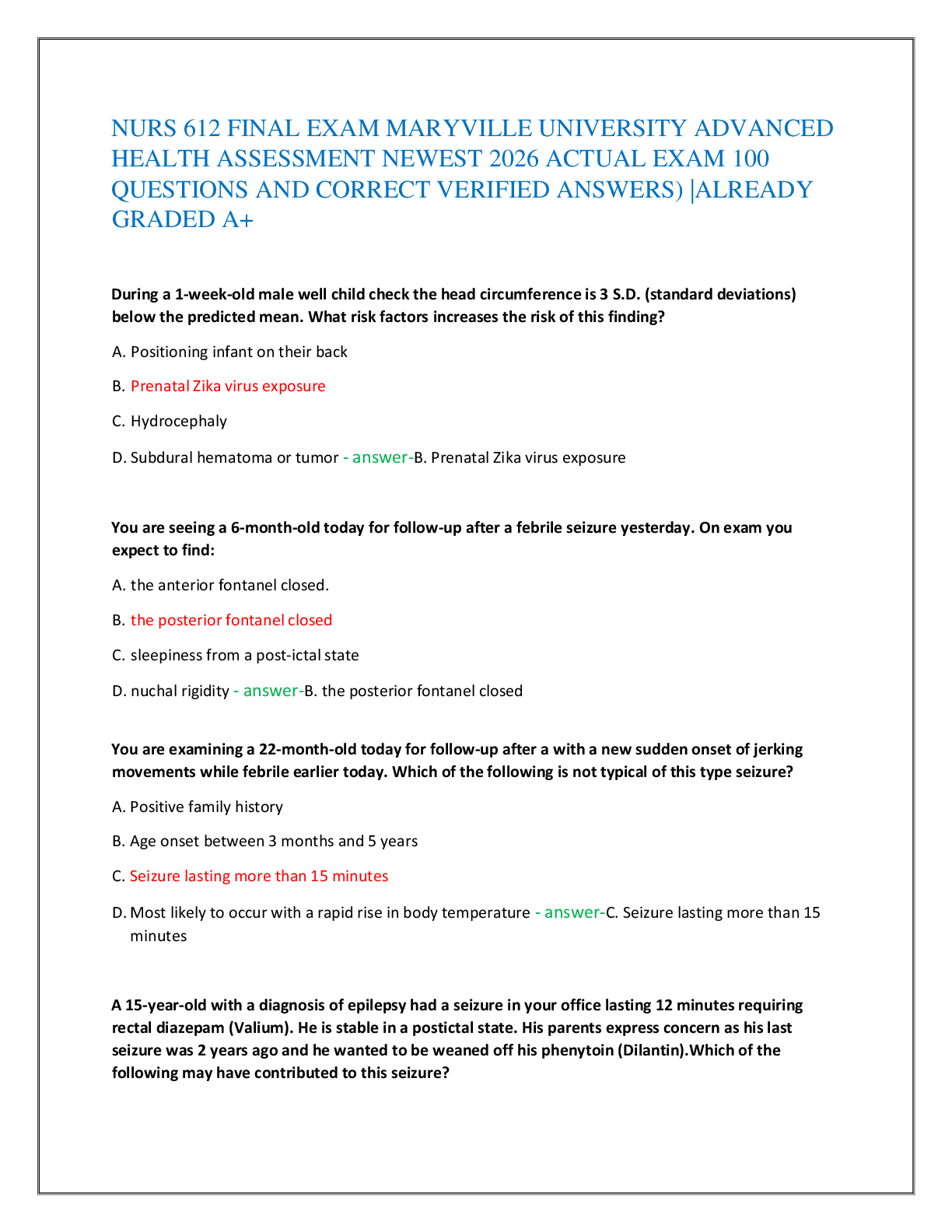


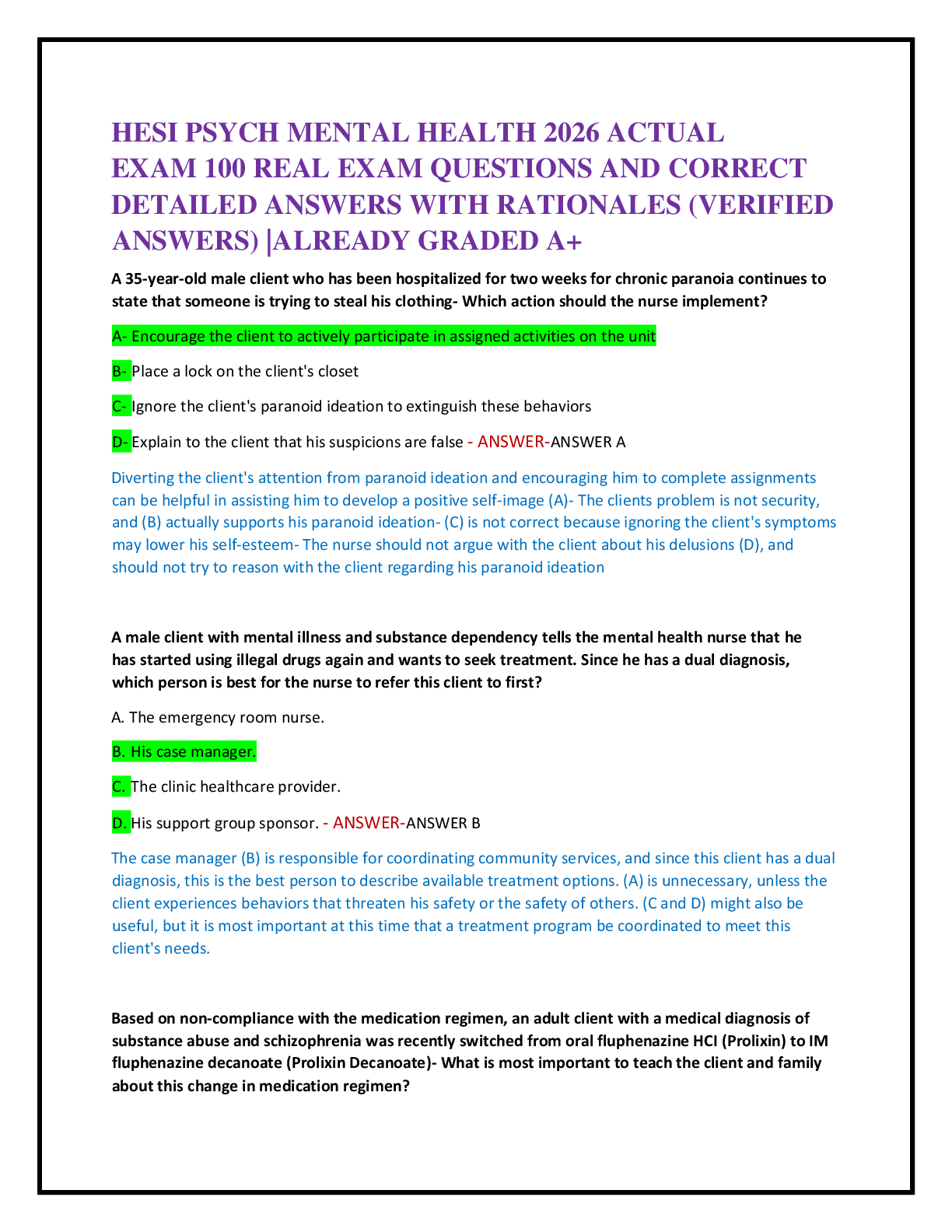
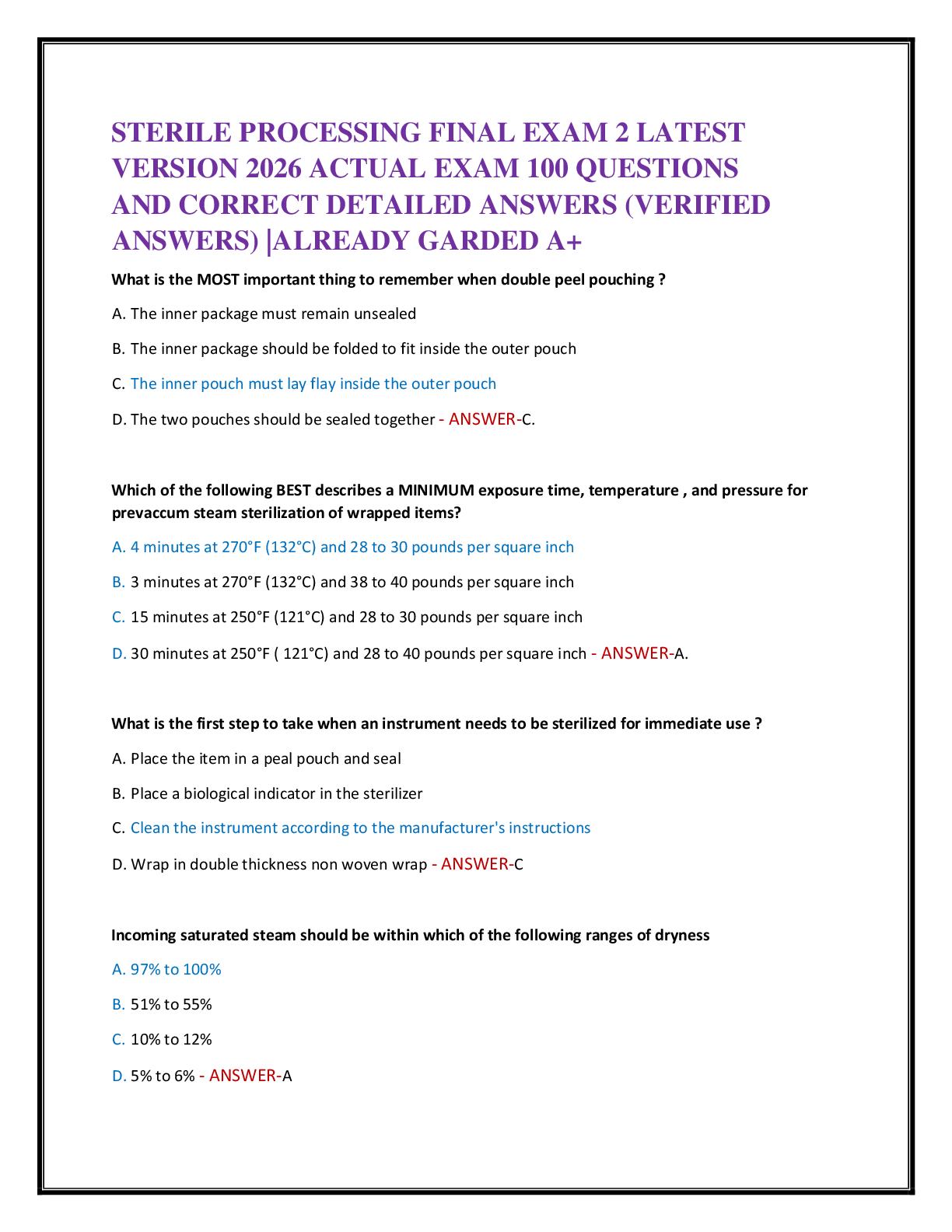
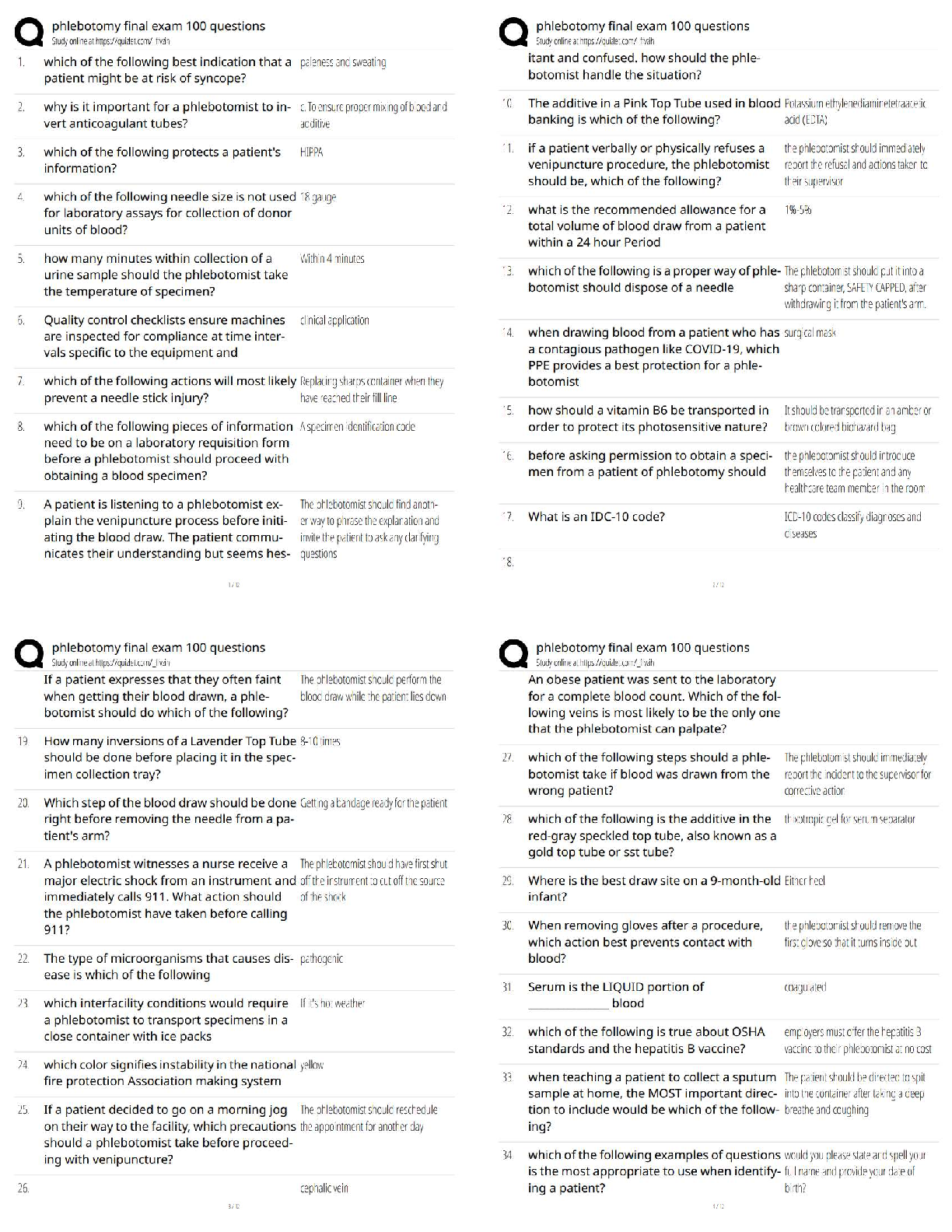

x.png)


![Preview of NUR2488 / NUR 2488 Exam 2 Study Guide [In Class Review] : Mental Health Nursing - Rasmuss](https://scholarfriends.com/storage/Mental Health Exam 2 Study Guide [In class review] MY21.png)
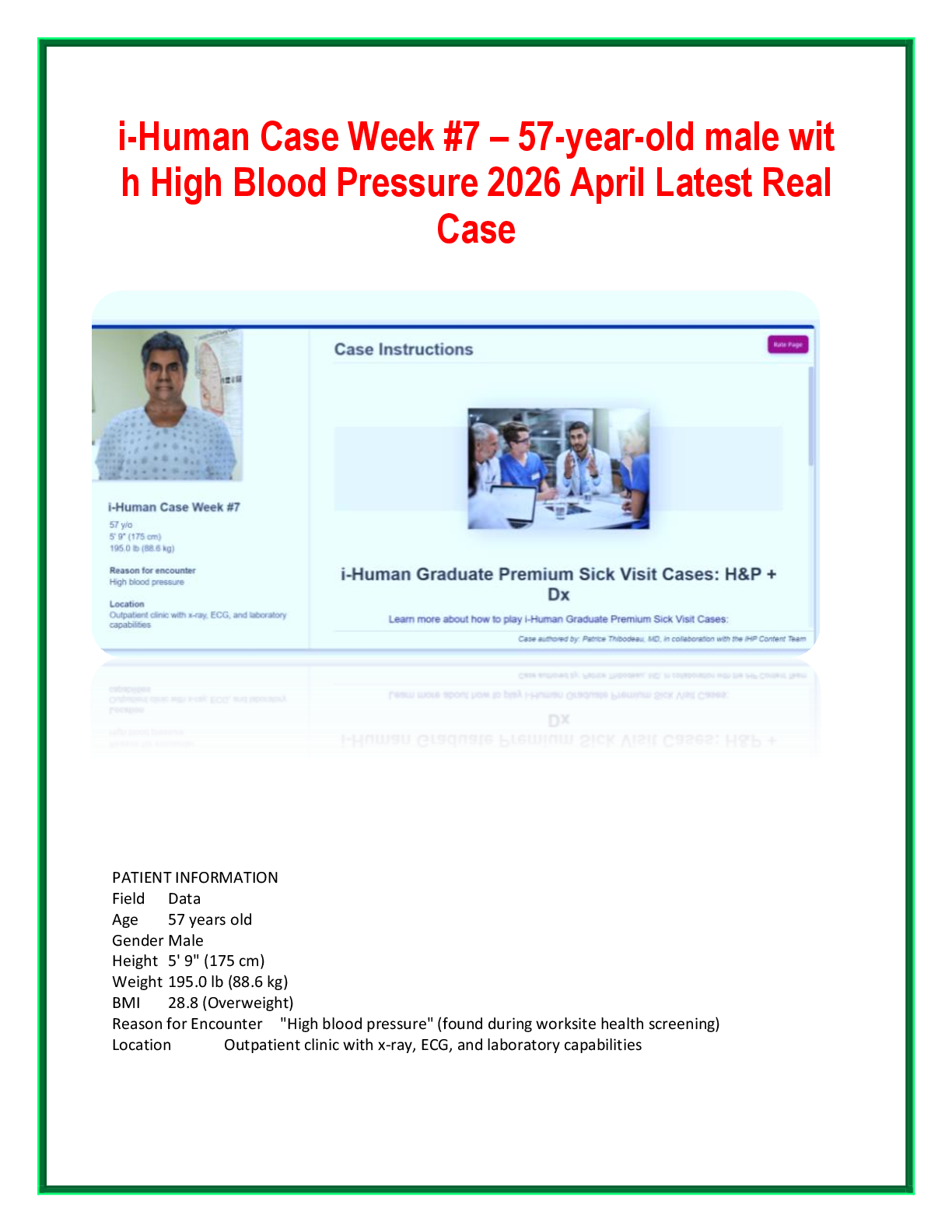


.png)


.png)