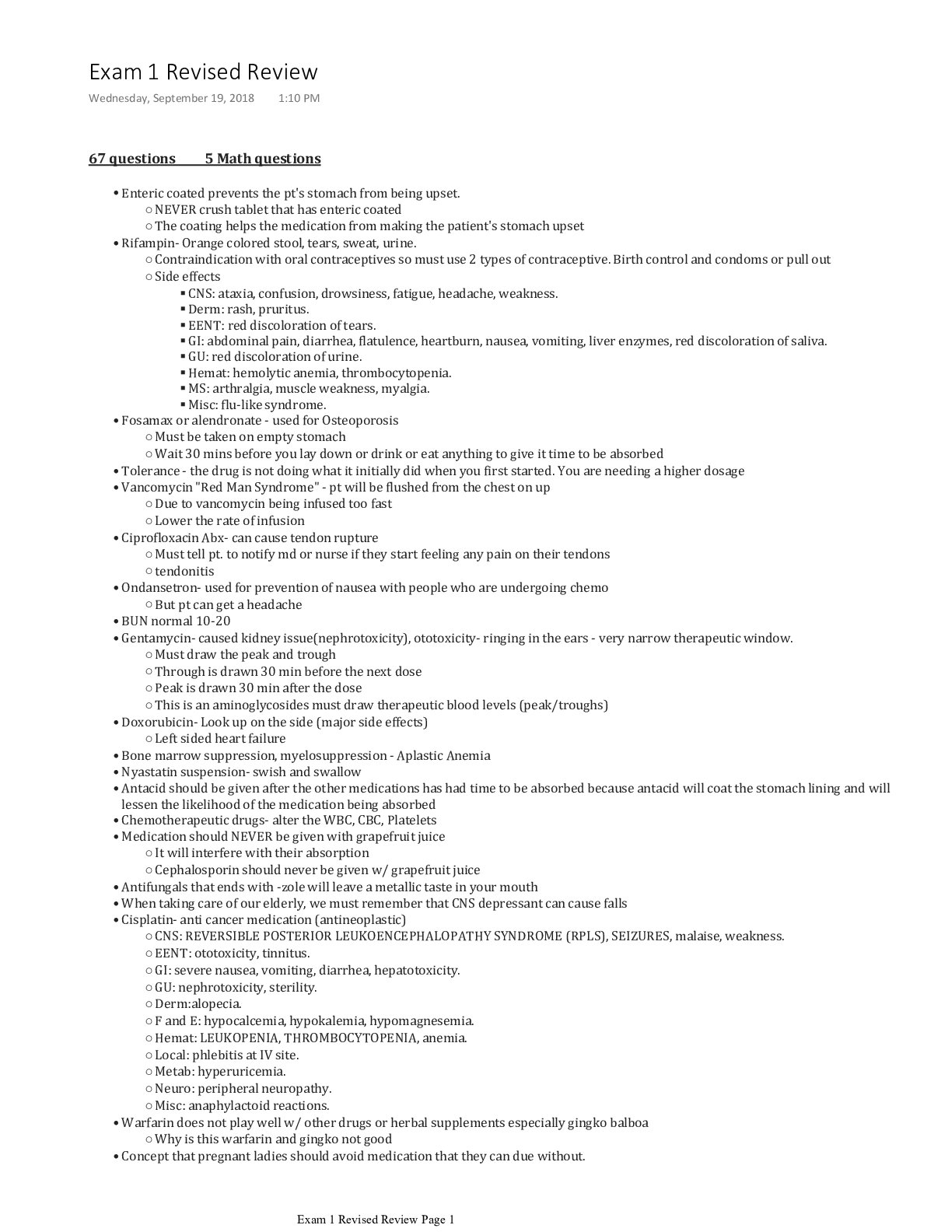
67 questions 5 Math questions
○ NEVER crush tablet that has enteric coated
○ The coating helps the medication from making the patient's stomach upset
• Enteric coated prevents the pt's stomach from being upset.
○ Con
...
67 questions 5 Math questions
○ NEVER crush tablet that has enteric coated
○ The coating helps the medication from making the patient's stomach upset
• Enteric coated prevents the pt's stomach from being upset.
○ Contraindication with oral contraceptives so must use 2 types of contraceptive. Birth control and condoms or pull out
CNS: ataxia, confusion, drowsiness, fatigue, headache, weakness.
Derm: rash, pruritus.
EENT: red discoloration of tears.
GI: abdominal pain, diarrhea, flatulence, heartburn, nausea, vomiting, liver enzymes, red discoloration of saliva.
GU: red discoloration of urine.
Hemat: hemolytic anemia, thrombocytopenia.
MS: arthralgia, muscle weakness, myalgia.
Misc: flu-like syndrome.
○ Side effects
• Rifampin- Orange colored stool, tears, sweat, urine.
○ Must be taken on empty stomach
○ Wait 30 mins before you lay down or drink or eat anything to give it time to be absorbed
• Fosamax or alendronate - used for Osteoporosis
• Tolerance - the drug is not doing what it initially did when you first started. You are needing a higher dosage
○ Due to vancomycin being infused too fast
○ Lower the rate of infusion
• Vancomycin "Red Man Syndrome" - pt will be flushed from the chest on up
○ Must tell pt. to notify md or nurse if they start feeling any pain on their tendons
○ tendonitis
• Ciprofloxacin Abx- can cause tendon rupture
○ But pt can get a headache
• Ondansetron- used for prevention of nausea with people who are undergoing chemo
• BUN normal 10-20
○ Must draw the peak and trough
○ Through is drawn 30 min before the next dose
○ Peak is drawn 30 min after the dose
○ This is an aminoglycosides must draw therapeutic blood levels (peak/troughs)
• Gentamycin- caused kidney issue(nephrotoxicity), ototoxicity- ringing in the ears - very narrow therapeutic window.
○ Left sided heart failure
• Doxorubicin- Look up on the side (major side effects)
• Bone marrow suppression, myelosuppression - Aplastic Anemia
• Nyastatin suspension- swish and swallow
Antacid should be given after the other medications has had time to be absorbed because antacid will coat the stomach lining and will
lessen the likelihood of the medication being absorbed
•
• Chemotherapeutic drugs- alter the WBC, CBC, Platelets
○ It will interfere with their absorption
○ Cephalosporin should never be given w/ grapefruit juice
• Medication should NEVER be given with grapefruit juice
• Antifungals that ends with -zole will leave a metallic taste in your mouth
• When taking care of our elderly, we must remember that CNS depressant can cause falls
○ CNS: REVERSIBLE POSTERIOR LEUKOENCEPHALOPATHY SYNDROME (RPLS), SEIZURES, malaise, weakness.
○ EENT: ototoxicity, tinnitus.
○ GI: severe nausea, vomiting, diarrhea, hepatotoxicity.
○ GU: nephrotoxicity, sterility.
○ Derm:alopecia.
○ F and E: hypocalcemia, hypokalemia, hypomagnesemia.
○ Hemat: LEUKOPENIA, THROMBOCYTOPENIA, anemia.
○ Local: phlebitis at IV site.
○ Metab: hyperuricemia.
○ Neuro: peripheral neuropathy.
○ Misc: anaphylactoid reactions.
• Cisplatin- anti cancer medication (antineoplastic)
○ Why is this warfarin and gingko not good
• Warfarin does not play well w/ other drugs or herbal supplements especially gingko balboa
6 week gestation can be most harmful to the patient
• Concept that pregnant ladies should avoid medication that they can due without.
Exam 1 Revised Review
Wednesday, September 19, 2018 1:10 PM
Exam 1 Revised Review Page 1○ 6 week gestation can be most harmful to the patient
○ It can be transferred via placenta or umbilical cord
• Glass ampule- put a piece of gauze on top ampule and towards you
• Suppository should be given to a pt via left sims position
• Drug past the expiration date should not be give
• Pt. who refuse the medication should be documented in the chart
○ Can cause renal toxicity- have pt. drink lots of fluids (2-3L of fluids)
○ Dilute the medication
• Metotraxate- used to tx RA and anticancer medication
○ INH
○ Rifampin the big hazard with these meds are liver failure
• TB Medication
• Penicillin - if someone has a hard time breathing, call the MD right away
○ Designed to release at a certain rate
• NEVER crush medication that is sustained release and extended release
○ If allergic to one then they will be allergic to the other one
• Cephalosporin and penicillin both share the beta lactam ring.
• Erythromycin- can cause tinnitus as an adverse effects
• Ask the pt. what their pill usually looks like (assessment) if they say "what's that pill", that’s not what they look like)
• If teaching someone regarding medication- use published journals, pharmacist
• Med reconciliation- must be done upon admission and discharge
• Oral medication in an infant- have the infant sit up , not laying down
• We never give aspirin who is bleeding or peptic disorder
• IM injection- use the z-track technique
• If given 2 drugs to use to give to via syringe don't give until they are compatible
• If giving meds using the syringe to peds pt. , put the syringe to the side to swallow
• Never hurt to check what the md's order
○ Use epi pen to stop reaction
• Any wheezing after taking the med, stop the and call the md
○ Facilitate in suppression of
• Glucosamine- lubricate a joint and facilitate less pain in the joint
○ Right patient
○ Right medication
○ Right dosage
○ Right route
○ Right frequency
○ Right documentation
○ (Right to Refuse)
• Six right of medication
When educating a patient about a medication it is important to understand the cognitive domain which is the basic domain
where things are learned and stored, the affect domain where emotions, expressions, opinions are conducted and the
psychomotor domain where new skill is learned.
•
○ Patient name or MR #
○ Name of medication
○ Route
○ Time and Date
○ Dose
○ Frequency
○ Reason
○ Prescriber's signature
• What should be included in a med order:
Absorption- gi tract
Distribution-blood
Metabolism-liver
Excretion-kidney
○ The study of what the body does to the drug
○ Cytochrome P-425 enzyme- also known as microsomal enzymes
Onset- The time it takes for the drug to elicit a
therapeutic response
Peak- The time it takes for a drug to reach its maximum therapeutic response
Duration- The time a drug concentration is sufficient to elicit a therapeutic response
○ A drug's onset time to peak time to trough time and time of duration
• Pharmacokinetics-
• PharmaceuticsAlex's Review
Exam 1 Revised Review Page 2○ How different forms of a drug affects the way in which the body absorbs the drug.
• Pharmaceutics-
Drug-receptor relationship
○ How the drug affects the body
• Pharmacodynamics
○ The clinical use of drugs to prevent and treat diseases
○ Defines what the drug action is
○ Classifies drugs in to classes
• Pharmacotherapeutics
○ Study of natural vs. synthetic sources of drugs
• Pharmacognosy
Uses cost-benefit, cost-effectiveness, cost-minimization, cost-of-illness and cost-utility analyses to compare
pharmaceutical products and treatment strategies
○
• Pharmacoeconomics
○ Time it takes for half of the medication to be removed from the body
• Half- life
○ the condition of producing adverse bodily effects due to poisonous qualities.
• Drug Toxicity
○ Initial metabolism in the liver of the medication that was absorbed in the GI tract before it reaches the blood stream
• First Pass effect-
○ Medication binds to the receptor site and stimulates activity in the body
• Agonist
○ Medication binds to the receptor site and inhibits activity in the body
• Antagonist
Oral
□ Fast absorption
□ Antihypertensives are given this route in times of emergencies.
□ No eating, drinking, or chewing
Sublingual- nitroglycerin- given to treat chest pain (angina)
Topical- always clean off the past medication when putting on a new layer, to prevent double dosage
Transdermal
Buccal
Rectal
○ Enteral- GI tract
IV- fastest route
IM
ID
Suq
○ Parenteral
• Routes
Results of the drug therapy in addition to the intended effects. Usually expected and known
○ Side effect
Undesirable effect that happens when a drug is administered or not administered.
○ Adverse effect
• Know the difference between adverse effect and side effect
○ Check the medication order 3 times
○ Know what the drug is for and if it makes sense to give the med to the pt
○ If order isn't legible or if you're confused call and confirm with doctor
○ Avoid medical shorthand
○ If a verbal order, spell the medication, and repeat med.
○ Never assume things about order
• How to prevent medication error
○ Educate them on why the drug was ordered
○ Try an another med if possible
○ Chart that they refused the med. It is a pt. right
• If patient does not want to take a medication
○ OTC drugs- can cause interaction with medication doctor orders
○ Multivitamins- considered medication and can cause interactions; not controlled by fda
• Ask pt about all the meds they are taking including herbal supplement
○ Folk medications should be advised against cause they cause interactions
African Americans don't respond well to beta- blockers, and respond best to calcium channel blockers. (Esp.
Diltiazem) Also respond less effectively to single- drug therapy.
○
• Cultural considerations
Exam 1 Revised Review Page 3Diltiazem) Also respond less effectively to single- drug therapy.
○ Older adults- go slow and low
○ Peds- be careful
Pregnant women- Class D proceed with caution weigh the risks and benefits; Class X DON’T GIVE, CAN CAUSE
FEATAL DEATH
○
• Developmental considerations
• Don't ever take meds with grapefruit juice or have grapefruit in diet while on a medication regimen
Controlled Substance Act- 1970- established a schedule for all controlled substances and promoted drug addiction
education
•
Health Insurance Portability and Accountability Act- 2003- HIPPA- Requires all healthcare facilities including schools to
keep personal information about private
•
• Medicare Part D- 2003- Provides seniors and disabled people with an insurance program for prescription drugs.
○ Warnings given out by the FDA to the prescribers of serious adverse events that happened due to the medication
○ Class 1- most severe- there is a reasonable probability that this drug causes serious adverse health event
○ Class 2- less severe- use of drug can cause a temporary health effect that can be reversed.
○ Class 3- least severe- use of drug is least likely to cause any significant health problems
• Black box warnings
• Veracity- duty to tell the truth
Antibiotics are chosen after looking at benefit of drug, cost effectiveness, patient's allergies, interest of patient, age, weight,
vitals of pt, labs, availability of drug, and drug interactions.
•
○ GI- N/V/D, Upset stomach
• Common adverse reactions of anti-infective are related to GI, kidney, and nervous system.
○ Sulfonamides
○ Penicillin
○ Cephalosporins
○ Macrolides
○ Quinolones
○ Aminoglycosides
○ Tetracyclines
• Classes
○ Adverse reactions- abdominal pain, constipation, N/V/D, abnormal neutrophil count, headache, vaginitis, and seizure
Teaching- teach to drink lots of fluids and that n/v/d is a symptom. Teach to report any signs of C. diff which can
happen 2 months or more after drug is taken.
○
• Ertapenem
Adverse reactions- Stevens- Johnson syndrome, toxic epidermal necrolysis, diarrhea, pseudomembranous
enterocolitis, serum sickness and hemolytic anemia
○
Teaching- teach that it may cause nausea, flu- like symptoms, rash, pain in joint, fever, malaise, enlarged lymph nodes
and severe diarrhea. Teach to call doctor before taking an antidiarrhea medication, and no alcohol.
○
• Cefaclor
Adverse reactions- rash, n/v/d, headache, irritability, aortic aneurysm, cardiorespiratory arrest, MI, C. diff, GI
hemorrhage, pancreatitis, nasal discharge, nasal pharyngitis, hepatitis, acute renal failure, depression, tendonitis,
burst tendons.
○
Teaching- teach pt to report any pain in joints and peripheral neuropathy. Teach to avoid tanning beds and use
sunscreen, avoid too much time in the sun, avoid activities that require coordination.
○
○ Don't take with dairy products or calcium fortifies juice.
Take 2 hours before or 6 hours after taking a magnesium or aluminum containing antacids or products with zinc, iron
or calcium. Avoid caffeine.
○
• Ciprofloxacin
Happens when patient does not complete the course of a medication. The agent causing the illness then becomes used
to the medication and builds up a resistance to it.
○
○ Can also happen if the medication is used to treat a different illness that prescribed.
• Resistance
Broad spectrum Narrow spectrum
Anti- infective medication that targets many microorganisms by
targeting a different biochemical mechanism.
Anti- infective medication that targets a few
organisms with a specific metabolic pathway
•
○ Used to treat UTI, combined with other medications
○ First group of antibiotics
○ Nephrotoxic
○ Prevents the synthesis of folic acid, which is required for the synthesis of nucleic acid and purines.
2000- 3000 ml of fluid/24 hrs
• Sulfomides
ANTIBIOTICS
Exam 1 Revised Review Page 4○ 2000- 3000 ml of fluid/24 hrs
Indication: UTI caused by Enterobacter spp., Escherichia coli, Klebsiella spp., Proteus mirabilis, Proteus vulgaris, S.
aureus
○
○ Used to treat MRSA
○ Infused over 60 mins, and is IV only
flushed skin, face and neck feels hot and itchy
Happens when Vanc is infused too quickly
○ Red- man syndrome
○ Therapeutic monitoring is needed.
This is done to see if there are any counter indications allergies, sickle cell, and anemic pt.
Also to prevent adverse side effects such as over antibiotic (Steven Johnson), hemolytic thrombocytopenia,
N/V/D, pancreatitis (Digest itself), hepatoxicity
○ Blood should be drawn every day or every other day to look at Vanc levels in blood
○ Oral is for C. diff
Make sure infusion is over an hour
Higher doses will be infused over a longer period of time
To prevent nephrotoxicity it is best to get adequate hydration after infusion
Rapid infusion causes severe hypotension, nephrotoxicity and ototoxicity.
○ To prevent complication when infusing Vanc
• Vancomycin
• Beta- lactamase- enzyme provides a mechanism for bacterial resistance to these antibiotics
○ One of the most allergic medication in the united states.
○ When it is first given to a patient nurse should not leave patient and monitor for any allergic reactions.
○ If allergic to Penicillin, cephalosporins should not be give either because they are so similar in shape.
○ Always take with LOTS of water, and no grapefruit juice.
○ Don't take any dairy products
○ Can cause angioedema- causing the lips, and face to blow up
○ Nafcillin- penicillinase- resistant drug
• Penicillin
○ Administer with food
○ Can cause GI upset
○ Absorption delay
□ Good gram- positive coverage
□ Poor gram- negative coverage
1st generation- used for surgical prophylaxis
□ Good gram- positive coverage
□ Better gram negative coverage than 1st generation
2nd generation
□ Most potent against gram- negative
□ Less active against gram- positive
□ Cefrtriaxone- IV and IM; hepatotoxic, treated for Meningitis
□ Ceftazdime- IV and IM; gram negative coverage, used for pseudommes
3rd generation
□ Broader spectrum antibacterial activity than 3rd esp. with gram- positive bacteria
□ Used to treat uncomplicated and complicated UTI
4th generation
◊ Including MRSA
Effective against a wide range of organisms
□ Ceftaroline
5th generation
○ Grouped into generations
○ Ancef- upper respiratory infections.
• Cephalosporin
○ BROADEST antibiotics TO DATE
○ Causes seizures
○ Infuse over 60 minutes
○ Primaxin: used to treat bone, joint, skin, and soft tissue infections
• Carbapenems
○ Protein binding drug- prevents protein synthesis in bacteria
○ Serum albumin needs to be checked because medication will not work without a lot of albumin in system
○ Decrease in proteins can cause ulcer sores and red joints.
If person has low protein the med is metabolized across a longer period of time
• Macrolides
Exam 1 Revised Review Page 5○ If person has low protein the med is metabolized across a longer period of time
○ Erythromycin- N/V/D, hepatoxicity, flatulence, jaundice anorexia, change in hue changes in mucus membrane
Used to treat C. diff,
Manage hemoglobin and hematocrit levels in CBC
Lovenox given for stomach
○ Fidaxomicin- N/V/D, GI bleed
○ Severe liver disease and causes other adverse effects
• Ketolide
○ Synthetic beta lactam antibiotic
○ Cause bed sores due to not enough albumin
• Monobactams
○ Enzyme that provides a mechanism for bacterial resistance to antibiotics
• Beta- lactamase
○ No milk or cheese
○ Rots teeth
○ Binds to calcium, magnesium and albumin
○ The calcium can cause growth deformities.
○ Cannot give to children under 8 because it cause permanent teeth discoloration
○ Must avoid dairy products, iron supplements, and avoid sunlight
○ Don't give to pregnant woman as it can cause fetal deformity
• Tetracyclines
○ Inhibits the growth of susceptible bacteria, rather than killing them
○ Eventually leads to bacterial death
□ Adverse reactions- skin irritation and burns
□ Topical antifungal
□ Characteristic of fungus
□ Establish baseline- rash goes away
□ NANDA- risk for impaired skin integrity
□ Cleanse with soap and water
□ Avoid occlusion- inhibits absorption, systematic absorption
Clotrimazole- binds to cell membrane and destroys cell walls
○ Chitin breaks through the cell wall of fungus
• Bacteriostatic
• Inhibits the growth of microorganisms
Empiric therapy- treatment of an illness, based on the symptoms and experience of HCP, before specific cultures and lab
test results come back
•
• Definitive therapy- treatment of illness after specific microorganism is identified through cultures.
Prophylactic therapy- treatment that is done to prevent an illness. Giving antibiotics before an surgery to prevent illness
after surgery.
•
• Therapeutic response- lowering of the s/s after medication is administers
○ herbal supplements and anticoagulants
○ Warfarin (Coumadin) and grapefruit
○ thyroid medication and spinach
• Food interactions
○ obesity and sedentary lifestyle
○ Pregnancy- medication can move into placenta and cause birth defects during the 1st trimester.
• Host factor
• Phenytoin- Dilantin- anticonvulsant
ANTISEPTICS
• Virus lives in cell
□ Synthetic nucleoside analog
□ Used to suppress replication of HSV-1, HSV-s, VZV
□ Drug of choice to treat initial and recurrent episodes of these infection
□ Comes in oral, topical and parenteral forms
Acyclovir
□ Synthetic nucleoside analog
□ Used to treat infection with cytomegalovirus
□ Oral and parenteral forms
□ CMV retinitis
Ganciclovir
○ HSV-1- Oral herpes
• Herpesviridae
ANTIVIRALS
Exam 1 Revised Review Page 6□ CMV retinitis
Oseltamivir, zanamivir
□ Bone marrow toxicity
□ Active against influenza types A and B
□ Reduce duration of illness
□ 24 to 48 hours
○ HSV-2- Genital herpes
○ Mild without symptoms
○ Occurs through blood and body fluid exposure
○ B vaccine
• Hepatitis B
○ Cause of liver failure
○ Has symptoms
○ Transmitted through infected blood or sexual contact
○ Alcoholism can lead to development of Hep. C
• Hepatitis C
○ Stage 1- non symptoms, infection present
○ Stage 2- early, general symptoms of disease occur
Weight loss
Chronic diarrhea
Fever continuously
CD4 count drops continuously
○ Stage 3- moderate symptoms
□ Blocks activity of the enzyme reverse transcriptase
□ Prevents production of new viral DNA
Reverse transcriptase inhibitors (RTIs)
□ Inhibits protease retroviral enzyme, preventing viral replication
Pis
□ Inhibits viral fusion, preventing viral replication
Fusion inhibitors
○ Stage 4- severe symptoms, often leads to death
○ Zidovudine- causes bone suppression
○ Maraviroc- liver function testing is needed, medication causes liver damage
• Stages of HIV
• Positive physiological function
○ Grow in uninhibited way- Autonomy
○ Ability to travel to other sites in body- Metasis
○ Angiogenesis- ability to grow new blood vessels to feed tumor
Manifests in blood and lymph tissues or from epithelial cells (Carcinoma) or from mesenchymal cells and connective
tissue (Sarcoma)
○
• Cancer forms from one abnormal cell. It grows and grows and cells lose normal function.
• Neoplasm- new tissue
○ Moles, cysts, polyps
• Preneoplastic lesion
○ Male- TSA
○ Female- PSA
• Tests
○ Decrease size of neoplasm so that the immune system can fight it and take care of it
• Goal of chemo
○ G0- resting phase
○ G1- first gap phase
○ S- synthesis phase
○ G2- second gap phase
○ M- mitosis phase (cell reproduction)
• Lymphoma and leukemia- circulating tumors or hepatologic malignancies
○ Lowest amount of WBC following chemotherapy
• Nadir
• Antimetabolites: works primarily in S phase
Interferes with folic acid- DNA not produced
○ Folate
Purine
• Med classification
ANTINEOPLASTIC
Exam 1 Revised Review Page 7 Interrupts metabolic pathway and interrupts DNA and RNA synthesis
○ Purine
Interrupts metabolic pathways
○ Pyrimidine
Adverse effects- impaired pancreatic function, which can lead to hyperglycemia and severe or fatal pancreatitis,
dermatologic, hepatic, genitourinary, neuro, musculoskeletal, GI and cardiovascular effects
○
○ Affects both normal and cancer cell by interrupting cell function and cancer cells division at carious paint in cycle
• Antineoplastic enzymes: look at genomes
○ Works better when given about 30 mins before chemo
○ Alkylators- nitrogen mustards
○ nitrosoureas
• Antimetics
○ Non cell cycle specific drugs
○ Interact with DNA through a process of intercalation
• Cytotoxic antibiotics
Routine monitoring of cardiac ejection fraction, and cumulative dosage limitations and use of cytoprotective drugs such as
dexrazoxane can decrease devastating toxicity
•
Bone marrow suppression
Nephro/ neurotoxicity
○ Carboplatin
Pulmonary fibrosis
○ Busulfan
Nephro/ neurotoxicity
○ Cisplatin
Hemorrhagic cystitis
○ Cyclophosphamide
• Alkylating drugs
High levels of uric acid and electrolyte imbalances (high phosphate, high potassium, low calcium) in the body
following the lysis of tumor cells,
○
○ Lysis of tumor cells lead to uric acid waste
Treated with diuretics
○ Hyperkalemia, hyperphosphatemia, and hypocalcemia
• Tumor lysis syndrome
○ Suppression of bone marrow function, which can result in dangerously reduced number of RBCs, WBCs, and platelets
• Myelosuppression
○ Dermatologic toxicity that is sever but usually reversible
○ Ranges from mild symptoms such as painless sells and erythema to painful blistering of palms and soles.
• Palmer- plantar dysesthesia
○ Works in various phases and stops the splitting of cells
• Mitotic inhibitors-
○ Oral inflammation and ulcerations
• Oral stomatitis
• Must be certified to give chemo drugs
Metabolized in the liver through acetylation—watch for “slow acetylators”
Used alone or in combination with other drugs
Contraindicated with liver disease
Adverse reactions- Peripheral neuropathy, hepatotoxicity
○ isoniazid (INH)*- PRIMARY - cell wall synthesis inhibitor
○ rifapentine
Adverse reactions- Retrobulbar neuritis, blindness
○ Ethambutol
○ rifabutin
○ pyrazinamide (PZA)
Adverse reactions- Hepatitis; discoloration of urine, stools, and other body fluids
○ Rifampin- protein synthesis inhibitor
○ streptomycin
• First-line drugs
ANTITUBERCULAR
• Wash hands
• Vesicant- really dangerous on veins, put through triple lumen catheter
• Veracity- truth
• Insulin- rotate site for patient
Exam 1 Revised Review Page 8• Insulin- rotate site for patient
○ Contraindicated with anticoagulants and antihypertensives; leads to heart failure
• Ginko
Makes them more confused
○ Sleeping pills- cause slower digestion
○ Sedatives given put them at a risk for falls
• Elderly
○ Organ maturity means they are unable to metabolize drugs
• Neonates
○ Leads to immature blood- brain barrier
○ More drugs can enter the brain
○ Gastric pH less acidic
• Pregnancy
Not uncommon to have side effects but if it continues for 7 day to 2 weeks call doctor
○ Long term meds should be started with a low dose and progress as needed.
• HTN
○ Must be singed before treatment
○ Explain risk and side effects, any counterindications
○ Know what medication individual is on
• Informed Consent and HIPPA
When giving antihypertensive make sure to teach about keeping a good diet because medication won't work if on a bad
diet.
•
○ Fever
○ Foul dark urine
○ Foul smelling sputum
• CBC, urine and sputum culture:
○ Dose medication according to their weight
○ Start low and common side effects happen if continuous for more than seven day contact doctor
• Drug toxicity in neonates
• RSV- give virazole/ ribavirin
○ Treats severe systemic mycoses
Intravenously experience fever, chills, hypotension, tachycardia, malaise, muscle and joint pain, anorexia,
nausea and vomiting and headache
○ Main drawback- it cause many adverse effects
• Amphotericin B (Fungizone) terrible for veins
Teach patient to wash mouth before and after eating and whenever to provide cleanliness
Teach pt to avoid lemon, glycerin, undiluted peroxide or alcohol- containing products because they are drying
and irritating
Recommend use of soft bristle brush
If pt has dentures encourage them to remove and clean them frequently
Advise using OTC saliva subs, keep lips moist and use sugarless candy or gum to stimulate saliva flow
Stress that spicy, acidic and alcoholic things should be avoided
Oral antifungal suspensions
○ Manage
• 5FU- stomatitis
○ Reduces side effects of chemo drugs, improves leukocytosis
• Leukoveran
○ Cause heart failure and red urine
• Danuoribin
○ Leads to wheezing, hives, diarrhea, SOB and swelling of tongue
• Hypersensitivity to medication
Nephro and ototoxicity
○ Causes serious toxicities
• Aminoglycoside
Ceftaroline
○ 5th generation- cephalosporin
○ Vancomycin
• Meds for MRSA
○ Fidaxomicin
○ Oral Vanc
○ Ciprofloxacin and Ertapenem
• Meds for C. diff
Exam 1 Revised Review Page 9Exam 1 Revised Review Page 10
[Show More]








.png)