THE PROBLEM
Background of the Study
Parents differ in their opinions about giving allowances to their children. Some parents
believe that they should provide for the material needs of their children, and there is no r
...
THE PROBLEM
Background of the Study
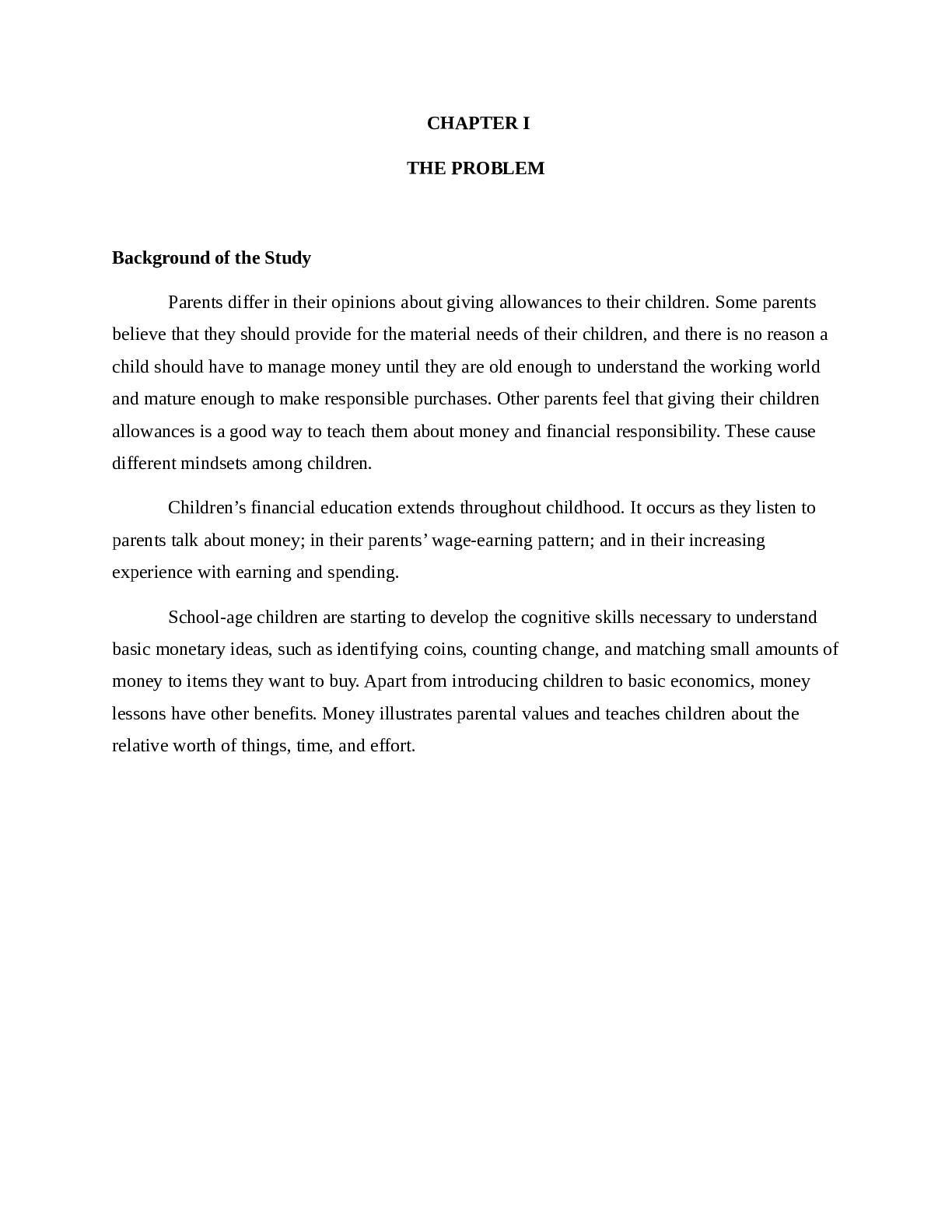
Parents differ in their opinions about giving allowances to their children. Some parents
believe that they should provide for the material needs of their children, and there is no reason a
child should have to manage money until they are old enough to understand the working world
and mature enough to make responsible purchases. Other parents feel that giving their children
allowances is a good way to teach them about money and financial responsibility. These cause
different mindsets among children.
Children’s financial education extends throughout childhood. It occurs as they listen to
parents talk about money; in their parents’ wage-earning pattern; and in their increasing
experience with earning and spending.
School-age children are starting to develop the cognitive skills necessary to understand
basic monetary ideas, such as identifying coins, counting change, and matching small amounts of
money to items they want to buy. Apart from introducing children to basic economics, money
lessons have other benefits. Money illustrates parental values and teaches children about the
relative worth of things, time, and effort.Every student has a responsibility in school including the submission of their project and
for doing different performance task in each subject. When it comes to the school project,
student’s allowance and even their socioeconomic status is involved.
Most of the students get their allowance from their parents and parents’ money earned as
salary from their work. Allowance refers to the money given to students that shall be used for
their daily needs and expenses. It is the money earned or given to a child at regular intervals to
teach the child how to manage money. Money plays a vital role in every person’s life. It is the
medium used for exchange, a unit of account and a store of value. It is used to buy products that
we want and need and to avail services that are necessary in our life. Higher family income may
have a good contribution in academic performance, but for the responsible and serious students,
low family income must not be an excuse for poor performance (Adzido, Dzogbede, Ahiare,
Dorkpah, 2016). Bhat, Joshi, Wani (2016) supported the latter claim that socioeconomic status is
a significant factor in academic achievement. Thus, the higher level of socioeconomic status
shows a big contribution toward the quality of student achievement. (Farooq, Chaudry, Shafiq
and Berhanu, 2011).
Academic achievement carry out primary significance in the context of education system,
intend a successful scholastic achievement of the students and human resources improvement at
the high level. In addition, adolescents having high and middle socioeconomic status excel in
academic performance than adolescents having low socioeconomic status (Singh and Choudhary,
2015). Socioeconomic status of the students have an impact to their academic achievement.Students having a high socioeconomic status have a good exposure and surroundings giving a
good result as compared to low socioeconomic status (Chandra and Azzimudin).
Statement of the Problem
This study has determined the relationship between allowance management and academic
achievement of the Grade 9 and 10 students of Ednas School of San Carlos and answers the
following questions:
1. What’s the profile of the respondents in terms of the following:
1.1. Age
1.2. Gender
1.3. Section
1.4. Average Grade
2. How much money do students allocate in terms of:
2.1. Transportation
2.2. Food
2.3. School Materials
2.4. Savings
2.5. If others, specify:__________
3. What are the student’s academic performances in all major subjects in terms of:
3.1. Quizzes
3.2. Oral Exams
[Show More]










dfdfefe.png)