Training and Development C235, Top
Exam Questions and answers, graded
A+
human capital - ✔✔-The knowledge, competency and motivation that resides in the human resources of
an organization
Buy or Build - ✔✔-2 ways
...
Training and Development C235, Top
Exam Questions and answers, graded
A+
human capital - ✔✔-The knowledge, competency and motivation that resides in the human resources of
an organization
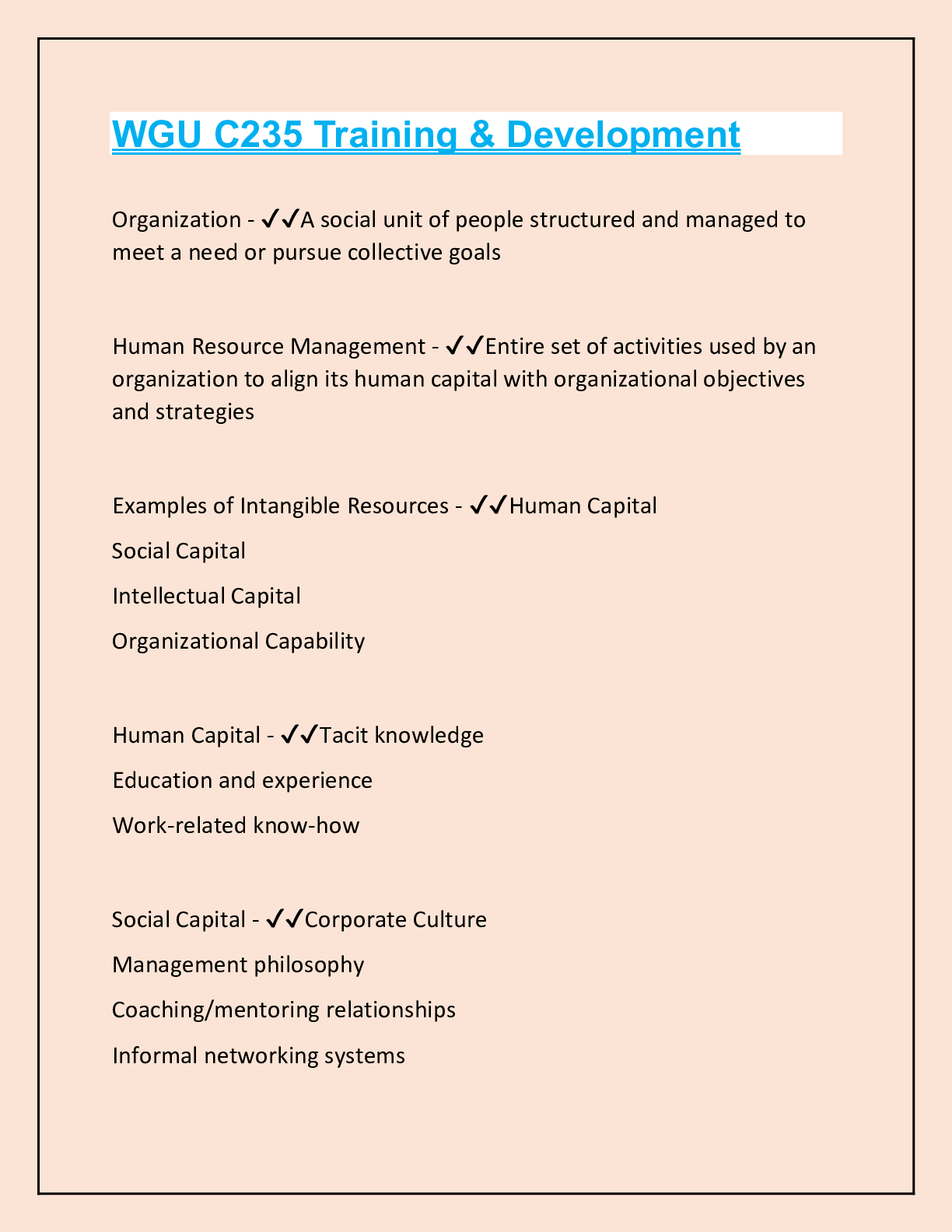
Buy or Build - ✔✔-2 ways to acquire skilled human resources: hire from outside, or develop from inside
HRM - ✔✔-Human Resource Management
Human Resource Management - ✔✔-consists of the activities managers perform to plan for, attract,
develop, and retain an effective workforce
HRM objective - ✔✔-to support organization's efforts toward effectively and efficiently meeting its
business goals and accomplishing strategy for succeeding in the marketplace
Training - ✔✔-a subsystem of human resource management
Orientation - ✔✔-the first step in the training and development process, designed to introduce
employees to the company culture and provide key administrative information
Human capital - ✔✔-HRM represents the entire set of activities used by an organization to align its
__________with organizational objectives and strategies.
HRM includes planning for____? - ✔✔--Recruitment and selection of employees
- Training and Development
-Assuring a safe and healthy work environment
What is the overarching objective of the HRM system? - ✔✔-Support the organization's efforts toward
effectively and efficiently meeting its business goals and accomplishing its strategy for succeeding in the
marketplace
What can be thought of as a "subsystem" in the broader system of overall human resource
management? - ✔✔-Training
Where is one of the first places a new employee is sent after he or she is hired? - ✔✔-Training
Resource-Based View (RBV) - ✔✔-This view pictures organizations as bundles of resources, such as
people, capital, plant, and equipment
Competitive Advantage - ✔✔-The ability to provide a product or service to a paying customer in a way
that cannot be matched now or in the foreseeable future by a competitor.
Four characteristics a resource must possess before it is capable of providing a firm with a sustained
competitive advantage. - ✔✔--Create value for the customer
-Be rare and/or unique
-Be non-substitutable
-Be inimitable
intangible resources - ✔✔-organizational capabilities, processes, systems, attributes, and knowledge
and information controlled by the firm
Example of Intangible Resource (1) - ✔✔-Human Capital
-Tacit knowledge
-Education and experience
-Work-related know-how
Example of Intangible Resource (2) - ✔✔-Social Capital
-Corporate culture
-Management philosophy and practices
-Coaching/mentoring relationships
-Informal networking systems
Example of Intangible Resource (3) - ✔✔-Intellectual Capital
-Patents and trade secrets
-Copyrights
-Intellectual property
Example of Intangible Resource (4) - ✔✔-Organizational Capability
-Bring new products to market quickly
-Absorb and integrate other cultures in a merger
-Identify customer needs and respond directly to them
-Continuously improve production processes to drive down costs
In the resource-based view of the firm, resources are considered potential sources of __________ in the
marketplace. - ✔✔-Competitive Advantage
According to RBV, when can a resource create a competitive advantage? - ✔✔-Only when it is not
available to other firms and when it can easily move across organizational boundaries.
Human resources works best when combined in ________ and _________ ways. - ✔✔-Creative and
Productive
Learning - ✔✔-A relatively permanent change in knowledge, skills, attitudes, or social behavior resulting
from practice or experience. It is the desired outcome of any training program
Training (note) - ✔✔-Is learning that is planned by the organization and designed so as to further
organizational objectives.
3 Goals of Training - ✔✔-a) to improve individual self-awareness,
b) to enhance knowledge and skill levels in one or more areas of expertise, and
c) to increase the motivation to do the job well
Self-Awareness - ✔✔-Includes an understanding of the impact one's behavior has on others, self�confidence in the performance of one's work, and a clarity about one's roles and responsibilities in the
organization.
Knowledge and Skill Enhancement - ✔✔-Skill level enhancement can be oriented toward motor skills
(driving a forklift safely), interpersonal skills (effective teamwork), intellectual skills (problem solving), or
others
ADDIE model - ✔✔-Five-step instructional design process that governs the development of learning
programs.
-Analysis
-Design
-Development
-Implementation
-Evaluation
ADDIE Model (note) - ✔✔-The ADDIE model evolved from instructional design theory that guided post�World War II training in the military, particularly in the Air Force.
ADDIE Model (note) - ✔✔-The goal of ADDIE from the beginning was to foster the design and conduct of
effective and efficient training for specific jobs, assuring that learners leave the training with the
knowledge and skills necessary to perform those jobs.
Training is used by an organization in order to: - ✔✔-Facilitate goal accomplishment
True or False: The Association for Talent Development (ATD) publishes an annual report on the state of
the training industry in which it refers to the state of L&D (learning and development). - ✔✔-True
Training may be aimed at one or more of the following three goals: - ✔✔--Improve individual self�awareness
-Enhance knowledge and skill levels in one or more areas of expertise
-Increase the motivation to do the job well
Before any training and development program is begun, you should first: - ✔✔-Assess the training needs
Organizations often skip a vital step in their training and development programs which is to: - ✔✔-
Evaluates the effectiveness of training
E-learning - ✔✔-The use of electronic technologies to deliver information and facilitate the development
of skills and knowledge.
Instructional; Example - ✔✔-Training that involves an instructor or on-line materials is a form of
________ training, whereas training that is on the job or coaching/mentoring is a form of _________
training.
In the public-sector, training and development programs seem to be: - ✔✔-Increasing
True or False: In the late 1970s, the average annual training expenditure per employee was under $100.
- ✔✔-True
As of 2011, the most common types of training were: - ✔✔-I: Managerial and supervisory training
II: Profession or industry specific training
III: Training on business practices
Learning Organization - ✔✔-A learning organization is capable of adapting quickly to a changing
environment by learning at three levels: individual, team, and organizational
Copyright Act of 1976 - ✔✔-protects the authors of "original works" from others who would use their
work unlawfully.
"Fair Use" provision - ✔✔-his provision allows the use of copyrighted works under certain conditions.
While the guidelines are at least partially subjective, "fair use" depends on five critical factors:
1) purpose (commercial or noncommercial),
2) nature (critique or parody versus a business flyer or advertisement),
3) percentage of the copyrighted work that is used,
4) amount (a few copies versus a hundred), and
5) effect on potential market value of the copyrighted work.
Civil Rights Act of 1964 - ✔✔-Title VII of this law prohibits discrimination in employment practices on the
basis of race, color, national origin, religion, and sex.
adverse impact - ✔✔-A substantially different rate of selection in hiring, promotion or other
employment decision which works to the disadvantage of members o a race, sex, or ethnic group.
Americans with Disabilities Act of 1990 - ✔✔-A law passed in 1990 that requires employers and public
facilities to make "reasonable accommodations" for people with disabilities and prohibits discrimination
against these individuals in employment.
Age Discrimination in Employment Act of 1967 - ✔✔-Prohibits discrimination against workers over the
age of 40 and restricts mandatory retirement
The Copyright Act of 1976: - ✔✔-Protects the authors of original works from others who would use their
work unlawfully.
Copyright is automatically granted when the original work is first: - ✔✔-Printed, drawn, and saved to a
file
According to the book, all are examples of copyrighted work except: - ✔✔-Methods or systems
It is illegal to use someone else's work without : - ✔✔-Getting permission from the original owner
True or False: According to the Copyright Act of 1976, if an employee creates an original work as part of
his job, the copyright is owned by the employee. - ✔✔-False
Globalization - ✔✔-the process by which businesses or other organizations develop international
influence or start operating on an international scale.
Hofstede's Cultural Dimensions - ✔✔-power distance, individualism, masculinity, uncertainty avoidance,
long-term orientation
The main reasons why training is becoming increasingly important are because of: - ✔✔-I: Globalization
II: Advances in technology
How have advances in technology impacted training? - ✔✔-Has made training more readily available
Increases in competitive pressures, when combined with the rapid advancement of technology: - ✔✔-
Lead to skills and competencies that quickly become obsolete
As a result of technology, globalization had become: - ✔✔-Easier
Globalization has made this type of training more common: - ✔✔-Diversity
True or False: Because of the aging and retirements of Baby Boomers, organizations are experiencing an
abundance of skilled leaders. - ✔✔-False
One of the main reasons employees leave jobs is because: - ✔✔-They are uncomfortable with the
working environment created by their direct supervisor
Training brought on by immigration and the aging labor force is necessary in order to: - ✔✔-- Teach
necessary technical skills
-Integrate immigrant workers
-Eliminate skill deficiencies
Training is a major influence on - ✔✔-Retention
Sustained competitive advantage comes from: - ✔✔-Intangible
True or False: Organizations that invest the most in training and development have shareholder returns
46 percent higher than the market average. - ✔✔-True
Training has gone from being a side issue in the past, to being part of the company's: - ✔✔-Business
Strategy
Training created as a result of immigration and the aging labor force is necessary in order to: - ✔✔-Fulfill
the psychological contract between employer and employee
Companies today are not offering employees ________ but, instead __________. - ✔✔-Job security;
Employment security
Needs Assessment - ✔✔-A step in the training process that is designed to ensure that any training
program is meeting a real need in the organization
Needs assessment (Note) - ✔✔-some research suggests that only 27 percent of organizations with
greater than 1,000 employees utilize needs analysis prior to implementation of training programs.
Subject Matter Expert (SME) - ✔✔-Employees at any level in the organization who are the experts on
the nature of the tasks that need to be performed more effectively or performed in the future.
KSAOs - ✔✔-knowledge, skills, abilities, and other characteristics necessary to perform tasks.
Needs Assessment - ✔✔-_______ is to determine if an organization needs training, where it needs
training, and the type of training that is needed.
Which role assesses current organizational effectiveness in broad terms? - ✔✔-Upper level management
Which role assesses current organizational effectiveness in broad terms? - ✔✔-Middle Management
SMEs are employees that can be found working in: - ✔✔--Lower management
-Upper level management
-Middle management
-Average employee
The three levels upon which needs assessment is conduced are: - ✔✔-Organizational level, task level,
and person level
Needs assessment is conducted on _____ levels. - ✔✔-Three
On what level of needs assessment would you determine what training needs to be done based on low
performance and quality? - ✔✔-Organizational
On what level of needs assessment would you assess the skills and knowledge necessary for a person to
perform a particular job? - ✔✔-Task
Person level of needs assessment: - ✔✔--Focuses on individual employees
-Utilizes individual annual performance review data
-Determines who needs the training
True or False: The first step, before needs assessment, is to determine the organization's goals and
needs. - ✔✔-True
Organization analysis addresses all the following issues EXCEPT: - ✔✔-How the organization relates to its
internal environment and what this environment suggests in terms of future training needs
When performing an organization analysis, it is necessary to investigate _________ components of an
organization. - ✔✔-System-wide
The degree to which the program is connected to—and supportive of—organizational goals and
strategy: - ✔✔-Determines the effectiveness of the training program
What is one reason why it is important for the training program to be supportive of organizational goals
and strategies? - ✔✔-So employees attend and take it seriously
So managers will value the training
A task analysis is used to: - ✔✔-Determine the tasks required to meet major organizational goals
Determine important dimensions of tasks at an organization
Develop a list of knowledge, skills, abilities, and other characteristics necessary for successful job
completion
A task analysis results in a detailed statement of: - ✔✔-A description of the job
The preliminary list of tasks associated with a given job can be developed by: - ✔✔-I: Talking with those
who have done the work
II: Talking with the supervisors of those who do the work
IV: Observing someone doing the job
Once the preliminary list of tasks is developed, the analyst should seek validation of the list by: - ✔✔-
Checking with other subject matter experts
What kinds of tasks should be targeted for training? - ✔✔-Tasks that are important
Tasks that are frequently performed
Tasks that are difficult to perform
True or False: Self and supervisor training needs analysis are usually fairly similar and can be used to
design specific training programs. - ✔✔-False
Person analysis is used to determine: - ✔✔-I: Which employees need the training?
II: What kind of training each employee needs?
Performance appraisals must be used in person analysis to: - ✔✔-Identify areas of performance
deficiency
Task analysis focuses on ________. Person analysis focuses on _________. - ✔✔-A group of workers;
individuals
In training design, it is important to understand the of incoming trainees', EXCEPT: - ✔✔-Work
Experience
Newer, more extensive versions of orientation are now frequently referred to as ______. - ✔✔-On�boarding
All are considered intangible resources except: - ✔✔-Company Equipment
What are the five basic steps in the training and development cycle? - ✔✔-Assessment, design,
development, implementation, and evaluation
The ADDIE Model is meant to be used as a cycle even though many organizations use the model as a
_________ series of steps. - ✔✔-Linear
According to ASTD, the most common type of training is... - ✔✔-Managerial and Supervisory
True or False: In most cases, employees will prefer training that is on-line to training that is in person
(traditional classroom). - ✔✔-False
According to ASTD, the least common type of training is... - ✔✔-Basic Skills
According to the ASTD survey in 2011, the average direct expenditure for training per employee was: -
✔✔-$1000-$2000
The term "Organization" refers to: - ✔✔-A social unit of people structured and managed to meet a need
or pursue collective goals.
Organizations can acquire skilled human resources by: - ✔✔-Hiring them from the outside
Develop them from the inside
Organizations which primarily focus on bringing in new talent for human resources eventually are faced
with what? - ✔✔-Upgrading their existing human resources capabilities.
In order for an organization to survive and prosper under changing environmental conditions,
employees must learn to: - ✔✔-Adapt
True or False: It is only through hiring from the outside that human resource departments are able to
upgrade and add to the existing competencies and capabilities of an organization's internal labor pool. -
✔✔-False
An organization's training and development reputation can help with: - ✔✔-Recruiting
The acronym "HRM" means: - ✔✔-Human Resource Management
A "Learning Organization" adapts quickly by learning at: - ✔✔-I: Individual levels
II: Team levels
III: Organizational levels
At what level is learning most difficult to understand and interpret? - ✔✔-Organizational
In a "learning organization," learning is __________-based. - ✔✔-Performance
Corporate culture, management philosophy and practices, coaching/mentoring relationships, and
informal networking systems are all examples of: - ✔✔-Social Capital
Tacit knowledge, education and experience, and work-related know-how are all examples of: - ✔✔-
Human Capital
HRM represents the entire set of activities used by an organization to align its __________with
organizational objectives and strategies. - ✔✔-Human Capital
HRM includes planning for __________? - ✔✔-Recruitment and selection of employees
Training and Development
Assuring a safe and healthy work environment
What is the overarching objective of the HRM system? - ✔✔-Support the organization's efforts toward
effectively and efficiently meeting its business goals and accomplishing its strategy for succeeding in the
marketplace.
What can be thought of as a "subsystem" in the broader system of overall human resource
management? - ✔✔-Training
Where is one of the first places a new employee is sent after he or she is hired? - ✔✔-Training
What is the "Resource-based view"? - ✔✔-View that pictures organizations as bundles of resources,
such as people, capital, plant, or equipment.
In the resource-based view of the firm, resources are considered potential sources of __________ in the
marketplace. - ✔✔-Competitive advantage
According to RBV, when can a resource create a competitive advantage? - ✔✔-Only when it is not
available to other firms and when it cannot easily move across organizational boundaries.
The four characteristics a resource must possess before it is capable of providing a firm with a sustained
competitive advantage are: - ✔✔-Create value for the customer, be rare and/or unique, be non�substitutable, and be inimitable.
Human resources works best when combined in ________ and _________ ways. - ✔✔-Creative and
Productive
Training is used by an organization in order to: - ✔✔-Facilitate goal accomplishment
True or False: The Association for Talent D
[Show More]


.png)
.png)