NACE-CIP3-001 Exam Practice Questions
This NACE-CIP3-001 exam PDF provides detailed practice questions, answers,
and explanations. These NACE NACE-CIP3-001 exam practice questions are
designed for IT professionals, sy
...
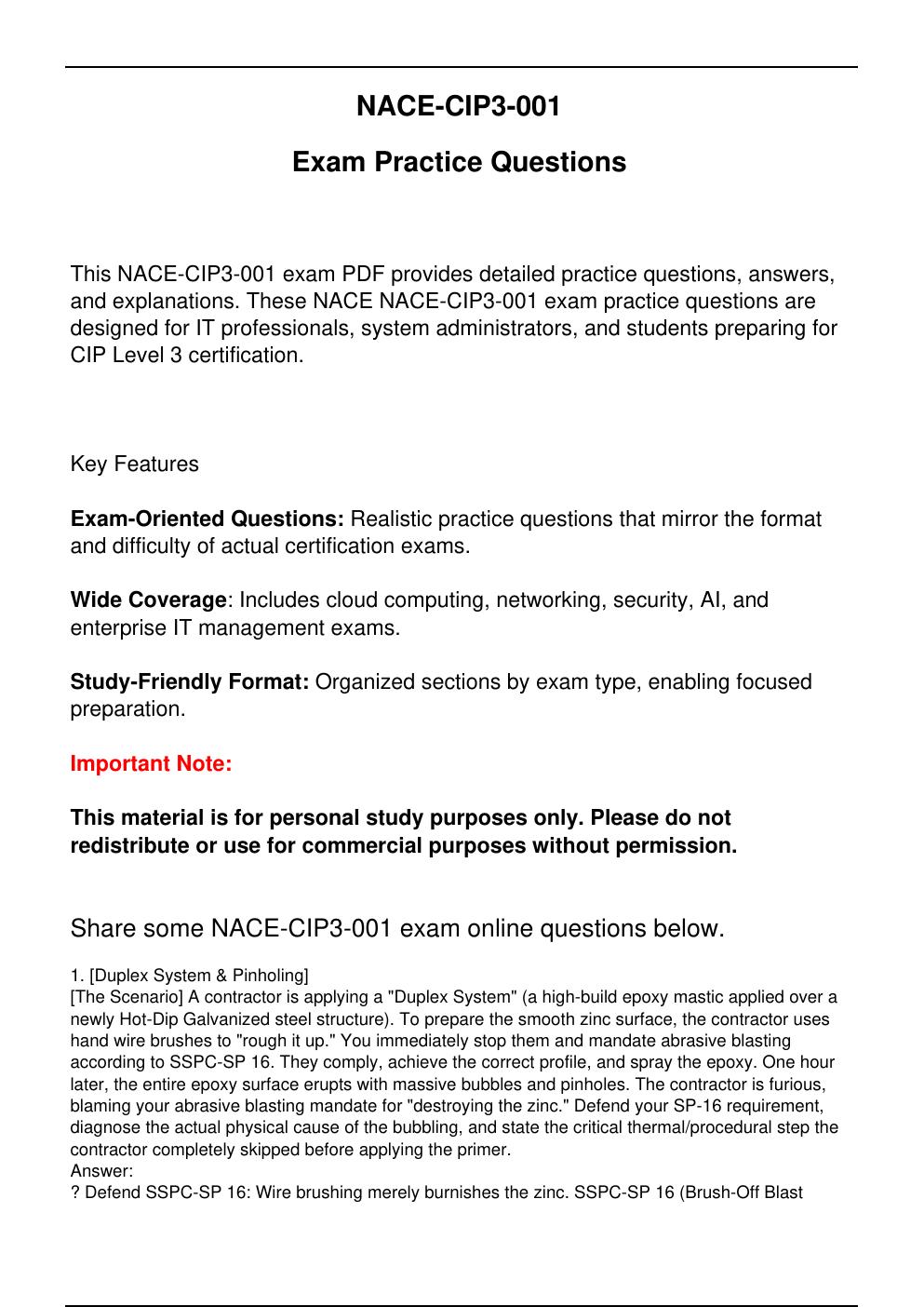
NACE-CIP3-001 Exam Practice Questions
This NACE-CIP3-001 exam PDF provides detailed practice questions, answers,
and explanations. These NACE NACE-CIP3-001 exam practice questions are
designed for IT professionals, system administrators, and students preparing for
CIP Level 3 certification.
Key Features
Exam-Oriented Questions: Realistic practice questions that mirror the format
and difficulty of actual certification exams.
Wide Coverage: Includes cloud computing, networking, security, AI, and
enterprise IT management exams.
Study-Friendly Format: Organized sections by exam type, enabling focused
preparation.
Important Note:
This material is for personal study purposes only. Please do not
redistribute or use for commercial purposes without permission.
Share some NACE-CIP3-001 exam online questions below.
1. [Duplex System & Pinholing]
[The Scenario] A contractor is applying a "Duplex System" (a high-build epoxy mastic applied over a
newly Hot-Dip Galvanized steel structure). To prepare the smooth zinc surface, the contractor uses
hand wire brushes to "rough it up." You immediately stop them and mandate abrasive blasting
according to SSPC-SP 16. They comply, achieve the correct profile, and spray the epoxy. One hour
later, the entire epoxy surface erupts with massive bubbles and pinholes. The contractor is furious,
blaming your abrasive blasting mandate for "destroying the zinc." Defend your SP-16 requirement,
diagnose the actual physical cause of the bubbling, and state the critical thermal/procedural step the
contractor completely skipped before applying the primer.
Answer:
? Defend SSPC-SP 16: Wire brushing merely burnishes the zinc. SSPC-SP 16 (Brush-Off Blast
Cleaning of Coated and Uncoated Galvanized Steel) is legally required to remove chemical
passivation treatments and impart a mandatory 0.75 to 1.5 mil mechanical anchor profile for the
heavy epoxy to grip.
? Diagnose the Pinholing: Hot-dip galvanized (HDG) steel is naturally highly porous. Those
microscopic pores contain trapped air and moisture. When the epoxy was applied and began to
exotherm (generate heat), the trapped air in the zinc expanded rapidly and blew forcefully straight
through the wet film, causing massive outgassing/pinholes.
? The Omitted Step: The contractor failed to perform Thermal Degassing (Outgassing) . Before
coating, they must bake/heat the bare galvanized structure to a temperature slightly above the peak
curing temperature of the epoxy to actively force the trapped air out of the pores.
2. When utilizing the ASTM D4263 Plastic Sheet method to test for capillary moisture in concrete,
what is the strict minimum duration the plastic sheet must remain taped to the surface?
Answer:
16 hours .
3. [Environmental Controls & Thermodynamics]
[The Scenario] You are inspecting the interior of an uninsulated steel petroleum storage tank in midJuly. The interior air is controlled by a dehumidifier. Your readings inside the tank show: Interior Air is
85°F (29°C) with 45% Relative Humidity. The calculated interior Dew Point is 61°F (16°C). The
contractor sprays a thick-film 100% solids epoxy. Two hours later, the entire coating system sags
heavily and physically slides down the wall, with a layer of liquid water trapped behind it. The
contractor blames "defective paint" because the internal environment was perfect. However, outside
the tank, a severe freezing thunderstorm suddenly rolled in during the application, dropping the
outside temperature to 50°F (10°C). As the Level 3 Inspector, explain the exact thermodynamic
physics of what caused this coating failure.
Answer:
? Decision: Veto the "defective paint" claim. The coating formulation is fine; this is a pure
thermodynamic failure.
? The Physics: Uninsulated carbon steel is a rapid thermal conductor. When the outside temperature
plummeted to 50°F (10°C), the interior steel shell immediately cooled to match that 50°F
temperature, regardless of the 85°F heated interior air.
? The Failure Mechanism: The calculated interior dew point was 61°F. Because the actual substrate
temperature (50°F) dropped significantly below the dew point, massive, invisible condensation
immediately formed on the internal steel wall behind the wet, uncured coating. This liquid water acted
as a massive bond-breaker. The heavy 100% solids epoxy lost all adhesion to the substrate and
succumbed to gravity, resulting in catastrophic sagging.
[Show More]




![Preview of eBook [PDF] Advanced Technologies for Rechargeable Batteries Metal Ion, Hybrid, and Metal-](https://browseimages.nyc3.digitaloceanspaces.com/paper-images/2024/Aug/31/4CeOA98s2024-08-31-08-3766d2ac249f11f.png)
![Preview of eBook [PDF] Digital Personality A Man Forever Volume 2 Technical Aspects 1st Edition By Ku](https://browseimages.nyc3.digitaloceanspaces.com/paper-images/2024/Aug/30/t3vEGYrg2024-08-30-02-3166d1adaa38427.png)