FORMULATION EXAM: Big A Overview
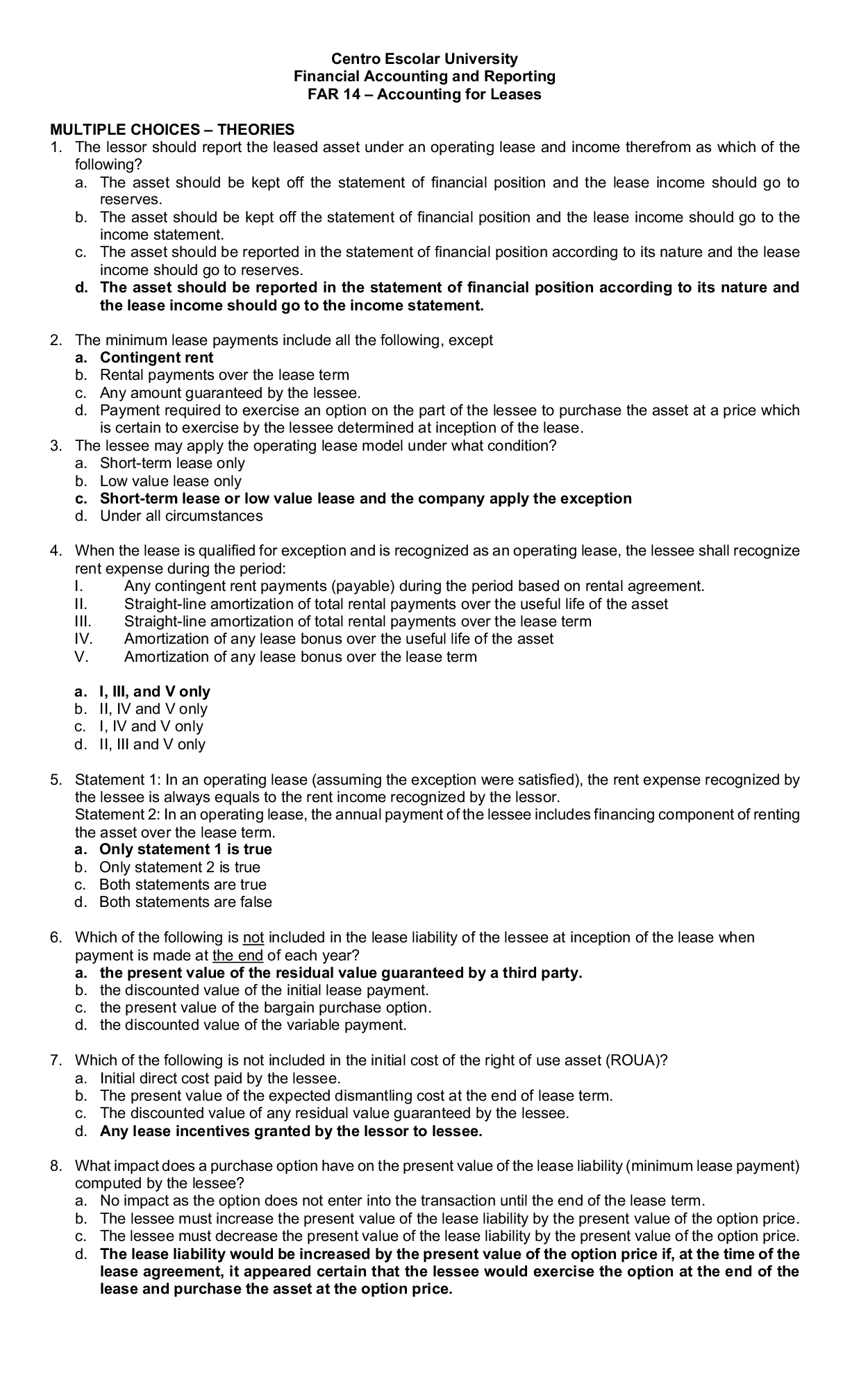
1) Acquisition programs must balance all of the following EXCEPT:
Performance
Schedule
Technology
Cost
2) Life-Cycle cost estimating may be useful to support inputs into the:
Progr
...
FORMULATION EXAM: Big A Overview
1) Acquisition programs must balance all of the following EXCEPT:
Performance
Schedule
Technology
Cost
2) Life-Cycle cost estimating may be useful to support inputs into the:
Program Objective Memorandum (POM)
Obligation Authority
Commitments
The Joint Capabilities International and Development System (JCIDS)
3) Who does the PM notify if the program breaches or will breach in the near future the
approved APB?
Office of the Secretary of Defense
The Component leadership
Congress
The Milestone Decision Authority (MDA)
4) The Army documents it position in which of the following using Program Optimization
and Budget Execution (PROBE):
All answer choices are correct
Programming
Planning
Execution
5) ____________ is comprised of authoritative data interfaces and tables used to display
the _________budget submission.
Resource Management Tool (RMT); Army
Automated Budget Interactive Data Environment System (ABIDES); Air Force Program Budget
Information System (PBIS); Air Force
Program Budget Information System (PBIS); Navy
Program Optimization and Budget Execution (PROBE) System; Army
6) Which of the following IS NOT a characteristic of APB Schedule Parameters:
Total Ownership Cost (TOC)
Initial Operational Capability (IOC)
Milestones
Integrated Master Schedule (IMS)
7) What system, or process, is used to translate the user needs into a weapon system or
automated information system?
The Joint Capabilities Integration and Development System (JCIDS)
The Planning, Programming, Budgeting, and Expertise Process (PPBE)
The Organizational Doctrine Guide produced by the National Security Council
The Defense Acquisition System (DAS)
8) This Acquisition Phase is when the product support strategy is executed while the
system is sustained over its life cycle.
Production & Deployment
Operations & Support
Engineering & Manufacturing Development
Technology Maturation & Risk Reduction
9) _________is the first step in the requirements generation process.
Develop the Capabilities Production Document (CPD)
Write and Document Requirements
Develop foreign materials list
Gather and Develop International Requirements
10) _________ identify requirements based on perceived threats and future needs.
Chairman of the Joint Chiefs of Staff
Policy Makers
The Joint Requirements Oversight Council (JROC) Sponsors
Sponsors
11) ____________________________________ is often referred to as the DoD's
"requirements generation process."
The Planning, Programming, Budgeting, and Execution Process (PPBE)
The Defense Acquisition System (DAS)
The Joint Capabilities Integration and Development System (JCIDS)
The Doctrine of the United States Operating Guide
12) The purpose of the _________ is to reduce technology, engineering, integration, and
life cycle cost risk.
Operations & Support phase (O&S)
Engineering & Manufacturing Development phase (EMD)
Technology Maturation & Risk Reduction phase (TMRR)
Production & Deployment phase (PD)
13) The primary purpose of the ___________ is to provide a guide to determine when a
specific aspect of planning, programming, budgeting, execution, or Congressional
enactment is occurring during any three calendar year period.
Fiscal year cycle
Programming Phase calendar
Resource Allocation Process (RAP) Chart
Planning Phase timeline
14) The outputs of the JCIDS process provide validated capability requirements to drive:
Capabilities Based Assessment
The International PPBE process
The DAS and to inform the PPBE processes
The Defense Acquisition Development System (DADS)
15) This document is a principle product of the JCIDS process, for a program in its
Technology Development Phase; it provides the thresholds and objectives for the system
attributes against which the delivered capability will be measured is:
Computer based Capabilities Production Document (CPD)
Joint Doctrine, Organization, Training, Material Leadership, Personnel, Facilities, and Policy
(DOTMLPF-P) Change Recommendation (DCR)
Capabilities Development Document (CDD)
Foreign National Initial Capabilities Document (FNICD)
16) OMB Circular Number A-123 provides:
Direction to bidders on reporting how well the program and policies area meeting their objectives
Direction to federal managers on creating long-term inflation rates
Guidance to federal managers on improving the accountability and effectiveness of Federal programs
Guidance to contractors on basic budget law, terms and concepts, and scoring legislation
17) Which of the following is the end product of the Budgeting Phase?
Program Objective Memorandum (POM)
DoD portion of the President's Budget
Commander's Integrated Priority List (IPL)
Future Year Defense Plan (FYDP)
18) Management includes the following tasks for the purpose of accomplishing specified
projects:
Planning
Controlling
All of the answer choices are correct
Budgeting
19) PPBE is a(n) ______driven system while DAS is a(n) ________driven system.
Milestone, Requirements
Events, Capabilities
Calendar, Event
Events, Calendar
20) Performance requirements are listed as _________ and linked to the program goals.
Key Performance Parameters (KPP) and Key System Attributes (KSA)
Thresholds
Objectives
The Acquisition Program Baseline (APB)
21) The _________ produces a DoD budget request that can be effectively defended before
Congress.
Budgeting Phase
Programming Phase
Planning Phase
Execution Phase
22) Which costs, whose benefits are derived for a limited period of time (expensed), are
typically incurred during the Production and Deployment phase and the Operations and
Support phase?
Procurement
Operations and Maintenance (O&M)
MILCON
RDT&E
23) The product support package includes the:
Array of product support functions required to maintain the system
Effective strategies for managing system costs including all functions related to weapon systems
readiness
All of the answers are correct
Array of product support functions required to deploy the system
24) Who is responsible for reviewing funding issues related to the Acquisition Strategy?
The Contractor
The Technology Manager
The Milestone Decision Authority
The Financial Manager
25) The _________ is submitted to the Program Manager by the User community
(Requirements Manager).
Capability Development Document (CDD) & Capability Production Document (CPD)
The Request for Proposal (RFP)
The Initial Capabilities Development Document (ICD)
Material Development Decision
26) Which of the following captures the purpose of the Planning, Programming,
Budgeting and Execution (PPBE) process?
Management of revolving funds including the Defense Logistics Agency
Prioritization and funding of programs to meet the goals outlined in the DoD strategic plan.
Manage Major Defense Acquisition Programs (MDAPs)
Determine program requirements based on the results of war games
27) DAS milestone C is the entry point into the _________. The activities of the phase are
funded primarily with resources from the _______ appropriation(s). The JCIDs document
that coincides with milestone C is the ______.
Technology Maturity & Risk Reduction phase (TMRR); RDT&E; CDD
Production & Deployment phase (PD); Procurement and O&M; CPD
Material Solution Analysis; RDT&E; ICD
Engineering & Manufacturing Development phase (EMD); RDT&E and Procurement; CDD
28) OMB Circulars No. A-11 provides instruction on:
Auditing of agency or departmental operations to determine whether federal funds are being spent
efficiently and effectively
The need for integrated and coordinated internal control assessments that synchronize all private
sector internal control-related activities
Direction on improving the Federal programs
Preparation and submission of the budget estimates
1) ________and other techniques will be used continuously to control and reduce cost.
The Acquisition Strategy
The Software Sustainment Plan (SSP)
The Configuration Steering Board
Should Cost Management
2) Which of the following IS NOT a characteristic of APB Performance Parameters:
The total number of performance parameters are the minimum number needed to characterize major
drivers of operational performance, supportability, and interoperability.
Identifies the Total Ownership Cost (TOC)
Includes the Key Performance Parameters
Broadly define operational-level measures of effectiveness or performance
[Show More]



.png)
.png)
.png)

.png)